Unearthing the Past: Archaeological Discoveries and Lost Texts in Mythology
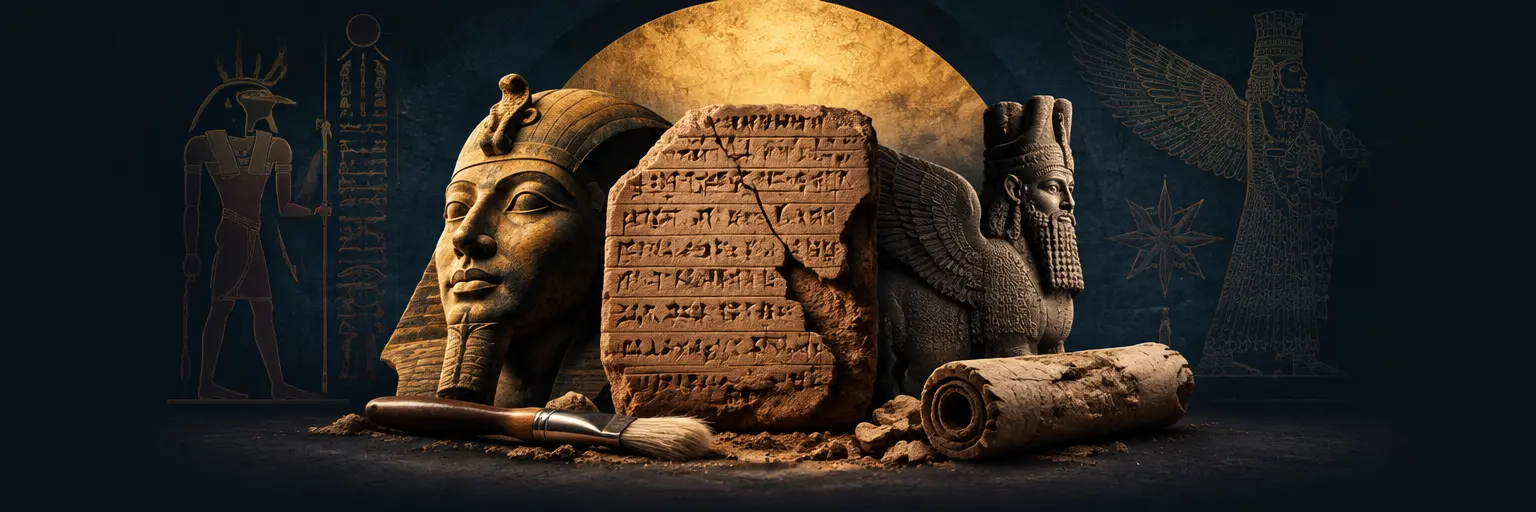
Dive into the thrilling intersection of dirt, stone, and myth. This subcategory explores how physical discoveries—from sunken temples to charred papyri—have reshaped our understanding of Egyptian and Mesopotamian mythology. Here, we examine the artifacts that confirmed ancient narratives, the lost texts that rewrote history, and the ongoing quest to recover the voices silenced by time. Expect a journey of decipherment, controversy, and awe, where every shard of pottery or tablet fragment offers a new clue to the gods, heroes, and rituals that once ruled the ancient world.
🏺 The Rosetta Stone and Decipherment Breakthroughs
The Rosetta Stone (1799) is the cornerstone of modern Egyptology, providing the key to hieroglyphs. Before its discovery, ancient Egyptian texts were largely silent, leaving mythology locked in cryptic iconography. This artifact, inscribed with a priestly decree in three scripts, allowed scholars like Jean-François Champollion to decode the language, unlocking a flood of hymns, creation myths, and royal annals that had been unreadable for centuries.
For enthusiasts, expect to understand not just the stone’s mechanics but its mythological payoff. Decipherment revealed the full Heliopolitan creation cycle, the Osiris-Isis-Horus saga, and the Book of the Dead’s spells. Similarly, in Mesopotamia, the Behistun Inscription (c. 520 BC) served as a linguistic bridge to cuneiform, enabling the reading of Enuma Elish and the Epic of Gilgamesh. These breakthroughs weren’t just academic—they transformed mythology from speculative art into verifiable history, showing how material culture preserves intangible beliefs.
📜 The Epic of Gilgamesh: Tablets from the Flood
Discovered in 1853 at Nineveh, the library of Ashurbanipal yielded the most complete version of the Epic of Gilgamesh. Lost for over two millennia, these eleven clay tablets contain the story of a demigod king who seeks immortality after the death of his friend Enkidu. The twelfth tablet, added later, provides a descent into the underworld, enriching Mesopotamian views of the afterlife.
This subcategory will show you how the tablets’ translation history—from George Smith’s 1872 announcement of a “Babylonian Flood” to modern digital reconstructions—exposed striking parallels with biblical Noah. You’ll explore how the epic’s mythological layers (Sumerian origins, Old Babylonian redactions, Assyrian standardization) reflect political and religious shifts. Moreover, the “lost” parts, like Tablet XII’s contradictory ending, remind us that textual transmission is never neutral. Expect a deep dive into how a broken clay tablet can redefine an entire civilization’s spiritual legacy.
⚱️ The Tel el-Amarna Letters and Religious Revolution
In 1887, a peasant woman in Amarna, Egypt, uncovered a cache of clay tablets—the diplomatic correspondence of Pharaoh Akhenaten. These 382 letters, written in Akkadian, reveal the geopolitical web of the 14th century BC, but more crucially, they document the brief, radical shift to Atenism, a monotheistic sun-worship that suppressed traditional Egyptian pantheons. The “lost” nature of these texts lay in their burial under desert sand for 3,000 years.
Here, you’ll dissect how the Amarna letters illuminate the solar mythology of Aten and the backlash after Akhenaten’s death, when polytheistic cults were restored. The letters also mention the Habiru, possibly early Hebrews, linking myth to geopolitical reality. For mythology lovers, this is a case study in how political upheaval erases and writes gods. Expect analysis of royal propaganda, the suppression of Amun’s priesthood, and the archaeological aftermath—including the rediscovery of the heretic king’s own lost tomb and his erased cartouches.
🜁 The Nag Hammadi Library: Gnostic Texts and Hidden Gospels
Found in 1945 near the Egyptian town of Nag Hammadi, this collection of 13 leather-bound codices contained over 50 texts, including the Gospel of Thomas and the Apocryphon of John. These “lost texts” were deliberately buried, likely to hide them from orthodox Christian authorities who deemed their content heretical. Their discovery reshaped our understanding of Gnostic mythology, a blend of Egyptian, Jewish, and Platonic ideas that reframed creation as a cosmic mistake.
This section will guide you through the mythological significance: the Demiurge as a flawed creator, the divine spark within humans, and Sophia’s fall and redemption. You’ll learn how these texts interweave with older Egyptian concepts—like the Ogdoad of Hermopolis—and how they challenge the tidy boundaries of “myth” versus “philosophy.” For storytellers and scholars, the Nag Hammadi library demonstrates how buried manuscripts can resurrect entire cosmologies, offering alternate creation narratives that still influence modern spirituality and fringe theories.
🏛️ The Library of Ashurbanipal: Recovering Cuneiform Classics
Rediscovered in the 1850s at Nineveh, this royal library held over 30,000 cuneiform tablets, including the standard versions of Gilgamesh, the Enuma Elish, and the Descent of Ishtar. Its “loss” occurred when the city fell to the Medes and Babylonians in 612 BC, and the clay tablets were fired by the great conflagration—paradoxically preserving them as “baked” artifacts. Excavators also found bilingual Sumerian-Akkadian lexical lists, the ancient world’s dictionaries.
For this subcategory, you’ll explore how the library’s systematic cataloging (by genre, incipit, and purpose) reveals the Mesopotamian classification of myth. You’ll see how wisdom literature (like the Ludlul-Bel-Nemeqi) and omen series coexisted with epic poetry, showing that mythology was not just entertainment but divinatory science. The library’s recovery also underscores the fragility of textual transmission—what was preserved was chosen, rewritten, and edited. Expect discussions on how modern reconstructions rely on joins and digital corpus analysis, turning fugitive fragments into coherent myths once more.
Frequently Asked Questions
What is the single most important lost text for Egyptian mythology?
The Book of the Heavenly Cow, inscribed in the tomb of Seti I, is crucial. It details the goddess Hathor’s slaughter of humanity and Ra’s decision to ascend to the sky, explaining the creation of the celestial realm and the origin of death. Lost to the public until 1828, it offers a unique, non-funerary view of divine conflict and cosmic order.
How do archaeologists verify that a tablet is part of the Epic of Gilgamesh?
They look for standardized opening lines, characters like Gilgamesh and Enkidu, and specific episode markers, such as the Cedar Forest or the Bull of Heaven. Comparative analysis with known fragments, plus linguistic dating of the cuneiform script, helps confirm authenticity. Digital databases, like the CDLI, now use pattern recognition to match fragment edges and joins automatically.
Are there any lost texts mentioned in mythology that remain undiscovered?
Yes, the “Book of Thoth” is a legendary text said to grant immense power and knowledge, referenced in Egyptian tales. Similarly, the “Summa Theologica” of Babylonian scholars, the Seven Tablets of Creation’s missing sections, and the complete poems of Sappho exist only in citations. Their unearthing is still a fervent hope for archaeologists, as any discovery could rewrite pantheons.
What role do inscriptions on everyday objects play in mythological reconstruction?
Unguent jars, scarabs, and pottery shards often carry short prayers or epithets to deities like Isis or Marduk. These “micro-texts” fill gaps left by grand literary works, revealing local cults, personal devotion, and regional variations of myths. For example, thousands of votive plaques dedicated to Gula (goddess of healing) document healing hymns not found in royal libraries.
How has carbon dating and modern imaging changed the identification of lost texts?
Radiocarbon dating identifies the age of papyrus or clay, while multispectral imaging can read hidden text on damaged surfaces (e.g., the Archimedes Palimpsest). These techniques allow scholars to separate original inscriptions from later annotations, and to recover erased layers—thus resurrecting “lost” mythological compositions from beneath later writings without physical damage. Their use continues to expand the corpus of recoverable myth.