Mythical Gardens: Paradises and Lost Worlds in Myth
🌿 Discover the enchanting allure of Mythical Gardens, where ancient legends and lost worlds inspire Mythical garden design inspiration. Explore how these…
Read article
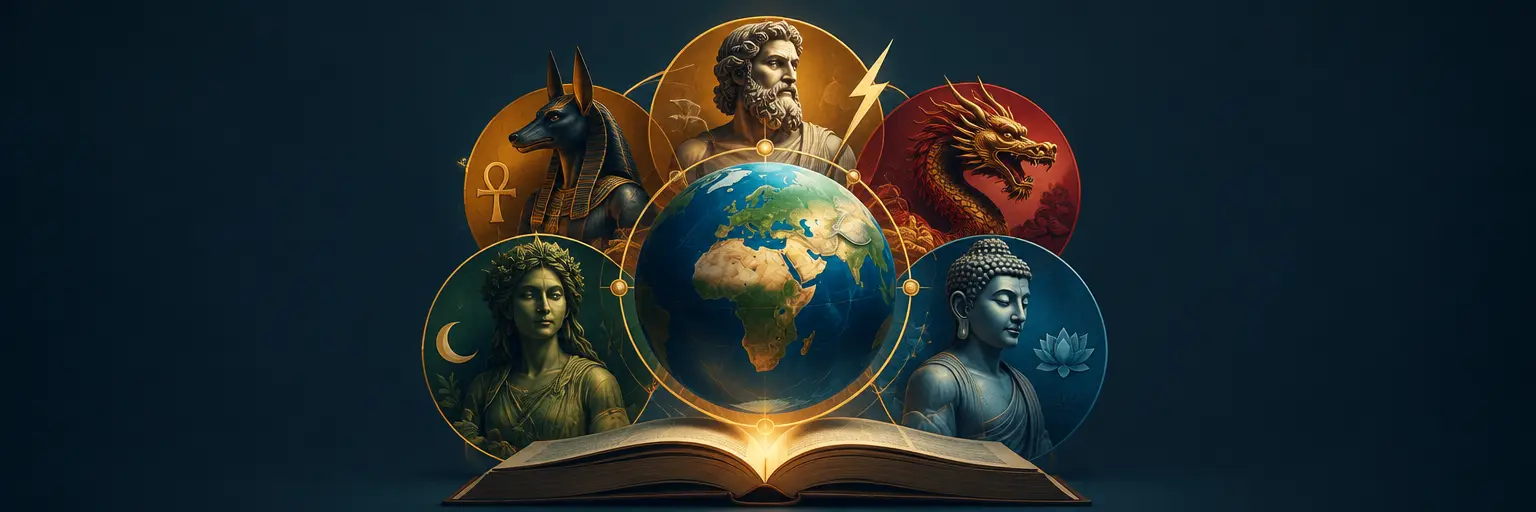
Explore the fascinating intersections of global storytelling with our Cross-Cultural Analysis, where we dissect how myths transcend borders, revealing shared human fears, hopes, and values. By comparing creation epics, hero journeys, and trickster tales from Asia, Africa, the Americas, and Europe, we uncover universal archetypes and unique cultural fingerprints that shape modern narratives. This section highlights how similar motifs—like flood myths or sun deities—evolve differently, offering deep insights into societal norms, historical exchanges, and psychological undercurrents. Whether examining the influence of Greek mythology on Hindu epics or the parallels between Norse and Native American legends, our analysis bridges ancient wisdom with contemporary relevance. Ideal for students, researchers, and mythology enthusiasts, this content enhances your understanding of cultural diffusion, symbolic interpretation, and the enduring power of myth in shaping identity and collective memory. Dive in to see how comparative studies illuminate the common threads binding humanity’s imaginative legacy. 🧠🌍

🌿 Discover the enchanting allure of Mythical Gardens, where ancient legends and lost worlds inspire Mythical garden design inspiration. Explore how these…
Read article
🌟 Embark on a captivating journey through ancient seafaring mythology exploration, where legendary voyages across seas and stars reveal timeless tales of…
Read article
🧙️ Discover how dragons symbolism across cultures reveals their dual roles as fearsome monsters and benevolent protectors, reflecting diverse societal values and…
Read articleWelcome to the Cross-Cultural Analysis subcategory within Comparative Mythology at Mythology and Legends. Here, we delve into the fascinating intersections, parallels, and divergences between mythic traditions across the globe. This space is dedicated to uncovering how different societies answer universal questions—creation, death, heroism, and the divine—through unique yet strikingly similar narratives. Whether you are a student, researcher, or curious enthusiast, our in-depth examinations will enhance your understanding of humanity’s shared storytelling heritage and its enduring influence on modern culture.
In this section, we explore the recurring archetypes found in myths from every continent—the hero, the trickster, the mother goddess, and the world tree. By comparing figures like the Greek Prometheus, the Norse Loki, and the West African Anansi, we reveal how core human experiences shape these powerful symbols. You will discover that despite vast geographic and historical distances, cultures often produce remarkably parallel characters that serve similar psychological and social functions. Expect detailed tables and side-by-side analyses that highlight both similarities and subtle cultural nuances.
Our content here emphasizes key comparative frameworks, such as Joseph Campbell’s monomyth and the structuralist approaches of Claude Lévi-Strauss. We break down how each tradition adapts archetypes to local values, such as the emphasis on community in many Indigenous myths versus individual glory in classical Greco-Roman tales. This section will equip you with the analytical tools to recognize these patterns yourself, fostering deeper appreciation for both the unity and diversity of human imagination across time and place.
Creation myths are among the most profound expressions of a culture’s worldview. Here, we juxtapose the Babylonian Enuma Elish, the Hindu Rigvedic hymn of Purusha, and the Aboriginal Australian Dreamtime stories. We analyze how each narrative addresses the origins of order from chaos, the role of sacrifice, and the relationship between gods, nature, and humanity. You will gain insight into how these foundational stories encode legal systems, gender roles, and ecological attitudes that persist in contemporary societies.
This subsection also investigates shared motifs, such as the cosmic egg, primordial waters, and the emergence of land from a diver animal. We discuss the implications of these similarities—whether they result from historical diffusion, shared human psychology, or independent invention. Through accessible language and vivid comparisons, we help you see how creation myths are not simply ancient stories but living frameworks that still shape modern cosmologies, from scientific narratives to religious fundamentalism.
Hero myths provide a mirror into what each culture values most—courage, cunning, sacrifice, or humility. We compare epic quests such as Odysseus’s wanderings, the Chinese Journey to the West, and the Maya Hero Twins’ descent to Xibalba. Our analysis highlights how each hero’s challenges reflect societal ideals, from the Mediterranean emphasis on cleverness to the Mesoamerican focus on cyclical rebirth and cosmic balance. You will learn how the hero’s journey adapts to local moral systems and historical contexts.
Beyond plot summaries, we delve into the psychological and social functions of hero narratives. We examine how these stories are used in rites of passage, political legitimacy, and national identity building, from ancient kingship rituals to modern superhero films. By tracking the evolution of hero archetypes across cultures and epochs, you will understand why certain heroes persist while others fade, and how the “monomyth” both unites and obscures cultural specificity. This section offers rich case studies and cross-references for further exploration.
The cyclical nature of life, death, and regeneration appears in myths as diverse as the Egyptian Osiris, the Greek Persephone, and the Japanese Amaterasu’s cave retreat. We analyze how these stories articulate seasonal change, agricultural cycles, and human mortality with striking parallels. Here, you will uncover the symbolic vocabulary—underworlds, resurrection, and light-dark contrasts—that cultures use to express hope and renewal in the face of loss. Our comparative approach reveals how geography and economy influence these symbols.
This section further explores ritual and festival connections, linking myths to practices like the Eleusinian Mysteries, Día de los Muertos, and Obon. We discuss how these narratives function as coping mechanisms for death anxiety and as vehicles for social cohesion. By examining ritual reenactments, you will see that myth and practice are inseparable, with cross-cultural analysis showing how similar existential questions yield both unique and convergent solutions. Expect rich visual aids and primary text excerpts to deepen your engagement.
Tricksters—Loki, Coyote, Hermes, and Eshu—embody chaos, wit, and boundary-crossing in mythological systems worldwide. This section compares their escapades to reveal how cultures negotiate rules, authority, and morality. We analyze how the trickster’s ambiguity serves as a safety valve for societal tensions, critiquing rigid structures while reinforcing them through comic relief. You will understand why these figures are both feared and celebrated, and how they often bridge the human and divine realms.
Our examinations focus on cultural variations in trickster morality, from the benevolent Hermes to the destructive Loki. We explore how such characters adapt to changing social needs, appearing in modern literature, film, and internet folklore. By tracing the trickster’s role in creation, theft of sacred knowledge, and social satire, you will appreciate the complexity of these figures beyond mere mischief. This section provides structured comparisons that illuminate deeper psychological and philosophical questions about order and chaos.
The goal is to identify universal patterns in myths while respecting each culture’s uniqueness. By comparing narratives, we reveal shared human concerns and diverse solutions, fostering empathy and deeper understanding of both our common heritage and distinct traditions.
Scholars use rigorous frameworks, context-specific evidence, and interdisciplinary methods. They emphasize historical, linguistic, and ethnographic details, avoiding superficial parallels. Each comparison is grounded in respect for original sources and cultural meanings, not just surface similarities.
Yes, many motifs and characters exist only in specific traditions due to unique historical or environmental factors. However, underlying themes—like creation or heroism—still recur, making complete uniqueness rare. Cross-cultural analysis helps identify what is truly distinct versus a variation.
Absolutely. Understanding mythic structures and archetypes allows writers to craft narratives that resonate universally while honoring cultural depth. Many contemporary films, novels, and games draw on comparative myth frameworks, enriching storytelling with symbolic power and relatability.
We provide annotated texts, comparative charts, academic summaries, and links to primary sources. Each article includes further reading suggestions, glossaries, and discussion questions, enabling both casual readers and researchers to deepen their exploration of comparative mythology.