
Marduk's House: Exploring the Great Ziggurat of Babylon

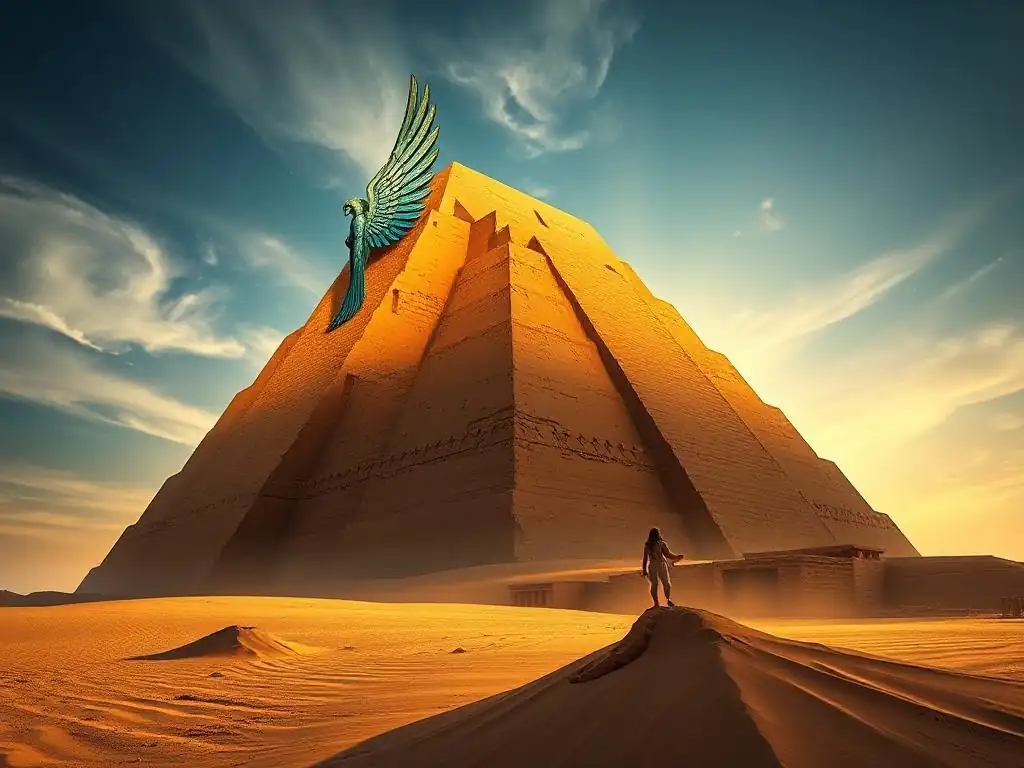
Welcome to Mythology and Legends, where ancient tales come alive! Ever wondered what secrets are hidden within the colossal structures of the past? Delve into the heart of Mesopotamia with us as we unravel the Marduk ziggurat architecture symbolism, and discover how this towering testament to faith shaped not only a city, but an entire civilization. Prepare to be amazed...
- Etemenanki: The Ziggurat of Babylon
- Introduction to Etemenanki: The Ziggurat of Marduk
- Historical Context: The Rise and Fall of Etemenanki
- Architectural Marvel: Understanding Etemenanki's Architecture
- Symbolism and Religious Significance
- Etemenanki in Literature and Art: Representations
- The Legacy of Etemenanki: Influence
- Conclusion: Remembering the Great Ziggurat of Babylon
-
Frequently Asked Questions
- What was the primary function of Marduk's Ziggurat in Babylon?
- How did the architecture of Marduk's Ziggurat reflect Babylonian cosmology?
- What materials were used in the construction of Marduk's Ziggurat, and what did they symbolize?
- What role did Marduk's Ziggurat play in Babylonian religious rituals and ceremonies?
- How did the symbolism of Marduk's Ziggurat influence later architectural and religious traditions?
- Final Reflection: The Enduring Legacy of Marduk's House
- Unearth the Secrets of Babylon!
Etemenanki: The Ziggurat of Babylon
Introduction to Etemenanki: The Ziggurat of Marduk
Unveiling Etemenanki: The Name and Its Meaning
The name "Etemenanki" itself holds profound significance, offering insight into the purpose and perception of this monumental structure in ancient Mesopotamia. It translates from Sumerian as "Temple of the Foundation of Heaven and Earth." This nomenclature immediately establishes the ziggurat's symbolic role as a cosmic link, a structure designed not merely for worship but as a physical connection point between the human realm on Earth and the divine realms of the heavens. The Akkadians, who later dominated Babylon, maintained this name, recognizing its deep cultural resonance and its embodiment of their worldview.
This powerful name underscores the core belief that the ziggurat was the axis mundi, the center of the world where the divine and earthly converged. The very concept embedded in "Etemenanki" reflects the sophisticated cosmological understanding of the Babylonians, positioning their capital as the nexus of creation. The architecture of the Marduk ziggurat was therefore intrinsically tied to this foundational belief, with each level potentially symbolizing stages in the ascent towards the divine, culminating in the temple at the summit dedicated to Marduk, the chief god of Babylon.
The Ziggurat of Babylon in Mesopotamian Cosmology
In Mesopotamian cosmology, the universe was often depicted as a series of layers, with the earth as a central disk surrounded by water, and the heavens above. The ziggurat, particularly Etemenanki, served as a microcosm of this cosmic structure. Its multi-tiered design represented the ascent through these cosmic levels, bridging the gap between the terrestrial plane and the celestial abode of the gods. This symbolic ascent was not just architectural; it was a theological statement about the relationship between humanity and divinity.
The Etemenanki ziggurat was seen as the physical manifestation of this cosmic link, providing a stairway for the gods to descend to Earth and for priests and kings to ascend to the divine presence. The temple atop the ziggurat, dedicated to Marduk, was considered his earthly dwelling place, where he could interact with humanity. This architectural symbolism of the Marduk ziggurat was central to Babylonian religious practice and identity, reinforcing Babylon's status as the divinely appointed center of the world and the seat of Marduk's power.
Historical Context: The Rise and Fall of Etemenanki
Babylonian History and the Construction of Etemenanki [Nebuchadnezzar II, Hammurabi]
While the concept of a ziggurat at Babylon likely existed earlier, possibly even back to the time of Hammurabi (c. 1792–1750 BC) who significantly expanded the city and elevated Marduk's status, the most famous and substantial iteration of Etemenanki is attributed to the Neo-Babylonian period, particularly the reign of Nebuchadnezzar II (c. 605–562 BC). Following periods of destruction and neglect, Nebuchadnezzar II embarked on a massive building program to restore Babylon to its former glory, making Etemenanki a centerpiece of this ambitious project. His inscriptions frequently boast of his work on the ziggurat and the Esagila temple complex.
Nebuchadnezzar II's efforts transformed Etemenanki into a truly colossal structure, solidifying its place as the spiritual heart of the city and a symbol of the Neo-Babylonian Empire's power and devotion to Marduk. While earlier rulers may have initiated or maintained versions of the ziggurat, it was under Nebuchadnezzar II that the structure likely reached its most impressive scale, reflecting the zenith of Babylonian power and the elaborate Marduk ziggurat architecture symbolism he wished to convey through his capital's grandeur.
Reconstructions and Destruction: A Timeline of Etemenanki
The history of Etemenanki is marked by a cycle of construction, destruction, and ambitious reconstruction, reflecting the turbulent history of Babylon itself. The earliest ziggurat foundations might date back to the Old Babylonian period, but it suffered damage or neglect over centuries. It is recorded that the Assyrian king Sennacherib destroyed Babylon in 689 BC, and presumably, the ziggurat was affected, though the extent is debated. His successor, Esarhaddon, began rebuilding Babylon, and Shamash-shum-ukin, his son and governor of Babylon, continued the work.
The most significant reconstruction, as noted, was undertaken by Nebuchadnezzar II in the 6th century BC. However, this grand structure did not last indefinitely. When the Persian king Xerxes I suppressed a Babylonian revolt in 484 BC, he is believed to have caused further destruction to the city, including possibly dismantling the upper levels or the temple of Etemenanki.
Alexander the Great reportedly intended to rebuild the ziggurat in the late 4th century BC but died before the project could be completed. Over subsequent centuries, the structure fell into ruin, its bricks repurposed or lost to erosion, leaving only the foundational remnants visible today.
Ancient Accounts: Herodotus and Other Historical References to the Ziggurat
One of the most famous, albeit potentially embellished, ancient accounts of Etemenanki comes from the Greek historian Herodotus, who visited Babylon in the 5th century BC. In his Histories (Book 1, sections 181-182), he describes a massive tower of solid masonry, one stadium in length and breadth (approximately 180-190 meters), with eight towers built upon it, culminating in a great temple at the top.
While modern archaeological evidence suggests the base was closer to 91 meters square and the number of stages was seven (plus the temple), Herodotus's account provides a valuable, if somewhat exaggerated, external perspective on the ziggurat's immense scale and appearance during its prime.
Other ancient references to Etemenanki appear in Babylonian cuneiform texts, particularly building inscriptions from Nebuchadnezzar II. These inscriptions detail his piety and his extensive construction work on the city, including the ziggurat dedicated to Marduk. One notable inscription, often referred to as the "East India House Inscription," explicitly describes the construction of Etemenanki, mentioning its height and the materials used. These local accounts, though sometimes formulaic, offer a crucial Babylonian perspective on the ziggurat's purpose, its builders, and the religious significance of this colossal Marduk ziggurat architecture.
Architectural Marvel: Understanding Etemenanki's Architecture
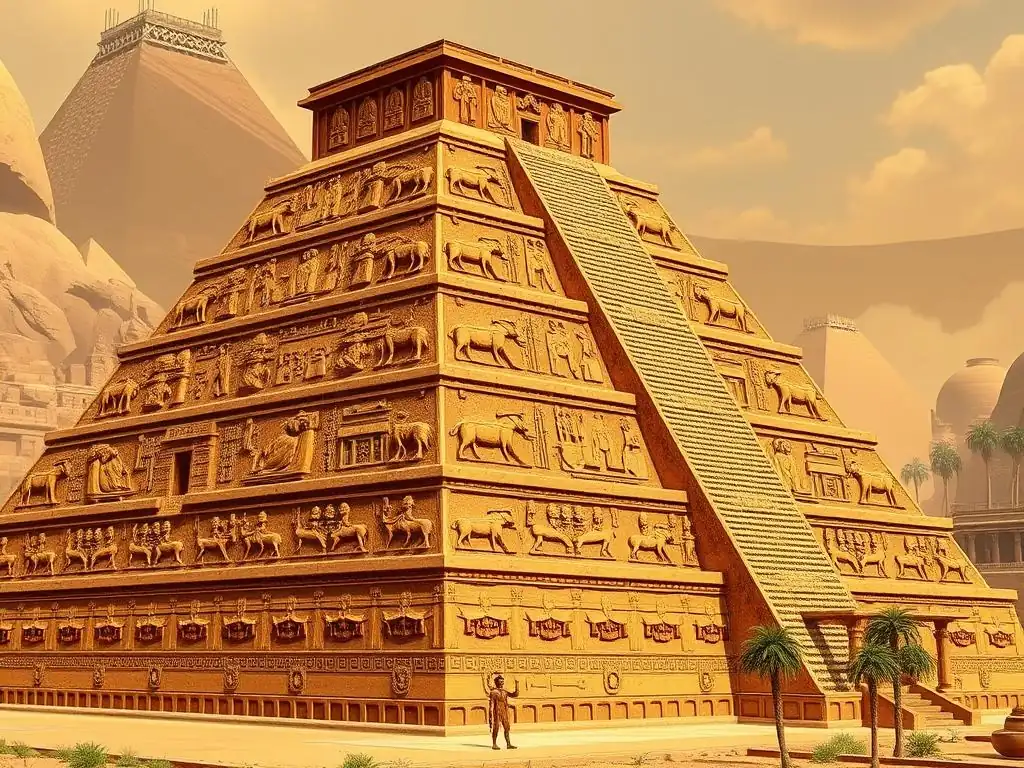
The Seven Stages of the Ziggurat: A Detailed Architectural Breakdown
Etemenanki, in its Neo-Babylonian form, is understood to have consisted of seven stages, or tiers, built upon a massive square base. While the exact dimensions and configuration of each stage are debated due to the lack of complete remains, archaeological evidence and textual accounts suggest a stepped pyramid structure. Each successive platform was smaller than the one below it, creating a receding profile as the structure rose towards the heavens. The total height was intended to be impressive, possibly mirroring the base dimensions, though this ideal proportion may not have been fully realized.
Access to the upper levels and the summit temple was provided by a complex system of stairs or ramps. Different interpretations exist based on archaeological findings and depictions of other ziggurats: some suggest a central stairway flanked by two side stairs, while others propose a system of ramps winding around the ziggurat's sides. Regardless of the exact layout, this intricate access system was integral to the Marduk ziggurat architecture, facilitating religious processions and the ascent of priests to perform rituals in the sacred space at the apex, embodying the symbolic journey towards the divine.
Construction Materials and Techniques Used in Etemenanki
The primary construction material for Etemenanki was mud brick, a readily available resource in the Mesopotamian alluvial plains. Millions of sun-dried mud bricks formed the vast core of the ziggurat's immense platforms. These bricks were often reinforced with reed mats or ropes laid between courses to provide stability. However, the exterior walls and surfaces, particularly those exposed to weather, were faced with fired or baked bricks, which were far more durable. These baked bricks were often set in bitumen, a naturally occurring asphalt that served as a waterproof mortar, providing structural integrity and protection against erosion.
The sheer scale of Etemenanki necessitated sophisticated organization and labor management. Building a structure potentially rising 60-90 meters required not only vast quantities of materials but also skilled labor for brickmaking, laying, and constructing the complex system of stairs and platforms. The use of both sun-dried and baked bricks, along with bitumen mortar, represents a practical adaptation to the local environment and a mastery of ancient building techniques. This combination of robust materials and careful construction was essential for creating the enduring architectural symbolism of the Marduk ziggurat.
Size and Scale: Dimensions and Comparisons to Other Ziggurats
While precise, undisputed dimensions for Etemenanki are elusive, archaeological data and interpretations of ancient texts provide approximate figures. Excavations at the site suggest a base measuring approximately 91 meters (300 feet) on each side, forming a perfect square. The intended height is often cited as being roughly equal to its base dimensions, suggesting a potential height of around 91 meters as well. This would have made it one of the tallest structures of its time, a true marvel of ancient engineering and a powerful statement of Babylon's might and the significance of the Marduk ziggurat architecture.
Comparing Etemenanki to other major ziggurats in Mesopotamia highlights its exceptional scale. For instance, the Great Ziggurat of Ur, dedicated to the moon god Nanna, is significantly smaller, with a base of approximately 64 x 46 meters and an estimated original height of around 30 meters.
The ziggurat at Chogha Zanbil in Elam (modern Iran) was also substantial, with a base of about 105 meters square, but its estimated height was around 52 meters. Etemenanki, therefore, stood out as a truly colossal undertaking, dwarfing many other similar structures and reinforcing its status as the preeminent temple mountain in Mesopotamia, reflecting the supreme status of Marduk.
Symbolism and Religious Significance
The Ziggurat as a Cosmic Mountain: Connecting Heaven and Earth
The most prevalent symbolic interpretation of the ziggurat, including Etemenanki, is that of the cosmic mountain. In Mesopotamian belief, mountains were sacred places where the gods resided or where the divine realm met the human world. As the Mesopotamian landscape was predominantly flat, the artificial mountain of the ziggurat served as a human-made representation of this concept. It was seen as the axis mundi, the central pillar connecting the heavens, the earth, and the underworld, facilitating communication and interaction between these realms.
Each of the ziggurat's seven stages may have held further symbolic meaning, potentially representing the seven heavens, the seven planets known to the Babylonians, or stages in the ascent towards divine enlightenment. The sheer act of building this immense structure was itself a religious act, a testament to human endeavor reaching towards the divine. This architectural symbolism of the Marduk ziggurat was fundamental to its function, providing a tangible link between the worshiper and the cosmic order, ensuring the flow of divine blessings upon the city and its people.
Marduk's Temple: The Abode of the Chief God of Babylon
At the very summit of Etemenanki stood a temple, known as the "Upper Temple" or sometimes identified with the shrine mentioned by Herodotus as containing only a couch and a golden table, where a single woman slept, chosen by the god. This temple was considered the most sacred part of the complex, the actual dwelling place of Marduk, the patron deity of Babylon and king of the gods in the Babylonian pantheon.
Unlike temples on the ground level, which were accessible for various rituals, the summit temple was likely reserved for the highest priests and possibly the king, acting as intermediaries with the deity.
The presence of Marduk's temple at the apex reinforced the ziggurat's function as a cosmic gateway. It was believed that here, the boundary between the divine and human realms was thinnest, allowing for direct communion. The temple served as the focal point for the entire structure's religious significance, housing the divine presence and ensuring the god's benevolent gaze upon the city below. The elaborate Marduk ziggurat architecture symbolism culminated in this sacred space, signifying Marduk's supreme position and his connection to the heart of Babylon.
Rituals and Ceremonies Performed at the Ziggurat [The Akitu Festival]
Etemenanki was not merely a static monument; it was a dynamic center for religious activity, particularly during major festivals. The most important of these was the Akitu festival, the Babylonian New Year celebration, which took place in the spring. This twelve-day festival involved a series of elaborate rituals, processions, and dramatic reenactments of the creation myth, the Enuma Elish, in which Marduk defeats the primeval goddess Tiamat and establishes cosmic order.
While many Akitu rituals occurred in the Esagila temple complex at the base of the ziggurat, Etemenanki played a crucial role. The statue of Marduk was central to the festival, paraded through the city and potentially brought into the ziggurat complex. The ascent of the ziggurat by priests or the king during the festival may have symbolized Marduk's victory and re-establishment of cosmic harmony. The Akitu festival vividly demonstrated the practical application of the Marduk ziggurat architecture symbolism, integrating the structure into the most vital religious and political event of the Babylonian year.
The Sacred Marriage Ritual and Its Connection to Etemenanki
Another significant ritual potentially associated with the Etemenanki complex was the Sacred Marriage ( hieros gamos). While details are debated and sources are fragmented, this ritual involved the symbolic union of the king (representing humanity and the land) with a high priestess (representing the goddess Ishtar or another consort deity), or possibly a symbolic union between Marduk and his divine consort. The purpose of this ritual was to ensure the fertility of the land, prosperity for the kingdom, and the well-being of the people for the coming year.
Some scholars suggest that the temple atop Etemenanki may have served as the location for this sacred union, symbolizing the divine marriage taking place in the celestial realm represented by the ziggurat's peak. Herodotus's description of the woman sleeping in the upper temple has been interpreted by some as a reference to the priestess involved in this rite.
Whether performed on the summit or within the broader Etemenanki/Esagila complex, the Sacred Marriage ritual underscores the ziggurat's role in fundamental fertility cults and its connection to the divine forces believed to govern the natural world, adding another layer to the rich Marduk ziggurat symbolism.
Etemenanki in Literature and Art: Representations
Depictions of Etemenanki in Ancient Babylonian Texts
Ancient Babylonian literature provides glimpses into the perception and importance of Etemenanki, primarily through building inscriptions and religious texts. As mentioned, inscriptions by Nebuchadnezzar II offer the most direct textual evidence of its construction and the pride taken in its scale and dedication to Marduk. These texts often emphasize the ziggurat's height, its solid construction, and its purpose as a dwelling for the great god, reinforcing the architectural symbolism of the Marduk ziggurat as a divine residence.
While narrative myths like the Enuma Elish focus on Marduk's rise to power rather than the ziggurat's construction, they establish the theological context for his preeminence, which in turn justified the building of such a magnificent structure in his honor. Other administrative or ritual texts might mention activities occurring at or near the ziggurat, providing indirect evidence of its function within daily or ceremonial life. Though no detailed architectural blueprints survive, these scattered textual references, alongside archaeological findings, allow scholars to piece together an understanding of Etemenanki's form and significance from a Babylonian perspective.
The Tower of Babel Narrative: Is There a Connection?
Perhaps the most famous literary connection to Etemenanki is the biblical narrative of the Tower of Babel found in the Book of Genesis (Chapter 11). This story describes a unified humanity attempting to build a city and a tower "with its top in the heavens" to make a name for themselves and avoid dispersion. God interprets this as an act of hubris, confuses their languages, and scatters them across the Earth, halting the construction.
Many scholars see a direct link between this narrative and Etemenanki. The description of a massive tower built in the land of Shinar (commonly identified with southern Mesopotamia/Babylonia) aiming for the heavens strongly resonates with the scale and purpose of the Babylonian ziggurat.
The biblical account can be interpreted as an Israelite theological commentary on Mesopotamian ziggurat construction, viewing the aspiration to reach the heavens through architecture as an offense against God. While the narrative is a theological one rather than historical, the architectural inspiration for the "Tower of Babel" is widely believed to be the great ziggurat of Babylon, Etemenanki, reflecting its immense fame in the ancient world and the powerful symbolism of its Marduk ziggurat architecture.
Modern Interpretations and Artistic Renderings of the Ziggurat
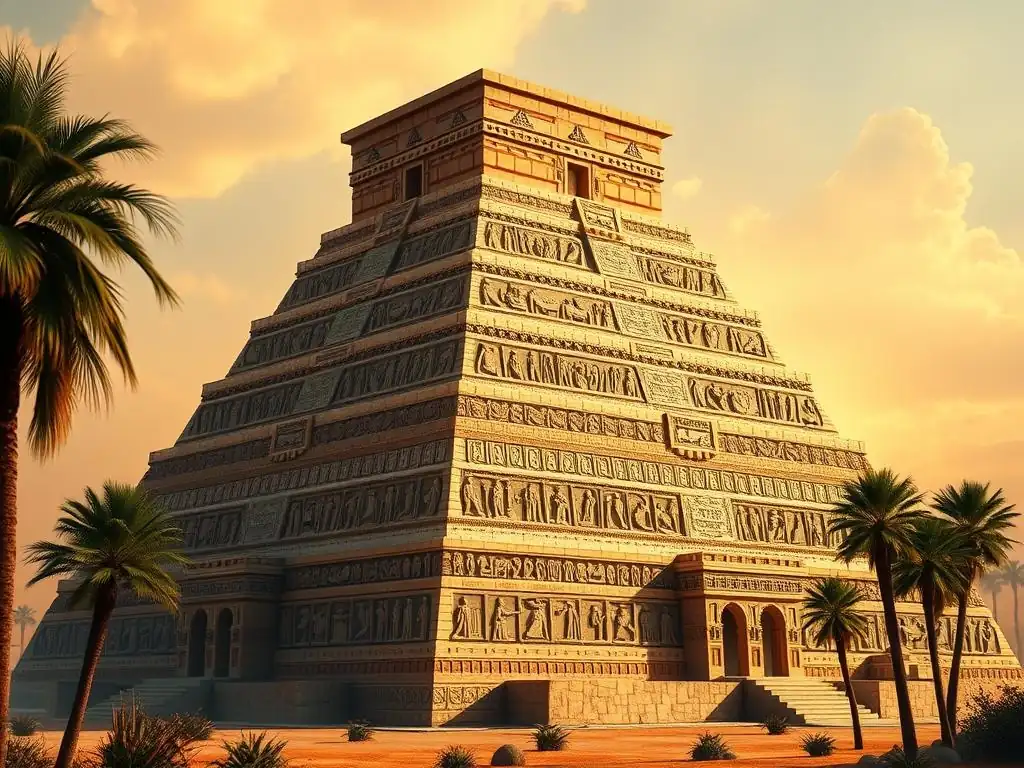
In modern times, Etemenanki continues to capture the imagination, inspiring various artistic renderings and scholarly interpretations. Based on archaeological data, ancient texts, and comparative studies of other ziggurats, artists and architects have attempted to visually reconstruct the likely appearance of the structure in its prime under Nebuchadnezzar II. These renderings often depict a towering, stepped structure with ramps or stairs leading to a vibrant blue-tiled temple at the summit, reflecting the use of glazed bricks in Babylonian architecture.
These modern interpretations, whether in illustrations, digital reconstructions, or museum models, help make the abstract concept of the ancient ziggurat tangible for contemporary audiences. They strive to convey the scale, complexity, and grandeur of Etemenanki, bringing the architectural symbolism of the Marduk ziggurat to life. While necessarily speculative in some details, they serve as valuable tools for understanding the visual impact and cultural significance of this monumental structure, bridging the gap between the ancient ruins and our imagination of Babylon's past glory.
The Legacy of Etemenanki: Influence
Influence on Mesopotamian Temple Architecture
Etemenanki, as perhaps the largest and most famous ziggurat, represents the pinnacle of a long tradition of Mesopotamian temple architecture. While ziggurats evolved over millennia, from the early temple platforms of the Ubaid period (c. 6500–3800 BC) to the sophisticated structures of the Ur III and Babylonian periods, Etemenanki's scale and prominence solidified the ziggurat form as the definitive symbol of Mesopotamian urban centers and their connection to the divine.
Its influence can be seen in the continued construction and maintenance of ziggurats in other cities, although none may have reached Etemenanki's purported dimensions. The tiered structure, the use of ramps or stairs for ascent, and the placement of a significant shrine at the summit became standard features of this architectural type. The Marduk ziggurat architecture set a precedent for how to build a 'cosmic mountain' on a truly grand scale, influencing subsequent temple construction projects across Mesopotamia and reinforcing the symbolic link between the city, its patron deity, and the cosmos.
The Ziggurat's Enduring Symbolism in Religious Thought
The symbolism embedded in Etemenanki – the cosmic mountain, the axis mundi, the stairway to heaven, the dwelling place of the god – has had a lasting impact beyond the physical structure itself. These concepts resonated deeply within Mesopotamian religious thought and influenced surrounding cultures. The idea of a sacred structure connecting earth and sky is a motif found in various religious traditions globally.
The association of the tower with human aspiration, divine communication, and potential hubris, as seen in the Tower of Babel narrative, demonstrates how the powerful symbolism of the Marduk ziggurat architecture transcended its original cultural context and entered broader religious and literary traditions. Even in ruin, the memory and symbolic meaning of Etemenanki persisted, representing the ambition of ancient civilizations to physically manifest their cosmological beliefs and connect with the divine realm through monumental building.
Etemenanki Today: Archaeological Site [Current Excavation Status]
Today, the site of Etemenanki in Babylon, located near modern Hilla in Iraq, is an archaeological ruin. Little remains of the original structure above the lower levels, primarily due to dismantling, erosion, and the repurposing of its baked bricks over centuries. What is visible are the massive foundational layers, revealing the immense square base of the ziggurat. The core fill of mud bricks and some remnants of the baked brick facing can be observed, providing tangible evidence of its colossal scale.
Archaeological excavations at Babylon, notably by German archaeologist Robert Koldewey in the early 20th century, meticulously uncovered the ground plan of Etemenanki's base and surrounding structures, including parts of the Esagila temple complex. While the upper levels are lost, these excavations provided crucial data for understanding the ziggurat's dimensions and layout, confirming aspects of ancient descriptions while also correcting exaggerated claims. The site remains a key location for understanding Babylonian history, architecture, and the powerful Marduk ziggurat architecture symbolism, though ongoing preservation challenges exist.
Conclusion: Remembering the Great Ziggurat of Babylon
The Enduring Significance of Etemenanki in Mesopotamian Culture
Etemenanki was far more than just a large building; it was the spiritual and symbolic heart of Babylon, the most important city in Mesopotamia for centuries. As the dwelling place of Marduk, the king of the gods, it embodied the city's divine favor and its central role in the cosmic order. Its construction and reconstruction were acts of profound religious devotion and political assertion, linking the power of the ruler directly to the will of the gods.
The ziggurat's design as a cosmic mountain and stairway to heaven encapsulated the Mesopotamian worldview, providing a physical bridge between the earthly and divine realms. It was the stage for crucial religious ceremonies like the Akitu festival, essential for renewing the cosmos and ensuring the prosperity of the state. The enduring significance of Etemenanki lies in its multifaceted role as an architectural marvel, a religious center, and a potent symbol of Babylonian identity and its relationship with its patron deity, Marduk.
Preserving the Memory of Etemenanki for Future Generations
Although the physical structure of Etemenanki is largely gone, its memory and significance are preserved through archaeology, historical texts, and cultural narratives. Archaeological work has meticulously documented its remains, providing the foundation for scholarly understanding and reconstruction. Ancient Babylonian inscriptions and foreign accounts, like that of Herodotus, offer invaluable perspectives on its appearance and purpose.
Furthermore, the enduring legacy of Etemenanki in stories like the Tower of Babel ensures its place in global cultural consciousness. Preserving the memory of this great ziggurat involves not only protecting the archaeological site itself but also continuing scholarly research, creating educational resources, and sharing its story with the public. Understanding Etemenanki provides crucial insights into the sophisticated religious beliefs, architectural achievements, and symbolic world of ancient Mesopotamia, keeping the legacy of the Marduk ziggurat architecture and its profound symbolism alive for future generations.
Frequently Asked Questions
What was the primary function of Marduk's Ziggurat in Babylon?
The primary function of the ziggurat, known as Etemenanki, was as a temple dedicated to Marduk, the patron deity of Babylon. It served as a connection point between heaven and earth, facilitating communication with the gods.
How did the architecture of Marduk's Ziggurat reflect Babylonian cosmology?
The ziggurat's tiered structure, with ascending levels, symbolized the cosmic mountain and the levels of the Babylonian universe. Its orientation and design were carefully planned to align with astronomical observations and religious beliefs.
What materials were used in the construction of Marduk's Ziggurat, and what did they symbolize?
The ziggurat was primarily constructed from mud bricks, symbolizing the earthly foundation. Glazed bricks, often in vibrant colors, adorned the upper levels, representing the celestial realm and the gods' divine presence.
What role did Marduk's Ziggurat play in Babylonian religious rituals and ceremonies?
The ziggurat served as the focal point for important religious rituals, including processions, sacrifices, and the sacred marriage ceremony. These ceremonies were intended to ensure the fertility of the land and the well-being of the Babylonian people.
How did the symbolism of Marduk's Ziggurat influence later architectural and religious traditions?
The ziggurat's towering form and symbolic significance influenced later religious structures, including the biblical Tower of Babel. It represents a powerful example of the Mesopotamian belief in the connection between the human and divine realms.
Final Reflection: The Enduring Legacy of Marduk's House
The majestic ziggurat of Marduk, though reduced to ruins, continues to resonate with power and mystery, offering a tangible link to a civilization that profoundly shaped the ancient world. Its architectural ingenuity and symbolic weight remain potent reminders of Babylon's ambition and the enduring human desire to reach for the heavens. The very stones themselves whisper tales of a sophisticated society, their arrangement reflecting a complex cosmology and a deeply held religious faith.
The impact of Marduk's ziggurat extends far beyond its physical presence; it represents a pivotal moment in architectural history, influencing subsequent structures and shaping our understanding of ancient Mesopotamian culture. Its symbolic representation of the cosmos, the connection between the earthly and divine realms, continues to fascinate and inspire. The ziggurat was not merely a building; it was a microcosm of the universe, a physical manifestation of the divine order.
This quote, though hypothetical, encapsulates the profound spiritual significance imbued within the structure, a significance that continues to shape our interpretations of ancient religious practices.
Consider, for a moment, the sheer audacity of the project, the dedication and skill required to construct such a monumental edifice. Reflect on the beliefs and aspirations that drove its creation. You, too, can build your own "ziggurats," metaphorical structures representing your ambitions and dreams. Let the legacy of Marduk's House inspire you to reach for your own heights, to build something enduring and meaningful, something that will stand as a testament to your own unique vision and purpose.
Unearth the Secrets of Babylon!
Thanks for exploring the fascinating world of Marduk's House! You've now gained a deeper understanding of this incredible ziggurat and its significance in ancient Mesopotamian culture. Ready to delve even further?
- Immerse yourself: Research other Babylonian temples and structures online to further expand your knowledge of their architectural prowess and religious beliefs. This could involve looking up specific deities or architectural styles.
- Share your newfound knowledge: Discuss your favorite aspect of Marduk's House with friends, family, or online communities dedicated to ancient history. What surprised you the most?
- Visualize Babylon: Try sketching or creating a digital model of Marduk's House based on the descriptions and images you've seen. How would you bring this lost wonder to life?
What other mysteries of ancient Babylon intrigue you most, and how might we uncover them together?