
Mesopotamian Temple Rituals: Feeding the Gods and Maintaining Cosmic Order

Welcome, seeker of ancient wisdom!
Delve into the captivating world of Mythology and Legends, where echoes of forgotten gods and heroes resonate through time. Ever wondered how ancient civilizations sought to appease the divine and maintain cosmic harmony? Our exploration begins with the fascinating realm of Mesopotamian temple rituals offerings, unlocking the secrets of how these sacred practices shaped their world and beliefs.
Prepare to uncover the profound symbolism and intricate details behind these ancient acts of devotion. What did it truly mean to "feed the gods," and how did these offerings impact the lives of those who offered them? Your journey into the heart of Mesopotamian faith starts now...
The Central Role of Temples in Mesopotamian Society and Religion
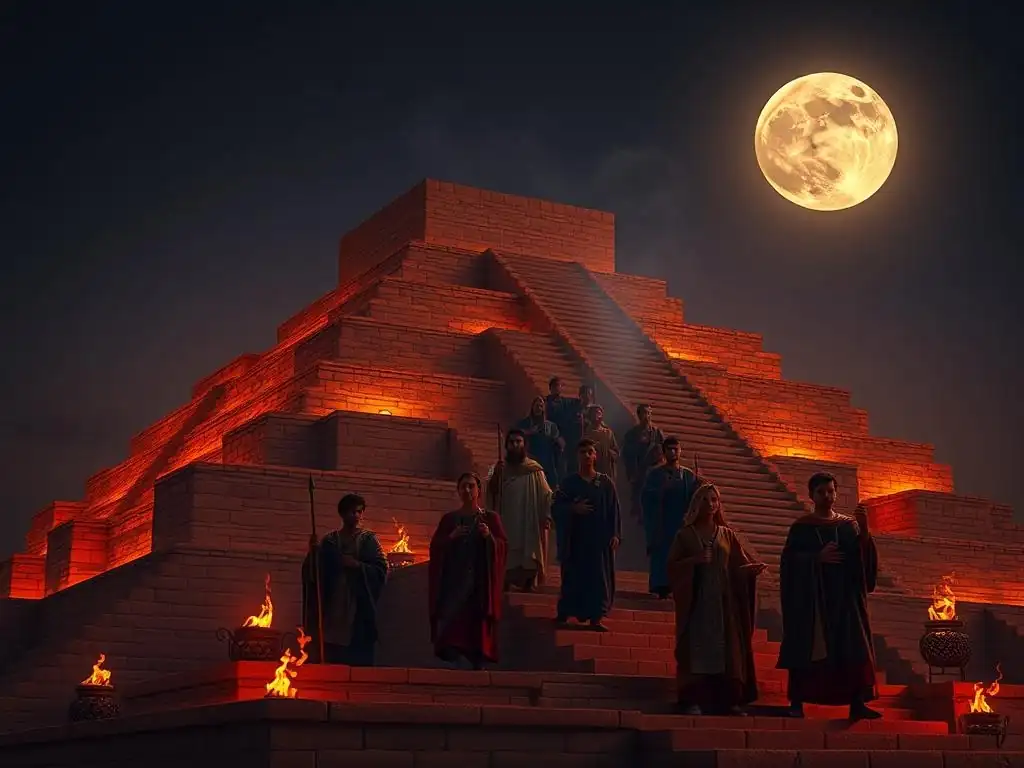
Ancient Mesopotamian temples were far more than mere places of worship; they were the vibrant heart of the city-state, serving as central hubs for religious, economic, and social life. These monumental structures, often dominated by towering ziggurats, symbolized the connection between the human world and the divine realm. Each major city boasted a primary temple dedicated to its patron deity, such as the Eanna temple complex in Uruk, associated with the goddess Inanna (Ishtar), or the Esagila in Babylon, dedicated to Marduk.
The temple bureaucracy managed vast landholdings, employing large numbers of people, from farmers and craftspeople to scribes and priests. This economic power meant the temple was a significant force in daily life, controlling resources and redistributing wealth.
The temple's paramount function was to serve the gods, ensuring their needs were met through meticulous Mesopotamian temple rituals offerings. It was believed that the deities required sustenance, care, and attention, much like human rulers. By providing these through elaborate ceremonies and daily offerings, the people believed they maintained the favor of the gods, which was essential for the prosperity and stability of the city and the entire cosmos.
Failure to perform the correct Mesopotamian temple rituals offerings could lead to divine displeasure, resulting in calamities such as floods, famine, or defeat in battle. Thus, the upkeep of the temple and the faithful execution of its rituals were matters of supreme importance for the ruler and the populace alike.
Understanding the Concept of Divine Sustenance in Ancient Mesopotamia
The core belief underpinning Mesopotamian temple rituals was that the gods, while immortal and powerful, depended on humanity for their material needs. This concept of divine sustenance was not merely symbolic but was understood in very literal terms. The gods were thought to consume the essence of the food and drink offered to them, just as humans consume physical nourishment. This reciprocal relationship formed the basis of Mesopotamian piety: humans served the gods by providing Mesopotamian temple rituals offerings, and in return, the gods maintained cosmic order, ensured fertility, brought victory in war, and granted prosperity.
This belief system necessitated a continuous flow of goods into the temple storehouses. Agricultural produce, livestock, crafted items, and precious materials were all considered appropriate Mesopotamian temple rituals offerings. The most visible and fundamental of these were the daily meals prepared and presented to the divine images housed within the temple's inner sanctum.
These elaborate meals, often consisting of the finest cuts of meat, fresh bread, fruits, vegetables, beer, and wine, were laid out on tables before the cult statue as if the deity were physically present and partaking of the feast. This daily act of feeding the gods was the most fundamental of all Mesopotamian temple rituals offerings, underscoring the intimate and dependent relationship between humanity and the divine.
- The Central Role of Temples in Mesopotamian Society and Religion
- Understanding the Concept of Divine Sustenance in Ancient Mesopotamia
- What was the primary purpose of Mesopotamian temple rituals?
- What types of offerings were commonly presented in Mesopotamian temple rituals?
- How did Mesopotamian priests and priestesses participate in these rituals?
- What role did music and hymns play in Mesopotamian temple rituals?
- How did Mesopotamian temple rituals reflect the society's understanding of the relationship between humans and gods?
The Mesopotamian Pantheon and Their Specific Ritual Needs
Anu, Enlil, Enki/Ea: Honoring the Chief Deities through Rituals
The Mesopotamian pantheon was vast and complex, with different deities holding sway over various aspects of the cosmos and human life. The supreme triad consisted of Anu, the god of the heavens; Enlil, the god of wind, air, and storms, who eventually became the king of the gods; and Enki (or Ea in Akkadian), the god of wisdom, freshwater, magic, and crafts.
Rituals dedicated to these powerful deities often focused on maintaining cosmic order, securing blessings for the land, and ensuring the proper functioning of the universe. Offerings to Anu, often associated with Uruk, might involve celestial observations and prayers for stability.
Enlil, whose primary cult center was Nippur, received particularly elaborate Mesopotamian temple rituals offerings, as he was seen as the active ruler of the world. Festivals for Enlil often involved processions and sacrifices aimed at guaranteeing bountiful harvests and the well-being of the state. Enki/Ea, revered particularly in Eridu, was invoked for protection against evil, for success in undertakings requiring skill and intelligence, and for the life-giving properties of water.
Rituals for Enki/Ea often involved libations of pure water and offerings of fish or other aquatic life, reflecting his domain. The specific nature of Mesopotamian temple rituals offerings varied depending on the deity's attributes and the desired outcome of the ritual.
Ishtar/Inanna and Dumuzi: Rituals for Fertility and Abundance
Ishtar (Akkadian) or Inanna (Sumerian) was one of the most prominent and complex deities, embodying aspects of love, beauty, sex, war, justice, and political power. Her cult was widespread, with major temples in Uruk, Nineveh, and other cities. Rituals for Ishtar were often vibrant and sometimes tumultuous, reflecting her multifaceted nature. A significant cycle of rituals revolved around her relationship with Dumuzi (Tammuz in Akkadian), the god of shepherds and vegetation. This myth, detailing Inanna's descent to the underworld, Dumuzi's death, and subsequent cyclical return, formed the basis for crucial fertility rites.
These rituals, involving lamentations for Dumuzi's death and celebrations of his return, were vital Mesopotamian temple rituals offerings aimed at ensuring the fertility of the land, the prosperity of livestock, and the abundance of harvests. The "Sacred Marriage" ritual, famously associated with Uruk, involved the king ritually marrying a high priestess representing Inanna, symbolizing the divine union that guaranteed the land's fruitfulness for the coming year.
Offerings to Ishtar often included precious materials, perfumes, and perhaps even symbolic acts related to love and war, seeking her favor for both personal desires and state affairs. The intensity and variety of these Mesopotamian temple rituals offerings underscore Ishtar's central role in the Mesopotamian worldview.
Shamash/Utu and Sin/Nanna: Maintaining Justice and Cosmic Balance with Offerings
Shamash (Akkadian) or Utu (Sumerian) was the revered god of the sun, justice, and truth. His light illuminated hidden wrongs, and he was invoked in legal proceedings and oaths. His primary cult centers were Sippar and Larsa. Rituals dedicated to Shamash focused on seeking justice, ensuring fairness, and gaining divine insight. Kings often depicted themselves standing before Shamash, receiving the symbols of kingship and justice, as seen on the famous stele of Hammurabi's Code. Offerings to Shamash were likely associated with seeking his benevolent gaze and upholding the moral order.
Sin (Akkadian) or Nanna (Sumerian) was the god of the moon, wisdom, and the cycles of time. His main temple was in Ur. Sin's light in the darkness provided guidance, and his phases marked the calendar, crucial for agriculture and festivals.
Rituals for Sin involved observing the lunar cycle and seeking his wisdom and protection, particularly during the night. Offerings to Sin might have included silver, a metal associated with the moon, and prayers for guidance and stability. Together, Shamash and Sin represented the celestial bodies that regulated time and order, and Mesopotamian temple rituals offerings to them were essential for maintaining the cosmic balance upon which all life depended.
Types of Mesopotamian Temple Rituals and Ceremonies
Daily Offerings and Sustenance Rituals for the Gods
The most frequent and fundamental Mesopotamian temple rituals offerings were the daily rites aimed at sustaining the divine inhabitants of the temple. These rituals followed a strict schedule, typically performed twice a day, in the morning and evening, mirroring the human routine of meals. The process began with the ritual awakening and washing of the cult statue, followed by dressing it in elaborate garments. Then came the main event: the presentation of an elaborate meal. Priests would bring trays laden with food and drink into the inner sanctum, placing them before the deity's image.
This daily meal was no simple affair; it consisted of the finest ingredients provided by the temple's extensive resources or donations from the populace. After a set period, during which the deity was believed to consume the 'essence' of the meal, the remaining physical food became the property of the temple staff, particularly the high-ranking priests, forming a significant part of their sustenance. These daily Mesopotamian temple rituals offerings were performed with meticulous care and reverence, accompanied by prayers, incantations, and possibly music, ensuring the god was properly served and thus remained benevolent towards the city.
Seasonal Festivals and Celebratory Offerings
Beyond the daily routine, the Mesopotamian year was punctuated by numerous festivals, many tied to agricultural cycles, celestial events, or significant mythological narratives. These festivals involved more elaborate and public Mesopotamian temple rituals offerings than the daily rites. The most famous example is the Akitu festival, celebrated annually in Babylon, primarily for Marduk. This twelve-day festival, marking the New Year, involved processions, recitations of the creation epic (Enuma Elish), rituals reaffirming the king's legitimacy, and significant offerings to Marduk and other deities.
Other festivals celebrated harvests, the changing seasons, or specific events in the myths of particular gods, such as the descent of Inanna. These occasions saw increased activity within the temples, with larger crowds, grander ceremonies, and more substantial Mesopotamian temple rituals offerings, including numerous animal sacrifices and large quantities of food and drink. Processions carrying divine statues through the city streets were common, allowing the wider populace to participate in the religious life and witness the veneration of the gods through magnificent offerings and elaborate rites.
Purification Rituals and Exorcisms Within the Temple Precinct
Maintaining the purity and sanctity of the temple precinct was paramount, as it was the dwelling place of the deity. Consequently, purification rituals were a constant feature of temple life. Priests and temple personnel underwent regular purification rites before entering sacred spaces or performing Mesopotamian temple rituals offerings. These might involve washing with holy water, fumigation with incense, and reciting specific incantations. The temple buildings and cultic objects themselves were also subject to periodic purification ceremonies to ward off evil influences and maintain their ritual purity.
Furthermore, temples served as centers for dealing with malevolent forces and misfortune. Exorcism rituals, performed by specialized priests (the āšipu), were often conducted within the temple complex or with the temple's authority. These rituals aimed to expel demons, curses, or evil omens that afflicted individuals or the community. Such rites involved specific incantations, symbolic actions, and sometimes specialized Mesopotamian temple rituals offerings designed to appease angry deities or trap malevolent spirits. The temple thus acted as a spiritual hospital and protective center, using ritual to maintain not only cosmic order but also individual and communal well-being.
Mesopotamian Temple Offerings: A Detailed Examination
Food and Drink Offerings: Sustaining the Divine
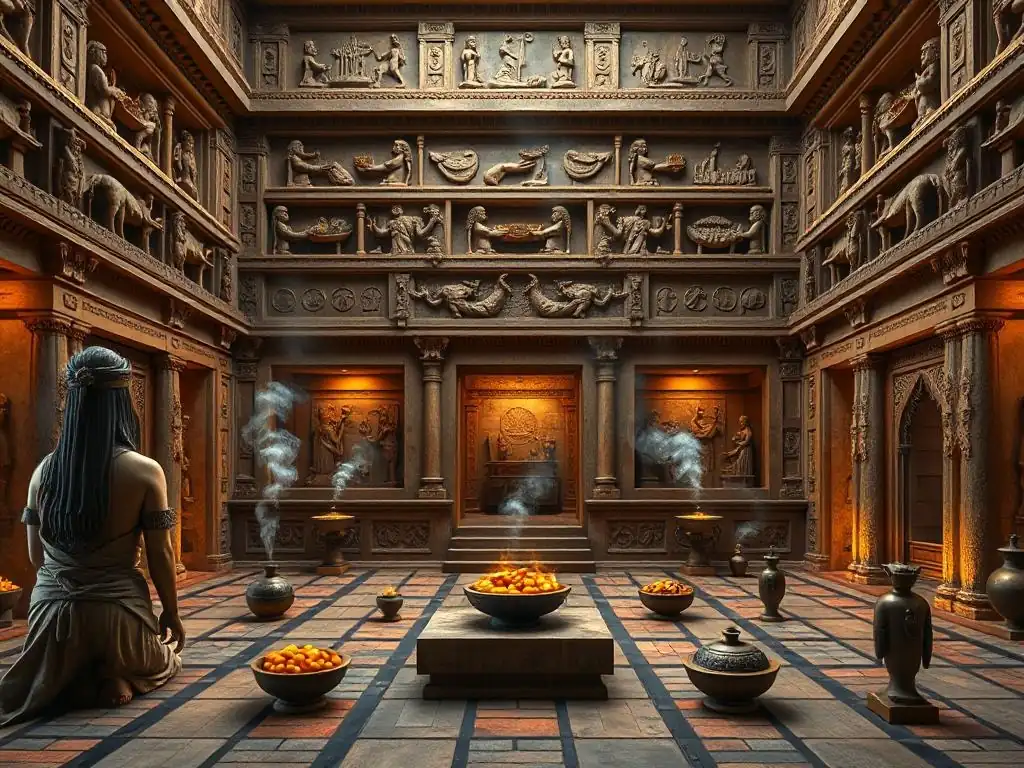
Food and drink were arguably the most essential components of Mesopotamian temple rituals offerings, reflecting the belief that the gods required nourishment. The daily meal presented to the deity's statue was a lavish affair. Records and texts describe offerings of:
- Bread: Various types of bread, often specially baked for the temple.
- Meat: Cuts from sacrificed animals, including beef, lamb, and goat.
- Poultry and Fish: Birds and fish were also offered, depending on availability and the deity's association.
- Fruits and Vegetables: Dates, figs, pomegranates, onions, and other produce from temple lands or donations.
- Dairy Products: Milk, cheese, and butter.
- Beer and Wine: These were staple beverages and frequently offered.
These offerings were presented on fine tables and dishes within the cella, the deity's private chamber. While the physical substance was later consumed by priests, the divine essence or 'smell' was believed to nourish the god. The scale of these daily Mesopotamian temple rituals offerings could be substantial, requiring significant organization and resources to procure, prepare, and present the food and drink according to strict ritual protocols.
Libations: Pouring Offerings to the Gods
Libations, the ritual pouring of liquids, were another fundamental aspect of Mesopotamian temple rituals offerings. This practice involved pouring liquids onto the ground, an altar, or into a specific vessel as an offering to a deity or sometimes to the dead. Common liquids used for libations included:
- Water: Pure water, especially from sacred sources, was frequently used.
- Beer and Wine: As with food offerings, these beverages were poured out.
- Milk: Offered, particularly to deities associated with fertility or cattle.
- Oil: Precious oils, sometimes perfumed, were used in libations.
Libations were performed during various rituals, from daily sustenance rites to purification ceremonies and major festivals. They symbolized the flow of life-giving substances and the act of dedicating valuable resources to the divine realm. Pouring a libation was a direct way of communicating with and honoring the gods, a simple yet powerful gesture within the complex system of Mesopotamian temple rituals offerings.
Incense and Aromatic Offerings: Pleasing the Divine Senses
The burning of incense and other aromatic substances was a crucial element in Mesopotamian temple rituals offerings, appealing directly to the deity's sense of smell. Sweet-smelling smoke was believed to be pleasing to the gods and helped create a sacred atmosphere, separating the ritual space from the mundane world. Texts mention various types of incense used, including:
- Cedarwood: A highly valued aromatic wood.
- Myrrh and Frankincense: Resins imported from distant lands.
- Other Aromatic Gums and Spices: Various plant-based fragrances.
Incense was burned during daily rituals, major festivals, and specific ceremonies like exorcisms or purification rites. Large censers were used to fill the temple with smoke. The act of offering incense was not just about creating a pleasant smell; it was a tangible offering, releasing valuable substances into the air for the deity to 'breathe in.' This type of offering was considered highly effective in gaining divine favor and was an indispensable part of Mesopotamian temple rituals offerings.
Animal Sacrifices: A Significant Aspect of Mesopotamian Temple Rituals
Animal sacrifice was a central and often large-scale component of Mesopotamian temple rituals offerings, particularly during festivals and important state ceremonies. Animals were considered valuable possessions, and offering them represented a significant gift to the gods. The most commonly sacrificed animals included:
- Sheep and Goats: These were the most frequent sacrificial animals.
- Cattle: Offered on more important occasions or to higher-ranking deities.
- Birds: Also used in some rituals.
The process involved selecting unblemished animals, ritually purifying them, and then slaughtering them within or near the temple precinct according to strict procedures. Specific parts of the animal, such as the fat and certain organs, might be burned on an altar, while the rest of the meat was often prepared as part of the divine meal offered to the cult statue or distributed among the priests and temple personnel. Animal sacrifice was seen as a potent way to appease angry deities, seek forgiveness, or secure major blessings, forming a dramatic and vital part of Mesopotamian temple rituals offerings.
Material Goods as Offerings: Wealth Dedicated to the Gods
Beyond consumables, a wide array of material goods constituted Mesopotamian temple rituals offerings. These were often valuable items dedicated to the deity as gifts, expressions of piety, or in fulfillment of vows. Such offerings contributed significantly to the wealth and resources of the temple. Examples include:
- Precious Metals: Gold, silver, copper, and bronze, often in the form of ingots, jewelry, or crafted objects.
- Precious Stones: Lapis lazuli, carnelian, and other valuable gems.
- Fine Textiles: Elaborate garments, hangings, and rugs.
- Crafted Objects: Statues, vessels, furniture, and weapons.
- Agricultural Produce: Grains, dates, oils, and other yields from temple lands or donations.
- Land and Property: Individuals or rulers might dedicate land or buildings to the temple.
These material Mesopotamian temple rituals offerings were stored in temple treasuries and storehouses. They were used for the upkeep of the temple, the maintenance of the priesthood, investment in economic activities, and sometimes for creating or repairing cultic objects. The accumulation of such wealth through offerings solidified the temple's position as a major economic and political power center in Mesopotamian society.
The Role of Priests and Priestesses in Performing Temple Rituals
The Hierarchy of Priestly Roles in Mesopotamian Temples
The performance of complex Mesopotamian temple rituals offerings required a specialized and highly organized priesthood. Mesopotamian temples had a sophisticated hierarchy of religious professionals, with different roles and responsibilities. At the apex was often a high priest or priestess, such as the En or Entu priest/priestess, particularly prominent in the cults of deities like Nanna in Ur or Anu and Inanna in Uruk. These individuals held significant religious and often political authority.
Below the high-ranking clergy were various specialized roles. The Sanga was responsible for the daily administration of the temple and overseeing the regular Mesopotamian temple rituals offerings. The Mašmašu specialized in exorcism and purification rites.
The Kalû were lamentation priests, skilled in chanting and music for rituals, particularly those involving mourning or appeasement. There were also administrators, scribes, butchers, bakers, musicians, and other personnel necessary for the smooth functioning of the temple and the execution of its many rituals and offerings. This intricate structure ensured that every aspect of divine service, from the grandest festival to the simplest daily offering, was performed correctly.
Ritual Attire and Preparations for Performing Sacred Duties
Priests and priestesses who performed Mesopotamian temple rituals offerings adhered to strict rules regarding purity and appearance. Before participating in sacred duties, they would undergo purification rites, which typically involved ritual washing. Their attire was also specific, designed to distinguish them as servants of the deity and to reflect the sanctity of their role. While detailed descriptions of specific garments are sometimes scarce, texts and depictions suggest that priests wore clean, often linen, robes.
Certain roles might have had distinctive elements of dress or regalia. For instance, high priests might wear special headwear or carry specific staffs or symbols associated with their deity. The preparation for performing Mesopotamian temple rituals offerings was not just physical but also involved mental and spiritual readiness. Priests might observe periods of fasting, abstinence, or meditation to ensure they were in a state of ritual purity and devotion before entering the most sacred areas of the temple or interacting directly with the divine image.
Recitations, Chants, and Music in Temple Rituals
Sound played a vital role in Mesopotamian temple rituals offerings, enhancing the solemnity and power of the ceremonies. Rituals were accompanied by the recitation of prayers, hymns, and incantations. Priests would chant ancient Sumerian or Akkadian texts, invoking the names of the gods, detailing their attributes, lamenting misfortunes, or petitioning for blessings. The accurate recitation of these texts was considered crucial for the efficacy of the ritual.
Music was also an integral part of temple worship. Various instruments were used, including lyres, harps, drums, and flutes. Specialized musicians were part of the temple staff.
Choirs of singers might perform hymns dedicated to the deities. The lamentation priests ( Kalû) were particularly known for their mournful chants used in rituals of appeasement or during festivals commemorating divine suffering, such as those for Dumuzi. The combination of recitation, chant, and instrumental music created a rich auditory experience that elevated the Mesopotamian temple rituals offerings, helping to bridge the gap between the human and divine realms and evoke the presence of the gods.
The Significance of Temple Architecture and Sacred Space
The Ziggurat: A Bridge Between Heaven and Earth
The ziggurat is perhaps the most iconic feature of Mesopotamian temple architecture. These massive, stepped towers, built of mudbricks, dominated the city skyline. While their exact function is debated, they are widely believed to have served as platforms for temples or shrines at their summit, or perhaps as symbolic mountains connecting the earthly realm with the heavens, the abode of the gods. The most famous examples include the ziggurat of Ur, dedicated to the moon god Nanna, and the Etemenanki ziggurat in Babylon, associated with Marduk (often suggested as the inspiration for the biblical Tower of Babel).
Access to the upper levels of the ziggurat was restricted, likely reserved for priests performing specific celestial observations or rituals. The sheer scale of the ziggurat symbolized the power and importance of the deity and the city itself. It was a visible manifestation of the city's devotion and its aspiration to reach towards the divine. While not directly involved in the daily Mesopotamian temple rituals offerings performed in the lower temple complex, the ziggurat provided the sacred context and elevated stage for the deity's dwelling, reinforcing the connection between heaven and earth.
The Inner Sanctum: The Abode of the Deity
At the heart of every Mesopotamian temple was the cella, or inner sanctum. This was the most sacred space, considered the actual dwelling place of the deity. The cella typically housed the cult statue of the god, which was the focal point of worship and the recipient of Mesopotamian temple rituals offerings. Access to the cella was highly restricted, generally limited to the high priest and perhaps a select few assisting personnel during the performance of the most sacred rites.
The cella was often small and dimly lit, adding to its mystique and sanctity. It was furnished with altars, offering tables, and possibly a throne for the deity. The cult statue itself was treated with the utmost reverence, believed to be animated by the god's presence.
Daily rituals of feeding, dressing, and caring for the statue took place within this intimate space. The design of the temple often involved a series of courtyards and anterooms leading progressively towards the cella, increasing the sense of entering a more sacred zone and emphasizing the separation between the divine presence and the outside world.
Temple Layout and Ritual Spaces: The Example of the Eanna Temple in Uruk
Mesopotamian temples varied in layout, but many followed a pattern involving courtyards, halls, and the central cella. The Eanna temple complex in Uruk, dedicated to Inanna and Anu, is a particularly well-documented example, showcasing the scale and complexity of these structures. Over millennia, Eanna grew into a vast precinct with multiple buildings, courtyards, and ziggurats. Early temple forms included ' tripartite' plans with a central long room (possibly the cella) flanked by smaller rooms, and 'bent-axis' approaches where one had to turn to face the altar, emphasizing reverence.
Later, temples often featured large central courtyards where more public aspects of festivals or gatherings might take place. Surrounding the courtyard were rooms for storage, workshops, priestly residences, and administrative offices – reflecting the temple's multifaceted role. The progression from the outer courtyard through increasingly restricted areas to the inner cella was designed to guide worshippers towards the divine presence while reinforcing the sacredness of the inner core. Specific areas might be designated for animal sacrifice, bread baking for offerings, or the storage of precious Mesopotamian temple rituals offerings, illustrating the integrated nature of ritual and practical administration.
The Impact of Mesopotamian Temple Rituals on Society
Mesopotamian temple rituals offerings played a crucial role in maintaining social order and legitimizing the authority of rulers. The king was often portrayed as the chief servant of the gods, responsible for building and maintaining temples and ensuring that the Mesopotamian temple rituals offerings were performed correctly. By fulfilling this duty, the king demonstrated his piety and secured divine favor, which in turn legitimized his rule in the eyes of the people. Rulers frequently recorded their temple-building activities and donations of lavish offerings on inscriptions, highlighting their role as pious custodians of the divine cult.
The temple hierarchy itself reinforced social structure, with priests holding positions of power and prestige. Participation in festivals and public rituals provided a sense of communal identity and shared purpose. The belief that the gods controlled destiny and responded to human actions through rituals encouraged adherence to established norms and obedience to authority, both divine and earthly. Thus, the religious practices centered around Mesopotamian temple rituals offerings were deeply intertwined with the political and social fabric of Mesopotamian civilization.
Promoting Economic Prosperity Through Divine Favor
A key function of Mesopotamian temple rituals offerings was to secure divine favor for the prosperity of the land and its people. It was believed that bountiful harvests, successful trade, and victory in war were gifts from the gods, contingent upon proper worship and generous offerings. Therefore, investing in the temple and providing lavish Mesopotamian temple rituals offerings was seen as a practical strategy for ensuring economic well-being.
The temple itself was a major economic engine. Its vast landholdings required extensive agricultural management, creating employment and generating wealth. Temple workshops produced goods, and the temple engaged in trade.
The collection and redistribution of offerings, whether agricultural produce or precious metals, meant the temple acted as a central bank and redistribution center, stabilizing the economy and providing a safety net in times of hardship. The economic activities generated by the temple were thus seen not merely as secular endeavors but as an extension of its sacred duty to serve the gods and promote the prosperity of the city-state through divine blessing gained via Mesopotamian temple rituals offerings.
The Temple as a Center for Storage and Redistribution of Resources
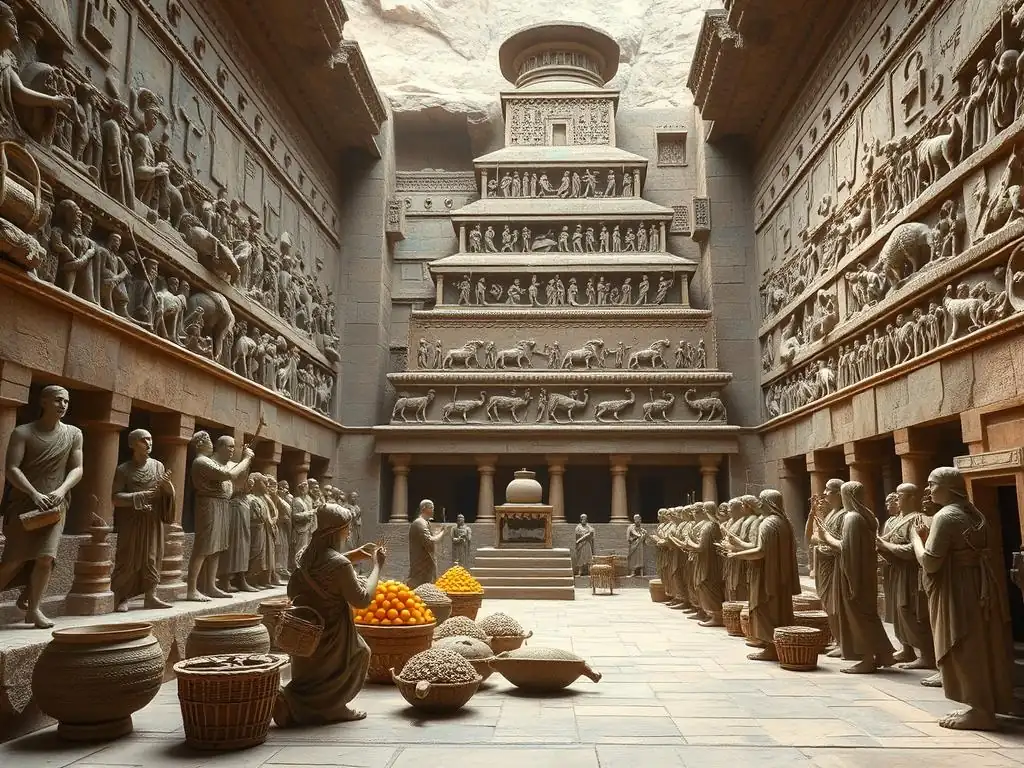
As recipients of extensive Mesopotamian temple rituals offerings, temples accumulated significant wealth and resources. They served as massive storehouses for agricultural surplus, livestock, and valuable goods. This function was vital in an economy that faced unpredictable environmental challenges, such as floods or droughts. The temple's granaries and storehouses provided a buffer against famine and allowed for the redistribution of resources to priests, temple workers, and sometimes the wider population in times of need.
The temple also acted as a center for economic administration. Scribes kept meticulous records of incoming offerings, expenditures, and land management. This administrative capacity made the temple a central node in the city's economy, facilitating trade, lending, and large-scale organizational projects. The economic power derived from being the central recipient and manager of Mesopotamian temple rituals offerings solidified the temple's influence, making it indispensable to the functioning and survival of the Mesopotamian city-state.
The Decline of Mesopotamian Temple Rituals
Factors Contributing to the Decline of Traditional Practices
The decline of traditional Mesopotamian temple rituals offerings and practices was a gradual process influenced by several factors over many centuries. Conquest by foreign powers played a significant role. Empires like the Achaemenid Persians, Greeks under Alexander the Great, Seleucids, and later the Parthians and Sassanians brought their own religious beliefs and administrative systems. While some rulers initially respected and even supported local cults, the shift in political power meant that the central authority and economic base of the traditional temples were often diminished.
Economic changes also played a part. The temple economy, while robust for millennia, faced challenges from private enterprise and changing administrative structures under foreign rule. Furthermore, internal factors such as neglect, corruption, or the inability to maintain the complex infrastructure required for elaborate rituals could contribute to decline. As cities waned in importance or populations shifted, the resources and human capital necessary for maintaining the full scope of Mesopotamian temple rituals offerings became harder to sustain.
The Influence of New Religions and Empires
The arrival of new religious ideas and the imposition of foreign rule had a profound impact on the status and practice of Mesopotamian temple rituals offerings. Under the Seleucids and Parthians, Greek and Iranian cults gained prominence, sometimes alongside, sometimes in competition with, traditional Mesopotamian worship. The rise of Zoroastrianism under the Achaemenids and later Sassanians, and eventually the spread of Christianity and Islam, offered alternative belief systems that gradually supplanted the ancient polytheistic worldview.
While some Mesopotamian cults and rituals persisted into the Hellenistic and Parthian periods, often adapting or incorporating foreign elements, they lost their central position in society. Temples fell into disrepair, priestly colleges dwindled, and the elaborate system of Mesopotamian temple rituals offerings became less central to the lives of the populace. By the early centuries CE, the traditional Mesopotamian religious system, which had thrived for thousands of years, had largely faded, leaving behind a rich legacy but ceasing to be a living tradition.
Legacy of Mesopotamian Temple Rituals and Offerings
Influence on Later Religious Traditions
Despite their eventual decline, Mesopotamian temple rituals offerings left an indelible mark on the religious landscape of the ancient Near East and beyond. Many concepts and practices found in later traditions, including the Abrahamic religions (Judaism, Christianity, and Islam), bear striking similarities to Mesopotamian precedents. The concept of a dedicated priesthood, the practice of animal sacrifice and libations, the use of incense, purification rituals, and the idea of a sacred house for the deity can all find parallels in Mesopotamian worship.
For instance, the layout of ancient Israelite temples, with their progression towards a holy of holies, echoes the Mesopotamian temple plan with its restricted cella. The system of offerings described in Leviticus shares functional similarities with Mesopotamian temple rituals offerings, aiming to maintain a relationship with the divine through material gifts and sacrifice. While not a direct linear descent in all cases, the long history of interaction and cultural exchange in the region ensured that Mesopotamian religious ideas and ritual practices influenced the development of subsequent belief systems.
Parallels in Ancient Egyptian Temple Practices
Significant parallels exist between Mesopotamian temple rituals offerings and those practiced in ancient Egypt, another great river valley civilization with a complex polytheistic religion. Both cultures believed in the necessity of daily rituals to sustain the gods and maintain cosmic order ( maat in Egypt). Egyptian temples also housed cult statues that were ritually washed, dressed, and fed daily by priests. Animal sacrifice, libations, and incense were integral to Egyptian worship, just as they were in Mesopotamia.
Egyptian temples also served as economic centers, managing vast resources. The priesthoods in both cultures were highly organized and specialized. While the specific pantheons, mythologies, and architectural styles differed, the fundamental function of the temple as the locus for maintaining the divine-human relationship through meticulous ritual and material offerings was remarkably similar. Studying these parallels helps illuminate common religious impulses in ancient civilizations and the vital role that temple rituals and offerings played in their societies.
Understanding Mesopotamian Spirituality Through Ritual Practices
The detailed examination of Mesopotamian temple rituals offerings provides invaluable insights into the spirituality and worldview of this ancient civilization. These practices reveal a people who saw themselves in a constant, dynamic relationship with powerful, anthropomorphic deities who required service and sustenance. The rituals were not merely symbolic acts but were believed to have tangible effects on the well-being of the individual, the city, and the cosmos.
The emphasis on meticulous performance, purity, and the provision of the finest offerings underscores the deep respect and perhaps also the anxiety that Mesopotamians felt towards their gods. By studying the specific types of Mesopotamian temple rituals offerings, the roles of the priests, and the function of the temple architecture, we gain a deeper understanding of their beliefs about divine nature, the structure of the universe, the importance of order, and humanity's place within the cosmic scheme.
The rituals were the language through which humans communicated with the divine, a language spoken through actions, objects, sounds, and scents, all aimed at ensuring the continuation of life and prosperity under the watchful eyes of the gods.
Conclusion: Reflecting on the Significance of Mesopotamian Temple Rituals
The Mesopotamian temple rituals offerings were the lifeblood of ancient Mesopotamian civilization, forming the core of its religious, economic, and social structure for millennia. These elaborate practices, from the daily feeding of the gods to grand seasonal festivals, were driven by the fundamental belief that humanity was created to serve the deities and provide them with sustenance. The temples, as the physical homes of the gods, became centers of immense power and wealth, managing resources, employing vast numbers of people, and reinforcing the authority of rulers.
The specific Mesopotamian temple rituals offerings – including food, drink, libations, incense, animal sacrifices, and material goods – were not just symbolic gifts but were believed to directly contribute to the gods' well-being and, consequently, to the maintenance of cosmic order and the prosperity of the land. The complex hierarchy of priests and priestesses dedicated their lives to performing these rites with precision and devotion.
While these traditions eventually declined under the weight of conquest and the rise of new religions, their legacy is evident in subsequent religious practices across the Near East. Studying Mesopotamian temple rituals offerings offers a unique window into the worldview of one of history's earliest complex societies, revealing a deep sense of dependence on the divine and a sophisticated system developed to honor and appease the powerful forces believed to govern their world.
Frequently Asked Questions
What was the primary purpose of Mesopotamian temple rituals?
The primary purpose was to feed the gods and maintain cosmic order. These rituals ensured the gods' well-being and, in turn, the prosperity of the Mesopotamian people.
What types of offerings were commonly presented in Mesopotamian temple rituals?
Offerings included food and drink, such as grains, fruits, and beer, as well as valuable objects like precious metals and jewelry. Animals were also sacrificed in some instances.
How did Mesopotamian priests and priestesses participate in these rituals?
Priests and priestesses played a crucial role in performing the rituals and interpreting the will of the gods. They oversaw the preparation and presentation of offerings.
What role did music and hymns play in Mesopotamian temple rituals?
Music and hymns were integral components of the rituals, used to invoke the gods' presence and create a sacred atmosphere. They were believed to please the deities.
How did Mesopotamian temple rituals reflect the society's understanding of the relationship between humans and gods?
The rituals demonstrated a belief in the gods' power and the necessity of human offerings to ensure divine favor. This highlighted a dependent relationship for survival and prosperity.
Final Reflection: Echoes of Sacrifice, Whispers of Order
The intricate rituals of Mesopotamian temples, far from being relics of a bygone era, offer a potent lens through which to understand our own enduring fascination with ritual, sacrifice, and the search for cosmic order. The meticulous offerings, the carefully choreographed ceremonies, and the profound beliefs underpinning them resonate deeply with contemporary anxieties about control, meaning, and our place in the universe. These ancient practices speak to a fundamental human need to connect with something larger than ourselves, a need that persists across millennia.
The impact of Mesopotamian religious practices extends far beyond the dusty ruins of ancient cities. Their influence can be traced in the development of later religious traditions, shaping concepts of sacrifice, divine favor, and the relationship between humanity and the divine. The gods are not indifferent to the offerings of men; they are moved by them, and they respond to them.
This sentiment, though expressed in a modern context, encapsulates the core belief system that fueled the elaborate rituals of Mesopotamia, a belief system that continues to inform our understanding of religious practice and the human need for spiritual connection.
Consider, for a moment, the meticulous detail involved in these offerings – the selection of animals, the preparation of food, the precise arrangement of objects. This dedication reflects a profound respect for the divine and a deep-seated desire to maintain cosmic harmony. You, too, can find meaning in this dedication, not through literal sacrifice, but through mindful engagement with your own values and beliefs.
What rituals, large or small, do you perform in your daily life to maintain a sense of order and purpose? What offerings, metaphorical or literal, do you make to the things you hold dear? Reflect on these questions, and discover the echoes of ancient Mesopotamia within your own life.
Unlock the Secrets of Ancient Mesopotamian Rituals!
Thanks for delving into the fascinating world of Mesopotamian temple rituals! You've now gained a deeper understanding of how these practices maintained cosmic order and appeased the gods. Ready to take your knowledge further?
- Craft your own symbolic offering: Imagine the ingredients used in ancient rituals and design a modern-day equivalent expressing your gratitude or aspiration. Share your creation in the comments below!
- Explore the rich iconography of Mesopotamian deities: Research the symbolism behind their representations and how they connect to the rituals discussed.
- Discuss your thoughts on the role of ritual in maintaining social order: How do you see parallels between ancient Mesopotamian practices and modern societal structures?
What surprising connections can you draw between ancient Mesopotamian rituals and contemporary practices of faith and community building?