
Atef Crown: Osiris's Symbol and the Afterlife's Majesty

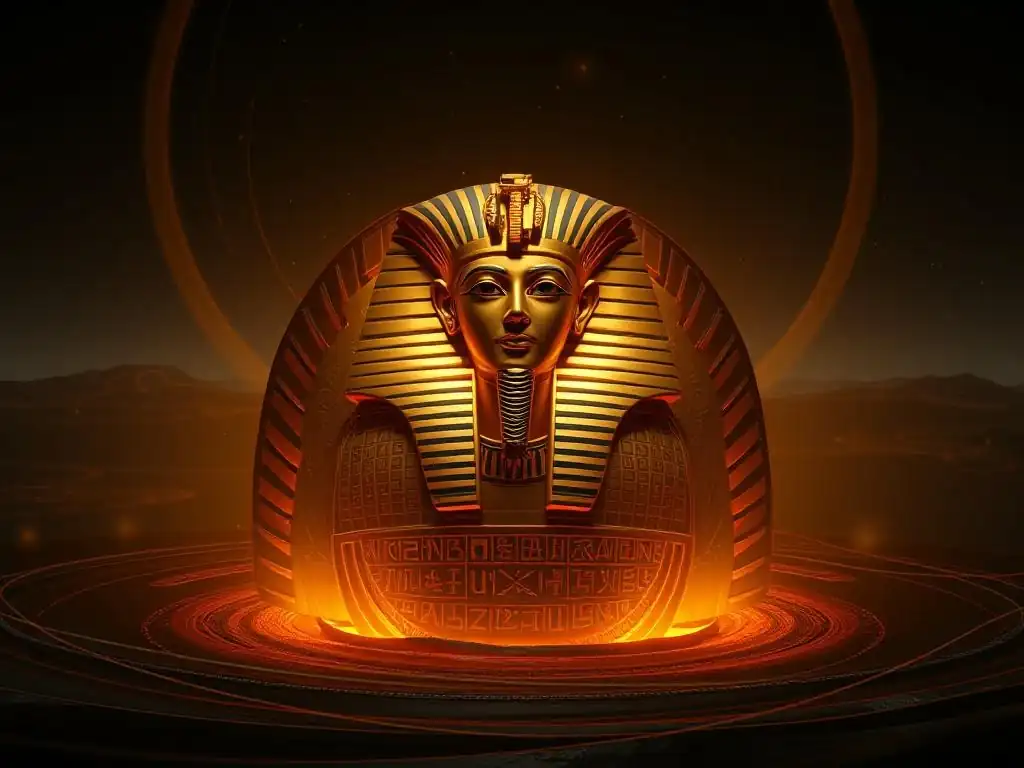
Welcome, seekers of ancient wisdom! Prepare to journey into the vibrant world of Mythology and Legends, where echoes of forgotten gods and heroic deeds resonate through the ages. Here, we delve into the captivating narratives that have shaped cultures and continue to inspire. Ever wondered about the secrets held within the Atef Crown, the majestic headwear of Osiris? Uncover the profound Osiris afterlife crown symbolism and its connection to the afterlife's majesty as we explore the intricate tapestry of Egyptian lore. Let the adventure begin!
- Atef Crown: Deciphering Osiris's Symbol of Power and the Afterlife
- The Symbolic Meaning of the Atef Crown Components
- Osiris's Afterlife and the Atef Crown's Significance
- The Atef Crown vs. Other Egyptian Crowns: A Comparison
- The Atef Crown in Ancient Egyptian Art and Rituals
- The Legacy of Osiris and the Atef Crown in Modern Culture
-
Frequently Asked Questions
- What is the Atef crown, and what does it symbolize in Egyptian mythology?
- How is the Atef crown related to Osiris's role in the afterlife?
- What are the key components of the Atef crown, and what do they represent?
- Besides Osiris, are there any other deities associated with the Atef crown?
- How does the symbolism of the Atef crown influence our understanding of ancient Egyptian beliefs about death and the afterlife?
- Final Reflection: The Enduring Majesty of the Atef Crown
- Unveil the Mysteries of the Atef Crown!
Atef Crown: Deciphering Osiris's Symbol of Power and the Afterlife
Introduction to the Atef Crown in Egyptian Mythology
The Atef crown stands as one of the most distinctive symbols within the complex pantheon of ancient Egyptian deities, primarily associated with the god Osiris. This elaborate headdress is far more than mere ornamentation; it is a powerful emblem embodying kingship, divine authority, and crucially, the mysteries of the afterlife. Its unique composition, bringing together elements representing Upper Egypt, truth, the sun, and fertility, encapsulates core Egyptian beliefs about life, death, and rebirth.
Understanding the Atef crown is key to unlocking significant aspects of Osiris afterlife crown symbolism. It visually communicates Osiris's dominion over the realm of the dead and his role in the cycle of resurrection. Depicted frequently in tombs, temples, and religious texts dating back possibly to the Old Kingdom and becoming prominent in the New Kingdom (circa 1550-1070 BCE), the Atef crown served as a constant reminder of the divine order and the hope for eternal life promised under Osiris's rule. Its presence in funerary contexts underscores its profound connection to the journey beyond death.
Osiris: God of the Afterlife and Resurrection
Osiris holds a central and complex position in Egyptian religion, primarily revered as the god of the afterlife, the underworld (Duat), and resurrection. His myth, involving betrayal, dismemberment by his brother Set, and subsequent reconstitution and revival by his sister-wife Isis, served as the foundational narrative for Egyptian beliefs about death and the possibility of overcoming it. This story established Osiris as the first mummy and the divine precedent for the deceased entering the afterlife.
As ruler of the dead, Osiris presided over the judgment of souls in the Hall of Two Truths. Mortals hoped to emulate his resurrection, achieving eternal life by identifying with him in death. Texts like the Book of the Dead provided spells and guidance for the deceased to navigate the underworld and pass Osiris's judgment. The widespread veneration of Osiris, evidenced by major cult centers like Abydos and Busiris, highlights his paramount importance in the spiritual lives of Egyptians seeking passage to the Field of Reeds, the Egyptian paradise.
The Symbolic Meaning of the Atef Crown Components
The base of the Atef crown is the Hedjet, the tall, conical white crown traditionally associated with Upper Egypt (the southern part of the country). This element immediately grounds the Atef crown in the concept of kingship and territorial dominion. By incorporating the Hedjet, the Atef crown signifies Osiris's status not just as a divine being but as a ruler, specifically connecting him to the ancient lineage and power structure of the unified Egyptian state.
The Hedjet symbolized the pharaoh's sovereignty over Upper Egypt and represented the legitimacy of their rule. Its integration into the Atef crown suggests that Osiris's authority over the afterlife realm is akin to the pharaoh's temporal authority over the living land. This connection reinforces the idea that the afterlife was not a chaotic void but an ordered kingdom, ruled by a divine sovereign who maintained cosmic balance, much like the earthly king was expected to.
Ostrich Feathers: Representing Ma'at (Truth and Balance)
Flanking the central Hedjet in the Atef crown are typically two tall ostrich feathers. These feathers are profoundly symbolic in Egyptian thought, most famously associated with Ma'at, the goddess personifying truth, justice, cosmic order, and balance. The feather of Ma'at was crucial in the Weighing of the Heart ceremony, where the heart of the deceased was weighed against this feather to determine their worthiness for the afterlife.
The inclusion of Ma'at's feathers in the Atef crown worn by Osiris reinforces his role as the ultimate judge and maintainer of cosmic order in the underworld. It signifies that his rule in the afterlife is based on the principles of truth and justice, the very standards by which souls are evaluated. The feathers emphasize that gaining passage to the blissful Field of Reeds under Osiris's reign is contingent upon living a life in accordance with Ma'at.
Golden Disc: Connection to the Sun God Ra and Rebirth
Often surmounting the Hedjet within the Atef crown is a golden solar disc. This element links Osiris to the powerful sun god Ra, the creator deity and symbol of cyclical renewal. While Osiris is primarily associated with the underworld and death, his connection to Ra through the solar disc introduces the crucial theme of rebirth and regeneration, which is central to the Egyptian concept of the afterlife.
The sun's daily journey across the sky and its setting and rising symbolized the cycle of life, death, and rebirth. By incorporating the solar disc, the Atef crown suggests that Osiris's realm is not one of static finality but one integrated into the cosmic cycle of renewal. It implies that the journey through the underworld under Osiris's guidance leads not just to eternal life, but to a form of renewed existence, mirroring the sun's daily rebirth.
Horns: Symbolism of Fertility and Divine Power
Sometimes depicted as part of the Atef crown are ram or cow horns, typically curving outwards from the base or supporting the solar disc. Horns in ancient Egyptian symbolism carried multiple connotations, including power, divinity, and fertility. Ram horns, for instance, were associated with deities like Amun and Khnum, who had creative or generative aspects. Cow horns were linked to goddesses like Hathor and Isis, often associated with motherhood and nurturing.
The presence of horns in the Atef crown can be interpreted as further emphasizing Osiris's divine power and, perhaps more significantly, his connection to fertility and regeneration. While Osiris is the god of the dead, he is also intimately linked with the fertility of the Nile and the annual inundation that brought life back to the land. The horns symbolize this life-giving aspect, highlighting that Osiris's dominion over death is paradoxically intertwined with the power of rebirth and the continuation of life in the afterlife.
Osiris's Afterlife and the Atef Crown's Significance
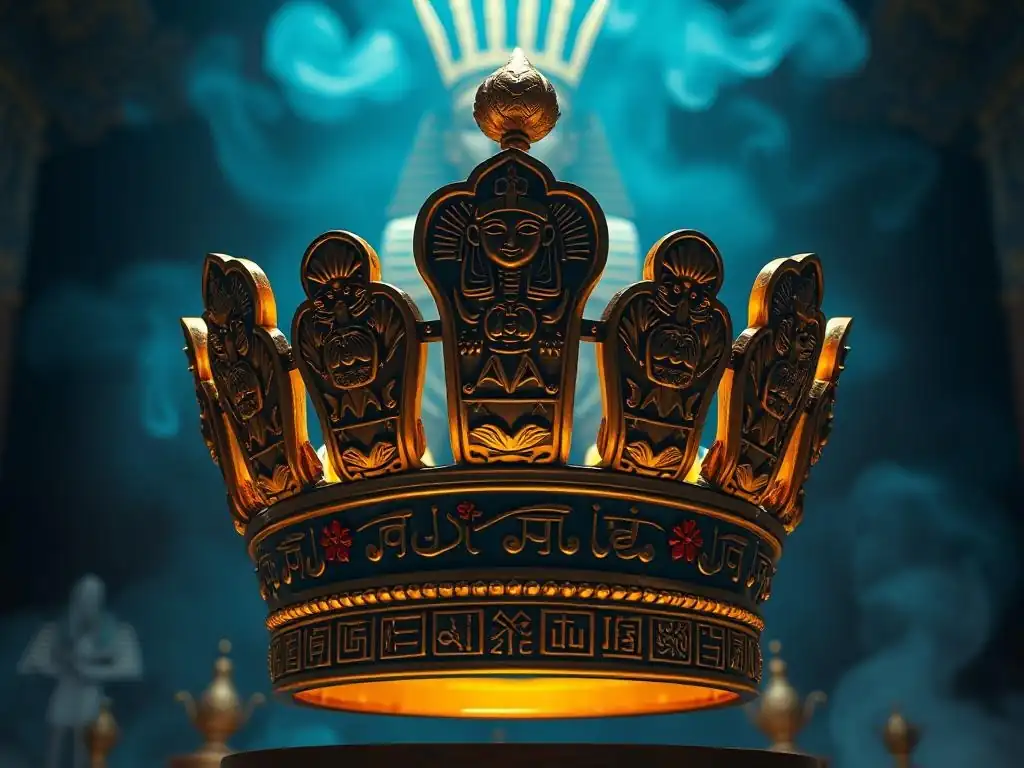
The Realm of Duat: Journey Through the Underworld
Duat was the ancient Egyptian underworld, a mysterious and perilous realm that the deceased soul had to navigate after death. Described in funerary texts like the Book of Gates and the Amduat, Duat was filled with challenges, demons, and divine beings. The journey through Duat was seen as a parallel to the sun god Ra's nightly passage through the underworld, symbolizing the transition from death to rebirth.
The Atef crown's symbolism is deeply embedded in this journey. As the soul progressed through Duat, it sought to reach the Hall of Two Truths for judgment by Osiris. The crown, representing Osiris's authority over this realm and his connection to cosmic order and rebirth, served as a visual assurance of the divine structure governing the underworld. The deceased, often depicted wearing symbols associated with Osiris or invoking his name, hoped to successfully traverse Duat and stand before the god adorned with his powerful Atef crown.
The Weighing of the Heart Ceremony: Judgment in the Afterlife
The culmination of the soul's journey through Duat was the Weighing of the Heart ceremony in the Hall of Two Truths, presided over by Osiris. In this critical moment, the heart (considered the seat of the soul and conscience) of the deceased was placed on one pan of a scale, balanced against the feather of Ma'at on the other. Thoth, the god of writing and knowledge, recorded the outcome, while the monstrous Ammit waited to devour the hearts of those found unworthy.
Osiris, seated on his throne and often depicted wearing the Atef crown, was the ultimate judge of this ceremony. His presence, marked by the powerful Osiris afterlife crown symbolism, underscored the gravity and fairness of the judgment. A heart that balanced with the feather indicated a life lived in accordance with Ma'at, granting the deceased passage to the Field of Reeds. A heart heavy with wrongdoing meant the soul was condemned to annihilation. The Atef crown, therefore, represented the divine authority upholding the cosmic law by which all souls were judged.
Osiris as Ruler of the Afterlife: Wearing the Atef Crown
Osiris's primary role in the Egyptian pantheon, especially during the New Kingdom and later periods, was that of the undisputed ruler of the afterlife. After his resurrection, he did not return to rule the land of the living (that role fell to his son Horus) but established his kingdom in the realm of the dead. He was depicted seated on a throne, often mummiform, holding the crook and flail (symbols of kingship), and invariably wearing the distinctive Atef crown.
This consistent depiction emphasizes that the Atef crown is intrinsically linked to Osiris's sovereignty over the dead. It signifies his divine right to rule Duat and preside over the fate of souls. The Osiris afterlife crown symbolism thus becomes synonymous with the established order of the underworld, promising a structured and judged existence after death rather than mere oblivion. For the ancient Egyptians, seeing Osiris adorned with the Atef crown in tomb paintings or papyri offered comfort and hope, representing the benevolent yet just ruler who awaited them in the next life.
The Atef Crown vs. Other Egyptian Crowns: A Comparison
Deshret (Red Crown): Lower Egypt
The Deshret, or Red Crown, was the ancient symbol of sovereignty over Lower Egypt (the northern part of the country, including the Delta). It was a flat-topped crown with a tall back extension and a coil projecting from the front. Unlike the Atef crown, which is primarily associated with a deity and the afterlife, the Deshret was a purely royal crown worn by pharaohs to signify their rule over Lower Egypt.
While both crowns represent authority, their domains are distinct. The Deshret signifies temporal power over a specific geographical region of the living world. The Atef crown, incorporating the White Crown of Upper Egypt, represents divine authority linked to kingship but specifically within the context of the afterlife realm ruled by Osiris. Pharaohs might wear the Deshret in procession or ceremony, but the Atef crown belonged almost exclusively to Osiris and, by extension, deceased pharaohs who identified with him.
Pschent (Double Crown): Unification of Egypt
The Pschent, or Double Crown, is perhaps the most iconic symbol of unified Egypt, created by combining the White Crown of Upper Egypt (Hedjet) and the Red Crown of Lower Egypt (Deshret). It represents the pharaoh's rule over both lands, signifying the political and territorial unity of the Two Lands achieved around 3100 BCE. The Pschent was a crown of supreme earthly power.
In contrast to the Pschent's representation of unified earthly rule, the Atef crown signifies divine rule over the afterlife. While both incorporate the White Crown component, the Atef adds divine symbols like feathers, the solar disc, and horns, elements not found in the Pschent. The Pschent represents the pharaoh's living kingship over a unified territory, whereas the Atef crown represents Osiris's divine kingship over the spiritual realm of the dead, highlighting a fundamental difference in their symbolic domains.
Khepresh (Blue Crown): Royal Power in Military Contexts
The Khepresh, often called the Blue Crown or War Crown, was a distinctive headdress worn by pharaohs, particularly during the New Kingdom. It was a rounded, blue crown adorned with small gold discs. While its exact purpose is debated, it is often depicted in contexts of military campaigns, royal processions, and during the pharaoh's appearances before the public, suggesting it symbolized the pharaoh's active power, vitality, and perhaps military authority.
The Khepresh is another example of a crown tied to the pharaoh's earthly power and active rule, contrasting sharply with the Atef crown's association with the passive, mummiform Osiris and his dominion over the afterlife. The Khepresh represents dynamic, living kingship and authority in the present world, whereas the Atef crown symbolizes established, divine authority over the realm of the dead and the promise of rebirth. Their contexts of use – battlefields/processions versus tombs/temples – further differentiate their symbolic meanings.
The Atef Crown in Ancient Egyptian Art and Rituals
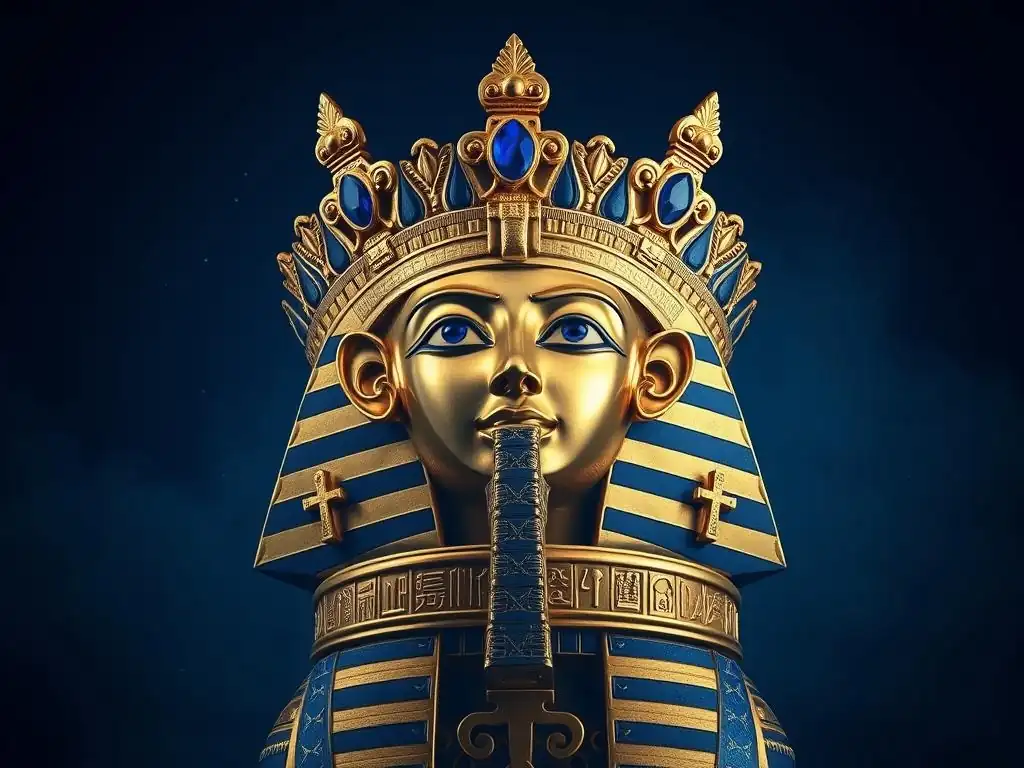
Depictions of Osiris Wearing the Atef Crown in Tombs and Temples
The Atef crown is most frequently encountered in ancient Egyptian art, specifically in religious and funerary contexts. Tomb walls, sarcophagi, stelae, and temple reliefs across Egypt bear countless depictions of Osiris enthroned, wearing his characteristic Atef crown. Examples can be found in royal tombs in the Valley of the Kings, such as the tomb of Horemheb (KV 57), and in the mortuary temples of pharaohs like Hatshepsut at Deir el-Bahari, where Osiris often appears as part of the divine assembly.
These depictions were not merely decorative; they served a vital religious function. In tombs, they guided the deceased and affirmed their connection to Osiris, essential for achieving eternal life. In temples dedicated to Osiris or where funerary rites were performed, reliefs of the god wearing the Atef crown reinforced his power and the promise of resurrection for the faithful. The consistent portrayal of the Osiris afterlife crown symbolism in these sacred spaces highlights its fundamental importance to Egyptian religious practice and beliefs about the world beyond death.
The Khoiak Festival: Ritualistic Use of the Atef Crown
The Khoiak Festival was a major annual religious celebration dedicated to Osiris, particularly prominent during the Late Period and Ptolemaic era. Held during the inundation season, it reenacted elements of the Osiris myth, including his death, dismemberment, and resurrection. Central to the festival were agricultural rituals symbolizing regeneration and the planting of Osiris 'beds' or 'gardens' – figures of Osiris made of earth and grain, which would sprout, representing his revival and the fertility of the land.
While the actual Atef crown itself, being a divine attribute, was likely not worn by priests in the same way a pharaoh wore his crown, its symbolism was integral to the festival. Representations of Osiris wearing the Atef crown would have been prominent, and elements of the crown's symbolism – particularly the connection to rebirth (solar disc, horns) and fertility (horns, Osiris's link to agriculture) – were central to the festival's themes. The ritualistic 'planting' and 'sprouting' directly mirrored the resurrection symbolized by the Atef crown, making its meaning palpable to the participants.
The Atef Crown as a Symbol of Hope and Rebirth
For the ancient Egyptians, death was not an end but a transformation, a passage to another form of existence. The promise of eternal life and rebirth was central to their religious outlook, and the god Osiris, along with his distinctive Atef crown, stood as the ultimate embodiment of this hope. The crown's complex symbolism, combining royal power, cosmic order (Ma'at), solar regeneration, and fertility, encapsulated the key elements required for a successful transition to the afterlife.
Seeing Osiris depicted with his Atef crown offered a potent visual representation of the desired outcome: passage through judgment and entry into a blessed, renewed existence in the Field of Reeds. The Osiris afterlife crown symbolism reassured believers that death was not victory for chaos but a transition governed by a just and powerful ruler who himself had overcome death. It was a symbol of the possibility of resurrection, mirroring the daily rebirth of the sun and the annual renewal of the land by the Nile.
The Legacy of Osiris and the Atef Crown in Modern Culture
Osiris and the Atef Crown in 20th Century Occultism
In the 20th century, there was a renewed interest in ancient Egyptian religion and symbolism within various esoteric and occult traditions, notably influenced by figures like Aleister Crowley. Osiris, as a god of death, resurrection, and the afterlife, became a significant figure in certain magical systems and philosophical frameworks that explored themes of transformation, initiation, and overcoming physical limitations.
The Atef crown, as Osiris's primary visual identifier, often appeared in the iconography and literature of these groups. Its complex symbolism, particularly the elements related to rebirth (solar disc) and the integration of diverse powers (White Crown, feathers, horns), resonated with alchemical and transformational concepts. While often interpreted through a syncretic lens blending Egyptian ideas with other traditions, the Osiris afterlife crown symbolism continued to represent mastery over death and the promise of spiritual regeneration in these contexts.
The Enduring Symbolism of the Osiris Afterlife Crown
Centuries after the decline of ancient Egyptian civilization, the powerful Osiris afterlife crown symbolism continues to resonate. While its direct religious function has ceased, its image persists in art, literature, and academic study as a potent symbol of Egyptian beliefs about death, judgment, and rebirth. It represents the ancient understanding of the afterlife not as an empty void but as a structured realm overseen by a divine ruler.
The Atef crown serves as a visual shorthand for Osiris and, by extension, the entire Egyptian funerary complex. It embodies the hope for resurrection that permeated Egyptian society for millennia. Its unique combination of earthly kingship (White Crown) and divine, cosmic elements (feathers of Ma'at, solar disc of Ra, horns of power/fertility) makes it a compelling symbol of the transition from the mortal realm to the divine, representing the ultimate transformation sought by every ancient Egyptian.
Further Exploration of Egyptian Mythology and Symbolism
The Atef crown is just one facet of the incredibly rich and complex tapestry of ancient Egyptian mythology and symbolism. Delving deeper into the stories of Osiris, Isis, Set, Horus, and other deities reveals a sophisticated understanding of the cosmos, human life, and the mysteries of death. Exploring other symbols, such as the Ankh (life), the Scarab (rebirth), and the Eye of Horus (protection and healing), provides further insight into their worldview.
Understanding Osiris afterlife crown symbolism opens a door to appreciating how the Egyptians conceived of the transition to the afterlife. It encourages further study into texts like the Book of the Dead and the Pyramid Texts, which elaborate on the journey through Duat and the judgment before Osiris. Each symbol and myth is interconnected, offering a holistic view of a belief system that profoundly shaped one of the world's longest-lasting civilizations.
Frequently Asked Questions
What is the Atef crown, and what does it symbolize in Egyptian mythology?
The Atef crown is a distinctive headdress worn by the Egyptian god Osiris. It symbolizes royal authority, resurrection, and his dominion over the afterlife.
The Atef crown visually represents Osiris's power to judge the dead and grant them eternal life. Its connection to Osiris reinforces his role as the ruler of the Duat (underworld).
What are the key components of the Atef crown, and what do they represent?
The Atef crown consists of a white headdress flanked by two ostrich feathers. The white headdress signifies Upper Egypt, while the feathers represent truth and balance.
Besides Osiris, are there any other deities associated with the Atef crown?
While primarily linked to Osiris, the Atef crown's symbolism of kingship and divine power could occasionally be associated with other deities involved in funerary rites or royal authority.
How does the symbolism of the Atef crown influence our understanding of ancient Egyptian beliefs about death and the afterlife?
The Atef crown reveals the importance of royal lineage and divine judgment in achieving eternal life. It highlights the Egyptians' complex belief system centered on resurrection and the continued existence of the soul.
Final Reflection: The Enduring Majesty of the Atef Crown
The symbolism of the Atef crown remains powerfully relevant today, a testament to the enduring human fascination with death, rebirth, and the mysteries of the afterlife. Its intricate design, far from being a relic of a bygone era, speaks to our ongoing quest for meaning and our persistent grappling with mortality. The crown's continued presence in popular culture, from art to literature to film, proves its timeless appeal and its ability to resonate across cultures and generations.
The Atef crown's influence extends far beyond its historical context; it represents a profound human yearning for something beyond the limitations of earthly existence. It embodies the hope for a continued journey, a transformation, and a connection to something greater than ourselves. This resonates deeply with me, personally, as it highlights the universal human desire for transcendence. Death is but a door, a passage to a greater realm.
This sentiment, though not directly from ancient Egyptian texts, captures the essence of the Atef crown's symbolic power and its enduring message of hope.
Consider, then, the enduring power of symbolism. The Atef crown, with its feathers and horns, is more than just a decorative headpiece; it's a visual representation of our deepest hopes and fears concerning the unknown. Let the image of the Atef crown serve as a reminder to explore your own beliefs about life and death, to contemplate your legacy, and to find meaning in the journey itself. Embrace the mystery, and allow the enduring majesty of Osiris's symbol to inspire your own personal quest for understanding.
Unveil the Mysteries of the Atef Crown!
Thank you for exploring the fascinating world of the Atef crown and its connection to Osiris and the Egyptian afterlife! We hope you gained a deeper appreciation for this powerful symbol. Now, it's time to take your newfound knowledge further.
- Delve deeper into Egyptian mythology: Research other significant symbols and deities associated with the afterlife, like Anubis or Isis. This will allow you to further enrich your understanding of this rich culture.
- Share your thoughts and discoveries: Engage in our comments section below and share your insights, interpretations, or further questions about the Atef crown and its symbolic power. Let’s build a community of mythology enthusiasts!
- Create your own symbolic representation: Design your own interpretation of the Atef crown using art, writing, or even a digital creation. What aspects of the afterlife would you represent?
What aspects of the Atef crown's symbolism resonate most strongly with you, and why?