
Sacred Animals: Divine Forms and Symbols in Egypt

Welcome, seeker of ancient lore!
Delve into the captivating world of Mythology and Legends, where tales whispered through time come to life. Prepare to be enchanted as we unravel the mysteries woven into the fabric of human history. This month, embark on a journey to the land of pharaohs and gods, exploring the profound significance of Egyptian sacred animal symbolism. Curious about how a humble scarab beetle could represent rebirth, or why the falcon was revered as a symbol of kingship? Uncover the secrets hidden within these divine forms and discover their enduring influence. Your adventure begins now...
- Sacred Animals: Divine Forms and Symbols in Ancient Egypt
- Introduction to Egyptian Sacred Animal Symbolism
- Major Sacred Animals of Ancient Egypt
- Lesser-Known Sacred Animals and Their Meanings
- The Role of Sacred Animals in Egyptian Religion and Rituals
- The Decline of Animal Worship in Egypt
- Conclusion: The Enduring Power of Egyptian Animal Symbolism
-
Frequently Asked Questions
- What role did sacred animals play in ancient Egyptian religion?
- How did the Egyptians choose which animals were considered sacred?
- Were all animals of a specific species considered sacred in ancient Egypt?
- What happened to sacred animals after they died in ancient Egypt?
- What can Egyptian sacred animal symbolism tell us about their culture and beliefs?
- Final Reflection: The Enduring Legacy of Egypt's Sacred Animals
- Unveil Your Inner Egyptian: Discover the Power of Sacred Animals
Sacred Animals: Divine Forms and Symbols in Ancient Egypt
Introduction to Egyptian Sacred Animal Symbolism
The Significance of Animals in Ancient Egyptian Culture
Animals held a profoundly significant place in the intricate tapestry of ancient Egyptian life, far exceeding their roles as mere sources of food, labor, or companionship. They were perceived as integral components of the cosmos, often embodying divine principles, natural forces, and the very essence of the gods themselves.
This deep reverence stemmed from keen observation of animal behavior, which the Egyptians interpreted as reflecting divine will or aspects of the natural world controlled by deities. The crocodile's power in the Nile, the falcon's dominance of the sky, or the cat's protective instincts were not just biological traits but manifestations of divine attributes, making Egyptian sacred animal symbolism a cornerstone of their worldview.
This spiritual connection translated into various forms of interaction, from domestic pets treated with immense affection and ritual burial, to wild animals hunted for symbolic purposes or feared as powerful forces of nature. The careful study of animal habits informed religious beliefs, artistic representations, and even hieroglyphic writing, where animal forms served as powerful symbols and phonetic signs. This pervasive presence of animals in their daily lives, religious practices, and artistic expression underscores the fundamental role that the animal kingdom played in shaping ancient Egyptian identity and their understanding of the divine.
Egyptian Deities and their Animal Associations
The relationship between Egyptian deities and animals was complex and multifaceted, forming a central aspect of Egyptian sacred animal symbolism. Unlike simple totems, animals associated with gods were seen as embodying aspects of the deity's power, personality, or domain.
A god might be depicted with an animal head on a human body (like Horus with a falcon head or Anubis with a jackal head), or as the animal itself (like Bastet as a cat or Apis as a bull). These theriomorphic representations were not meant to suggest the god was the animal, but rather that the animal was a sacred manifestation or symbol of the god's presence and power in the earthly realm.
Different animals became linked to specific gods based on observed characteristics that mirrored divine attributes. The swift, soaring falcon symbolized the sky god Horus and the sun god Re, representing kingship and divine authority. The powerful, fertile bull was associated with deities of creation and strength like Ptah and Montu, and embodied in sacred bulls like Apis. This intricate web of associations meant that veneration of a particular animal was often an indirect worship of the deity it represented, highlighting the intertwined nature of animals, gods, and the spiritual landscape of ancient Egypt.
Major Sacred Animals of Ancient Egypt
The Cat: Bastet and Feline Deities
Cats held a uniquely cherished position among the animals revered by the ancient Egyptians, becoming potent symbols within Egyptian sacred animal symbolism. Initially associated with the fierce lioness goddess Sekhmet, representing destructive power, the domestic cat became linked to her gentler counterpart, Bastet. This transformation mirrored the taming of the wild feline, symbolizing protection, home, fertility, and gentle warmth. Cats were valued for their ability to kill vermin, protecting grain stores from mice and rats, a vital service in an agrarian society, which further elevated their status from practical helpers to sacred protectors.
The veneration of cats reached its zenith during the Late Period, with the cult of Bastet centered at Bubastis. Millions of cat mummies have been discovered at sites like Bubastis and Saqqara, interred in vast catacombs, often alongside small statues or offerings. This sheer scale of mummification demonstrates the widespread devotion to Bastet and the deep reverence for the feline form, indicating that cats were not merely pets but living representatives of the goddess, treated with exceptional care and mourned deeply upon their death.
The Role of Cats in Egyptian Society
In ancient Egyptian society, cats were more than just animals; they were considered members of the family and held a protected status by law. Harming a cat, even accidentally, could result in severe punishment, including the death penalty. This legal protection underscores their importance, not just religiously but socially. Cats were frequently depicted in tomb paintings, accompanying their owners, sitting under chairs during feasts, or hunting birds, illustrating their integration into daily life and leisure activities.
Their presence in households was seen as bringing good fortune and protection against evil spirits, linking their practical pest control abilities with spiritual guardianship. The export of cats from Egypt was forbidden, a testament to their value and sacredness within the kingdom. This pervasive presence and privileged status highlight the unique role cats played, embodying both practical utility and profound spiritual significance in the lives of the ancient Egyptians.
Bastet: Protector of the Home and Fertility
Bastet, initially depicted as a lioness, evolved into a goddess represented as a domestic cat or a human woman with a cat's head. Her transformation reflects her association with the more benevolent aspects of feline nature, becoming the protector of the home, fertility, childbirth, music, dance, and joy. Her cult center at Bubastis became a major pilgrimage site, where festivals in her honor were celebrated with great revelry, emphasizing her connection to pleasure and abundance.
As a goddess of fertility, Bastet was invoked by women seeking to conceive or ensure safe childbirth. Her image, often shown with kittens, reinforced this aspect of her domain. The protective nature of the cat, defending the home from pests, extended symbolically to Bastet defending the household from evil and disease. Her dual nature, stemming from her earlier association with Sekhmet, reminded worshippers that while she was benevolent, she still possessed a powerful, potentially fierce aspect if angered, embodying the complex and sometimes contradictory nature of divine power within Egyptian sacred animal symbolism.
The Bull: Apis, Mnevis, and Divine Power
Bulls were powerful symbols of strength, fertility, and kingship in ancient Egypt, with specific bulls elevated to divine status, representing key aspects of Egyptian sacred animal symbolism. The Apis bull, associated primarily with Ptah, the creator god of Memphis, and later linked with Osiris, was the most famous example. Another significant sacred bull was Mnevis, associated with the sun god Re and worshipped at Heliopolis. These bulls were not merely sacrifices but living embodiments of the divine, chosen for specific markings believed to indicate their sacred nature.
The selection process for sacred bulls was meticulous, involving priests who examined potential candidates for specific patterns of color and markings. For the Apis bull, these included a white triangle on the forehead, a scarab shape under the tongue, and double hairs in the tail. Once chosen, the bull lived a life of luxury and veneration, housed in special temples, attended by priests, and paraded on important religious occasions. Their health and well-being were seen as directly linked to the prosperity of Egypt and the favor of the gods.
Apis Bull: Embodying Fertility and Kingship
The Apis bull was a potent symbol of fertility, representing the regenerative power of the earth and the annual flooding of the Nile, essential for agriculture. Its association with Ptah, the god of craftsmanship and creation, further linked it to the divine spark of life and order. Through its connection with Osiris, the god of the afterlife and resurrection, the Apis bull also symbolized cyclical renewal and the continuity of life beyond death, particularly after the syncretism creating the god Serapis (Osiris + Apis).
Beyond fertility, the Apis bull was closely tied to kingship. The Pharaoh was often depicted in scenes running with the Apis bull during the Sed festival, a jubilee celebrating the king's continued vitality and right to rule. This ritual demonstrated the king's strength and connection to the divine power embodied by the bull, reinforcing the legitimacy of his reign. The death of an Apis bull was a national event, followed by elaborate mourning rituals and mummification, before its burial in the Serapeum catacombs at Saqqara, awaiting the selection of its successor.
Mnevis Bull: Associated with Re and Solar Power
The Mnevis bull, worshipped at Heliopolis, the center of the cult of the sun god Re, represented the power and vitality of the sun. As an embodiment of Re, the Mnevis bull symbolized the solar cycle, creation, and divine authority, complementing the Apis bull's association with earthly fertility and the underworld. Like the Apis, the Mnevis bull was chosen for its specific markings, often described as being entirely black, though variations existed.
The Mnevis bull cult, while perhaps less well-documented than the Apis cult, was significant, particularly during periods when the cult of Re was dominant. Its veneration underscored the importance of the sun in Egyptian cosmology and its link to the king, who was often seen as the son of Re. The Mnevis bull reinforced the concept of divine power descending from the heavens, balancing the earthly and underworld associations of the Apis bull within the complex system of Egyptian sacred animal symbolism.
The Ibis: Thoth and Wisdom
The ibis, particularly the sacred ibis (Threskiornis aethiopicus), was intimately linked with the god Thoth, the deity of wisdom, writing, magic, and the moon. This association made the ibis a prominent figure in Egyptian sacred animal symbolism, representing intellect, learning, and divine order. Thoth was often depicted as a man with the head of an ibis or as an ibis itself, sometimes shown perched on a scale during the judgment of the dead, recording the outcome.
The precise reason for the ibis's association with Thoth is debated, but possibilities include its migratory patterns being linked to astronomical observations (Thoth was a moon god and regulator of time), or its long, slender beak resembling the scribes' pens. Regardless of the origin, the ibis became the primary animal symbol for Thoth, appearing frequently in art, amulets, and as mummified offerings at Thoth's cult centers.
Thoth: God of Knowledge, Writing, and Magic
Thoth was one of the most important deities in the Egyptian pantheon, credited with inventing writing (hieroglyphs), arithmetic, astronomy, and magic. He was the divine scribe, record-keeper of the gods, and mediator in divine disputes. He played a crucial role in the underworld judgment, recording the weighing of the heart against the feather of Ma'at (truth). His extensive domains made him indispensable to both divine and human affairs.
As the god of knowledge, Thoth was the patron of scribes, scholars, and magicians. Temples dedicated to him, such as the one at Hermopolis Magna (modern El Ashmunein), housed extensive libraries and served as centers of learning. His wisdom was considered vast and ancient, encompassing all aspects of the cosmos and the divine laws that governed it.
The Ibis as a Symbol of Wisdom and Learning
The ibis, as the sacred animal of Thoth, naturally became a symbol of wisdom, learning, and the scribal arts. Statues and amulets of ibises were popular, particularly among scribes and those seeking knowledge or divine protection in academic pursuits. The mummification of ibises was practiced on a massive scale, with millions of mummified birds found in catacombs, most notably at Tuna el-Gebel (ancient Hermopolis). This indicates a widespread devotion to Thoth and the veneration of his sacred animal.
The image of the ibis served as a constant reminder of Thoth's presence and his role in maintaining cosmic order through knowledge and divine law. Its appearance in art and writing reinforced its symbolic meaning, solidifying the ibis's place as a key element in the complex tapestry of Egyptian sacred animal symbolism, representing the pursuit of truth and the power of the written word.
The Crocodile: Sobek and Protection
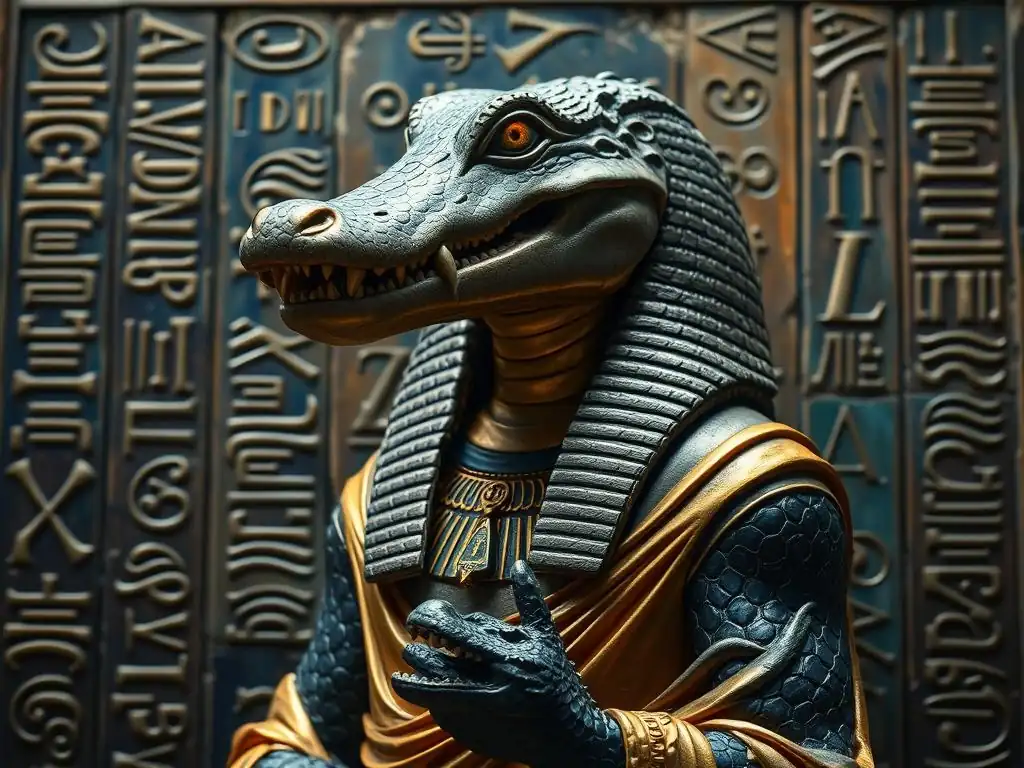
The Nile crocodile, a powerful and dangerous predator inhabiting the vital waterway of Egypt, held a complex and often fearful place in Egyptian sacred animal symbolism. Its raw power and potential for destruction led to its association with the god Sobek, a deity embodying the power of the Nile, fertility, and sometimes, royal authority and military prowess. While feared, the crocodile was also respected, and worshipping Sobek was believed to offer protection from the very dangers the animal represented.
Sobek was often depicted as a crocodile or a man with a crocodile head. His main cult center was at Crocodilopolis (ancient Shedet) in the Faiyum region, where live crocodiles were kept in temple pools, adorned with jewelry, and fed by priests as representatives of the god. These sacred crocodiles, like the Apis bulls, were believed to embody the spirit of the deity and were treated with great reverence.
Sobek: God of the Nile and Military Strength
Sobek was primarily associated with the Nile River, its waters, and its annual inundation, which brought fertility to the land. As such, he was seen as a god of fertility and vegetation. However, the crocodile's predatory nature also linked Sobek to power, strength, and aggression. He was sometimes invoked for military success and protection, reflecting the crocodile's formidable capabilities as a hunter.
In some myths, Sobek played a role in creation narratives, and he was also associated with the sun god Re (as Sobek-Re), further enhancing his divine status. His temples, particularly in the Faiyum and at Kom Ombo (which he shared with Horus), were significant centers of worship, illustrating the importance of appeasing and venerating the powerful forces he represented.
Crocodile Symbolism: Power, Fertility, and Protection
Crocodile symbolism in ancient Egypt was inherently dualistic, reflecting the animal's nature. It represented raw power and potential danger, yet also fertility and renewal due to its association with the life-giving Nile. Worshipping Sobek and venerating the sacred crocodile was a way of acknowledging and attempting to control these powerful forces. Amulets and depictions of crocodiles were used for protection, particularly against the dangers of the Nile itself.
The crocodile's ability to thrive in both water and on land, and its fearsome appearance, contributed to its image as a formidable deity capable of both destruction and protection. This complex symbolism highlights how the Egyptians perceived natural forces – as powerful entities that required respect, appeasement, and integration into their religious framework, forming a significant part of Egyptian sacred animal symbolism.
The Jackal: Anubis and the Afterlife
The jackal, or more likely the Egyptian wolf (Canis lupaster), was strongly associated with the afterlife and funerary practices in ancient Egypt, primarily through the god Anubis. Anubis was the god of mummification, embalming, cemeteries, and the guide of souls in the underworld. His connection to the jackal, an animal often seen prowling around desert cemeteries, likely arose from observations of jackals scavenging near tombs, leading to the belief that they were guardians of the dead or associated with the transition to the afterlife.
Anubis was almost always depicted as a jackal or a man with a jackal head, typically black, symbolizing decay and the rich fertile soil of the Nile, both connected to the cycles of life and death. His image is ubiquitous in tombs and funerary texts, underscoring his crucial role in the Egyptian beliefs about death and the journey to the next world.
Anubis: Guardian of the Dead and Embalming
Anubis played several vital roles in the Egyptian funerary process. He was the patron god of embalmers, overseeing the intricate and sacred ritual of mummification, which was believed to be essential for the deceased to have a successful afterlife. He was also the guardian of cemeteries and tombs, protecting them from desecration.
Perhaps his most famous role was in the Hall of Two Truths, where the heart of the deceased was weighed against the feather of Ma'at (truth). Anubis guided the soul to the scales and often supervised the weighing, ensuring fairness before Thoth recorded the result. If the heart was lighter than the feather, the deceased was deemed worthy to enter the afterlife; if heavier, it was devoured by the monster Ammit. This pivotal role cemented Anubis's importance in the Egyptian concept of judgment and salvation.
Jackal Imagery in Funerary Rituals
Jackal imagery was pervasive in Egyptian funerary rituals and art. Statues of Anubis as a seated jackal were often placed at the entrance to tombs or shrines within the burial complex, serving as divine guardians. Scenes of embalming and funerary processions frequently included depictions of priests wearing jackal masks, embodying Anubis as they performed the necessary rites.
The black color of Anubis and his associated jackal symbolized not only death and the underworld but also the fertile black soil (kemet) brought by the Nile flood, representing regeneration and rebirth – essential concepts in the journey through the afterlife. The presence of the jackal in funerary contexts reinforced the belief in Anubis's guidance and protection for the deceased, making the jackal a powerful and ever-present symbol within Egyptian sacred animal symbolism related to death and the afterlife.
The Scarab Beetle: Khepri and Rebirth
The scarab beetle (Scarabaeus sacer), specifically the dung beetle, held immense symbolic power in ancient Egypt, representing transformation, regeneration, and the cycle of the sun. This symbolism was linked to the god Khepri, a form of the sun god Re associated with the rising sun and creation. The Egyptians observed the dung beetle rolling balls of dung across the ground, depositing its eggs within them, and from which new life would emerge. This act was likened to the sun god rolling the solar disc across the sky each day, bringing light and life, and his rebirth each morning.
Khepri was often depicted as a scarab beetle, a man with a scarab beetle for a head, or simply a scarab beetle pushing the solar disc. The scarab became one of the most enduring and recognizable symbols of ancient Egypt, central to Egyptian sacred animal symbolism concerning life, death, and rebirth.
Khepri: God of the Rising Sun and Transformation
Khepri embodied the concept of spontaneous creation and the daily rebirth of the sun. He represented the morning sun, emerging anew from the horizon each day, just as the beetle emerged from the dung ball. This powerful metaphor for regeneration made Khepri a significant deity, particularly in beliefs surrounding the afterlife, where the deceased hoped for rebirth and continued existence.
As a manifestation of Re, Khepri was integral to the solar cycle, which was fundamental to Egyptian cosmology. The daily journey of the sun across the sky was seen as a struggle against the forces of chaos, and Khepri's role in its rising symbolized victory and the renewal of order. His connection to transformation extended to the deceased, who sought to transform their earthly body into an akh, a blessed spirit capable of traversing the afterlife.
Scarab Amulets: Symbols of Regeneration
Scarabs were incredibly popular as amulets and seals throughout Egyptian history. Carved from stone, faience, or precious metals, they were inscribed on the flat underside with names, titles, prayers, or decorative motifs. Scarab amulets were worn by the living for protection and good fortune, symbolizing life, health, and regeneration.
In funerary contexts, scarabs were particularly important. Heart scarabs, often larger and inscribed with a specific spell (Chapter 30B of the Book of the Dead), were placed on the chest of the mummy. This spell implored the heart not to testify against the deceased during the judgment in the Hall of Two Truths, ensuring a favorable outcome. The scarab's symbolism of rebirth was intended to aid the deceased's transition into the afterlife, making it a powerful tool in overcoming death and achieving eternal life, a key element in Egyptian sacred animal symbolism related to the afterlife.
Lesser-Known Sacred Animals and Their Meanings
The Hippopotamus: Taweret and Protection During Childbirth
While crocodiles represented the dangerous aspects of the Nile, the hippopotamus held a more complex place in Egyptian sacred animal symbolism. Though also capable of immense destruction, the female hippopotamus was associated with Taweret, a benevolent goddess of childbirth, fertility, and protection of women and children. Taweret was depicted as a composite creature, primarily a pregnant hippopotamus standing upright, with the paws of a lion and the tail of a crocodile.
Her fearsome appearance was intended to ward off evil spirits and demons that might harm mothers or infants during the vulnerable time of pregnancy and birth. Amulets of Taweret were widely used by women, and her image appeared on beds and headrests, signifying her role as a protector of the home and family. This highlights how even potentially dangerous animals could be integrated into the religious system as symbols of protection and divine aid.
The Falcon: Horus and Kingship
The falcon, particularly the Peregrine falcon (Falco peregrinus) and the Lanner falcon (Falco biarmicus), was a powerful symbol of kingship, the heavens, and the sun, embodying crucial aspects of Egyptian sacred animal symbolism. Its ability to soar high into the sky linked it to the celestial realm and solar deities. The most prominent association was with the god Horus, one of the oldest and most important Egyptian deities, who was often depicted as a falcon or a man with a falcon head.
Horus was the god of the sky, war, and protection, and most significantly, the divine patron of kingship. The reigning pharaoh was considered the living embodiment of Horus, establishing a direct link between the divine realm, the animal world, and earthly rule. The Eye of Horus, a powerful protective amulet, is also derived from falcon imagery. This deep connection between the falcon, Horus, and the pharaoh underscored the divine legitimacy of the king's power.
The cobra, specifically the Egyptian cobra (Naja haje), was a potent symbol of royalty, protection, and divine authority in ancient Egypt, forming a key part of Egyptian sacred animal symbolism. Its ability to rear up and strike with deadly venom made it a fearsome creature, embodying protective power. The cobra was primarily associated with the goddess Wadjet, the patron deity of Lower Egypt (the North).
Wadjet was often depicted as a cobra, sometimes winged, or as a woman with a cobra head. Her image, known as the uraeus, a rearing cobra, became a prominent symbol worn on the headdresses of pharaohs and deities, positioned on the forehead. The uraeus symbolized the king's divine authority and Wadjet's protection, ready to strike down the pharaoh's enemies with divine fire. This powerful emblem reinforced the king's status as divinely appointed ruler and protector of Egypt.
The Vulture: Nekhbet and Upper Egypt's Patronage
Complementing the cobra of Lower Egypt, the vulture, specifically the Egyptian vulture (Neophron percnopterus), was the symbolic animal of Nekhbet, the patron goddess of Upper Egypt (the South). Nekhbet was often depicted as a vulture, sometimes with outspread wings, or as a woman wearing a vulture headdress. Along with Wadjet, she was one of the "Two Ladies," representing the unification of Egypt and the duality of the kingdom.
Nekhbet was a protective deity, particularly associated with the king. Her image often appeared alongside the uraeus on royal regalia, symbolizing the protection of both Upper and Lower Egypt under the pharaoh's rule. The vulture's association with Nekhbet also linked it to motherhood and nurturing, contrasting with its scavenging habits in nature. Like the cobra, the vulture was a powerful emblem of divine protection and royal legitimacy within Egyptian sacred animal symbolism.
The Role of Sacred Animals in Egyptian Religion and Rituals
Animal Mummification: Honoring the Gods
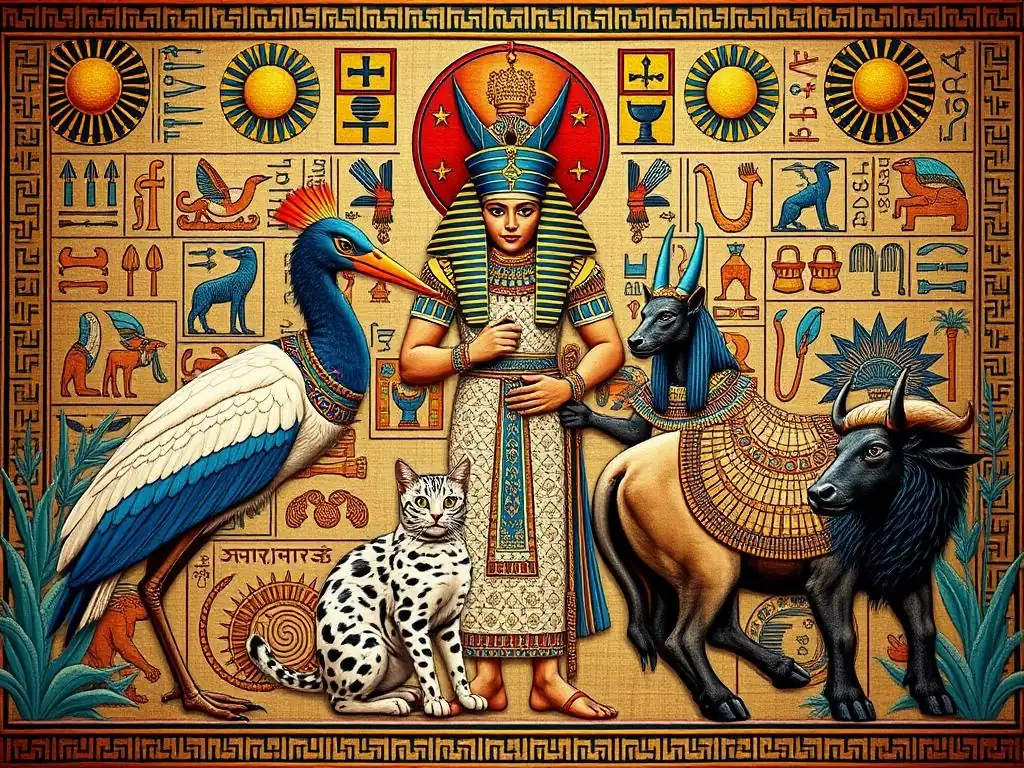
One of the most striking manifestations of Egyptian sacred animal symbolism was the widespread practice of animal mummification. Millions of mummified animals, ranging from cats and ibises to crocodiles, falcons, and even shrews, have been discovered in vast catacombs across Egypt. These were not the beloved pets of the deceased, although pet mummification also occurred, but rather votive offerings to the gods.
Pilgrims would purchase mummified animals from temple vendors to present to the deity associated with that animal, hoping to gain divine favor or fulfill a vow. For example, mummified ibises were offered to Thoth, cats to Bastet, and falcons to Horus. This practice grew significantly in the Late Period and Ptolemaic era, becoming a major industry centered around temple complexes. The sheer scale of these animal burials underscores the deep religious significance attributed to these creatures and their role as intermediaries between humans and the divine.
Animal Cults: Dedicated Worship of Specific Animals
Beyond individual offerings, some animals were the focus of dedicated cults, where specific living animals were selected as embodiments of a deity and housed in temples, attended by priests. The most famous examples are the Apis bull at Memphis and the Mnevis bull at Heliopolis, but sacred crocodiles were kept at Faiyum, and sacred rams at Mendes. These animals were treated with immense reverence, living lives of privilege within the temple precincts.
These cults involved complex rituals, processions, and festivals centered around the sacred animal. Their well-being was seen as crucial to the prosperity of the land and the favor of the associated deity. Upon the death of a sacred animal, a period of mourning was observed, followed by elaborate mummification and burial rituals, and the search for a successor. These animal cults demonstrate the Egyptians' belief that the divine could manifest directly in the animal form, making these creatures living idols within Egyptian sacred animal symbolism.
The Relationship Between Animals and Pharaohs
The relationship between animals and the pharaoh was deeply symbolic and integral to the concept of kingship in ancient Egypt. The pharaoh was often depicted alongside or in the form of powerful animals that symbolized royal authority, strength, and divine protection. The most prominent example is the association of the pharaoh with the falcon god Horus, with the king being considered the living embodiment of Horus on earth.
Other animal symbols frequently linked to the pharaoh included the lion (representing strength and power, often shown trampling enemies), the bull (symbolizing vigor and fertility, seen in the Sed festival), and the uraeus cobra and vulture (symbolizing the protection of Lower and Upper Egypt). These associations reinforced the pharaoh's divine legitimacy, his role as protector of Egypt, and his connection to the powerful forces of the cosmos, illustrating the vital intersection of kingship and Egyptian sacred animal symbolism.
The Decline of Animal Worship in Egypt
The Influence of Christianity and Islam
The long-standing traditions of Egyptian sacred animal symbolism and animal worship gradually declined with the rise and spread of monotheistic religions in Egypt. Christianity, which began to gain significant traction in Egypt during the Roman period (1st-4th centuries CE), explicitly rejected the veneration of animals or any form of polytheism. Early Christian writers and missionaries actively campaigned against pagan practices, including animal cults, viewing them as idolatry.
Following the Arab conquest in the 7th century CE, Islam became the dominant religion. Like Christianity, Islam is strictly monotheistic and prohibits the worship of creatures. While animals are respected in Islam, they are not considered divine intermediaries or worshipped. The establishment of Coptic Christianity and later Islam as the primary faiths led to the dismantling of the traditional Egyptian temple system, the decline of the priesthoods, and the eventual cessation of large-scale animal cults and mummification practices.
The Legacy of Egyptian Sacred Animal Symbolism
Despite the decline of active animal worship, the rich legacy of Egyptian sacred animal symbolism did not entirely disappear. The iconic images of Egyptian animals – the scarab, the uraeus, the Eye of Horus – persisted as powerful cultural symbols, even after their direct religious context faded for much of the population. These symbols influenced later art, architecture, and even magical traditions.
Furthermore, the extensive archaeological evidence left behind, from monumental temple carvings and tomb paintings to millions of mummified animals and countless amulets, continues to inform our understanding of ancient Egyptian beliefs. Modern scholarship allows us to reconstruct the complex relationship between the Egyptians, their environment, their gods, and the animals they held sacred, ensuring that the fascinating world of Egyptian sacred animal symbolism remains a subject of study and admiration millennia later.
Conclusion: The Enduring Power of Egyptian Animal Symbolism
The animals of ancient Egypt were far more than just fauna; they were living embodiments of divine power, symbols of cosmic forces, and integral components of the religious and social fabric. From the protective cat of Bastet and the powerful bull of Apis to the wise ibis of Thoth and the fearsome crocodile of Sobek, each creature held specific meanings within the intricate system of Egyptian sacred animal symbolism. This symbolism permeated every aspect of life, from daily interactions and household protection to elaborate temple rituals, funerary practices, and the very concept of kingship.
While the specific cults and practices faded with the rise of new religions, the visual language and conceptual framework established by Egyptian sacred animal symbolism have left an indelible mark on history. The enduring fascination with these animal-headed gods and their sacred counterparts speaks to the profound connection the ancient Egyptians felt with the natural world and their ability to see the divine reflected in the creatures around them. Their legacy continues to shape our understanding of this remarkable civilization and the deep spiritual significance they attributed to the animal kingdom.
Frequently Asked Questions
What role did sacred animals play in ancient Egyptian religion?
Sacred animals were seen as manifestations of specific deities and were worshiped as earthly representatives of those gods. They served as intermediaries between the divine and human realms.
How did the Egyptians choose which animals were considered sacred?
The selection process varied, but often involved observing specific physical characteristics or behaviors believed to mirror a particular god's attributes. Sometimes, rare or unique individuals of a species were chosen.
Were all animals of a specific species considered sacred in ancient Egypt?
Not necessarily. While certain species were associated with a deity, it was often specific individual animals that were treated as sacred. These animals were often raised in temples and cared for.
What happened to sacred animals after they died in ancient Egypt?
After death, sacred animals were often mummified with great care and buried in dedicated animal cemeteries. This practice showed the respect and reverence held for these divine symbols.
What can Egyptian sacred animal symbolism tell us about their culture and beliefs?
The use of sacred animals reveals the Egyptians' deep connection to nature and their belief in the interconnectedness of the divine and the natural world. It reflects their complex religious system and values.
Final Reflection: The Enduring Legacy of Egypt's Sacred Animals
The intricate relationship between ancient Egyptians and their sacred animals remains profoundly relevant today, a testament to the enduring power of symbolism and the human need to connect with the divine. Understanding these symbolic connections offers a window into a complex civilization and its sophisticated spiritual beliefs, revealing surprising parallels with modern spiritual and environmental concerns. The reverence shown to these animals speaks volumes about the ancient Egyptian worldview and its lasting impact on our understanding of mythology and religious expression.
The influence of Egyptian sacred animal symbolism continues to ripple through our culture, shaping our artistic expressions, influencing our understanding of mythology, and even subtly informing our modern environmental consciousness. The very act of studying these creatures—from the majestic falcon representing Horus to the protective power of the scarab beetle—forces us to confront our own relationship with the natural world and the spiritual significance we ascribe to it. The gods are not far off, but are near to us, in the animals, in the plants, in the stones.
This sentiment, though not directly from ancient Egypt, perfectly encapsulates the deeply interwoven relationship between the divine and the natural world that the Egyptians so powerfully embodied.
Consider the enduring power of these symbols. You, the reader, now possess a deeper understanding of the rich tapestry of ancient Egyptian belief. Take this knowledge and apply it to your own life. Reflect on the symbols that resonate with you, the animals that hold personal meaning. Explore the ways in which we continue to imbue animals with symbolic significance in our own time. By understanding the past, we can better appreciate the present and shape a more meaningful future, one where the connection between humanity and the natural world is once again revered and protected.
Unveil Your Inner Egyptian: Discover the Power of Sacred Animals
Thank you for exploring the fascinating world of sacred animals in ancient Egypt! We hope you gained a deeper appreciation for the rich symbolism and spiritual significance woven into their divine forms. Now it's time to take that knowledge further.
- Dive deeper into a specific animal: Choose one that resonated with you most and research its unique mythology and symbolism. Explore its artistic representations and cultural impact. This will allow you to truly understand its multifaceted significance.
- Share your newfound knowledge: Discuss your favorite sacred animal and its meaning with friends and family. Engage in conversation and spread the wonder of ancient Egyptian beliefs.
- Create your own symbolic artwork: Inspired by the imagery you've discovered, try creating a piece of art – a drawing, painting, or even a digital design – featuring your chosen sacred animal. This is a powerful way to personalize your learning.
Ready to unlock the hidden messages within these powerful symbols? What animal speaks most powerfully to you and why?