
The Ogdoad: Primordial Beings Before the Egyptian Gods

Welcome, seeker of ancient lore! Prepare to journey beyond the familiar pantheon and delve into the mysteries that existed before the gods themselves. We unveil the enigmatic world of Egyptian primordial beings myths, starting with the Ogdoad – eight entities of chaos and potential from which all of creation sprang. Are you ready to unravel the secrets of the void and discover the forces that shaped the very fabric of Egyptian mythology? Let the exploration begin...
- The Ogdoad of Hermopolis: Primordial Deities of Creation
- Introduction to the Ogdoad: Unveiling Ancient Egyptian Creation Myths
- The Eight Primordial Gods of the Ogdoad: A Detailed Overview
- The Creation Myth: How the Ogdoad Gave Rise to the World
- The Ogdoad's Representation and Symbolism
- Contrasting the Ogdoad with Later Egyptian Gods
- The Legacy of the Ogdoad in Ancient Egyptian Culture
- Exploring Variations in Egyptian Primordial Beings Myths
- Conclusion: The Enduring Importance of the Ogdoad
-
Frequently Asked Questions
- ### What is the Ogdoad, and what role did they play in Egyptian mythology?
- ### What characteristics defined the male and female pairs within the Ogdoad?
- ### How did the Ogdoad contribute to the creation myth of ancient Egypt?
- ### Where did the Ogdoad reside, according to ancient Egyptian beliefs?
- ### What happened to the Ogdoad after the creation of the world and the emergence of the gods?
- Final Reflection: Echoes of Creation in the Sands of Time
- Unveil the Secrets of the Ogdoad: Dive Deeper into Ancient Egyptian Creation
The Ogdoad of Hermopolis: Primordial Deities of Creation
Introduction to the Ogdoad: Unveiling Ancient Egyptian Creation Myths
Understanding the Significance of the Ogdoad in Hermopolitan Cosmology
The Ogdoad represents one of the most ancient and profound concepts within the tapestry of Egyptian primordial beings myths. Originating primarily from Hermopolis (modern El Ashmunein), this group of eight deities embodies the chaotic, formless state that existed before the ordered cosmos came into being.
Unlike later, more anthropomorphic pantheons focused on solar or earthly domains, the Ogdoad personifies the fundamental elements of this pre-creation void, providing a foundational layer to understanding how ancient Egyptians conceived of the universe's origins. Their significance lies in defining the conditions from which the first tangible form, often the primeval mound or the sun god, arose.
This cosmogony, centered around the Ogdoad, offers a distinct perspective compared to other major Egyptian creation narratives, such as those from Heliopolis or Memphis. While other myths might focus on a single creator god's actions, the Hermopolitan tradition emphasizes the inherent qualities of the pre-existent state itself, personified by these eight beings. They are not creators in the sense of actively shaping the world but rather the stuff or conditions out of which creation spontaneously emerged. Studying the Ogdoad is crucial for grasping the diversity and complexity of ancient Egyptian thought regarding the ultimate beginnings.
The Role of Primordial Deities in the Formation of the World
The Ogdoad deities played a passive yet essential role in the formation of the world according to the Hermopolitan myths of Egyptian primordial beings. They represented the four key characteristics of the state before creation: the watery abyss (Nu/Naunet), boundless space (Heh/Hauhet), darkness (Kuk/Kauket), and hiddenness or invisibility (Amun/Amaunet). These pairs, male and female counterparts representing the same principle, existed together in a state of inertia and potential.
From this interaction and presence of the Ogdoad within the Nun (the primordial waters), the potential for existence coalesced. The myths suggest that their combined essence or activity somehow stirred the Nun, leading to the emergence of the primeval mound (the benben) from the waters. On this mound, the first act of self-creation occurred, typically attributed to the sun god Atum or Ra. Thus, the Ogdoad didn't sculpt the world but provided the necessary, pre-existing environment for creation to spring forth, acting as the cosmic womb from which order was born.
The Eight Primordial Gods of the Ogdoad: A Detailed Overview
Nu and Naunet: The Primordial Waters of Chaos
Nu (or Nun) and Naunet embody the primordial, formless waters of chaos that existed before the ordered universe. Nu represents the male aspect of this watery abyss, often depicted as the inert, boundless expanse from which everything originated. Naunet is his female counterpart, personifying the same concept but emphasizing the fluid, potential nature of this chaos. Together, they are the source, the cosmic ocean that enveloped everything before the first land or sky appeared.
These deities are fundamental to all Egyptian creation myths, not just the Hermopolitan one, but the Ogdoad tradition gives them a central place as part of the eight foundational principles. They represent not just water, but the absence of distinction, form, and boundary – the state of absolute nothingness and yet infinite potential. Their presence was eternal, the baseline reality before the divine spark or the primeval mound emerged.
Heh and Hauhet: Infinity and Boundlessness
Heh and Hauhet represent the concept of infinite space and boundless duration. Heh is the male deity, often depicted holding up the sky or embodying endless time and space. Hauhet is his female counterpart, reinforcing the notion of limitlessness in all directions and throughout eternity. They personify the sheer expanse and unending nature of the primordial void.
Within the context of the Ogdoad and Egyptian primordial beings myths, Heh and Hauhet define the scope of the pre-creation state. They indicate that the Nun was not just water but an infinitely vast and eternal ocean. Their presence underscores the magnitude of the task of creation – bringing order to something so immense and unending. They are also associated with the concept of millions of years (the Heh-number), linking the primordial state to the vastness of cosmic time.
Kuk and Kauket: Darkness and Obscurity
Kuk and Kauket embody the primordial darkness and obscurity that filled the chaotic void. Kuk is the male deity of this darkness, representing the absence of light and visibility. Kauket is his female counterpart, emphasizing the hidden, unseen nature of the pre-creation state. Together, they are the negation of light and form, the state where nothing could be perceived or distinguished.
These deities highlight the lack of definition and clarity in the primordial realm. Before the sun god or any source of light appeared, the universe was shrouded in absolute darkness. Kuk and Kauket represent this fundamental characteristic, a state of mystery and the unknown. In the myths of Egyptian primordial beings, their presence signifies the transition that creation brings – moving from a state of absolute darkness to one illuminated by the sun.
Amun and Amaunet represent the principle of hiddenness, invisibility, and mystery. Amun, the male deity, signifies that which is concealed or unknown, the hidden potential within the void. Amaunet, his female counterpart, reinforces this concept of the unseen and the inaccessible nature of the primordial state. They are the most enigmatic pair within the Ogdoad.
In the Hermopolitan cosmogony, Amun and Amaunet point to the mysterious, perhaps even spiritual, quality of the pre-creation state. They suggest that within the chaos of water, space, and darkness lay a hidden power or essence that would eventually facilitate creation. Later, Amun would rise to become a prominent state god, particularly in Thebes, absorbing aspects of other deities. However, in the context of the Ogdoad, he and Amaunet are purely primordial, representing the inaccessible, potent secret residing within the Nun.
The Creation Myth: How the Ogdoad Gave Rise to the World
The Mound of Creation: Emergence from the Waters of Chaos
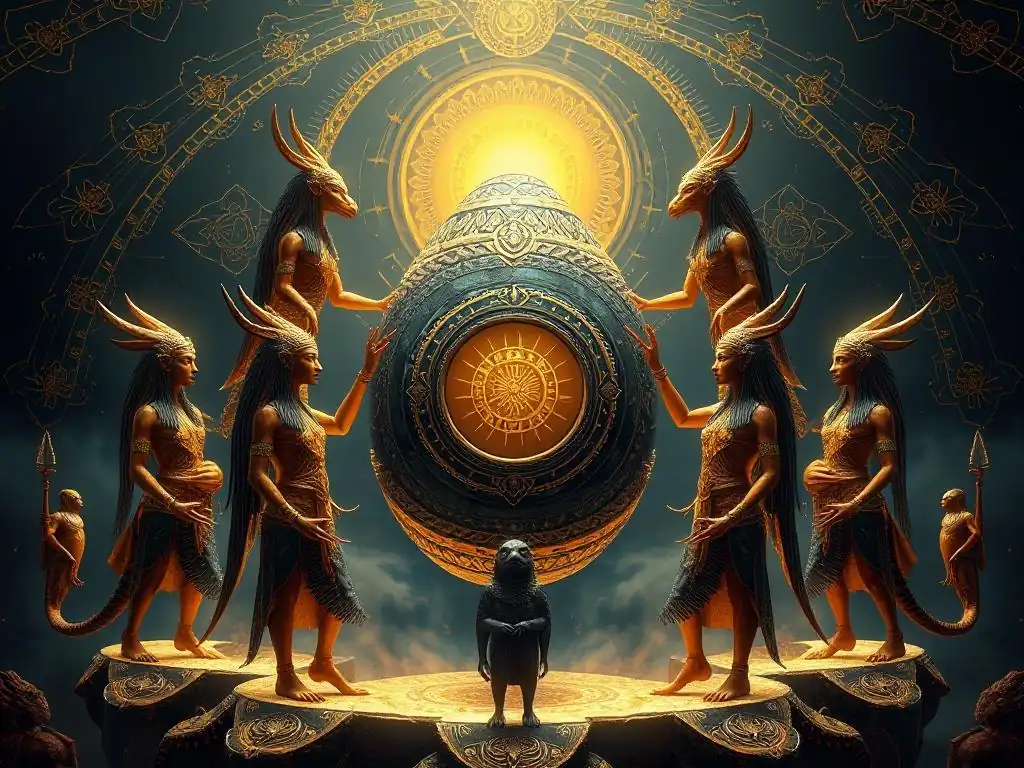
According to the Hermopolitan account of Egyptian primordial beings myths, the interaction and presence of the Ogdoad within the Nun somehow caused a significant event: the spontaneous emergence of the primeval mound, known as the benben. This mound is the first solid ground, the initial point of stability and form to rise from the formless, chaotic waters. It represents the transition from the potential of the Nun to the reality of existence.
The emergence of the benben is a critical turning point in this creation narrative. It provides the necessary platform for the next stage of creation to occur. While the Ogdoad represents the conditions before creation, the mound is the first result of those conditions. It is the island of order appearing in the ocean of chaos, a recurring motif in Egyptian thought, symbolizing the fertile land emerging from the annual Nile floodwaters.
Atum's Role: Self-Creation and the Beginning of Order
Upon the primeval mound, the solar deity Atum (or sometimes Ra-Atum) performed the crucial act of self-creation. Having somehow come into being within the Nun or on the mound, Atum, as the sole conscious entity, willed himself into existence. This act marked the true beginning of ordered creation. Lacking a partner, Atum created the first pair of gods, Shu (air) and Tefnut (moisture), typically by spitting, sneezing, or masturbating, depending on the version of the myth.
Atum's self-creation and the subsequent generation of Shu and Tefnut mark the establishment of the Ennead, the nine deities centered around Atum in the Heliopolitan cosmogony. This shows how the Ogdoad myth of Hermopolis can connect to and provide the foundation for other, later creation narratives. Atum represents the active principle of creation, bringing forth the elements and subsequent generations of gods that will form the sky, earth, and ultimately, humanity.
The Ogdoad's Retreat: From Active Creation to Passive Existence
Once creation began with the emergence of the mound and Atum's actions, the active "role" of the Ogdoad in the creation process seemingly ceased. Having provided the initial conditions and perhaps the impetus for the mound's rise, these primordial beings receded from the forefront of cosmic activity. They returned, in a sense, to a state of passive existence within the deep, dark, boundless, hidden waters – the Nun.
However, their presence was still considered essential. The Nun, with the Ogdoad dwelling within it, was believed to surround the ordered cosmos, representing the ever-present possibility of a return to chaos. The Ogdoad were sometimes thought to reside in the underworld or a subterranean realm, maintaining the boundary between the structured world and the formless void. Their retreat signifies the establishment of order (Ma'at) from chaos (Isfet), with the Ogdoad embodying the latter, now contained but still existing.
The Ogdoad's Representation and Symbolism
Frog and Snake Deities: Iconography of the Primordial Gods
The most common and distinctive iconography for the Ogdoad deities depicts the male gods as frogs and the female goddesses as snakes. Nu, Heh, Kuk, and Amun are typically shown with frog heads or as full frogs. Naunet, Hauhet, Kauket, and Amaunet are shown with snake heads or as full snakes. This visual representation is strongly linked to their primordial, watery, and hidden nature.
Frogs were associated with fertility, regeneration, and the chaotic, life-giving waters of the Nile flood, which emerged from the primordial Nun. Snakes were often linked to the earth, the underworld, hidden places, and cyclical renewal (shedding skin). These forms were seen as creatures belonging to the liminal spaces – the mud, the water's edge, the dark earth – perfectly embodying the deities of the chaotic, undefined beginning in Egyptian primordial beings myths.
Symbolic Meanings Associated with Each Deity in the Ogdoad
Each pair within the Ogdoad carried specific symbolic weight reflecting the characteristics of the primordial state.
- Nu and Naunet: Symbolized the unformed, potential-filled watery abyss, the source of all existence.
- Heh and Hauhet: Represented boundless space and infinite time, the sheer scale of the pre-creation void.
- Kuk and Kauket: Embodied the absolute darkness and obscurity, the absence of light and visibility.
- Amun and Amaunet: Signified hiddenness, mystery, and the unseen, potent force within the chaos.
These symbolic meanings collectively paint a picture of a state that was vast, dark, hidden, and formless, yet contained the fundamental potential for life and order. The duality of male and female within each pair underscores the idea that even in this chaotic state, the basic principles of existence were inherently balanced and complete within themselves.
Hermopolis: The City of the Eight and its Religious Significance
Hermopolis Magna (modern El Ashmunein) was the primary cult center for the Ogdoad. Its Egyptian name, Khemenu (or Khnumu), translates to "City of the Eight," a direct reference to these primordial deities. Archaeological evidence from the site, though often fragmented due to the city's long history and subsequent use as a quarry, includes temple remains dedicated to Thoth, the patron deity of Hermopolis, who was sometimes associated with the wisdom that emerged from the primordial state or even seen as orchestrating the Ogdoad's actions.
The religious significance of Hermopolis lay in its role as the presumed location where the primeval mound first rose from the Nun. Pilgrims and priests would have regarded this site as the very birthplace of the cosmos according to this specific tradition of Egyptian primordial beings myths. While the site's temples saw renovations and expansions throughout various periods, from the Old Kingdom through the Ptolemaic and Roman eras, its identity as the "City of the Eight" remained central to its religious importance, solidifying its place in the geography of Egyptian creation narratives.
Contrasting the Ogdoad with Later Egyptian Gods
Primordial vs. Solar Deities: Differences in Power and Influence
A significant contrast exists between the Ogdoad and later, more prominent Egyptian pantheons, particularly those centered around solar deities like Ra or Amun-Ra. The Ogdoad represents the state of existence before order, embodying passive, fundamental principles (water, space, darkness, hiddenness). Their power is inherent in their being the conditions of chaos, not in actively ruling or interacting with the created world in the same way later gods do.
Solar deities, conversely, are active creators, rulers, and sustainers of the cosmos. Ra sails across the sky, bringing light and time; Amun-Ra becomes king of the gods, involved in human affairs and cosmic order. Their power is dynamic and manifest within the created world, while the Ogdoad's power is static and lies in the potential of the pre-existent state. This difference highlights an evolution in Egyptian religious thought, moving from abstract primordial concepts to more personified, interactive divine figures.
The Ogdoad's Influence on the Ennead of Heliopolis
Despite originating from different cities, the Hermopolitan Ogdoad and the Heliopolitan Ennead are often seen as complementary or sequentially related in Egyptian primordial beings myths. The Ennead, headed by Atum (or Ra-Atum), describes the first nine gods who emerged from the single creator god and established the basic structure of the cosmos (air, moisture, earth, sky, etc.). The Ogdoad, however, provides the context for Atum's self-creation – the chaotic void from which he emerged.
In some interpretations or syncretic versions of myths, the Ogdoad's stirring of the Nun is what leads to Atum's appearance on the primeval mound, which is the starting point for the Ennead. Thus, the Ogdoad can be viewed as the necessary precursor to the Ennead's existence. They are the 'parents' of the environment from which the first active creator god arises, demonstrating how different regional myths could be integrated or understood within a larger theological framework.
The Evolution of Egyptian Religious Beliefs: From Chaos to Order
The shift in emphasis from the Ogdoad to later pantheons reflects a broader evolution in ancient Egyptian religious beliefs – a move from contemplating the abstract, chaotic origins of the universe to focusing on the maintenance and interaction of the ordered cosmos. Early thought, as seen in the Ogdoad, grappled with the fundamental nature of the pre-creation state. Later periods saw the rise of complex pantheons involved in kingship, cosmic cycles, justice (Ma'at), and the afterlife.
While the Ogdoad never disappeared entirely from theological texts or temple inscriptions, their role became more symbolic of the primordial past and the ever-present potential of chaos. The focus shifted to gods who actively upheld Ma'at against the forces of Isfet (chaos), personified by deities like Ra, Osiris, Isis, and Horus. This evolution demonstrates the dynamic nature of Egyptian religion, adapting and building upon earlier concepts like the Egyptian primordial beings myths to address changing societal and theological concerns over millennia, from the Old Kingdom through the New Kingdom and beyond.
The Legacy of the Ogdoad in Ancient Egyptian Culture
The Ogdoad in the Pyramid Texts and Coffin Texts
References to the primordial watery abyss (Nun) and sometimes allusions to pairs of primordial forces can be found in some of the earliest religious texts, such as the Pyramid Texts (dating back to the Old Kingdom, circa 24th-23rd centuries BCE) and the Coffin Texts (Middle Kingdom, circa 21st-18th centuries BCE). While explicit, detailed accounts of the specific Ogdoad of Hermopolis with all eight named deities are more prominent in later periods, these earlier texts certainly lay the groundwork by acknowledging the pre-existent chaotic state.
For example, the Pyramid Texts frequently mention Nun as the source from which the king ascends to the sky or as the realm surrounding the cosmos. The Coffin Texts further elaborate on creation themes, sometimes mentioning primeval deities or states. These early references indicate that the fundamental concepts embodied by the Ogdoad – the primordial waters, darkness, etc. – were deeply ingrained in Egyptian thought from very early times, providing a continuous thread connecting the myths of Egyptian primordial beings across different historical periods.
The Ogdoad's Impact on Egyptian Art and Architecture in Hermopolis
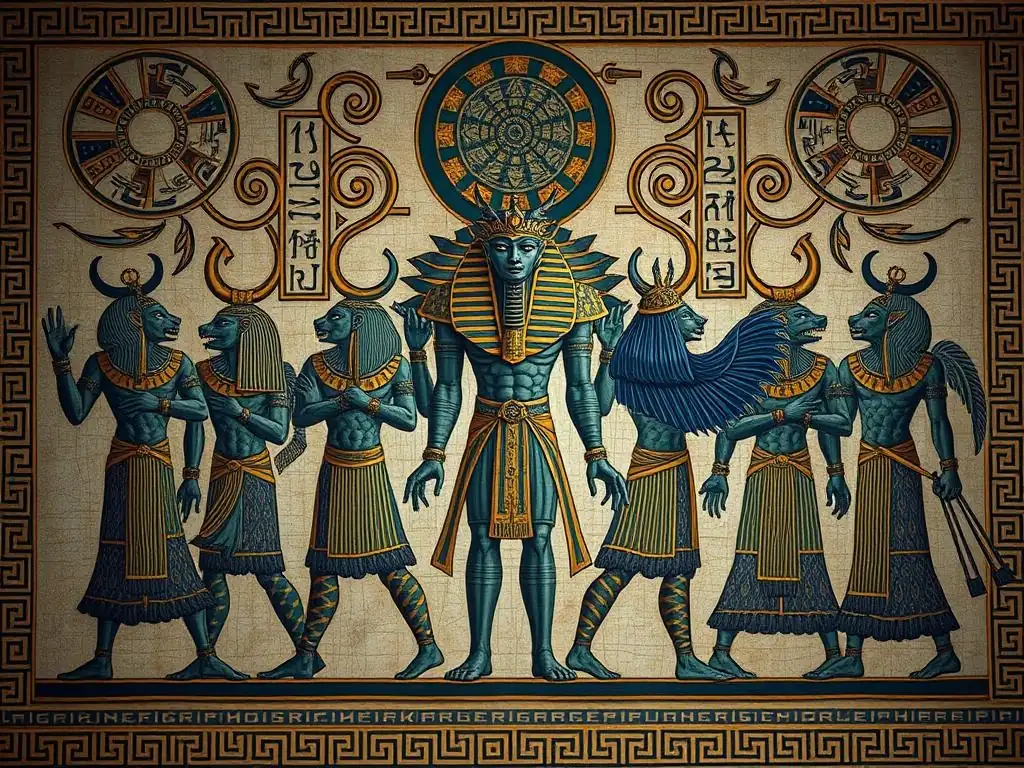
The most direct impact of the Ogdoad on Egyptian art and architecture is found at their cult center, Hermopolis. Although much of the ancient city is ruined, remnants of temples dedicated to Thoth, often associated with the Ogdoad cosmogony, have been excavated. These temples would have housed depictions and inscriptions related to the city's creation myth, potentially including representations of the Ogdoad figures themselves, likely in their frog and snake forms, or perhaps anthropomorphized.
While specific, well-preserved depictions of the full Ogdoad from Hermopolis are less common than images of major state gods from sites like Karnak or Luxor, textual evidence from temple walls and stelae at Hermopolis and other locations confirms their significance in the city's religious landscape. The very layout and orientation of temples in Hermopolis might have been influenced by the cosmogony, potentially reflecting the symbolic geography of the primeval mound emerging from the waters, anchoring the city's identity to these ancient Egyptian primordial beings myths.
The Ogdoad's Enduring Symbolism in Modern Interpretations of Egyptian Mythology
Even in modern interpretations and studies of Egyptian mythology, the Ogdoad retains significant symbolic importance. They represent the universal concept of a primordial state of chaos or potential from which order arises, a theme found in many world mythologies. Scholars and enthusiasts study the Ogdoad to understand the depth and complexity of ancient Egyptian cosmology beyond the more popular deities.
The frog and snake symbolism continues to be recognized as uniquely tied to these earliest concepts of divinity. The Ogdoad serves as a reminder that Egyptian religion was not monolithic but comprised diverse traditions and layers of belief, with some myths delving into profound philosophical ideas about existence, non-existence, and the transition between them. Their study provides crucial insight into the foundational layers of Egyptian thought regarding creation and the nature of the cosmos, enriching our understanding of these ancient Egyptian primordial beings myths.
Exploring Variations in Egyptian Primordial Beings Myths
Variations in Ogdoad Composition: Regional Interpretations
While the standard Ogdoad of Hermopolis consists of the eight deities Nu/Naunet, Heh/Hauhet, Kuk/Kauket, and Amun/Amaunet, there were sometimes minor variations in the composition or names of the pairs in different regional traditions or over time. For instance, in some lists, the pair Gereh and Gerehet, representing 'cessation' or 'completion', might appear instead of or alongside another pair, though this is less common than the standard eight.
These variations highlight the fluid nature of Egyptian theology, particularly in earlier periods or outside the major religious centers. Local priests and scribes might emphasize slightly different aspects of the primordial state or associate different names with the fundamental principles. However, the core concept of four male-female pairs embodying the characteristics of the pre-creation void remains consistent across most versions of the Hermopolitan tradition of Egyptian primordial beings myths.
Regional Variations in the Creation Narrative: Memphis and Heliopolis
The Ogdoad myth from Hermopolis is just one of several significant creation narratives in ancient Egypt, with prominent alternatives coming from Memphis and Heliopolis. The Memphite theology, recorded on the Shabaka Stone (though likely based on much older traditions), centers on the god Ptah. Ptah, as the ultimate creator, conceives the cosmos in his mind and brings it into being through his word, a more intellectual and theological creation process compared to the Ogdoad's primordial emergence.
The Heliopolitan cosmogony, centered around Atum and the Ennead, is perhaps the most widely known. As mentioned earlier, this myth begins with Atum's self-creation on the primeval mound emerging from the Nun. While it acknowledges the Nun, it focuses more on the lineage and actions of the first nine gods. These regional variations demonstrate that ancient Egypt did not have a single, universally accepted creation story but rather a collection of myths that reflected different theological perspectives and local traditions regarding Egyptian primordial beings myths and the origins of the cosmos.
How the Myths of the Ogdoad Evolved Over Time
The myths surrounding the Ogdoad, like much of Egyptian religion, were not static but evolved over time. While the core concept of the eight primordial deities remained tied to Hermopolis and the pre-creation state, their representation and theological context could shift. In the New Kingdom, for example, as Amun rose to national prominence, his association with the Ogdoad pair Amun and Amaunet was sometimes used to emphasize his ancient, hidden, and primordial nature, linking the great state god back to the very beginnings of time.
Later, during the Ptolemaic and Roman periods, when Egyptian religion interacted with Greek and Roman influences, attempts were sometimes made to rationalize or syncretize Egyptian myths. However, the Ogdoad largely retained its identity as the ancient, foundational deities of Hermopolis. Their continued presence in temple inscriptions from these later periods indicates their enduring importance as symbols of the primordial state, even as the dominant religious landscape changed, showing the remarkable longevity of these Egyptian primordial beings myths.
Conclusion: The Enduring Importance of the Ogdoad
Recap of the Ogdoad's Role in Ancient Egyptian Beliefs
The Ogdoad of Hermopolis played a fundamental role in one of ancient Egypt's key creation narratives. These eight deities – Nu/Naunet, Heh/Hauhet, Kuk/Kauket, and Amun/Amaunet – personified the chaotic, formless, and hidden state that existed before the ordered cosmos. They represented the primordial waters, infinite space, darkness, and invisibility, providing the essential, pre-existing conditions from which the first solid ground and the first active creator god emerged.
Their significance lies not in active creation but in embodying the potential and the raw material of existence. They are the background against which creation happens, the state of chaos (Isfet) from which order (Ma'at) is established. Understanding the Ogdoad is vital for appreciating the complexity and regional diversity of Egyptian religious thought, particularly regarding the ultimate origins of the universe according to these specific Egyptian primordial beings myths.
The Ogdoad as a Foundation for Later Egyptian Theology
The concepts embodied by the Ogdoad provided a crucial foundation for later developments in Egyptian theology. The idea of the Nun, the primordial waters, remained a constant throughout Egyptian history, seen as surrounding the cosmos and the source of the annual Nile flood. The emergence of the primeval mound from these waters is a motif found in various creation accounts, including the Heliopolitan one.
Furthermore, the Ogdoad's role as the state before creation highlights the Egyptian concept of Ma'at (order) constantly needing to be upheld against the forces of Isfet (chaos). The Ogdoad, representing the primordial chaos, remained a symbolic presence in the cosmic understanding, a reminder of the origins and the ever-present potential for disorder if Ma'at faltered. Thus, they were not just figures from a single creation myth but integral to the broader theological framework.
Why Study the Ogdoad? Understanding the Roots of Egyptian Mythology
Studying the Ogdoad is essential for anyone seeking a comprehensive understanding of ancient Egyptian mythology. They represent one of the earliest layers of Egyptian cosmological thought, offering insight into how Egyptians conceived of the absolute beginning. Their unique iconography (frog and snake forms) and abstract personifications of cosmic conditions provide a fascinating contrast to the more anthropomorphic deities of later periods.
Exploring the Ogdoad allows us to delve into the rich regional variations of Egyptian religion, specifically the traditions of Hermopolis. It helps demonstrate that Egyptian belief was not a single, monolithic system but a dynamic collection of interconnected ideas that evolved over millennia. Ultimately, understanding the Egyptian primordial beings myths of the Ogdoad provides a deeper appreciation for the complexity, antiquity, and philosophical depth of this ancient civilization's view of the cosmos.
Frequently Asked Questions
### What is the Ogdoad, and what role did they play in Egyptian mythology?
The Ogdoad were a group of eight primordial deities who existed before the creation of the world and the established Egyptian pantheon. They represented the formless state of chaos from which the universe emerged. Their role was to eventually give way to the sun god Ra, initiating the creation process.
### What characteristics defined the male and female pairs within the Ogdoad?
The male deities of the Ogdoad were typically depicted with frog heads, while the female deities were depicted with snake heads. These forms symbolized the primordial waters and earth from which all life originated. Their names often reflected their attributes, such as nothingness or darkness.
### How did the Ogdoad contribute to the creation myth of ancient Egypt?
The Ogdoad's existence represented the pre-creation state, a void of darkness and watery chaos. They eventually tired of their existence and brought forth the lotus flower, from which the sun god Ra emerged. This marked the beginning of the ordered cosmos.
### Where did the Ogdoad reside, according to ancient Egyptian beliefs?
The primary center of worship for the Ogdoad was in Hermopolis Magna, also known as Khemnu. It was believed that they dwelled in the primordial waters before creation and later retired to an island of fire after Ra's birth.
### What happened to the Ogdoad after the creation of the world and the emergence of the gods?
After their role in creation was fulfilled, the Ogdoad retreated to the Duat, the Egyptian underworld. Some accounts say they died and were buried, becoming the soil from which new life would spring. Their energy was believed to have returned to the primordial waters.
Final Reflection: Echoes of Creation in the Sands of Time
The Ogdoad, those eight primordial beings who predate even the familiar pantheon of Egyptian gods, remain a potent symbol of the enduring power of creation myths. Their influence resonates far beyond the dusty pages of ancient texts; they speak to our innate human desire to understand origins, to grapple with the mysteries of existence itself. The very act of seeking to understand these beings, to trace the threads of their narratives, is a testament to the enduring power of storytelling and its ability to shape our understanding of the world.
The Ogdoad's enduring legacy lies not just in their mythological significance, but in their reflection of humanity's ongoing quest for meaning. They represent the chaotic, formless void from which order emerges, a concept that continues to fascinate and inspire artists, writers, and thinkers today. Their influence can be seen in countless works of art, literature, and philosophy, all grappling with similar themes of creation, destruction, and the cyclical nature of time. The beginning is the end, and the end is the beginning.
This timeless sentiment, though not directly from ancient Egyptian texts, perfectly encapsulates the cyclical nature inherent in the Ogdoad's narrative and its enduring relevance.
Consider, for a moment, the power of these primordial beings. Their very existence challenges us to question our own assumptions about beginnings and endings, about order and chaos. You, the reader, are now invited to explore these concepts further.
Reflect on your own understanding of creation and the role of myth in shaping our worldview. What narratives resonate with you, and how do they influence your perception of the world around you? Let the echoes of the Ogdoad inspire you to delve deeper into the mysteries of existence, and to find your own answers within the rich tapestry of human storytelling.
Unveil the Secrets of the Ogdoad: Dive Deeper into Ancient Egyptian Creation
Thanks for exploring the fascinating world of the Ogdoad with us! We hope you gained a new appreciation for the complex mythology behind these primordial beings. Ready to delve even further into this enigmatic world?
- Craft your own Ogdoad interpretation: Visualize these powerful forces in your own way. Draw them, write a poem, or create a short story – let your imagination run wild! This is your chance to actively engage with the rich symbolism.
- Share your thoughts and discoveries: Join the discussion in the comments below! What resonated most with you about the Ogdoad? What new questions did it spark?
- Explore related articles on our site for a deeper understanding of ancient Egyptian creation myths.
What unexpected connections can you draw between the Ogdoad and other creation myths from around the world?