
The Temple of Hera at Samos: Myths of a Goddess's Power

Welcome, seeker of ancient truths!
Delve into the captivating world of Mythology and Legends, where we unearth the timeless tales that have shaped civilizations. Are you ready to explore the potent narratives surrounding one of the most revered goddesses of Olympus? Prepare to journey to the island of Samos and unravel the mysteries embedded within the very stones of the Hera temple Samos myths. What secrets does this ancient sanctuary hold, and how did it become a testament to Hera's enduring power? Let the exploration begin...
Introduction: Unveiling the Secrets of the Heraion of Samos
The island of Samos, nestled in the Aegean Sea, holds a place of profound significance in the mythology and religious practices of ancient Greece. Central to this significance is the Heraion, the sanctuary dedicated to the goddess Hera. This site was not merely a place of worship but a vibrant center where myths intertwined with daily life and grand architectural endeavors.
Exploring the secrets of the Heraion involves delving into layers of history, archaeology, and the rich tapestry of stories that define Hera's connection to this specific location. The myths surrounding the Hera temple on Samos offer invaluable insights into the perceived power and character of one of the most important goddesses in the Greek pantheon.
For centuries, the Heraion of Samos was one of the largest and most revered sanctuaries in the Greek world. Its origins are lost in the mists of time, stretching back to the Geometric period, long before the monumental structures for which it became famous were erected. Archaeological evidence suggests continuous cult activity at the site from as early as the 8th century BCE.
The sheer scale of the later temples, particularly the massive structure commissioned by the tyrant Polycrates in the 6th century BCE, speaks volumes about the wealth, ambition, and deep devotion directed towards Hera by the Samians. This dedication was fueled by the powerful myths associated with the goddess and her purported birth and marriage on the island.
- What is the Temple of Hera at Samos best known for?
- Which myths are specifically connected to the Temple of Hera at Samos?
- How did the Temple of Hera at Samos influence the surrounding society?
- What archaeological evidence supports the existence of the Hera Temple at Samos?
- Why is understanding "Hera temple Samos myths" important today?
Hera's Role in the Olympian Pantheon
Hera held a paramount position within the Olympian pantheon, primarily recognized as the queen of the gods and the wife of Zeus, the king. Her domain extended over marriage, childbirth, women, and the family, making her a central figure in the social and domestic life of ancient Greeks.
Despite her elevated status, Hera is famously depicted in mythology as a complex and often vengeful deity, frequently clashing with Zeus over his numerous infidelities and taking retribution upon his mortal and divine lovers, as well as their offspring. Her authority was derived not only from her marriage to Zeus but also from her inherent divine power and her role as a protectress, particularly of married women.
While her association with marriage and fidelity might seem contradictory given her mythological portrayals, Hera's importance as a divine figure remained undeniable. She was worshipped throughout the Greek world, with major sanctuaries dedicated to her in Argos, Olympia, and, perhaps most notably, on Samos.
These sites served as focal points for regional identity and collective worship, reinforcing her status as a powerful patron goddess. The myths of Hera at Samos specifically often highlight her connection to the island from birth, establishing a unique and intimate relationship between the deity and the location, which undoubtedly contributed to the prominence of the Heraion.
The Attributes and Symbols of Hera: A Visual Representation
Hera is typically depicted with regality and majesty, often seated on a throne or standing with a scepter, symbolizing her queenly authority. Her primary animal symbol is the peacock, whose magnificent plumage is said to represent the hundred eyes of the giant Argus, whom Hera tasked with watching over Io, one of Zeus's lovers.
The peacock's association with Hera is frequently seen in ancient art and literature, signifying her watchful nature and divine splendor. Another significant symbol is the cuckoo, linked to the myth of Zeus's seduction of Hera, where he transformed into a cuckoo to gain her pity and affection.
Beyond the peacock and cuckoo, Hera is also associated with the pomegranate, a fruit often symbolizing fertility and marriage, aligning with her domain over these aspects of life. In artistic representations, she is frequently shown wearing a polos, a tall cylindrical crown, further emphasizing her status as queen. The visual language surrounding Hera reinforces her identity as a powerful, majestic, and sometimes formidable goddess. These attributes were not just abstract symbols but were incorporated into the rituals and imagery found at sanctuaries like the Hera temple on Samos, helping worshippers connect with her divine presence.
The Heraion of Samos: A Monument to Divine Power
The Archaeological Significance of the Temple of Hera
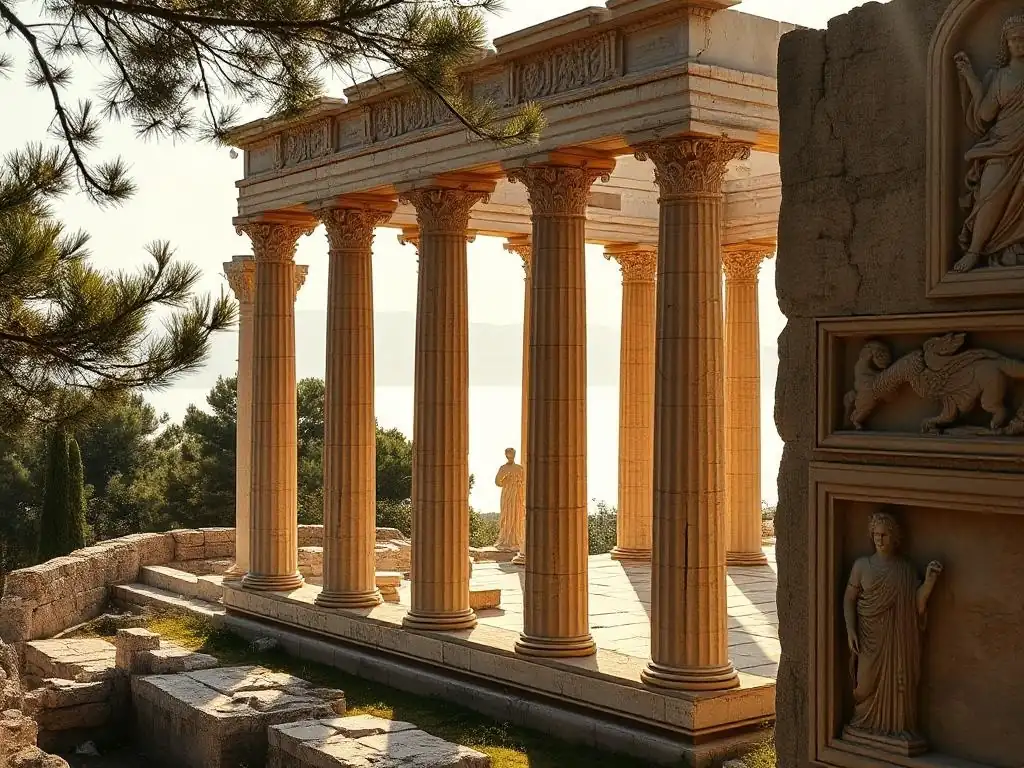
The Heraion of Samos holds immense archaeological significance, providing crucial evidence for the development of Greek architecture, religious practices, and the socio-political landscape of the Aegean world over nearly a thousand years. Excavations at the site have revealed multiple phases of construction, dating from the Geometric period (8th century BCE) through the Hellenistic and Roman eras.
The most famous phase is the massive dipteral temple initiated by the tyrant Polycrates around 530 BCE, intended to be one of the largest Greek temples ever built. Although never fully completed, its scale and innovative design, such as the use of a double colonnade, were groundbreaking and influenced later architectural developments.
The archaeological finds at the Heraion are vast and diverse, including votive offerings from across the Mediterranean, pottery, bronze figurines, jewelry, and inscriptions. These artifacts testify to the sanctuary's widespread fame and the international connections of Samos in antiquity.
The discovery of monumental kouroi and kore statues, typical of the Archaic period, also highlights the sanctuary's role as a center for artistic production and display. Studying the stratigraphy and remnants of successive temples, altars, and surrounding structures allows archaeologists to reconstruct the evolution of the cult of Hera on Samos and understand the changing forms of worship and the economic power of the island-state.
Architectural Marvels: Describing the Grandeur of the Hera Temple
The most ambitious iteration of the Hera temple on Samos, the Polycrates Temple, was a marvel of Archaic engineering and design. It was envisioned as a colossal dipteral structure, meaning it had a double row of columns surrounding the cella (inner sanctuary). While precise dimensions vary slightly between historical accounts and archaeological estimates, it is believed to have measured approximately 55 meters wide and 108 meters long, with columns possibly reaching heights of 20 meters or more. This scale rivaled other famous contemporary temples, such as the Temple of Artemis at Ephesus.
The architectural style of the Heraion was predominantly Ionic, characteristic of the East Greek world. The temple featured ornate capitals, carved friezes, and a complex roof structure. Although only fragments of the Polycrates temple survive today – most notably a single standing column base and capital – these remnants, combined with foundation plans and ancient descriptions, allow scholars to appreciate its intended grandeur. The site also contains remains of earlier, smaller temples, including the Hekatompedos (100-foot) temple, illustrating the continuous effort to build ever-larger and more magnificent structures to honor Hera at this sacred location.
The Sacred Way: The Processional Route and its Significance
Connecting the ancient city of Samos (modern Pythagoreion) to the Heraion sanctuary was the Sacred Way, a processional road that played a crucial role in the religious life of the island. This paved route, parts of which are still visible today, stretched for approximately 5 kilometers (about 3 miles).
Its purpose was to facilitate the movement of worshippers, processions, and offerings from the urban center to the sanctuary during festivals and religious ceremonies dedicated to Hera. The journey along the Sacred Way was likely an integral part of the worship experience, allowing pilgrims to prepare themselves spiritually as they approached the divine precinct.
Along the Sacred Way, archaeological evidence suggests there were numerous votive offerings, small shrines, and burial monuments, enhancing the sacred character of the path. The most striking feature discovered is the Eupalinian Aqueduct, a remarkable engineering feat of the 6th century BCE, which tunneled through a mountain to supply water to the city but also served as a symbolic and practical link between the city and the sanctuary area.
The existence and elaboration of the Sacred Way underscore the centrality of the Heraion to the life of Samos and highlight the communal nature of the cult of Hera, where the journey to the temple was as significant as the rituals performed within its walls.
Mythological Narratives Associated with the Hera Temple on Samos
The Birth of Hera and the Island of Samos
One of the most prominent myths associated with the Hera temple on Samos is the belief that the goddess herself was born on the island. According to Samian tradition, Hera was born under a lygos tree (chaste tree) near the banks of the River Imbrasos, which flows through the Heraion sanctuary.
This specific lygos tree was considered sacred and was a central feature of the sanctuary, sometimes referred to as the 'bridal tree' or the 'birth tree' of Hera. The cult statue of Hera housed in the temple was often said to be made from the wood of this tree, further cementing the physical connection between the goddess, her birth, and the sacred site.
This myth provided the Samians with a powerful claim to being the birthplace of one of the most important Olympian gods, distinguishing their sanctuary from others dedicated to Hera elsewhere. The annual festival known as the Tonaia ("Binding") is sometimes linked to this myth, where the ancient wooden cult statue was ritually washed and rebound, possibly symbolizing Hera's renewal or her connection to the sacred tree.
This foundational myth gave the Heraion of Samos a unique status and likely attracted pilgrims from far and wide, eager to visit the very spot where the queen of the gods was said to have entered the world.
Hera's Marriage to Zeus: Symbolic Interpretations and Associated Rituals
Another key myth tied to the Hera temple on Samos concerns the sacred marriage ( hieros gamos) of Hera and Zeus. While accounts vary across different Greek regions, Samian tradition placed the consummation of their marriage on the island, often near the lygos tree associated with her birth. This myth elevated Samos as a place of divine union and harmony, despite the later mythological depictions of the couple's tumultuous relationship. The hieros gamos myth was central to Hera's identity as the goddess of marriage and played a significant role in the rituals performed at her sanctuaries.
The festival known as the Heraia, celebrated on Samos and elsewhere, likely commemorated this sacred marriage. While specific details of the Samian Heraia are scarce, festivals dedicated to Hera typically involved processions, sacrifices, athletic contests, and ceremonies celebrating female virtues and marital bonds.
The focus on the hieros gamos at the Heraion reinforced the temple's role as a sanctuary dedicated to the sanctity of marriage and the divine power inherent in the union of the king and queen of the gods. The myths surrounding the Hera temple Samos thus provided a mythological basis for the sanctuary's role as a center for marriage rituals and prayers for fertility and marital harmony.
Hera's Wrath and Revenge: Mythological Examples Tied to the Samos Temple
While the myths of Hera's birth and marriage highlight her positive connections to Samos, the island is also implicitly linked to narratives of her notorious wrath, a recurring theme in Greek mythology. Hera's jealousy, primarily directed towards Zeus's numerous lovers and their offspring, is a defining characteristic.
Although specific tales of Hera's direct vengeance at the Heraion itself are not as common as those tied to other locations (like her pursuit of Io or Heracles), the very existence of a major sanctuary dedicated to her on Samos meant that worshippers would have approached the goddess with an awareness of her formidable and potentially dangerous nature.
The stories of Hera's harsh punishments, such as driving Io mad or attempting to thwart the labors of Heracles, served as cautionary tales throughout the Greek world. Worshippers at the Hera temple on Samos would have understood the need to appease the goddess and seek her favor, acknowledging her power not just as a protector but also as a force to be reckoned with if angered.
The opulent offerings and massive scale of the temple can be seen, in part, as an attempt to honor Hera sufficiently to avoid her displeasure, reflecting the complex and sometimes fearful relationship humans had with the powerful Olympians depicted in Greek myths.
Rituals and Offerings at the Temple of Hera
Sacred Rites and Ceremonies Performed in the Heraion
The religious life at the Heraion of Samos revolved around a cycle of sacred rites, festivals, and daily worship dedicated to Hera. The most important public ceremony was likely the Heraia festival, an annual event featuring a grand procession along the Sacred Way from the city to the sanctuary. This procession would have involved priests, priestesses, magistrates, and citizens, carrying sacred objects and leading sacrificial animals. The culmination of the festival was typically a sacrifice performed at the great altar in front of the temple, often involving cattle, followed by feasting and communal celebration.
Beyond the major festivals, daily or regular rituals would have included prayers, libations (pouring of liquids like wine or oil), and smaller offerings. The inner sanctuary (cella) of the temple housed the cult statue of Hera, which was the focal point of worship. Access to the cella might have been restricted, with priestesses performing rites on behalf of the community or individual worshippers. The sheer size and complexity of the Heraion precinct, with its various altars, stoas (colonnaded walkways), and treasuries, indicate a well-organized and elaborate system of religious practice that sustained the cult of Hera for centuries.
Votive Offerings: Evidence of Devotion to Hera
Archaeological excavations at the Heraion of Samos have unearthed an extraordinary array of votive offerings, providing tangible evidence of the devotion shown to Hera by worshippers from various social strata and geographical locations. These offerings range from simple clay figurines and pottery to elaborate bronze statuettes, precious jewelry, and even large-scale sculptures. The sheer quantity and value of some finds, particularly during the Archaic period (7th-6th centuries BCE), reflect the wealth of Samos and the widespread fame of the sanctuary.
Notable finds include miniature tripods, bronze animals (especially bulls), and numerous small bronze human figures, some representing worshippers or the goddess herself. Imported goods, such as Phoenician bowls, Egyptian scarabs, and Near Eastern bronzes, attest to the extensive trade networks Samos participated in and the international reach of the Heraion's reputation. These votives were dedicated to Hera to fulfill vows, express gratitude, seek divine favor, or simply honor the goddess. The discovery of such a rich collection of artifacts allows archaeologists to piece together the religious practices, economic prosperity, and cultural connections centered around the Hera temple on Samos.
The Role of Priestesses in the Temple of Hera
Like many Greek sanctuaries dedicated to female deities, the cult of Hera at Samos was served by priestesses. These women held significant religious authority and were responsible for overseeing the rituals, maintaining the temple and its treasures, and interpreting the will of the goddess. While specific details about the organization and selection of priestesses at the Heraion are limited compared to some other sites, historical sources and inscriptions confirm their presence and importance. Priestesses often came from prominent families, and holding the position was a matter of great honor and prestige.
The chief priestess would have presided over the major festivals and sacrifices, serving as the primary intermediary between the community and Hera. They would have been guardians of the temple's sacred objects, including the ancient cult statue. Their role extended beyond ritual; they were also involved in the administration of the sanctuary, which controlled significant land and wealth. The prominence of priestesses in the cult of Hera underscores the goddess's connection to womanhood and highlights the roles women could hold within the religious sphere of ancient Greek society, particularly at a major sanctuary like the Hera temple Samos.
The Legacy of the Hera Temple: Influence and Interpretations
The Temple of Hera in Ancient Greek Culture
The Heraion of Samos held a significant place in ancient Greek culture, recognized as one of the most important and ancient sanctuaries dedicated to Hera. Its fame spread throughout the Greek world and beyond, attracting pilgrims, merchants, and artists. The monumental building projects undertaken at the site, particularly in the Archaic period under rulers like Polycrates, contributed to the development of Greek monumental architecture, influencing later temple designs. The colossal scale of the Hera temple on Samos was a testament to the power and ambition of the Samian state and its devotion to its patron goddess.
Beyond architecture, the Heraion was a center of cultural exchange and artistic production. The wealth generated by trade and offerings allowed for the commissioning of magnificent sculptures, metalwork, and other art forms found at the site. The sanctuary was also a repository of knowledge and history, preserving traditions and myths related to Hera and Samos. Its mention in ancient texts, including those by Herodotus and Strabo, confirms its status as a renowned religious and historical landmark, deeply embedded in the collective consciousness of the ancient Greek world.
The Enduring Power of Hera: Her Influence on Art and Literature
Hera, as Queen of the Gods and goddess of marriage, has exerted a lasting influence on Western art and literature, continuing to be depicted and interpreted through various periods. Her complex character – majestic queen, jealous wife, protectress of women – has provided fertile ground for artists and writers. In classical sculpture and pottery, she is often portrayed with dignity and authority, reflecting her divine status. Renaissance and later artists frequently depicted her in scenes from mythology, particularly those involving her conflicts with Zeus or her interactions with heroes like Heracles.
In literature, from Homer's Iliad and Odyssey to later tragedies and epics, Hera is a powerful force, sometimes aiding heroes, often hindering them, but always asserting her will. Her portrayal as a formidable and sometimes fearsome figure reflects the complexities of divine power and human interaction with it. The myths of Hera, including those associated with the Hera temple on Samos, continue to be retold and reinterpreted, demonstrating the enduring fascination with the Olympian pantheon and the archetypal roles they embody. The stories of the Hera temple Samos myths remain a vital part of this ongoing cultural legacy.
The Heraion Today: Current State and Archaeological Efforts
Today, the Heraion of Samos is a UNESCO World Heritage Site, recognized for its historical and archaeological importance. While the monumental temple of Polycrates lies largely in ruins, marked primarily by the single standing column often referred to as "the Column of Hera," the site remains an active area for archaeological research. Ongoing excavations continue to uncover new information about the sanctuary's long history, its architectural evolution, and the religious practices performed there.
Visitors to the site can explore the foundations of multiple temples, the remnants of the great altar, parts of the Sacred Way, and various other structures within the vast sanctuary precinct. Archaeological work is focused on understanding the different phases of construction, analyzing the thousands of artifacts recovered, and preserving the fragile remains for future generations. The efforts at the Heraion today aim to deepen our understanding of this crucial ancient site, allowing us to better appreciate the scale of devotion, the architectural innovation, and the rich tapestry of myths that defined the Hera temple on Samos.
Exploring the Myths of Samos and the Divine Power of Hera
Decoding the Myths: Interpretations and Meanings Behind the Stories
The myths associated with the Hera temple on Samos, particularly those concerning Hera's birth and marriage on the island, are more than just entertaining stories; they offer profound insights into ancient Greek beliefs, social structures, and the relationship between humans and the divine. The birth myth rooted Hera firmly in the landscape of Samos, making the island a sacred space intrinsically linked to the goddess's identity. This connection would have fostered a strong sense of regional pride and a unique relationship between the Samians and their patron deity.
The myth of the hieros gamos on Samos reinforced Hera's role as the goddess of marriage, lending divine sanction to human marital unions. It also presented a narrative of cosmic harmony, even if temporary, between the king and queen of the gods, which could be interpreted as a reflection of societal ideals for marriage, despite the often-dysfunctional portrayal of Zeus and Hera's relationship in other myths.
These narratives served to legitimize the cult at the Heraion, explain the origins of its sacred features (like the lygos tree), and provide a framework for understanding Hera's power and her connection to the island. Decoding the Hera temple Samos myths helps us understand the specific religious landscape of Samos and its place within the broader Greek mythological tradition.
The Enduring Allure of the Hera Temple: Reasons for Continued Fascination
The Heraion of Samos continues to fascinate scholars, archaeologists, and the public for several compelling reasons. Firstly, its sheer scale and the ambition of its builders, particularly the Polycrates temple, represent a pinnacle of Archaic Greek architecture and engineering. The surviving remnants, though fragmented, speak of a monumental achievement that pushed the boundaries of what was possible at the time. Secondly, the vast quantity and diversity of votive offerings provide a unique window into ancient religious practices, economic connections, and artistic trends over many centuries.
Furthermore, the deep mythological roots of the site, specifically the myths of Hera's birth and marriage on Samos, imbue the ruins with a powerful sense of sacredness and history. Visiting the Heraion allows one to walk in the footsteps of ancient pilgrims and connect with the stories that shaped the identity of the island and the worship of one of Greece's most important goddesses. The combination of impressive archaeological remains, rich historical context, and vibrant mythological associations ensures that the Hera temple on Samos remains a site of enduring interest and significance.
Archaeological work at the Heraion of Samos is ongoing, promising further discoveries that will enhance our understanding of this complex site. Future research efforts are likely to focus on several areas. Detailed stratigraphic analysis of different layers of the sanctuary can provide more precise dating for various phases of construction and activity, refining our timeline of the Heraion's development. The study of previously excavated but unanalyzed artifacts, particularly smaller finds and pottery fragments, can yield valuable information about daily life, trade patterns, and subtle changes in religious practices.
Additionally, the application of new technologies, such as geophysical surveys and 3D modeling, can help map unexcavated areas of the sanctuary precinct and reconstruct the appearance of the temples and other structures more accurately. There is also potential for further exploration along the Sacred Way and in areas surrounding the main sanctuary.
Each new season of excavation or re-examination of existing collections has the potential to uncover new inscriptions, votives, or architectural fragments that could shed light on previously unknown aspects of the Hera temple Samos myths, rituals, and history, adding more pieces to the puzzle of this extraordinary ancient site.
Frequently Asked Questions
What is the Temple of Hera at Samos best known for?
The Temple of Hera at Samos is best known as one of the largest and most important sanctuaries dedicated to the goddess Hera in the ancient Greek world. It was a significant center for her worship and associated myths.
Which myths are specifically connected to the Temple of Hera at Samos?
While many myths involving Hera exist, those directly linked to the Samos temple often highlight her birth or early life on the island. Some accounts describe Samos as her sacred birthplace or a location she favored.
How did the Temple of Hera at Samos influence the surrounding society?
The temple's influence extended beyond religious practice, impacting the economic and political landscape of Samos. It served as a cultural hub, attracting pilgrims and contributing to the island's prosperity and prestige.
What archaeological evidence supports the existence of the Hera Temple at Samos?
Extensive archaeological excavations have unearthed the remains of multiple temples dedicated to Hera on Samos, spanning several centuries. These discoveries include foundations, columns, and votive offerings, confirming the site's significance.
Why is understanding "Hera temple Samos myths" important today?
Understanding these myths provides insights into ancient Greek religion, culture, and social structures. They also reveal the lasting impact of mythological narratives on art, literature, and contemporary society.
Final Reflection: Echoes of Hera's Power in a Modern World
The enduring legacy of the Temple of Hera at Samos isn't merely a collection of stones; it's a testament to the enduring power of mythology and its continued influence on our understanding of femininity, divinity, and societal structures. The myths surrounding Hera, woven into the very fabric of the temple's existence, continue to resonate today, challenging our perceptions of power, gender roles, and the enduring strength of ancient narratives.
The stories of Hera, whether portraying her as a jealous wife or a powerful protector, offer a complex and multifaceted image of female divinity rarely seen in ancient mythology. These narratives, passed down through generations, continue to shape our interpretations of female leadership and the complexities of human relationships. The gods themselves cannot escape the human condition; they are bound by the same passions and frailties that plague us mortals.
This quote, though not directly about Hera, highlights the timeless relevance of exploring these ancient myths – they reflect our own struggles and triumphs, offering a mirror to our own humanity.
Consider the enduring power of these myths. How do they shape our understanding of female empowerment today? How can we learn from both the positive and negative aspects of Hera's portrayal to foster a more nuanced and equitable understanding of gender dynamics? I urge you to reflect on the echoes of Hera's power in your own life, to consider the ways in which ancient narratives continue to shape our present, and to seek out the strength and complexity within yourself, just as Hera's story embodies.
Unlock Hera's Secrets: Dive Deeper into Samian Mythology!
Thank you for exploring the fascinating world of Hera and the Temple of Samos! We hope you gained a new appreciation for the complexities of this powerful goddess and her rich history. Ready to take your understanding further?
- Delve into our extensive Samian mythology archive: Explore related articles on Hera's myths, symbols, and impact on ancient Greek culture. This is where you'll uncover even more fascinating details about this iconic figure.
- Share your thoughts and interpretations: Did Hera's story resonate with you in a particular way? Join the conversation in the comments below and share your unique perspectives with fellow mythology enthusiasts.
- Challenge yourself with a Samian-themed creative project: Write a short story, create a piece of art, or compose a poem inspired by Hera's legacy and the temple's grandeur. Let your imagination soar!
What other ancient goddesses or temples inspire you, and why?