
The Fates: Do Even the Gods Bow to Their Threads?

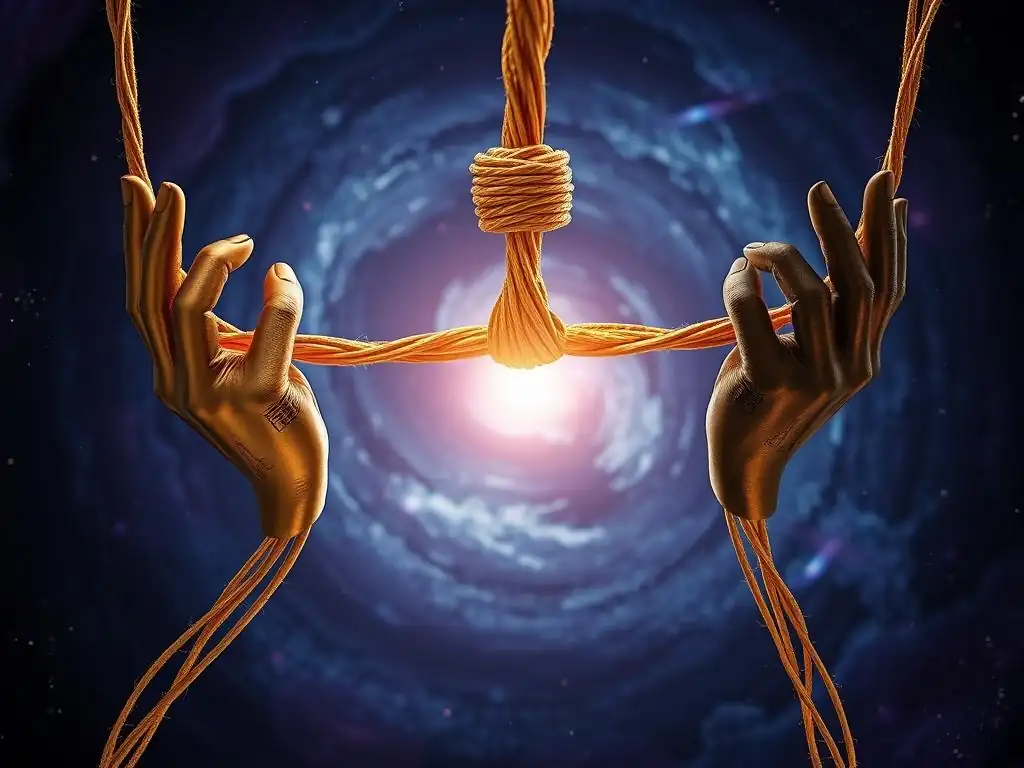
Welcome to Mythology and Legends, your portal to the world's captivating stories! Ever wondered if even the mighty Zeus trembled before a power greater than himself? Delve into the enigmatic world of Greek mythology fate threads and discover the weavers of destiny, the Moirai. But are they truly omnipotent, or are their threads more fragile than we imagine? Explore with us and unravel the mysteries within...
- The Fates: Do Even the Gods Bow to Their Threads? - Exploring the Moirai in Greek Mythology
- Understanding the Concept of Fate in Ancient Greek Mythology
- The Moirai: The Embodiment of Fate in Greek Mythology
- The Power and Influence of the Fates
- The Symbols Associated with the Greek Fate Threads
- Fate vs. Free Will: A Philosophical Debate in Greek Thought
- The Legacy of the Fates in Art, Literature, and Culture
- Exploring Similar Concepts of Fate in Other Mythologies
- Conclusion: The Enduring Mystery of the Greek Mythology Fate Threads
-
Frequently Asked Questions
- What are the Fate Threads in Greek mythology, and what do they represent?
- Who are the Moirai, or the Fates, and what are their individual roles?
- Does anyone, even the gods, have the power to change or defy the Fate Threads?
- How do the Greek mythology Fate Threads impact contemporary society or storytelling?
- Where can I find more information about the Fates and their influence on Greek mythology?
- Final Reflection: Unraveling the Threads of Fate
- Unravel Your Destiny: Explore the Power of Fate!
The Fates: Do Even the Gods Bow to Their Threads? - Exploring the Moirai in Greek Mythology
In the rich tapestry of Greek mythology, few concepts are as fundamental and awe-inspiring as fate. It is a force that dictates the course of events, shaping the lives of mortals and, perhaps even more surprisingly, influencing the actions and destinies of the immortal gods themselves. At the heart of this concept lie the Moirai, the three sisters who personify destiny and control the very threads of life. Understanding their role provides deep insight into the ancient Greek worldview and their perception of order, inevitability, and the limits of power, even divine power.
Understanding the Concept of Fate in Ancient Greek Mythology
The Significance of Fate in Greek Beliefs
Fate, or moira, held a central and complex position in ancient Greek cosmology and philosophy. It wasn't simply a passive acceptance of what would happen, but rather an active, sometimes terrifying, force that operated above gods and men. This belief system suggested an underlying order to the cosmos, a predetermined path or portion ( moira) assigned to each being from birth, encompassing their lifespan, fortune, and ultimate end. This inherent structure provided a framework for understanding the seemingly chaotic events of life, from personal triumphs and tragedies to the rise and fall of civilizations.
This pervasive belief in fate deeply influenced Greek religious practices, ethical considerations, and literary works. Major epics like Homer's Iliad and Odyssey are permeated with the concept of destiny, with characters often struggling against or submitting to their predetermined paths. Oracles, such as the famous Oracle at Delphi, were consulted not to change fate, but to understand it, offering cryptic pronouncements about what was already set in motion. The very notion of piety often involved recognizing and accepting one's moira, even when it was tragic.
How the Ancient Greeks Perceived Destiny and Free Will
The relationship between destiny and free will in ancient Greek thought is a subject of ongoing debate among scholars, reflecting the nuanced and sometimes contradictory views held by the Greeks themselves. While the Moirai spun the threads of life and allotted each person's moira, there was also a recognition of individual actions and choices. Heroes often made decisions that led them towards their fate, suggesting a degree of agency within the predetermined framework. It was a complex interplay, where one's character and choices seemed to interact with the unchangeable decrees of destiny.
Some philosophical schools grappled explicitly with this tension. Stoicism, for instance, emphasized accepting one's fate with equanimity, arguing that while external events were predetermined, one's internal response and virtue were matters of free will.
Conversely, other thinkers might have leaned more heavily towards either deterministic views or those emphasizing human agency. The enduring presence of this philosophical puzzle in their literature and thought underscores its importance; the Greeks were acutely aware of the apparent paradox between a fixed fate and the feeling of making genuine choices, a question that continues to resonate today when discussing concepts like the Greek mythology fate threads.
The Moirai: The Embodiment of Fate in Greek Mythology
Who Were the Moirai? Origins and Genealogy of the Fates
The Moirai, the personifications of destiny, are among the most ancient and powerful figures in Greek mythology, their origins shrouded in the mists of time. Their parentage varies across different accounts, highlighting their primordial nature. Homer, in the Iliad, speaks of a single, abstract 'Moira' or fate, suggesting a less personified concept initially.
Later traditions solidified them as three sisters. Hesiod, in his Theogony, presents two different genealogies: first, naming them daughters of Nyx (Night), born without a father, emphasizing their dark and ancient nature; and later, listing them as daughters of Zeus and Themis (Divine Law), positioning them as instruments of divine order, albeit an order that even Zeus must respect.
This dual parentage reflects their unique position – both older than the Olympian order and yet sometimes associated with it. Regardless of their specific lineage in any given myth, their authority is consistently portrayed as supreme, operating outside the direct command of even Zeus, the king of the gods.
They reside in a realm beyond the everyday world, working silently and ceaselessly on the threads that govern existence. Their power is not derived from physical strength or divine decree in the same way as other gods, but from their intrinsic connection to the fundamental structure of the cosmos and the inevitable flow of time and life.
Clotho, Lachesis, and Atropos: The Three Sisters of Destiny
The Moirai are invariably depicted as three sisters, each with a distinct role in manipulating the Greek mythology fate threads. Their names and functions are consistent across most major accounts, embodying the linear progression of life from birth to death. They are often portrayed as stern, ancient women, sometimes blind or veiled, working together in unison to determine the destiny of every being, from the smallest insect to the mightiest god.
Clotho: Spinner of the Thread of Life
Clotho, whose name means "the Spinner," is the youngest of the three sisters and is responsible for spinning the thread of life from her distaff. This action marks the beginning of existence for an individual, determining their birth and the initial length of their thread. She is often depicted holding a spindle or distaff, symbolizing the very raw material of life being drawn out and twisted into existence.
Her work is the genesis of each destiny, the first step in weaving the intricate pattern of a life. The length and quality of the thread she spins are not explicitly determined by her whim, but rather according to the dictates of fate itself, which she merely enacts. She sets the initial potential and parameters of a life's journey, the raw material from which all future events will unfold, represented by the Greek mythology fate threads.
Lachesis: Allotter of Destiny and Life's Course
Lachesis, meaning "the Allotter" or "the Measurer," is the sister who determines the length and course of the life thread spun by Clotho. Using a measuring rod, she assigns each person their destiny or moira, deciding the major events, fortunes, and misfortunes they will encounter throughout their existence. She measures the thread, determining how long it will be before it is cut.
Her role is perhaps the most complex, as she doesn't just measure length but also allocates the specific path and experiences within that life. She decides whether a person will be rich or poor, healthy or sickly, successful or tragic. While Clotho starts the thread, Lachesis shapes its journey, allotting the joys and sorrows, the triumphs and failures that constitute a person's fate, intertwining the Greek mythology fate threads with specific events.
Atropos: Inflexible Cutter of the Thread of Life
Atropos, whose name chillingly translates to "the Inflexible" or "she who cannot be turned," is the eldest and most feared of the Moirai. Her task is the final and irreversible one: she cuts the thread of life spun by Clotho and measured by Lachesis, determining the moment and manner of death. Once Atropos cuts the thread, life ends, and there is no appeal or reprieve.
She is typically depicted holding a pair of shears, the instrument of finality. Unlike her sisters, who deal with the beginning and middle of life, Atropos represents the absolute and unchangeable end. Neither gods nor mortals can persuade or force her to delay her action once the appointed time arrives. Her role underscores the ultimate power of fate over all beings, demonstrating that even the most powerful figures are subject to the final snip of her shears, cutting their Greek mythology fate threads.
The Power and Influence of the Fates
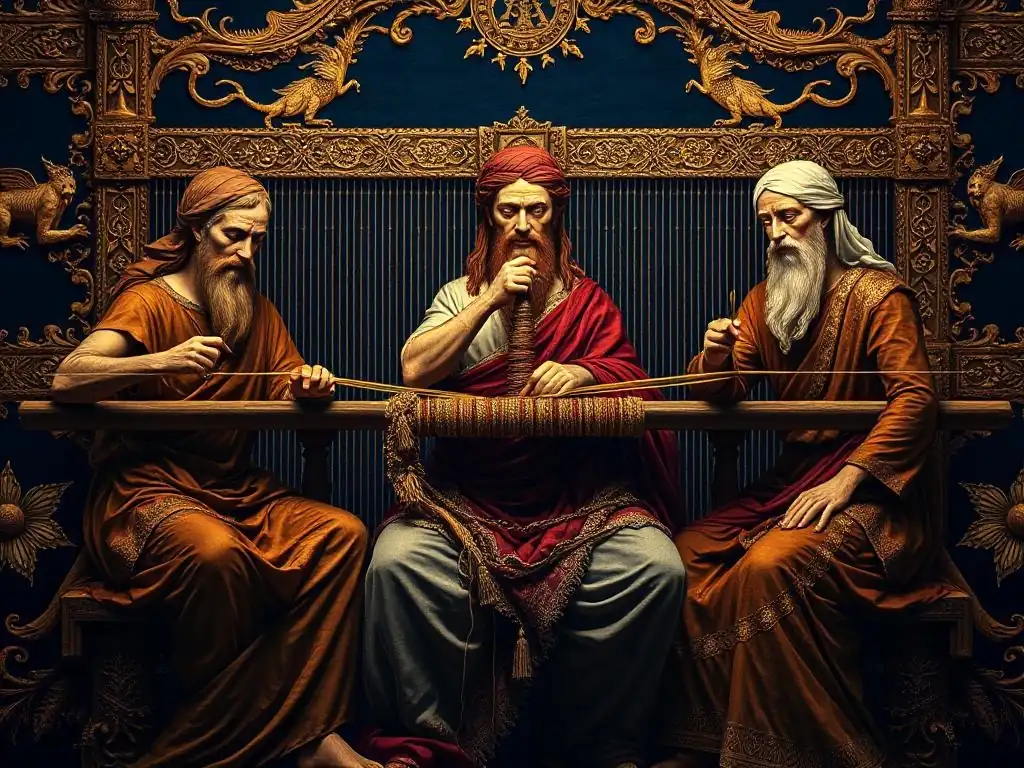
The Moirai occupy a unique position in the Greek pantheon, often depicted as being even above the Olympian gods, including Zeus himself. While Zeus is king and ruler of the cosmos, his power seems to operate within the framework established by the Fates. There are instances in mythology where Zeus wishes to alter a hero's destiny but is either unable to or chooses not to, recognizing the supreme authority of the Moirai. This suggests that the Fates represent a cosmic law or order that transcends even divine will, embodying the principle of inevitability.
This supreme authority means that the lives of both the lowliest mortal and the mightiest deity are subject to the same fundamental force. A shepherd's lifespan and a god's reign are both dependent on the threads spun, measured, and cut by the Moirai. While gods possess immortality in the sense of not dying from old age or disease in the same way mortals do, their ultimate existence and influence within the cosmic order are still bound by the larger pattern of fate, which the Fates oversee through their manipulation of the Greek mythology fate threads.
Examples of the Fates' Influence on Mythological Stories
The influence of the Moirai is woven throughout Greek mythology, often serving as the underlying force driving narrative conflict and tragic outcomes. Their decrees are not always explicitly stated by the Fates themselves but are often revealed through prophecies or simply unfold as an inevitable sequence of events. These stories highlight the struggle against, and ultimate submission to, the predetermined paths set by destiny.
The Fate of Oedipus: Prophecy and Inevitable Tragedy
Perhaps one of the most famous examples of inescapable fate is the story of Oedipus. Before his birth, it was prophesied that he would kill his father and marry his mother. Despite desperate attempts by his parents (King Laius and Queen Jocasta of Thebes) to avert this destiny by abandoning him, and later by Oedipus himself trying to avoid his supposed Corinthian parents, every action taken only served to lead him closer to fulfilling the prophecy.
The intricate series of events – Oedipus being adopted, his flight from Corinth, his encounter with Laius at a crossroads, and his arrival in Thebes to solve the Sphinx's riddle – were all seemingly independent choices or accidents. Yet, they culminated precisely in the predicted patricide and incestuous marriage. This narrative powerfully illustrates the Greek belief that while individuals might make choices, these choices ultimately operate within a predetermined framework, guided by the unseen hand of fate and the Greek mythology fate threads.
The Intervention of the Fates in the Trojan War
The Trojan War, as depicted in Homer's Iliad, is another grand stage where fate plays a significant role. While the gods are actively involved, taking sides and intervening in battles, there is an underlying sense of destiny guiding the overall outcome. The deaths of major heroes like Hector and Achilles, though resulting from specific divine or human actions, are often spoken of as fulfilling their fated end.
Even Zeus, who might try to save his son Sarpedon from death, is reminded by Hera that Sarpedon's fate has been determined and interfering would upset the cosmic order. Ultimately, Zeus allows Sarpedon to die, recognizing the limits of his own power against the decrees of fate. The war itself, from its instigation through the judgment of Paris to its destructive conclusion, feels less like a random conflict and more like an inevitable unfolding of events set in motion by destiny, influenced by the Greek mythology fate threads.
Challenging Fate: Attempts to Defy the Moirai
Throughout Greek mythology, heroes and even gods occasionally attempt to defy or alter the fate decreed by the Moirai. These attempts, however, invariably fail, often with tragic consequences, serving to reinforce the unyielding nature of destiny. Figures like King Laius and Queen Jocasta tried to prevent Oedipus's fate, only for their actions to inadvertently ensure its fulfillment.
Another notable example is the story of Admetus, who was fated to die young. Apollo, who favored Admetus, managed to persuade the Moirai to allow Admetus to live longer, but only if someone else willingly died in his place.
This wasn't a change of fate, but a conditional substitution allowed by the Fates, and even then, finding someone willing proved incredibly difficult, ultimately leading to his wife Alcestis sacrificing herself. These stories emphasize that while one might gain insight into fate or find minor, often costly, ways to navigate it, outright defiance or alteration of the threads woven by the Moirai is impossible.
The Symbols Associated with the Greek Fate Threads
The Significance of the Thread in Representing Life and Destiny
The most central and potent symbol associated with the Moirai is the thread. This simple yet profound image encapsulates the essence of life and destiny in Greek thought. The thread is spun at birth, measured throughout life, and cut at death. Its length represents the duration of a person's existence, while its quality and texture can symbolize the nature of their life – smooth or tangled, strong or weak.
The act of weaving or spinning threads was a common activity in ancient Greece, making the metaphor instantly relatable. It suggests that individual lives are not isolated incidents but are intricately woven together into a larger cosmic fabric, a vast tapestry representing the interconnectedness of all destinies. The manipulation of these Greek mythology fate threads by the Moirai visually represents their direct control over the very substance and duration of life itself.
Other Symbols Associated with the Moirai (e.g., spindles, shears)
Beyond the thread itself, the tools used by the Moirai are also significant symbols of their power and function. Clotho is often depicted with a spindle or distaff, the tools used for spinning wool or flax into thread. These symbolize the beginning of life, the raw material being gathered and formed. The act of drawing out the fiber and twisting it embodies the process of bringing existence into being.
Lachesis is typically shown with a measuring rod or a scroll. The measuring rod symbolizes her role in determining the length of the thread and, by extension, the duration of life. A scroll or book could represent the recording of destiny, the detailed plan laid out for each individual's journey.
Atropos is universally recognized by her attribute: a pair of shears or scissors. These represent the final, irreversible act of cutting the thread, symbolizing death and the absolute end of a life's predetermined course. These tools vividly illustrate the different stages of fate's work on the Greek mythology fate threads.
Fate vs. Free Will: A Philosophical Debate in Greek Thought
Exploring the Tension Between Predestination and Choice
The concept of the Moirai and their control over the Greek mythology fate threads inherently raises profound questions about free will. If destiny is predetermined, are individual choices merely illusions? Greek philosophers and tragedians wrestled with this tension, presenting narratives where characters make seemingly free choices that nonetheless lead them precisely to their fated outcomes. This suggests a view where individual actions are not necessarily independent of fate but might be the very means by which fate is realized.
The debate wasn't always framed as a simple either/or. Some perspectives suggested that while major life events and the ultimate lifespan were fixed, there was still room for agency within those parameters – how one responded to their fate, how they faced adversity, or what virtues they cultivated. The tragic heroes of Greek drama often attain their heroic status not by escaping fate, but by confronting it with courage and dignity, highlighting a form of freedom in the face of necessity.
Did the Greeks Believe in True Free Will?
It is difficult to give a single, definitive answer to whether all ancient Greeks believed in true free will as understood in modern terms. The evidence from their literature, philosophy, and religious practices presents a complex picture. While the Moirai's existence implies a strong element of predestination, there was also a clear emphasis on personal responsibility, moral choice, and the consequences of one's actions. For instance, the concept of hubris (excessive pride) leading to divine punishment suggests that choices do matter and can provoke reactions from the cosmos or the gods.
Perhaps the most accurate interpretation is that the ancient Greeks held a view where fate and free will coexisted in a dynamic, sometimes contradictory, relationship. Destiny set the stage and determined the ultimate end, but within that framework, individuals possessed a degree of freedom to act, to err, and to strive. Their choices did not change the final outcome but shaped the journey towards it. The Greek mythology fate threads represented the unchangeable framework, within which the human drama unfolded.
The Legacy of the Fates in Art, Literature, and Culture
Representations of the Moirai in Ancient Greek Art
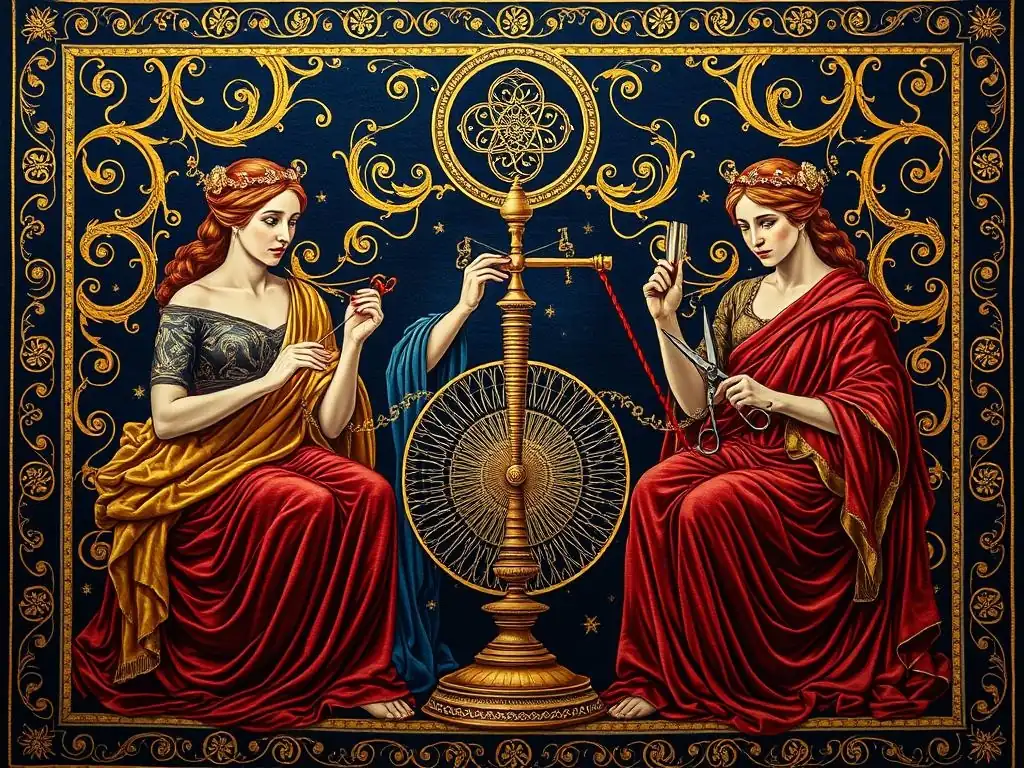
The Moirai were frequently depicted in ancient Greek art, appearing on pottery, sculptures, and architectural friezes. Early representations might show them as stern, elderly women, often working with their symbolic tools – the spindle, the measuring rod, and the shears. For example, they are believed to have been depicted on the eastern pediment of the Parthenon, although their identification among the surviving figures is debated by scholars.
These artistic portrayals emphasized their quiet, relentless work, often showing them seated side-by-side, focused on their task of manipulating the Greek mythology fate threads. Their presence in funerary art also highlights their connection to death and the end of life's thread. While not as widely or dynamically depicted as the Olympian gods involved in heroic myths, their presence in art underscores their fundamental importance in the Greek worldview as the arbiters of destiny.
The Fates in Modern Literature and Film
The concept of the Moirai and their control over destiny has resonated through the centuries and continues to appear in modern literature, film, and popular culture. They serve as powerful archetypes for the forces of fate, inevitability, and the limits of human control. Authors and screenwriters often draw upon the image of the three sisters weaving the threads of life to represent destiny, cosmic order, or even bureaucratic control over existence.
Examples can be found in various genres, from fantasy novels that personify destiny to science fiction stories exploring predestination. While often adapted or reinterpreted, the core image of beings who control the threads of life remains a potent symbol. These modern appearances demonstrate the enduring power of the Greek mythology fate threads as a metaphor for the forces that shape our lives, reminding contemporary audiences of the ancient struggle between agency and destiny.
The Enduring Influence of Greek Mythology Fate Threads
The concept of the Greek mythology fate threads, controlled by the Moirai, has left an indelible mark on Western thought and culture. It provided one of the earliest and most compelling personifications of fate, a concept that remains a subject of philosophical and personal contemplation. The image of life as a thread, susceptible to being measured and cut, is a powerful metaphor for human vulnerability and mortality.
Beyond direct references, the Moirai's legacy can be seen in the recurring theme of destiny versus free will in countless stories and philosophical discussions. They represent the idea that some forces operate beyond human (and even divine) control, imposing a fundamental structure on existence. The enduring fascination with their story reflects a universal human concern: how much of our lives is determined for us, and how much is truly within our power? The Greek mythology fate threads continue to symbolize this fundamental mystery.
Exploring Similar Concepts of Fate in Other Mythologies
Parallels to the Moirai in Roman Mythology (The Parcae)
The Roman pantheon, heavily influenced by Greek mythology, features a direct parallel to the Moirai in the form of the Parcae (also known as the Fata). Like their Greek counterparts, the Parcae are three sisters who control the destiny of mortals and gods. Their names and roles closely mirror the Moirai: Nona (equivalent to Clotho) spins the thread of life, Decima (equivalent to Lachesis) measures it, and Morta (equivalent to Atropos) cuts it.
The Roman concept of fate, or fatum, shared the Greek emphasis on inevitability and supreme authority. The Parcae were likewise considered to be powerful entities whose decrees could not be altered. Roman literature and art depict them in similar ways, highlighting the cross-cultural resonance of the image of fate as a woven thread. This clear parallel underscores the deep connection between Greek and Roman religious and philosophical thought regarding destiny.
Fate and Destiny in Norse Mythology: The Norns
Norse mythology also features powerful female figures who determine fate: the Norns. While distinct from the Greek Moirai, the Norns share the fundamental role of shaping destiny, albeit with a different cosmology. The three principal Norns are Urðr (Urd - "that which has come to pass," representing the past), Verðandi (Verdandi - "that which is in the act of becoming," representing the present), and Skuld ("that which is to be," representing the future). They reside by the well Urðarbrunnr at the roots of the world tree Yggdrasil.
The Norns are described as carving runes into the trunk of Yggdrasil or weaving a tapestry, actions that dictate the fate of gods, giants, dwarves, and humans. While their method differs from spinning threads, the core concept of powerful female entities determining destiny is a clear parallel. The Norns' influence extends over all beings, and even the gods of Asgard are subject to the fate they weave, demonstrating that the idea of an overarching destiny controlled by powerful, ancient figures is a theme that appears across diverse mythologies.
Conclusion: The Enduring Mystery of the Greek Mythology Fate Threads
The Moirai, the personifications of fate in Greek mythology, remain compelling figures who embody the ancient world's deep contemplation of destiny, life, and death. Clotho, Lachesis, and Atropos, through their manipulation of the Greek mythology fate threads, represent the beginning, duration, and end of every existence, wielding an authority that even the mighty Olympians seem to respect. Their story highlights the Greek belief in an underlying cosmic order and the potential limits of free will in the face of predetermined events.
From the tragic tale of Oedipus to the grand sweep of the Trojan War, the influence of the Fates is a constant, often unyielding, force. While the exact nature of their power and its interaction with individual choice sparked debate even in antiquity, their symbolism – the thread, the spindle, the shears – provides a powerful and enduring metaphor for the human condition.
The legacy of the Moirai and the concept of the Greek mythology fate threads continues to resonate, reminding us of the enduring mystery of destiny and the profound questions it poses about our place in the cosmos.
Frequently Asked Questions
What are the Fate Threads in Greek mythology, and what do they represent?
The Fate Threads, spun by the Moirai (the Fates), represent the lifespan of every mortal and immortal. They determine the course of life and when it will end.
Who are the Moirai, or the Fates, and what are their individual roles?
The Moirai are the three goddesses who control destiny. Clotho spins the thread of life, Lachesis determines its length, and Atropos cuts the thread, marking the end of life.
Does anyone, even the gods, have the power to change or defy the Fate Threads?
The article suggests the Fates' power is absolute, even over the gods. While some heroes might try to alter their destiny, they are generally believed to be bound by fate.
How do the Greek mythology Fate Threads impact contemporary society or storytelling?
The concept of fate and destiny, as embodied by the Fate Threads, continues to influence literature, film, and other forms of media. It explores themes of free will versus determinism and the inevitability of death.
Where can I find more information about the Fates and their influence on Greek mythology?
You can explore resources from websites like "Mythology and Legends" offering comprehensive information on Greek myths. Look for details about specific stories where the Fates play a central role.
Final Reflection: Unraveling the Threads of Fate
The concept of fate, as woven into the rich tapestry of Greek mythology, remains strikingly relevant today. We grapple with the same questions the ancient Greeks did: Are our lives predetermined, or do we hold the power to shape our destinies? The intricate threads of fate, as depicted in myths from the three Moirai to the prophecies of Cassandra, continue to resonate, prompting us to examine the delicate balance between free will and an inescapable destiny.
The enduring power of these myths lies in their ability to mirror our own human experiences. We all face moments of seemingly unavoidable hardship, times when we feel swept along by currents beyond our control. Yet, the stories also showcase the human spirit's resilience, the capacity to struggle against the perceived inevitability of fate. Even the gods cannot escape their destiny,
a common refrain in Greek mythology, highlights the universal nature of this struggle, reminding us that even those with seemingly boundless power are subject to the larger forces at play. This understanding fosters a profound sense of empathy and shared human experience across millennia.
Consider the threads of your own life. Are you actively weaving your destiny, or are you passively accepting what comes your way? This article has explored the complexities of fate in Greek mythology; now, it's your turn to reflect on your own narrative. Embrace the challenges, learn from the triumphs and setbacks, and remember that even within the seemingly predetermined, there is always room for agency, for choice, for the creation of your own unique and powerful story. The threads of your fate are in your hands.
Unravel Your Destiny: Explore the Power of Fate!
Thanks for diving into the captivating world of the Fates! We hope you gained a fresh perspective on the intricate tapestry of destiny and free will. Now it's your turn to weave your own narrative.
- Delve deeper: Research a specific myth related to fate from a different culture. See how their understanding of destiny differs from the Greek interpretation. Perhaps you’ll uncover surprising parallels!
- Share your thoughts: What role do you believe fate plays in your own life? Let's discuss in the comments below. Share your personal interpretations of the Fates' power.
- Consider the counterpoint: Explore stories or philosophical viewpoints that challenge the absolute power of fate.
Do you believe we are truly bound by the threads of destiny, or do we hold the shears to cut our own path?