
Caelus: The Roman God of the Sky Before Jupiter

Welcome, seeker of ancient lore!
Delve into the captivating tapestry of Mythology and Legends, where we unravel the threads of stories whispered through millennia. Ever wondered who ruled the heavens before Jupiter? Prepare to ascend into the realms of the Roman god Caelus myths, a figure shrouded in celestial mystery. Discover his origins, his role in the cosmic order, and the legacy he left behind – a legacy that might just surprise you. Are you ready to explore the story of the god who was the very sky itself?
- Uranus: The Greek Primordial God of the Sky
- Introduction to Uranus: Unveiling the Ancient Greek Sky God
- The Mythology of Uranus: Stories and Legends
- Uranus vs. Zeus: A Comparison of Greek Sky Gods
- Uranus in Ancient Greek Culture and Thought
- The Legacy of Uranus: Influence and Modern Interpretations
- Conclusion: Reflecting on the Greek God Uranus and His Place in Mythology
-
Frequently Asked Questions
- ### Who was Caelus in Roman mythology?
- ### What is Caelus's role in Roman creation myths?
- ### What is the relationship between Caelus and Uranus in Greek mythology?
- ### Why is Caelus less prominent in Roman mythology than Jupiter?
- ### Are there any surviving temples or significant cults dedicated to Caelus?
- Final Reflection: Caelus's Enduring Legacy in the Roman Pantheon
- Unveil the Celestial Secrets of Caelus!
Uranus: The Greek Primordial God of the Sky
Introduction to Uranus: Unveiling the Ancient Greek Sky God
Who Was Uranus? Exploring the Origins of the Greek Sky Deity
Uranus, whose name literally means "sky" or "heaven," holds a unique place in Greek mythology as one of the primordial deities, representing the vast expanse of the celestial dome. Unlike later gods who were born from parents, Uranus is often depicted as emerging directly from the void, or in some accounts, as the son of Gaia, the Earth.
This makes him a foundational figure in the Greek cosmogony, existing at the very beginning of time and space as understood by the ancient Greeks. His existence marked the separation of the sky from the earth, creating the fundamental structure of the cosmos.
As the personification of the sky, Uranus was seen as the overarching, omnipresent entity that covered and contained the world. He was not typically depicted with anthropomorphic features in the earliest myths, but rather as the sky itself. His union with Gaia, the Earth, was fundamental to the generation of the universe's earliest inhabitants. This pairing of Sky and Earth is a common motif in creation myths across many cultures, signifying the union of masculine and feminine principles to bring forth life and order.
Uranus' Role in Early Greek Cosmology and Mythology
Uranus's primary role in early Greek cosmology was as the first supreme ruler of the universe. Before the reign of the Titans and long before the Olympian gods held sway from Mount Olympus, Uranus held absolute power over creation. His presence defined the upper boundary of the world, separating it from the unknown realms beyond. Myths regarding the Greek god Uranus often center on his prolific procreation with Gaia, which led to the birth of the universe's first generations of powerful beings.
However, Uranus's rule was characterized by tyranny and fear. Fearing the power of his own children, particularly the monstrous ones, he imprisoned them within the depths of Gaia's womb or in the underworld, Tartarus. This act of oppression set the stage for his eventual overthrow and marked a crucial turning point in Greek mythology, demonstrating the cyclical nature of power and rebellion that would continue through the reigns of Cronus and Zeus. Understanding these early myths helps illuminate the philosophical underpinnings of Greek thought regarding cosmic order and generational conflict.
The Mythology of Uranus: Stories and Legends
Uranus and Gaia: The Primordial Couple in Greek Myths
The union of Uranus and Gaia is central to the early Greek creation narrative, as chronicled most famously by Hesiod in his Theogony. Gaia, the Earth, emerged from Chaos, and then gave birth to Uranus, the starry Sky, among others, or in some versions, copulated with Pontus (the Sea) and the Mountains. The most significant union, however, was that between Gaia and Uranus, from which sprang the first dynasties of divine beings. Their constant embrace represented the original state of the cosmos where sky and earth were locked together.
This fertile coupling produced a vast and varied progeny. Their children included the twelve Titans, powerful anthropomorphic deities like Cronus, Rhea, Oceanus, and Themis; the three Cyclopes, one-eyed giants renowned for their craftsmanship; and the three Hecatoncheires, monstrous beings with a hundred hands and fifty heads each. These myths of the Greek god Uranus and his consort Gaia lay the foundation for the complex family tree of the Greek pantheon and explain the origins of many significant mythological figures.
The Children of Uranus: A Lineage of Titans, Cyclopes, and Hecatoncheires
The offspring of Uranus and Gaia represent different aspects of the primordial world. The Titans, six male and six female, were the first generation of powerful gods, embodying immense forces of nature and cosmic order. Oceanus represented the world-encircling river, Themis divine law and order, and Cronus time itself. These Titans would later rule the cosmos after Uranus's downfall.
The Cyclopes – Brontes (Thunder), Steropes (Lightning), and Arges (Bright) – possessed immense strength and skill, particularly in forging. They would later play a crucial role in the Olympian myths, crafting Zeus's thunderbolts. The Hecatoncheires – Briareus (the Vigorous), Cottus (the Striker), and Gyes (the Limbed) – were beings of monstrous power and appearance. Uranus, disgusted or fearful of these latter two groups, imprisoned them in Tartarus, deep within the Earth. This act of cruelty towards his own children sowed the seeds of resentment in Gaia and ultimately led to his demise.
Uranus's Downfall: Castration by Cronus and the Rise of the Titans
Uranus's fear and cruelty towards his children created deep anguish for Gaia, who felt the burden of her imprisoned offspring within her. Seeking vengeance and release, Gaia conspired with her children. Only Cronus, the youngest and most daring of the Titans, was willing to act. Gaia armed him with a sickle made of adamantine.
As Uranus descended to lie with Gaia, Cronus, ambushing him from within, castrated his father with the sickle. The severed genitals fell into the sea, and from the foam arose Aphrodite, the goddess of love and beauty. From the blood that spilled onto the earth sprang the Erinyes (Furies), the Giants, and the Meliae (nymphs of the ash trees).
This violent act marked the end of Uranus's reign as the supreme cosmic ruler and ushered in the age of the Titans, with Cronus assuming leadership. These Greek god Uranus myths highlight themes of generational conflict, rebellion against tyranny, and the violent birth of new powers and entities in the universe.
Uranus vs. Zeus: A Comparison of Greek Sky Gods
Uranus: The Original Sky God, Preceding Zeus's Reign
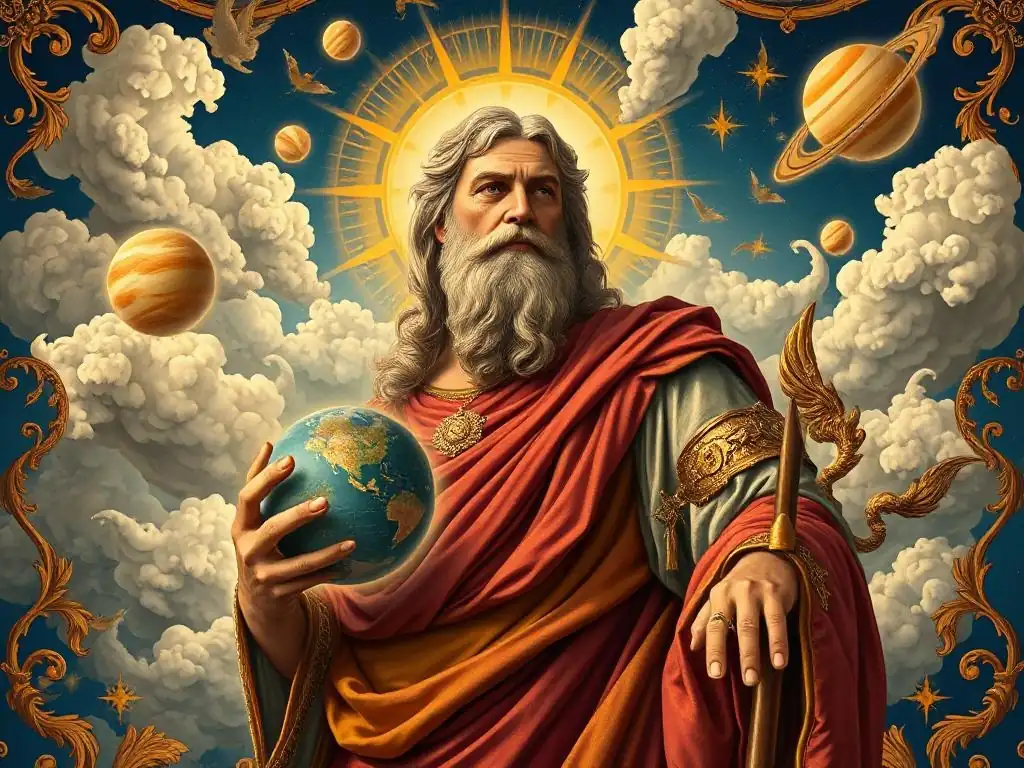
Uranus holds the title of the original sky god in the Greek pantheon, representing the primordial heaven itself. His reign predates both the age of the Titans and the age of the Olympians. He was a god of the fundamental cosmic structure, the vast expanse above the earth. His power was absolute but perhaps less defined in terms of specific domains compared to later gods. He represented the overarching authority of the primeval sky, the source from which all subsequent divine generations sprang.
Unlike Zeus, who is often depicted interacting directly with mortals, intervening in their affairs, and ruling from a specific location (Mount Olympus), Uranus's connection to the world was more abstract and foundational. He was the sky itself, not a deity in the sky. His mythology primarily revolves around his role in creation and his eventual overthrow, rather than ongoing interactions with the cosmos he helped create.
Zeus's Ascension: How Zeus Overthrew Cronus and Became King of the Gods
Zeus's rise to power is a complex saga detailed in the Titanomachy. He was the son of Cronus and Rhea. Cronus, warned by an oracle that he would be overthrown by his own child just as he had overthrown his father, swallowed each of his children as they were born. However, Rhea hid Zeus and gave Cronus a stone wrapped in swaddling clothes to swallow instead.
When Zeus grew up, he forced Cronus to regurgitate his siblings. Along with his brothers Poseidon and Hades, and his sisters Hestia, Demeter, and Hera, Zeus waged a ten-year war against the Titans. Aided by the Cyclopes (released from Tartarus) who forged his thunderbolts, and the Hecatoncheires, Zeus and the Olympians eventually triumphed, casting most of the Titans into Tartarus. This victory established Zeus as the new supreme ruler, the king of the gods and lord of the sky, marking a shift from the primordial and Titan reigns to the Olympian era.
Comparing Uranus and Zeus: Attributes, Powers, and Importance
Comparing Uranus and Zeus reveals a transition in Greek theological thought. Uranus was a primordial, almost abstract entity, personifying the physical sky and representing the initial, often brutal, order of the cosmos. His power was inherent in his being as the sky, but his rule was characterized by repression and inertia, ultimately leading to his overthrow. He is less associated with specific powers like weather manipulation (though as sky, this is implicit) and more with the act of creation itself.
Zeus, while also a sky god wielding thunder and lightning, is a more dynamic and anthropomorphic figure. He is the king, the judge, the protector and punisher, deeply involved in the affairs of both gods and mortals. His power is not just in the sky but in governance, justice, and the maintenance of order (albeit a chaotic one at times). While Uranus represents the source of the divine lineage and the initial cosmic structure, Zeus represents the culmination of divine power in the Olympian age, establishing a new, more complex, and enduring hierarchy.
Uranus in Ancient Greek Culture and Thought
Uranus in Ancient Greek Art and Literature: Depictions and References
References to Uranus in ancient Greek art are less frequent and detailed compared to Olympian deities like Zeus or Athena. As a primordial deity often conceptualized as the sky itself rather than a distinct anthropomorphic figure, he was harder to depict visually. Early representations might be symbolic, focusing on the starry heavens or the act of castration. Literary sources, particularly Hesiod's Theogony (circa 700 BCE), provide the most comprehensive accounts of his myths, including his union with Gaia, his children, and his overthrow by Cronus.
Later Greek tragedy and philosophy might reference Uranus in discussions of cosmic origins or generational conflict, but he rarely appears as an active character in narratives after his castration. His significance lies primarily in the mythological past, as the distant, foundational figure from whom all subsequent divine power derives. When depicted, he might be shown as a bearded, ethereal figure associated with the celestial sphere, often in scenes related to his castration or his union with Gaia.
The Philosophical Significance of Uranus in Pre-Socratic Thought
In the era of Pre-Socratic philosophy (roughly 6th-5th centuries BCE), thinkers began to move away from purely mythological explanations of the cosmos towards more rational and empirical ones. However, the mythological framework, including figures like Uranus, often served as a starting point or a symbolic reference. Some philosophers, like Anaximander or Anaximenes, proposed fundamental principles like the apeiron (the boundless) or air as the origin of the universe, implicitly challenging or reinterpreting the roles of primordial deities.
Despite this shift, the concept of Uranus as the overarching, all-encompassing sky might have resonated with philosophical ideas about a cosmic order or a fundamental principle governing the universe. While not directly worshipped or integrated into philosophical systems in the way that figures like Zeus might be used to discuss justice or order, Uranus represented the earliest attempt within Greek thought to conceptualize the structure and origin of the physical world and the divine lineage that governed it.
Uranus's Influence on the Greek Understanding of the Cosmos
Uranus's myth profoundly shaped the ancient Greek understanding of the cosmos by providing a foundational narrative for its structure and inhabitants. His union with Gaia explained the existence of the earth and the sky as distinct but intimately connected entities. The birth of the Titans, Cyclopes, and Hecatoncheires from this union populated the world with the first powerful beings, defining the forces and forms that existed before the age of the Olympians.
Furthermore, the myth of Uranus's castration established a pattern of generational conflict and the violent transition of power that would be repeated with Cronus and Zeus. This cyclical view of cosmic rule reflected a deep-seated understanding of history and change.
The spilled blood and severed body parts of Uranus also explained the origin of specific entities like the Furies and Giants, embedding these beings directly into the primeval history of the world. Thus, the Greek god Uranus myths were essential for explaining not just the origin of the sky, but the very fabric and early history of the mythological universe.
The Legacy of Uranus: Influence and Modern Interpretations
Uranus's Enduring Presence in Astronomy and Astrology
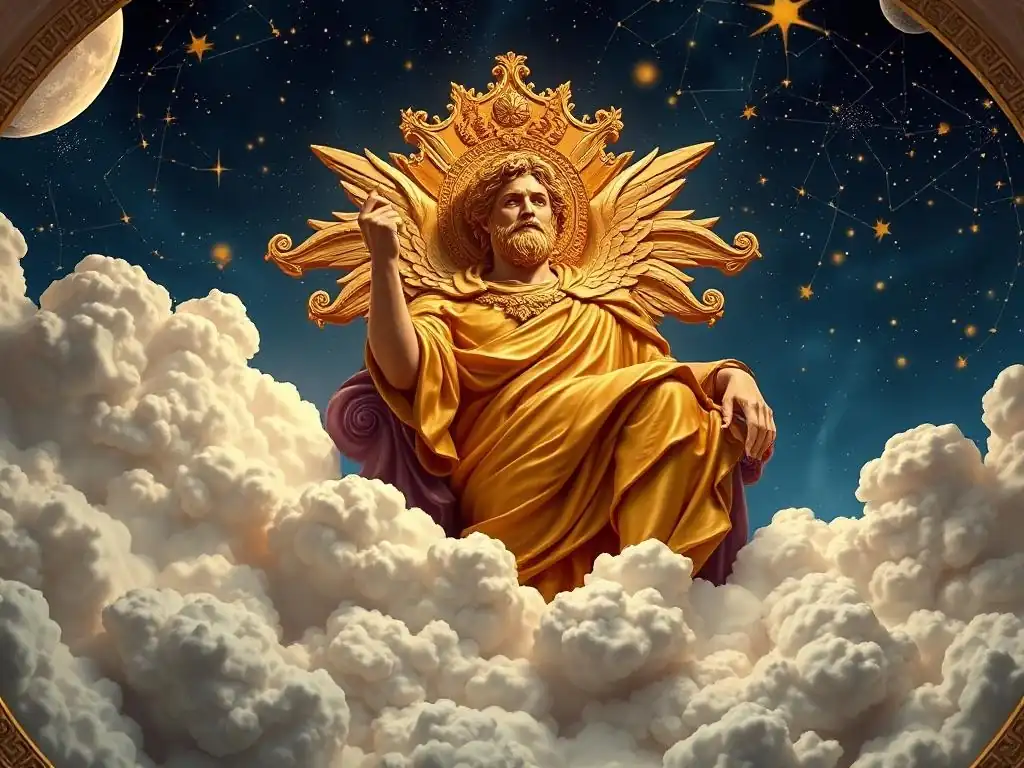
One of the most significant and enduring legacies of Uranus is found in astronomy and astrology. The seventh planet from the Sun, discovered by William Herschel in 1781, was eventually named Uranus. This naming convention followed the tradition of naming planets after Roman deities (Mercury, Venus, Mars, Jupiter, Saturn), with Uranus being the Roman counterpart to the Greek Ouranos (Uranus). This choice solidified the primordial sky god's place in modern scientific nomenclature, representing the vast, distant reaches of our solar system.
In astrology, the planet Uranus is associated with sudden change, rebellion, innovation, and unpredictability. Its discovery coincided with major historical upheavals like the American and French Revolutions, leading astrologers to link its influence to radical shifts and technological advancements. While astrological interpretations are distinct from mythological narratives, the core association with the sky, vastness, and perhaps the disruptive nature of his overthrow resonates loosely with his mythological identity.
Uranus in Modern Mythology and Fantasy: Examples in Literature and Film
Although not as prominent as Zeus or Hades, Uranus occasionally appears or is referenced in modern literature and fantasy works that draw upon Greek mythology. Authors and creators might depict him as a distant, ancient power, a force of the cosmos, or perhaps a cautionary tale about oppressive rule. He might feature in retellings of the Greek creation myth, often focusing on his role as the tyrannical father overthrown by his son.
Examples are more subtle than direct appearances. He might be mentioned in fantasy novels exploring the origins of their worlds, drawing parallels to the primordial sky god. In some interpretations or adaptations, the violent nature of his myth is emphasized, reflecting themes of generational trauma or the necessary destruction of old orders for new ones to emerge. While not a mainstream character, his foundational role in Greek mythology ensures his occasional inclusion when exploring the deepest roots of the pantheon.
The Importance of Remembering Uranus: Understanding Early Greek Beliefs
Understanding the myths of the Greek god Uranus is crucial for anyone seeking a comprehensive grasp of Greek mythology and ancient Greek beliefs. He represents the initial state of the cosmos, the first ruler, and the source from which the powerful Titans and subsequently the Olympians descended. His story explains the origin of key figures like Aphrodite and the Furies and establishes the theme of generational conflict that defines much of Greek divine history.
Studying Uranus allows us to appreciate the evolution of Greek theological thought, from the primordial, abstract deities representing fundamental cosmic elements to the more anthropomorphic and complex gods of the Olympian pantheon. The Greek god Uranus myths provide a window into the ancient world's attempts to explain creation, order, and the often-violent transitions of power that shaped their understanding of the universe. Ignoring Uranus would be like starting a family history from the grandchildren, missing the foundational figures and events.
Conclusion: Reflecting on the Greek God Uranus and His Place in Mythology
Uranus, the primordial Greek god of the sky, stands as a foundational figure in Hellenic mythology. As the starry heaven personified, his union with Gaia, the Earth, birthed the universe's first divine generations – the mighty Titans, the skilled Cyclopes, and the monstrous Hecatoncheires. His reign, though supreme, was marked by fear and tyranny, culminating in his violent overthrow by his son, Cronus. This pivotal event not only ended the age of Uranus but also paved the way for the rise of the Titans and, eventually, the Olympian gods led by Zeus.
While less celebrated in popular culture than his Olympian descendants, the legacy of Uranus endures. His name graces a planet, linking ancient myth to modern science. His story, particularly the Greek god Uranus myths detailing his creation and downfall, remains essential for understanding the structure, history, and core themes of Greek mythology, from the origins of the cosmos to the cyclical nature of power and rebellion that shaped the divine world. He remains a potent symbol of the primeval sky and the distant, foundational source of the mythological universe.
Frequently Asked Questions
### Who was Caelus in Roman mythology?
Caelus was the Roman god of the sky, often considered the personification of the heavens. He predates many of the more well-known Roman deities like Jupiter.
### What is Caelus's role in Roman creation myths?
Caelus is typically depicted as the primordial sky god who, with Terra (Earth), gave birth to the first generation of gods and titans. He is a foundational figure in Roman cosmology.
### What is the relationship between Caelus and Uranus in Greek mythology?
Caelus is the Roman equivalent of the Greek god Uranus. Both represent the sky and are considered the father of the Titans.
### Why is Caelus less prominent in Roman mythology than Jupiter?
Caelus's role diminished over time as Jupiter rose to prominence. He became more of an abstract concept while Jupiter became the king of the gods with a more active role.
### Are there any surviving temples or significant cults dedicated to Caelus?
Unlike Jupiter, there is limited archaeological evidence of dedicated temples or widespread cults specifically worshipping Caelus. His worship was less formalized and more integrated into broader cosmological beliefs.
Final Reflection: Caelus's Enduring Legacy in the Roman Pantheon
The myths surrounding Caelus, the primordial Roman god of the sky, offer not just a glimpse into ancient Roman cosmology but a powerful reflection on the cyclical nature of power and the enduring human fascination with the heavens. His story, one of both creation and violent overthrow, resonates even today, reminding us that even the most seemingly immutable forces are subject to change.
Caelus's influence extends far beyond the dusty pages of ancient texts. His story, a narrative of generational conflict and the shifting tides of divine authority, continues to shape our understanding of mythology and the very structure of power itself. The struggle between father and son, a recurring motif in mythology, finds a potent expression in the conflict between Caelus and Saturn. This primal struggle speaks to something deeply ingrained in the human psyche – the tension between established order and the inevitable rise of new forces. The gods themselves cannot escape the laws of change and decay.
This timeless truth, applicable to both divine and human realms, is powerfully illustrated in Caelus's eventual dethronement.
Consider, for a moment, the vastness of the sky above you. Think of the countless stories woven into the constellations, each a testament to the enduring human need to understand and make sense of the universe.
Let Caelus's story inspire you to explore the rich tapestry of Roman mythology, to delve deeper into the stories that shaped a civilization, and to contemplate the ever-shifting dynamics of power and legacy, both in the divine and the human world. His tale is not merely a historical account; it is a timeless narrative that speaks to our own ongoing quest for meaning and understanding in a constantly evolving world.
Here's a CTA tailored to an article about Caelus, the Roman god of the sky, on MythologyAndLegends.org:
Unveil the Celestial Secrets of Caelus!
Thank you for exploring the fascinating world of Caelus, the Roman sky god! We hope you gained a new appreciation for his influence on Roman mythology and the rich tapestry of ancient beliefs. Now it's your turn to delve deeper!
- Share your newfound knowledge: Discuss Caelus's story with friends or family – you might spark a whole new interest in Roman mythology! Imagine the conversations you could start!
- Dive into further research: Explore other early Roman deities and their connections to Caelus. Who else shared his power and influence?
- Create your own Caelus-inspired art: Let your creativity soar! Design a representation of Caelus, or perhaps a scene from his mythology. Share your creation with us – we’d love to see it!
What other lesser-known Roman deities would you like to explore next? Let us know in the comments below!