
Min: Egypt's Ancient God of Fertility and Kingship

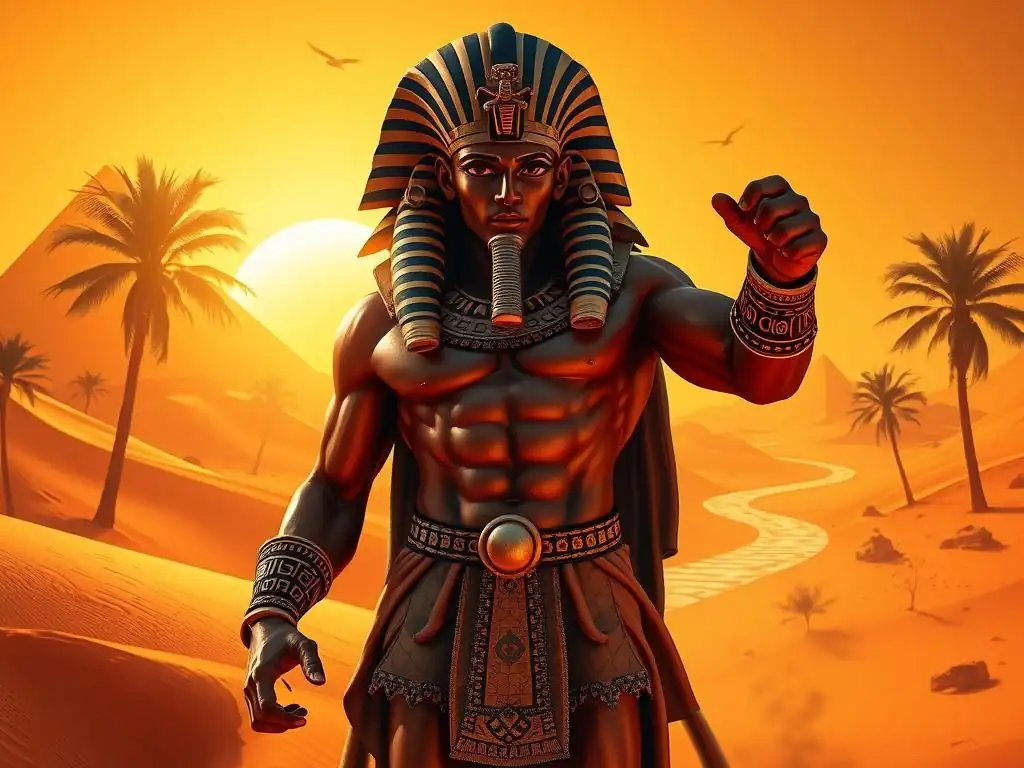
Welcome, seeker of ancient wisdom!
Delve into the captivating world of Mythology and Legends, where stories whisper from the dawn of civilization. Ever wondered about the forces that shaped ancient beliefs and continue to resonate today? Let's unravel the mysteries together.
Our journey begins in the fertile lands of Egypt, where we explore the enigmatic figure of Min: Egyptian fertility deity. What secrets does this ancient god hold, and how did he influence the lives of pharaohs and commoners alike? Prepare to be intrigued as we uncover the story of Min, and his enduring legacy.
- Introduction to Min
- Origins and Evolution of Min
- Min's Attributes and Symbolism
- Min as a God of Fertility and Agriculture
- Min's Association with Kingship
- Major Cult Centers and Temples
- Min in Egyptian Art and Literature
- Min's Syncretism with Other Deities
- Decline of Min's Worship and Legacy
- Conclusion
- Frequently Asked Questions
- Final Reflection: The Enduring Legacy of Min, God of Fertility and Kingship
- Unleash the Power of Min: Explore Ancient Egypt's Mysteries!
Introduction to Min
Overview of Min's Role
Min stands as one of the most ancient and enduring deities in the Egyptian pantheon, revered primarily as a god of fertility, procreation, and regeneration. His influence extended beyond the natural world, encompassing the fertility of the land and the generative power necessary for abundant harvests, crucial for the survival of Egyptian society. As a Min: Egyptian fertility deity, he was essential for ensuring the continuity of life, from human reproduction to the annual cycle of crops.
Beyond his powerful association with fertility, Min also held significant sway over aspects of kingship and royal power. He was often depicted as a protector of the pharaoh, ensuring the king's vitality and ability to rule effectively. Furthermore, Min was linked to travelers, particularly those journeying through the Eastern Desert, acting as a guardian for miners and traders. This multifaceted role solidified his position as a vital deity across various strata of ancient Egyptian life.
Min's Significance
The significance of Min in ancient Egypt cannot be overstated, as he embodied fundamental forces essential to civilization: life, abundance, and continuity. His worship was deeply intertwined with the agricultural calendar, with festivals dedicated to him marking crucial points in the growing cycle, such as the harvest. This direct link to the sustenance of the population made him a central figure in the daily lives and religious practices of ordinary Egyptians.
Moreover, Min's connection to kingship elevated him to a position of national importance. The health and vigor of the pharaoh were believed to directly impact the prosperity of the land, and Min's role in ensuring fertility extended to the generative power of the ruler. His presence in royal ceremonies reinforced the divine legitimacy of the king, portraying the pharaoh as a vital link between the divine forces of creation and the earthly realm's abundance.
Origins and Evolution of Min
Pre-Dynastic Origins
The roots of Min's worship stretch back into Egypt's Predynastic period (before c. 3100 BCE), making him one of the oldest attested gods. Evidence for his early veneration is particularly strong at Coptos (modern Qift) in Upper Egypt. Archaeological finds from this era, notably three colossal limestone statues dating possibly to the Naqada II period (c. 3500-3200 BCE), are widely believed to represent Min. These early, somewhat rudimentary depictions already hint at his ithyphallic nature and perhaps foreshadow his later attributes.
The presence of a well-established cult center at Coptos during such an early period suggests that Min was a significant regional deity long before the unification of Egypt. His association with this important trade route gateway to the Red Sea might also indicate an early connection to travelers or protective functions alongside his primary role as a Min: Egyptian fertility deity. This deep history underscores his foundational importance in the development of Egyptian religious thought.
Development of Iconography
Min's iconic representation became remarkably consistent throughout dynastic history, solidifying his visual identity. From at least the Early Dynastic period, he is typically depicted as a mummiform figure, wrapped tightly in linen, standing upright with an erect phallus. This distinctive posture and attribute immediately communicate his role as a god of fertility and generative power.
Over time, other elements were added and standardized in his iconography. He is almost always shown wearing a tall, plumed crown, often featuring two prominent feathers. In his raised right hand, he holds a flail or whip, a symbol associated with authority, and sometimes linked to agricultural practices like threshing. His skin is frequently colored black, potentially symbolizing the fertile black silt of the Nile or the regenerative earth. These consistent visual cues made Min instantly recognizable across countless temple reliefs, statues, and tomb paintings.
Min's Attributes and Symbolism
The Erect Phallus
The most prominent and unmistakable attribute of Min is his erect phallus, central to his iconography and symbolic representation. This feature directly and powerfully embodies his primary role as a Min: Egyptian fertility deity, symbolizing procreation, potency, and the generative forces of life. It represents the raw power of creation, essential for the continuation of species, the flourishing of crops, and the regeneration of the world itself.
This explicit depiction was not merely about human sexuality but encompassed the broader concept of vitality and abundance in all forms. It signified the divine energy that spurred growth, ensured successful reproduction in animals, and guaranteed the bounty of the earth. The erect phallus served as a constant visual reminder of Min's crucial function in maintaining the cosmic order by providing the necessary life force.
Lettuce and Agricultural Symbols
Among the less overt but equally significant symbols associated with Min is the lettuce plant. Specifically, a type of wild lettuce ( Lactuca serriola) was linked to Min because of its milky sap, which was perceived by the Egyptians as analogous to semen. This association reinforced Min's role as a god of fertility and sexual potency, connecting plant life directly to the generative power he represented.
Min was also frequently depicted surrounded by gardens or fields, sometimes shown with offerings of produce. These visual cues further emphasized his domain over agriculture and the fertility of the land. The success of the harvest was directly attributed to his power, and the rituals performed in his honor, such as the "Going Forth of Min" festival, were designed to invoke his blessing for a bountiful yield, highlighting his integral role in the agricultural economy.
The White Bull
The bull, particularly the white bull, was another important animal associated with Min, symbolizing virility, strength, and reproductive power. Bulls were revered in various Egyptian cults for their potent life force, and their connection to Min underscored his own powerful generative capabilities. The white bull specifically might have held additional symbolic significance related to purity or divine essence.
While not as central to his iconography as the phallus or flail, the association with the bull reinforced Min's image as a potent, life-giving deity. This link connected him to the broader Egyptian reverence for powerful, fertile animals and integrated his worship into the wider symbolic language of vitality and strength that permeated Egyptian religious thought.
Min as a God of Fertility and Agriculture
Min's Role in Crop Growth
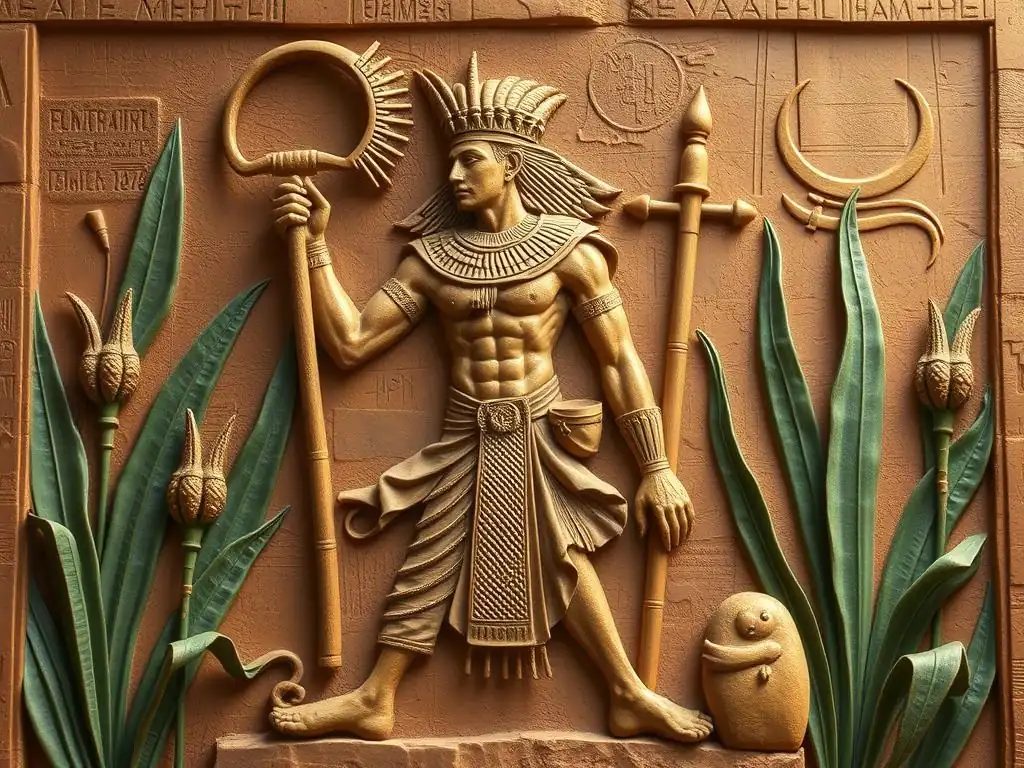
As a Min: Egyptian fertility deity, Min was considered instrumental in ensuring the success of agricultural endeavors, the backbone of the Egyptian economy. His divine power was believed to initiate and sustain the growth cycle, from the germination of seeds to the ripening of crops. Egyptians prayed to Min and performed rituals to invoke his blessing for abundant harvests of essential grains like barley and emmer wheat, as well as other produce.
The annual flooding of the Nile, which deposited fertile silt crucial for farming, was implicitly linked to Min's generative power. While other gods, like Hapi, embodied the inundation itself, Min's domain over fertility meant he was seen as the force that made the land receptive and fruitful after the waters receded. His role thus spanned the entire process, from the potential inherent in the earth to the realization of a successful yield.
Rituals and Festivals
Worship of Min involved numerous rituals and festivals designed to celebrate and invoke his life-giving powers. The most famous was the "Going Forth of Min" (or "Procession of Min"), a major state festival often celebrated at the beginning of the harvest season or sometimes linked to the king's accession or Heb Sed jubilee. This festival was depicted in reliefs in various temples, notably at the Ramesseum in Thebes.
During the festival, a statue of Min would be carried in procession, often accompanied by the pharaoh, who would perform symbolic agricultural acts, such as cutting the first sheaf of grain or plowing a furrow. These rituals were intended to ensure the fertility of the land for the coming year and reaffirm the king's role as mediator between the divine and the earthly realm, ensuring prosperity through his connection to Min. The festival was a vibrant public display of reverence for the god responsible for the nation's sustenance.
Connection to the Nile
Min's role as a Min: Egyptian fertility deity was inextricably linked to the Nile River, the source of Egypt's life and fertility. Although the Nile itself was personified by the god Hapi, the transformative power of the inundation – turning arid land into fertile fields – fell under Min's generative domain. The rich, black silt deposited by the floodwaters was seen as the fertile earth, made productive by Min's divine energy.
The cyclical nature of the Nile's flooding and receding mirrored the themes of death and regeneration central to Egyptian belief, and Min's power was key to this cycle of renewal. His festivals were often timed to coincide with phases of the agricultural year dictated by the Nile's behavior. Thus, the prosperity brought by the Nile was ultimately attributed to the life-giving force embodied by Min.
Min's Association with Kingship
Min as a Protector of the Pharaoh
Min was closely associated with the Egyptian pharaoh and often regarded as a divine protector of the king. His power over fertility extended to ensuring the vitality and potency of the ruler, which was considered essential for the well-being and prosperity of the entire kingdom. A vigorous and fertile king was believed to guarantee the fertility of the land and the success of the harvest.
Reliefs and inscriptions frequently depict Min alongside the pharaoh in ceremonial contexts, underscoring this protective relationship. The king, as the intermediary between the divine and human realms, relied on gods like Min to validate his rule and ensure the continuity of the dynasty. Min's association with strength and potency further reinforced the image of the pharaoh as a powerful and capable leader.
Min's Role in Royal Ceremonies
Min played a significant role in various royal ceremonies, most notably the "Going Forth of Min" festival, which often featured the pharaoh prominently. As described earlier, the king's participation in symbolic agricultural acts during this festival directly linked his legitimacy and power to the fertility of the land, which was under Min's purview. This ritual demonstrated the king's ability to secure divine favor for abundance.
Furthermore, Min was sometimes linked to the Heb Sed festival, a jubilee celebrating the king's long reign (typically after 30 years). While primarily focused on the rejuvenation of the king's powers, the underlying theme of renewed vitality and continuity resonated with Min's domain over regeneration and fertility. His presence in such ceremonies reinforced the idea that the king's rule was blessed by the forces of life and abundance embodied by this important Min: Egyptian fertility deity.
Link Between Fertility and the Pharaoh's Reign
A fundamental concept in ancient Egyptian ideology was the intrinsic link between the fertility and prosperity of the land and the vitality and legitimacy of the pharaoh. Min, as the primary deity of fertility, was central to this concept. It was believed that if the king was strong and righteous, the gods, including Min, would bless Egypt with abundant harvests and successful reproduction.
Conversely, famine or hardship could sometimes be interpreted as a sign of divine displeasure, potentially linked to the king's actions or lack of favor from deities like Min. Therefore, maintaining a close relationship with Min through worship and ritual was crucial for the pharaoh, not only to ensure personal potency but also to guarantee the well-being and continuity of the entire state, which depended on the fertility of the land and its people.
Major Cult Centers and Temples
Coptos (Qift)
Coptos (modern Qift) was arguably the most ancient and important cult center for Min, dating back to the Predynastic period. Located in Upper Egypt, Coptos was a strategic city at the start of trade routes leading through the Eastern Desert to the Red Sea. This location likely contributed to Min's expanded role as a protector of travelers and the desert, alongside his primary function as a Min: Egyptian fertility deity.
The archaeological evidence from Coptos, particularly the colossal statues discovered by Flinders Petrie, provides compelling proof of Min's early and sustained importance here. Throughout dynastic history, temples dedicated to Min flourished in Coptos, serving as major centers of worship and pilgrimage. The city's identity became strongly tied to the god, reflecting his deep roots in the region.
Other Temples and Shrines
While Coptos remained primary, Min was also widely worshipped throughout Egypt, with significant cult centers in other locations. Akhmim (ancient Panopolis) in Upper Egypt was another major city dedicated to Min, sometimes considered a twin cult center to Coptos. Panopolis derived its Greek name from "Pan," a Greek god with fertility aspects, highlighting the perceived similarities by later cultures.
Beyond these major centers, shrines and smaller temples dedicated to Min were found in various parts of the country, often integrated into larger temple complexes dedicated to other gods. His image and symbols appear on temple walls from the Delta to Nubia, indicating his widespread recognition and importance as a Min: Egyptian fertility deity and god of kingship across the land.
Archaeological Evidence
Archaeological findings have been instrumental in understanding the worship and significance of Min. Excavations at Coptos have yielded not only the early colossal statues but also temple remains, stelae, and inscriptions that detail his cult and rituals. These artifacts provide concrete evidence of his long history and prominence in this region.
Reliefs and paintings depicting Min are abundant in temples and tombs across Egypt, such as the Ramesseum and Medinet Habu in Thebes, which feature scenes of the "Going Forth of Min" festival. Statues of Min, ranging from monumental to small votive figures, have been found at various sites. These material remains collectively paint a detailed picture of Min's iconography, his associations with fertility, kingship, and festivals, and the widespread nature of his veneration as a crucial Min: Egyptian fertility deity.
Min in Egyptian Art and Literature
Depictions of Min
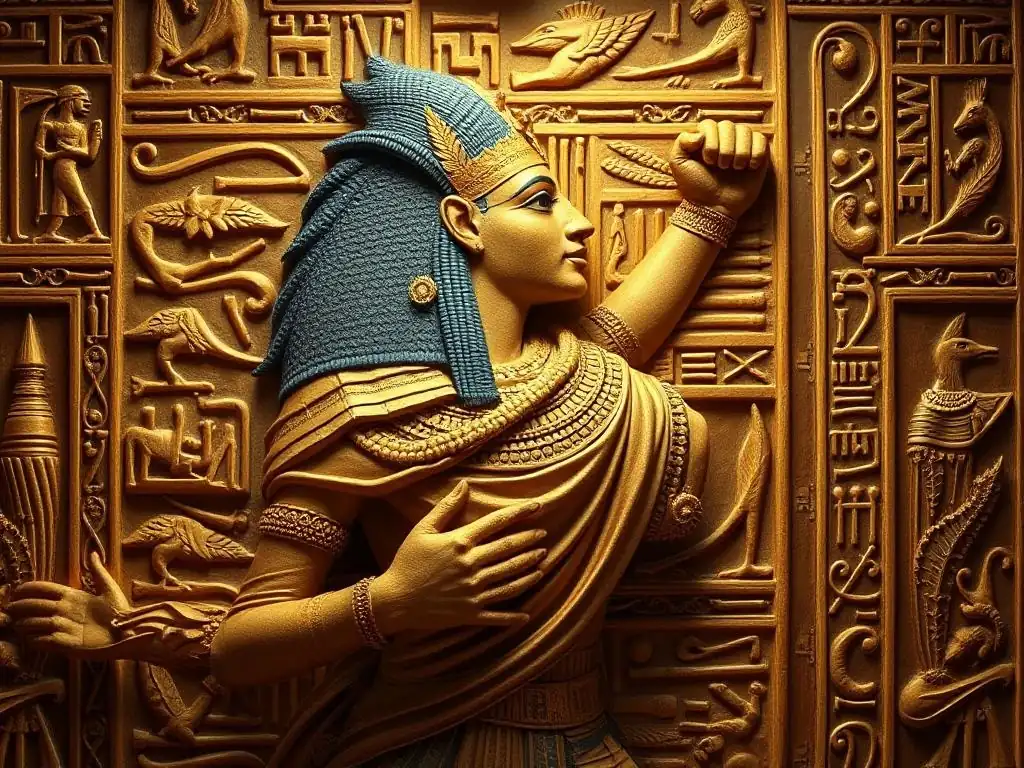
Min's representation in ancient Egyptian art is highly standardized, making him one of the most easily identifiable deities. He is almost invariably depicted as a mummiform figure, standing erect with an exposed and erect phallus. His right arm is raised, often holding a flail or whip, and he wears a distinctive tall crown with two plumes, sometimes referred to as the atef crown with added feathers, or simply the two-plumed crown.
These depictions appear across a wide range of media, including monumental temple reliefs (such as those illustrating his festivals), tomb paintings, stelae, and statues made from stone, wood, or metal. The consistency of his portrayal underscores the fixed nature of his core attributes and roles as a Min: Egyptian fertility deity and symbol of generative power. His black skin, often depicted, symbolizes the fertile soil of the Nile Valley.
References in Religious Texts
Min is referenced in various ancient Egyptian religious texts, including hymns, spells, and inscriptions found in tombs and temples. These texts provide insights into the theological understanding of his nature and functions. Hymns praise him for his generative power, his role in ensuring abundant harvests, and his connection to the king's vitality. For example, texts might describe him as "Min, lord of processions, who makes the garden flourish."
Spells often invoke Min's power for fertility, protection, or regeneration. His name and attributes appear in funerary texts, reflecting the Egyptian belief in regeneration and rebirth in the afterlife, a concept closely aligned with Min's domain over life and continuity. These literary sources complement the visual representations, offering a deeper understanding of Min's significance within the complex tapestry of Egyptian religious thought.
Min's Syncretism with Other Deities
Min-Amun
Over time, particularly during the New Kingdom (c. 1550-1070 BCE), Min was often syncretized with other powerful deities, most notably Amun of Thebes, creating the composite deity Min-Amun. This fusion represented a combination of Min's ancient fertility aspects with Amun's role as the king of the gods, a solar deity, and a creator god. In this combined form, Min's generative power became integrated into the supreme divine force of the state pantheon.
Min-Amun was especially prominent in Thebes, where Amun's cult was dominant. The iconography of Min-Amun often retained Min's characteristic erect phallus and flail, combined with Amun's headdress (often with two tall plumes, aligning easily with Min's crown) and sometimes the ram or goose associated with Amun. This syncretism elevated Min's fertility domain to a cosmic level, linking it directly to the power of the most important state god.
Evolution of Min's Cult
The syncretism with Amun is just one example of how Min's cult evolved throughout Egyptian history. His association with Coptos and desert routes led to connections with deities like Isis and Seth, who also had ties to these regions or to protective functions. In later periods, particularly during the Ptolemaic and Roman eras, Min was sometimes associated with Greek deities like Pan or Priapus, who shared similar fertility attributes.
The evolution of Min's worship reflects the dynamic nature of ancient Egyptian religion, where divine roles and identities could merge and adapt over millennia. While his core identity as a Min: Egyptian fertility deity remained central, these syncretic forms demonstrate how his power was integrated into changing theological landscapes and interactions with foreign cultures, ensuring his continued relevance, albeit sometimes in modified forms.
Decline of Min's Worship and Legacy
Factors Contributing to Diminishment
The direct, prominent worship of Min as a standalone deity gradually diminished with the decline of the ancient Egyptian civilization itself. The end of the pharaonic period, followed by successive foreign rules (Persian, Greek, Roman), led to shifts in religious practices and the prominence of different cults. The rise of Christianity and later Islam in Egypt ultimately replaced the traditional polytheistic religion.
Specific factors contributing to the decline of Min's distinct cult might include the increasing dominance of syncretic forms like Min-Amun, which absorbed his identity into a larger deity, or simply the natural ebb and flow of divine popularity over thousands of years. While aspects of his role might have been implicitly transferred to other figures or concepts, his explicit veneration faded as the ancient temples fell into disuse.
Min's Lasting Impact
Despite the cessation of his formal worship, Min's symbolism and the concepts he embodied left a lasting impact. His central role as a Min: Egyptian fertility deity underscores the paramount importance of agricultural abundance and regeneration in Egyptian culture, themes that continued to resonate even under different religious systems. The visual power of his iconography, particularly the erect phallus, ensured his recognition throughout history as a potent symbol of life force.
Furthermore, his association with kingship highlights the ancient understanding of the link between a ruler's vitality and the prosperity of the state, a concept found in various cultures. While the deity Min faded, the underlying principles of fertility, regeneration, and the sacredness of life, which he so powerfully represented, remained fundamental to the land and people of Egypt.
Min's Representation in Modern Interpretations
In modern times, Min is primarily encountered in the context of academic study, museum collections, and popular culture interested in ancient Egypt. Egyptologists study his origins, iconography, and cult practices to understand ancient Egyptian religion and society. His striking visual representation makes him a memorable figure in books and documentaries about Egyptian mythology.
While not worshipped today, Min serves as a powerful symbol of the ancient Egyptian reverence for fertility, life, and the generative forces of nature. He appears in historical fiction, art, and sometimes even in contemporary spiritual or esoteric contexts exploring ancient pantheons. As a Min: Egyptian fertility deity, he continues to represent the enduring fascination with the life-affirming beliefs of this ancient civilization.
Conclusion
Summarizing Min's Role
Min was a pivotal deity in the ancient Egyptian pantheon, revered primarily as a god of fertility, procreation, and regeneration. His domain encompassed the abundance of the land, ensuring successful harvests crucial for sustenance, and the generative power necessary for the continuity of life in all its forms. As a Min: Egyptian fertility deity, he was essential for the very survival and prosperity of the civilization.
Beyond fertility, Min held significant sway over kingship, protecting the pharaoh and ensuring the ruler's vitality, which was intrinsically linked to the well-being of the state. He was also a guardian of travelers, particularly in the desert regions. His multifaceted role, deeply rooted in Egypt's Predynastic past, made him a central figure in religious life, agriculture, and royal ideology for millennia.
Reflecting on Min's Significance
Min's significance lies in his embodiment of life's fundamental forces and his integral connection to the core concerns of ancient Egyptian society: securing food, ensuring continuity, and validating leadership. His ancient origins and consistent worship over thousands of years attest to his enduring importance. The elaborate rituals and festivals dedicated to him demonstrate the profound reliance placed on his divine power for the nation's prosperity.
His powerful and explicit symbolism, particularly the erect phallus and association with fertile plants and animals, communicated his role with unmistakable clarity. As a Min: Egyptian fertility deity, he was a source of vital power, essential for the flourishing of both the natural world and the human realm, including the royal lineage.
Min: A Lasting Legacy
Though the temples where Min was worshipped now stand as historical monuments, his legacy as a key figure in ancient Egyptian mythology endures. He represents the deep connection the Egyptians felt to the cycles of nature, the importance they placed on fertility and regeneration, and the way they integrated these concepts into their understanding of divine power and kingship.
Min, the Min: Egyptian fertility deity, remains a fascinating subject of study, offering insights into the beliefs and practices of one of history's greatest civilizations. His powerful iconography and ancient cult remind us of the universal human concerns with life, death, and rebirth, and the diverse ways ancient cultures sought to understand and influence these fundamental forces.
Frequently Asked Questions
What were Min's primary roles in Ancient Egyptian religion?
Min was primarily worshipped as a fertility deity and a god of kingship. He was also associated with male virility and the eastern desert regions.
What are the common symbols associated with Min?
Common symbols include an erect phallus, a flail, and a bed of lettuce. These symbols represent his power of procreation and his connection to agriculture.
How was Min typically depicted in Egyptian art?
He was usually depicted as a mummified man with an erect penis, wearing a crown with two tall plumes. He often held a flail in his raised hand.
What kinds of festivals and rituals were performed in honor of Min?
The most important festival was the Festival of Min, celebrating the harvest. It involved processions, offerings, and the enthronement of the pharaoh.
How did Min's worship impact ancient Egyptian society and culture?
Min's worship reinforced the importance of fertility and kingship, ensuring the continuity of the royal line and the success of the harvest, both vital for Egyptian society.
Final Reflection: The Enduring Legacy of Min, God of Fertility and Kingship
The worship of Min, a potent symbol of life's generative force, resonates deeply even in our modern world. His enduring presence in ancient Egyptian art and mythology speaks volumes about the timeless human fascination with fertility, power, and the cyclical nature of life and death. While the temples may be silent ruins, the echoes of Min's influence continue to reverberate.
Min's impact transcends the confines of ancient Egypt; his symbolism of virility and abundance continues to subtly shape our understanding of power and prosperity. The connection between fertility, both human and agricultural, and the strength of a kingdom remains a powerful metaphor, even in societies vastly different from ancient Egypt. The gods are not dead, but only sleeping,
a phrase often used to describe the resurgence of interest in ancient mythologies, perfectly encapsulates Min's continued relevance. His image, a potent reminder of the cyclical nature of life, continues to inspire awe and reflection.
Consider, for a moment, the enduring power of symbols. Min's image, whether in the form of his iconic erect phallus or his majestic depictions in temple reliefs, serves as a potent reminder of the fundamental forces that shape our world. You, too, can draw strength and inspiration from his legacy. Reflect on the importance of balance, the cyclical nature of life, and the enduring power of generative forces in your own life. Embrace the energy and vitality that Min represents, and let it fuel your own journey towards growth and fulfillment.
Here's a CTA tailored for an article about Min, the Egyptian god of fertility and kingship, on MythologyAndLegends.org:
Unleash the Power of Min: Explore Ancient Egypt's Mysteries!
Thank you for exploring the fascinating world of Min, Egypt's powerful god of fertility and kingship! You've now gained a deeper understanding of his vital role in ancient Egyptian life and mythology. Ready to delve even further?
- Craft your own Min-inspired artwork: Let Min's energy inspire your creativity. Draw, paint, sculpt – any medium will do! Share your creation on social media using #MinGodOfEgypt and tag MythologyAndLegends.org.
- Learn more about ancient Egyptian deities: Explore our website's extensive collection of articles on other fascinating Egyptian gods and goddesses. Discover the interconnected stories and rich symbolism of their world.
- Engage with our community: Share your thoughts and questions about Min in the comments below. What aspects of his story resonated most with you?
What other hidden symbols and rituals of ancient Egypt intrigue you now that you've uncovered the power of Min?