
Marduk vs. Tiamat: The Ritual Reenactment of Creation in the Akitu Festival

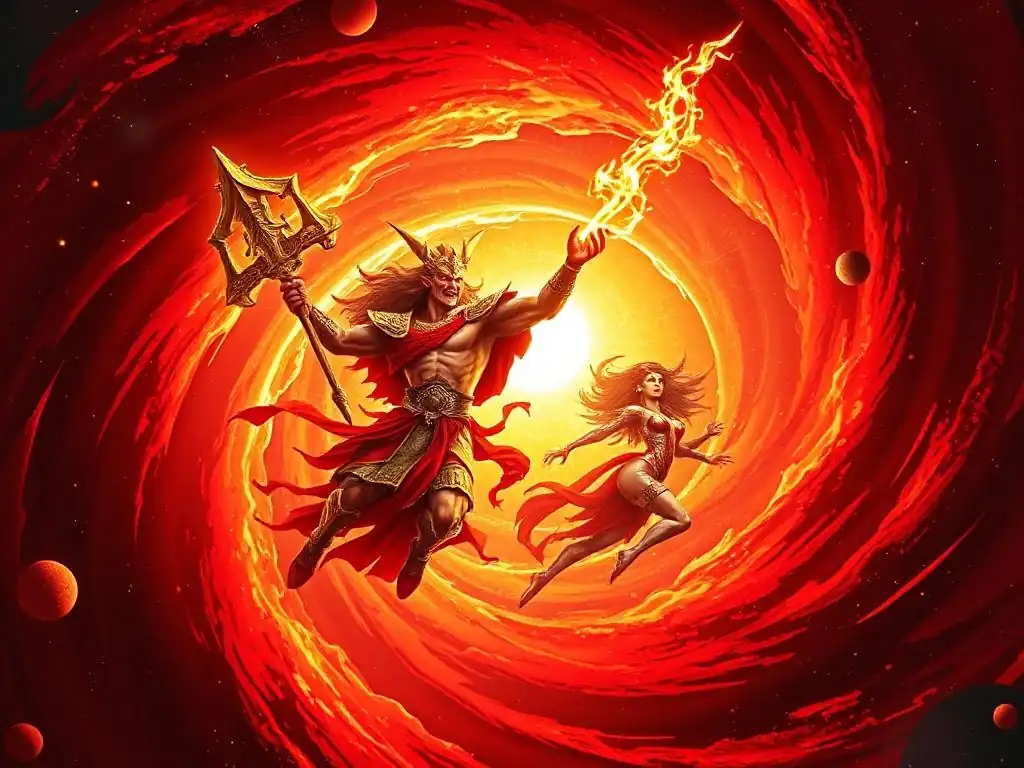
Welcome to Mythology and Legends, where the echoes of ancient tales resonate through the ages. Ever wondered how the universe itself was forged in the fires of conflict? Delve into the heart of Mesopotamian mythology as we unravel the epic struggle between Marduk and Tiamat, a battle dramatically re-enacted each year during the vibrant Akitu Festival. The story promises more than just a legend; it holds the key to understanding a civilization's very creation. Intrigued? Let's begin...
- Introduction: Understanding the Akitu Festival and its Significance
- The Myth of Marduk and Tiamat: A Cosmic Conflict
-
The Akitu Festival: Reenacting the Cosmic Drama
- The Stages of the Akitu Festival: A Detailed Overview
- Purification Rituals and the Preparation for Renewal
- The Humiliation of the King: A Symbolic Submission to the Gods
- The Recitation of the Enuma Elish: Reaffirming the Cosmic Order
- The Procession of the Gods: A Visual Representation of Divine Power
- The Sacred Marriage: Ensuring Fertility and Prosperity
- The Triumph of Marduk: Re-establishing Order and Kingship
- The Ritual Combat: Symbolizing Marduk's Victory
- Interpreting the Akitu Festival: Meaning and Purpose
- The Legacy of the Akitu Festival
- Conclusion: The Akitu Festival as a Window into Mesopotamian Cosmology
-
Frequently Asked Questions
- What is the Akitu Festival, and why is it important?
- Who were Marduk and Tiamat in Babylonian mythology?
- How was the battle between Marduk and Tiamat reenacted during the Akitu Festival?
- What was the symbolic significance of the Marduk-Tiamat battle reenactment?
- Beyond reenactment, what other activities were part of the Akitu Festival?
- Final Reflection: Echoes of Creation in a Modern World
- Unleash Your Inner Babylonian: Explore the Akitu Festival!
Introduction: Understanding the Akitu Festival and its Significance
The Akitu Festival: A Celebration of Renewal and Kingship in Ancient Mesopotamia
The Akitu festival was arguably the most important religious festival in ancient Mesopotamia, particularly in Babylon. Celebrated annually, typically spanning eleven days around the vernal equinox (the beginning of spring), it marked the New Year and the renewal of the natural world.
This complex series of rituals was not merely a calendar event; it was a crucial performance designed to re-establish cosmic order, ensure the fertility of the land, and legitimize the power of the reigning king. The festival's prominence grew significantly under the Babylonian Empire, especially during the reign of Nebuchadnezzar II, becoming a central pillar of state religion.
The festival's elaborate ceremonies took place in and around the temple complex dedicated to Marduk, Babylon's patron deity, known as the Esagila, and extended to the Akitu house (Bit Akitu), a special temple located outside the city walls. The journey between these locations, the Procession of the Gods, was a key element. The Akitu festival involved the entire community, from priests and the king to ordinary citizens, all participating in rituals that mirrored and reinforced the fundamental beliefs about the cosmos and humanity's place within it. It was a time of intense religious activity, processions, sacrifices, and dramatic performances.
The Role of Myth and Ritual in Mesopotamian Society
In Mesopotamian society, myth and ritual were deeply intertwined, serving as the foundational pillars for understanding and interacting with the world. Myths, such as the Enuma Elish, provided the narrative framework – explaining the origins of the cosmos, the gods, humanity, and the structure of society. Rituals, on the other hand, were the practical means by which these myths were made real and effective in the present. They were seen as essential actions that maintained cosmic balance, appeased the gods, and ensured the continued prosperity and stability of the community.
Rituals were not static performances but dynamic engagements with the divine realm. They could involve complex sequences of prayers, sacrifices, processions, and dramatic reenactments. These acts were believed to influence the gods, avert disaster, heal the sick, and ensure successful harvests. The performance of rituals like those in the Akitu festival was considered vital work, as necessary for the functioning of the cosmos as farming was for sustenance. The correct execution of these rites was paramount, often recorded in detail on clay tablets, reflecting their critical importance in Mesopotamian religious and social life.
Marduk, Tiamat, and the Enuma Elish: The Cosmic Battle at the Heart of the Akitu
At the very core of the Akitu festival, particularly in Babylon, lay the epic myth of Marduk and Tiamat, as recounted in the Enuma Elish, the Babylonian creation epic. This narrative describes a cosmic conflict between the younger gods, led by Marduk, and the primordial goddess Tiamat, who embodies the chaotic, salt-water ocean. Tiamat rises up to destroy her divine descendants, prompting the gods to choose Marduk as their champion, granting him supreme power to face her.
Marduk successfully defeats Tiamat in a dramatic battle, splitting her body in two to create the heavens and the earth. From the blood of Tiamat's consort, Kingu, who led her forces, humanity is created to serve the gods. This victory establishes Marduk as the king of the gods and the architect of the ordered cosmos.
The Enuma Elish thus explains not only creation but also the divine hierarchy, the role of humanity, and the establishment of Babylon as the cosmic center, with Marduk's temple, the Esagila, at its heart. The annual recitation and ritual reenactment of this Marduk Tiamat Akitu festival myth were believed to reaffirm this foundational cosmic order and Marduk's supremacy at the start of each year.
The Myth of Marduk and Tiamat: A Cosmic Conflict
Tiamat: The Primordial Mother and the Chaos of the Deep
Tiamat is depicted in the Enuma Elish as the primordial mother goddess, the embodiment of the saltwater ocean, existing from the very beginning alongside Apsu, the god of fresh water. Together, they represent the undifferentiated, chaotic waters from which the first generation of gods emerged. Initially, Tiamat seems a nurturing figure, but as her divine descendants multiply and become increasingly noisy and disruptive, disturbing Apsu, she is initially hesitant to join Apsu's plan to destroy them.
However, after Apsu is killed by the god Ea, Tiamat transforms into a vengeful, monstrous force. She gathers an army of fearsome creatures, including scorpion-men, demon dogs, and raging storms, appointing her new consort, Kingu, as their leader and bestowing upon him the Tablets of Destiny, which grant supreme authority. Tiamat becomes the ultimate symbol of chaos and primeval, untamed nature, a formidable threat to the newly established divine order and the very existence of the younger gods.
The Rise of Marduk: Champion of the Gods and Order
Facing the terrifying might of Tiamat and her monstrous army, the younger gods are paralyzed by fear. None dare to challenge her until Ea's son, Marduk, steps forward. Marduk is initially a relatively young deity, but he possesses extraordinary wisdom, strength, and strategic prowess. The gods, desperate, agree to grant him absolute sovereignty over them if he can defeat Tiamat and save them.
Empowered by this agreement, Marduk is equipped with divine weapons, including a bow, a mace, and a net, and he harnesses the four winds. He creates storms and fills his body with fire. He is depicted as a brilliant and powerful deity, destined to bring order out of chaos. His acceptance of the challenge and the subsequent granting of supreme authority mark his transition from a powerful god to the undisputed king of the gods, the central figure in the Babylonian pantheon, and the champion of cosmic order against the forces of Tiamat.
The Enuma Elish: Recounting the Epic Battle for Cosmic Supremacy
The Enuma Elish, meaning "When on High," is the Babylonian creation epic, inscribed on seven clay tablets. It narrates the cosmic struggle that culminates in Marduk's elevation to kingship and the creation of the world. The epic details the genealogy of the gods, the initial conflict between the older and younger generations, Tiamat's transformation into a vengeful monster, and her preparations for war.
The climax of the Enuma Elish is the dramatic confrontation between Marduk and Tiamat. Marduk challenges Tiamat, and they engage in a fierce duel. Marduk uses his winds to inflate Tiamat, then shoots an arrow that splits her heart. He then cleaves her massive corpse in two, using one half to form the sky and the other to form the earth.
He establishes cosmic boundaries, sets the stars in their courses, and creates humanity from the blood of Kingu to perform labor for the gods. The epic concludes with the gods acclaiming Marduk as their king and building his magnificent temple, the Esagila, in Babylon. The annual recitation of the Enuma Elish was a central ritual of the Akitu festival, reaffirming this narrative of creation and order.
The Creation of the World from Tiamat's Corpse: A Mesopotamian Cosmogony
Following his defeat of Tiamat, Marduk undertakes the monumental task of organizing the cosmos from her remains. This act of creation from the body of a slain primordial being is a common motif in various mythologies, but in the Enuma Elish, it is specifically Tiamat's vast corpse that provides the raw material for the ordered world. Marduk splits her body "like a mussel into two halves."
From the upper half, Marduk creates the heavens, fastening them securely to prevent the waters above from escaping. He establishes dwelling places for the gods and sets the celestial bodies – the sun, moon, and stars – in their paths to regulate time. From the lower half, he forms the earth.
He organizes the waters, creating rivers like the Tigris and Euphrates. This cosmogony portrays the world not as a result of divine fiat from nothingness, but as a transformation of primordial chaos (Tiamat) into a structured, habitable realm under the authority of Marduk. The creation of humanity from Kingu's blood reinforces the idea that humans are intrinsically linked to the cosmic conflict and exist to serve the gods who brought order from the chaos of Tiamat.
The Akitu Festival: Reenacting the Cosmic Drama
The Stages of the Akitu Festival: A Detailed Overview
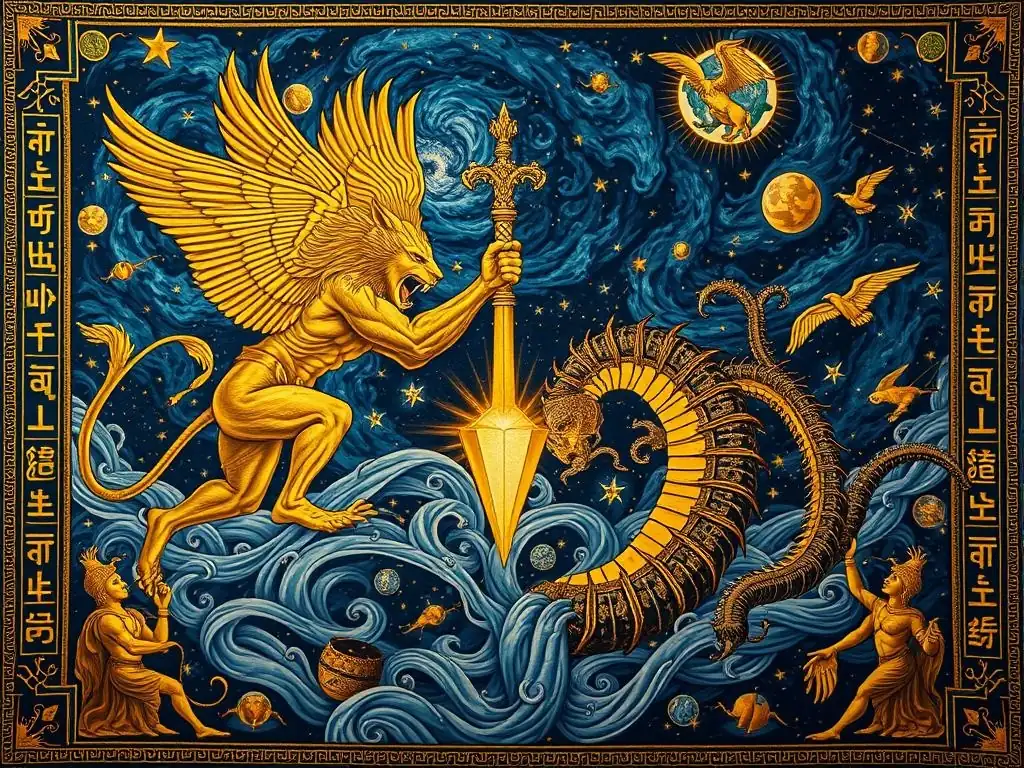
The Akitu festival in Babylon was an elaborate eleven-day event, each day marked by specific rituals and ceremonies. While details vary slightly in surviving texts, a general sequence can be reconstructed. The first few days involved preparatory rituals, including purification rites for the temple and priests, and private prayers. On the fourth day, a significant event was the recitation of the entire Enuma Elish in the Esagila temple. The fifth day saw the symbolic humiliation of the king.
The latter half of the festival involved public processions and more dramatic reenactments. The statues of various gods from surrounding cities would be brought into Babylon to participate. A key event was the procession of Marduk's statue along the processional way to the Akitu house outside the city walls.
This journey often symbolized a battle or struggle, culminating in a ritual victory for Marduk. The festival concluded with celebrations, possibly including a sacred marriage rite, and the return of the gods' statues to their temples, signifying the renewal of kingship, the cosmos, and the city's prosperity for the coming year.
Purification Rituals and the Preparation for Renewal
Before the main events of the Akitu festival could commence, extensive purification rituals were undertaken. These were essential to cleanse the sacred spaces, the participants, and the city itself, preparing them for the renewal of the cosmos. Priests would perform rites to purify the Esagila temple, removing any ritual impurity accumulated throughout the year.
These purification ceremonies likely involved washing, fumigation with incense, and specific incantations. The goal was to create a ritually pure environment suitable for the presence of the gods and the performance of the most sacred rites, including the recitation of the Enuma Elish and the ritual reenactment of the Marduk Tiamat conflict. This preparatory phase underscored the Mesopotamian belief that order and divine favor required meticulous attention to ritual purity and correctness.
The Humiliation of the King: A Symbolic Submission to the Gods
A striking ritual performed on the fifth day of the Akitu festival involved the symbolic humiliation of the Babylonian king. The king, stripped of his royal regalia, would enter the Esagila temple. The high priest would meet him, remove his crown, scepter, and ring, and perhaps even strike him across the face. The king would then kneel before the statue of Marduk and make a negative confession, vowing that he had not committed any sins against the god or his city during the past year.
Following this act of submission and confession, the high priest would restore the king's insignia, signifying that Marduk had reaffirmed his kingship. This ritual served multiple purposes: it reinforced the idea that the king's authority was derived from Marduk, demonstrated the king's piety and accountability to the divine realm, and ritually cleansed the king, preparing him to lead the city and the cosmos into the new year under Marduk's favor. It was a powerful symbolic representation of the king's dependence on divine legitimacy, mirroring the cosmic hierarchy established by Marduk's victory over Tiamat.
The Recitation of the Enuma Elish: Reaffirming the Cosmic Order
A pivotal moment in the Akitu festival, typically occurring on the fourth day, was the full, public recitation of the Enuma Elish. This epic poem, detailing Marduk's victory over Tiamat and the subsequent creation of the world and humanity, was read aloud within the sacred precincts of the Esagila temple. The act of reciting the myth was not merely a retelling; it was a performative act believed to ritually re-create or re-affirm the cosmic order described within the narrative.
By recounting Marduk's struggle and triumph over the forces of chaos (Tiamat), the Babylonians ritually reinforced the stability and structure of their world at the critical juncture of the New Year. The recitation served to remind everyone of Marduk's supremacy, the divine basis of the cosmos, and the established hierarchy. It was an auditory reenactment of the foundational myth, ensuring that the power and order brought forth by Marduk's defeat of Tiamat were renewed and secured for the coming year, linking the narrative of the Marduk Tiamat Akitu Festival directly to the city's well-being.
The Procession of the Gods: A Visual Representation of Divine Power
A highly public and visually impressive part of the Akitu festival was the procession of the gods. Statues of prominent deities from temples within Babylon and possibly from surrounding cities would be carried along the city's grand processional way, adorned with bright glazed bricks depicting lions and other symbols, to the Akitu house located outside the city walls. Marduk's statue was the central figure in this procession.
This journey was more than just a parade; it was a symbolic movement representing the gathering of the divine assembly, acknowledging Marduk's leadership, and potentially reenacting elements of the cosmic journey or battle described in the Enuma Elish. The return journey from the Akitu house back into the city symbolized the re-entry of divine power and blessing into Babylon for the new year.
The procession was a tangible manifestation of the divine presence and hierarchy, reinforcing the religious and political centrality of Marduk and Babylon, and allowing the populace to witness and participate in the movement of the divine powers that governed their world.
The Sacred Marriage: Ensuring Fertility and Prosperity
While the evidence is debated among scholars, some interpretations suggest that a ritual known as the "sacred marriage" (hieros gamos) may have been part of the later stages of the Akitu festival, particularly in earlier Sumerian or Old Babylonian periods, though its precise form and timing in the Neo-Babylonian Akitu focused on Marduk are less clear. If performed, this rite typically involved the king symbolically marrying a priestess representing a major goddess (like Inanna/Ishtar in Sumerian contexts), or perhaps even enacting a union between deities like Marduk and his consort Zarpanitu.
The purpose of the sacred marriage was primarily to ensure the fertility of the land, the prosperity of the kingdom, and the abundance of harvests in the coming year. It was a ritual act designed to stimulate the creative forces of nature through the symbolic union of divine or divinely-representing figures. While its exact role and performance in the Marduk-centric Akitu festival are subjects of ongoing scholarly discussion, the concept aligns with the festival's overall theme of renewal and the securing of blessings for the new year.
The Triumph of Marduk: Re-establishing Order and Kingship
Every aspect of the Akitu festival ultimately pointed towards the reaffirmation of Marduk's triumph over Tiamat and the re-establishment of the cosmic order he created. The recitation of the Enuma Elish narrated the victory, the procession of the gods acknowledged his supremacy, and the humiliation and reinstatement of the king demonstrated that earthly rule was contingent upon Marduk's divine favor.
The conclusion of the eleven-day festival marked the successful ritual renewal of the cosmos. Marduk's power, which had been challenged by chaos (Tiamat) at the mythical beginning of time, was ritually revitalized. The king's legitimate rule, derived from Marduk, was confirmed. The city of Babylon, as Marduk's earthly seat, was reaffirmed as the center of the ordered world. The Akitu festival was, therefore, a yearly performance guaranteeing the continued stability and prosperity of the Babylonian state and cosmos under the reign of Marduk, echoing the foundational events of the Marduk Tiamat Akitu Festival narrative.
The Ritual Combat: Symbolizing Marduk's Victory
The Symbolic Reenactment of the Battle Between Marduk and Tiamat
While the Enuma Elish describes a violent physical battle between Marduk and Tiamat, the Akitu festival's reenactment of this conflict was likely symbolic rather than a literal fight to the death. Texts indicate a ritual drama or performance where the struggle between order and chaos was represented. This could have involved mock combat, dramatic recitation with gestures, or a ritual procession that symbolized Marduk's journey to confront Tiamat and his subsequent victorious return.
Scholars suggest that elements like the journey to the Akitu house outside the city walls and the events that transpired there may have ritually mirrored Marduk's confrontation with the forces of chaos beyond the ordered city. The exact nature of this "ritual combat" is debated due to the limited nature of surviving ritual texts, but it is understood as a symbolic performance designed to make the mythical victory of Marduk over Tiamat present and effective, ensuring the continued subjugation of chaos at the start of the new year.
The Role of Priests and Performers in the Ritual Combat
The performance of the symbolic combat and other dramatic elements of the Akitu festival fell primarily to the priests and possibly specialized ritual performers. The high priest played a crucial role, particularly in rites involving the king and the recitation of the Enuma Elish. Other priests would have been responsible for handling the divine statues, leading processions, performing sacrifices, and enacting specific ritual gestures or dialogues representing aspects of the cosmic drama.
These individuals were highly trained in the complex liturgical traditions and astronomical knowledge associated with the festival. Their precise movements, recitations, and interactions were considered essential for the ritual's efficacy. They acted as intermediaries between the human and divine realms, ensuring that the reenactment of the Marduk Tiamat Akitu Festival myth was performed correctly to secure divine favor and maintain cosmic order for the Babylonian state.
The Significance of Weapons and Costumes in the Reenactment
While specific details about the costumes and props used in the Akitu festival's ritual combat are scarce, it is likely that significant symbolic elements were employed. In the Enuma Elish, Marduk is armed with powerful weapons like the wind, a net, a mace, and a bow. Tiamat is depicted as a monstrous creature. In a ritual reenactment, performers or statues might have been adorned with or utilized items symbolizing these elements.
For instance, a figure representing Marduk might carry symbolic weapons or wear attire signifying his divine power and kingship. Representations of Tiamat or her monstrous allies could have involved specific masks, costumes, or effigies embodying chaos and terror. The use of specific colors, materials, or symbolic objects would have helped convey the identities of the participants (divine or chaotic forces) and the nature of the conflict, making the abstract cosmic battle of Marduk vs. Tiamat visually comprehensible and ritually potent for the observers.
Royal Garments and Divine Insignia: Symbolism in the Akitu Costumes
Beyond the potential costumes for the ritual combat itself, the garments and insignia worn by the king and the statues of the gods during the Akitu festival were laden with symbolism. As mentioned, the king was stripped of his royal attire during his humiliation rite, emphasizing his temporary vulnerability and dependence on Marduk. His subsequent re-clothing in royal garments by the high priest symbolized the renewal of his divinely sanctioned authority.
The statues of the gods, particularly Marduk, were adorned with lavish textiles, jewelry, and insignia representing their power and attributes. Marduk's statue would likely be outfitted to reflect his status as king of the gods, possibly with a crown, scepter, and robes signifying his victory over Tiamat and his role as creator and orderer of the cosmos. These elaborate adornments were not mere decoration; they were integral to the ritual, making the divine presence manifest and visually reinforcing the hierarchy and power dynamics central to the Marduk Tiamat Akitu Festival narrative.
Interpreting the Akitu Festival: Meaning and Purpose
The Akitu Festival as a Celebration of Kingship and Royal Power
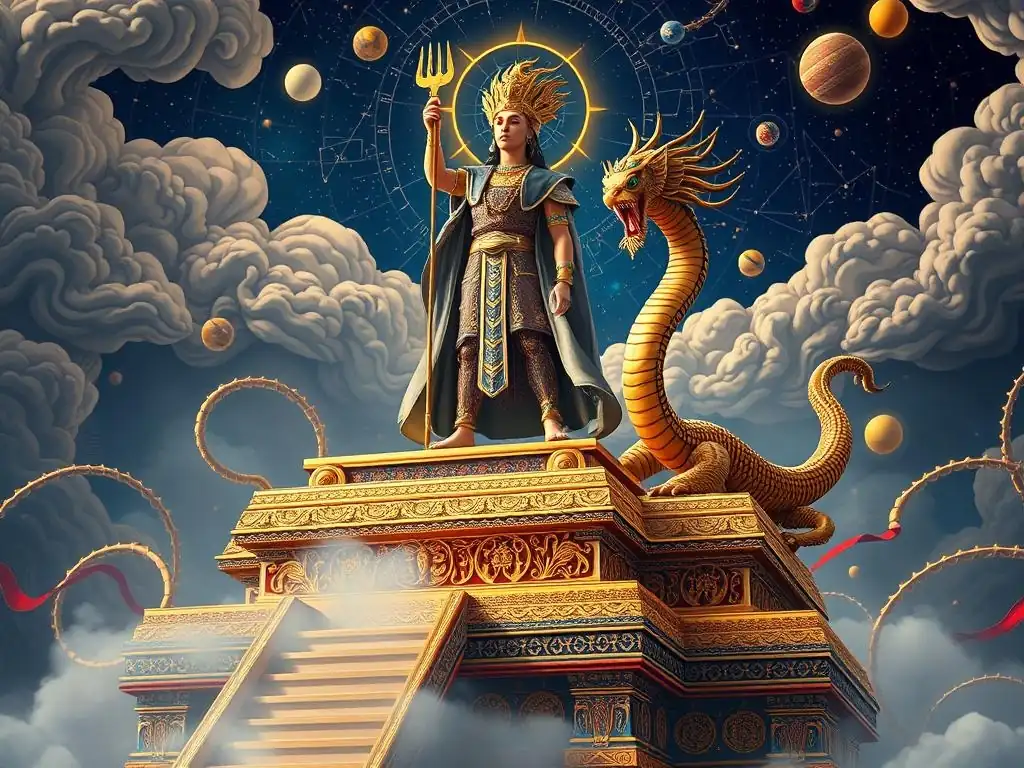
One of the primary functions of the Akitu festival was the legitimation and celebration of Babylonian kingship. The ritual humiliation and reinstatement of the king by the high priest, acting on behalf of Marduk, explicitly demonstrated that the king's authority was derived from the supreme deity. This annual renewal of the king's mandate reinforced his position as the divinely chosen ruler, essential for the stability and prosperity of the state.
Furthermore, the king's participation in the festival, presiding over processions and rituals, positioned him as the central human figure mediating between the divine and human realms. By ritually aligning himself with Marduk's triumph over Tiamat and the re-establishment of order, the king's own rule was cast as essential for maintaining that order on earth. The festival thus served as a powerful piece of state propaganda, solidifying the bond between divine power, cosmic order, and the reigning monarch.
The Akitu Festival as a Renewal of the Cosmos and the Natural Order
Beyond politics, the Akitu festival was fundamentally about the renewal of the entire cosmos and the natural world. Occurring at the vernal equinox, it coincided with the beginning of spring, the season of growth and fertility after the dormancy of winter. The ritual reenactment of Marduk's creation from Tiamat's body was believed to reactivate the creative forces that brought the world into being.
The festival aimed to ensure fertile harvests, abundant water, and the overall vitality of nature for the coming year. The procession to the Akitu house, often located near agricultural fields, and possibly the sacred marriage rite, underscored this focus on fertility and the agricultural cycle. The Akitu festival was seen as necessary to prevent the world from relapsing into the primordial chaos represented by Tiamat, guaranteeing the continuation of life and order.
The Akitu Festival as a Reflection of Mesopotamian Beliefs about Creation and Order
The Akitu festival provides a profound window into Mesopotamian cosmology and their understanding of creation and order. It demonstrates a belief that the world was not created perfectly and permanently, but rather required annual ritual effort to maintain its structure and prevent a return to chaos. The myth of Marduk and Tiamat highlights a worldview where existence arose from conflict and where order is the result of a divine struggle against primordial forces.
The festival's structure, moving from purification and submission to dramatic reenactment and triumphant procession, mirrors the journey from potential chaos to established order. It underscores the Mesopotamian conviction that human actions, particularly ritual actions performed correctly by priests and king, were vital in cooperating with the gods to sustain the created world. The Marduk Tiamat Akitu Festival was the ultimate expression of this belief system, where myth and ritual converged to ensure the world kept turning.
Interpretations of the Akitu Festival: Frankfort, Jacobsen, and Bottéro
Scholars have offered various interpretations of the Akitu festival's central meaning. Henri Frankfort, in his work Kingship and the Gods, emphasized the festival as a ritual drama of cosmic renewal and the king's role in ensuring the fertility and well-being of the land through his identification with the victorious deity. He saw it as deeply rooted in the cyclical view of nature.
Thorkild Jacobsen, known for his work Towards the Image of Tammuz and Other Essays on Mesopotamian Religion, focused on the political aspects, viewing the festival as a symbolic reenactment of the transfer of power from the old year (and potentially a defeated divine figure) to the new year, embodied by Marduk and the reigning king. He also explored the concept of the divine assembly validating Marduk's rule.
Jean Bottéro, in Mesopotamia: Writing, Reasoning, and the Gods, highlighted the festival's role in integrating the various city-states and their deities under the supremacy of Babylon and Marduk, using the Enuma Elish narrative as a theological justification for Babylonian hegemony. These interpretations, while differing in emphasis, all acknowledge the festival's multi-layered significance, encompassing religious, political, and cosmological dimensions centered around the Marduk Tiamat Akitu Festival myth.
The Legacy of the Akitu Festival
The Influence of the Akitu Festival on Other Mesopotamian Rituals
As the preeminent festival in Babylon, the Akitu significantly influenced religious practices and festival structures in other Mesopotamian cities, particularly those within the sphere of Babylonian influence. The concept of an annual renewal festival, often centered around the city's patron deity and involving processions and the recitation of foundational myths, can be seen in earlier Sumerian traditions and later Assyrian practices, where deities like Ashur might replace Marduk but the underlying structure of affirming divine kingship and cosmic order persists.
Elements like purification rites, the importance of divine statues, and the role of the king as a key participant in state rituals became standard features. While the specific narrative of Marduk and Tiamat was central to the Babylonian Akitu, the ritual pattern of confronting chaos, achieving victory, and re-establishing order at the start of the year had broader resonance throughout Mesopotamian religious life. The detailed liturgical texts associated with the Akitu also provided a model for the documentation and performance of other significant religious ceremonies.
The Enduring Power of the Marduk and Tiamat Myth
The myth of Marduk and Tiamat, as preserved in the Enuma Elish, remains one of the most significant pieces of ancient Mesopotamian literature discovered. Its detailed account of creation through conflict, the rise of a divine champion, and the establishment of cosmic and social order has captivated scholars and readers for centuries. The narrative itself survived the fall of Babylon, being copied and studied in various periods, testifying to its cultural importance.
The myth provides invaluable insights into Babylonian theology, political ideology, and worldview. It illustrates their understanding of the origins of the universe, the nature of chaos and order, the relationship between gods and humanity, and the divine mandate for kingship. Even today, the story of Marduk's battle with Tiamat is a primary source for understanding the complex religious landscape of ancient Mesopotamia, underscoring the central role the Marduk Tiamat Akitu Festival played in keeping this narrative alive and relevant.
Echoes of the Akitu: Parallels in Later Religious and Cultural Practices
While direct lineage is debated and complex, scholars have noted potential parallels between elements of the Akitu festival and rituals in later religious and cultural traditions in the ancient Near East. The concept of a New Year festival involving themes of creation, judgment, and renewal appears in various cultures. The idea of a cosmic battle between order and chaos finds echoes in narratives like the conflict between Yahweh and Leviathan in some interpretations of Hebrew scripture, or the battle between Baal and Yam in Canaanite myth.
Ritual processions and the symbolic humiliation and reinstatement of rulers or religious figures are also found in diverse contexts. While caution is needed to avoid oversimplification, the Akitu festival's sophisticated structure and powerful themes of confronting chaos, achieving cosmic order, and renewing kingship represent a significant early example of religious practices designed to ensure the stability and prosperity of both the natural and social world, providing potential points of comparison for understanding later ritual traditions.
Conclusion: The Akitu Festival as a Window into Mesopotamian Cosmology
The Importance of Understanding Ancient Rituals
Understanding ancient rituals like the Akitu festival is crucial for grasping the complexities of past societies. Rituals were not peripheral activities but were deeply embedded in the social, political, and economic fabric of life. They provided a framework for understanding the world, maintaining social cohesion, legitimizing authority, and interacting with the divine. Studying the Akitu allows us to move beyond simply reading myths to seeing how those myths were actively lived and performed by the people who believed them.
Through the detailed study of ritual texts, archaeological evidence, and comparative mythology, we can reconstruct not only the steps of the ceremonies but also the beliefs, fears, and aspirations that motivated them. The Akitu festival, with its focus on renewal and order, highlights the Mesopotamian concern with stability in a potentially unpredictable world, revealing their strategies for ensuring survival and prosperity through cosmic alignment and divine favor.
The Akitu Festival: A Complex and Meaningful Expression of Mesopotamian Culture
The Akitu festival was a masterpiece of Mesopotamian cultural expression, weaving together myth, ritual, drama, politics, and cosmology into an eleven-day spectacle. It was a time when the foundational narrative of the Enuma Elish, the myth of Marduk and Tiamat, was brought to life, reminding the populace of their origins and their place within the divine order. The festival's complexity, involving purification, royal rites, public processions, and the potential for symbolic combat, underscores the sophistication of Babylonian religious thought and practice.
Every element of the Akitu served a purpose, from the practical need to mark the agricultural New Year to the profound theological imperative of reaffirming Marduk's kingship and the stability of the created world. It was a powerful annual performance that reinforced identity, celebrated divine power, and sought to guarantee the future well-being of Babylon and its people, demonstrating the deep meaning embedded within Mesopotamian ritual life.
Marduk, Tiamat, and the Akitu Festival: A Lasting Legacy
The intertwined story of Marduk, Tiamat, and the Akitu festival offers a compelling glimpse into the heart of ancient Babylonian religion and culture. The conflict between the champion of order and the primordial force of chaos, as narrated in the Enuma Elish, provided the essential script for the most important annual ritual. The Akitu festival was the stage upon which this cosmic drama was reenacted, making the myth a living reality and ensuring its continued power and relevance.
The legacy of the Marduk Tiamat Akitu Festival endures through the surviving texts and archaeological remains, allowing us to reconstruct and interpret this vital ancient practice. It stands as a testament to the ingenuity of Mesopotamian civilization in using myth and ritual to structure their understanding of the universe, legitimize their rulers, and navigate the challenges of existence, leaving behind a rich cultural heritage centered on the annual triumph of order over chaos.
Frequently Asked Questions
What is the Akitu Festival, and why is it important?
The Akitu Festival was an important Babylonian New Year festival. It was a celebration of renewal and the reaffirmation of Marduk's kingship, central to Mesopotamian society.
Who were Marduk and Tiamat in Babylonian mythology?
Marduk was the chief god of Babylon, often associated with storms and justice. Tiamat was the primordial goddess of the sea, representing chaos and the old order overthrown by Marduk.
How was the battle between Marduk and Tiamat reenacted during the Akitu Festival?
The reenactment involved a dramatic performance of the Enuma Elish, the Babylonian creation epic. Priests and performers would symbolically recreate the battle, ensuring cosmic order and the king's legitimacy.
What was the symbolic significance of the Marduk-Tiamat battle reenactment?
It symbolized the triumph of order over chaos, the establishment of the cosmos, and the legitimization of the king's power as Marduk's representative on Earth.
Beyond reenactment, what other activities were part of the Akitu Festival?
Besides the reenactment, the Akitu Festival included processions, prayers, and the renewal of the king's authority. It was a time for social cohesion and reaffirming religious beliefs within Babylonian society.
Final Reflection: Echoes of Creation in a Modern World
The epic clash between Marduk and Tiamat, as reenacted in the Akitu Festival, remains a potent symbol of creation and order amidst chaos – a narrative that resonates deeply with our own struggles to understand and shape our world. The ancient Mesopotamians grappled with existential questions of power, creation, and the very nature of reality, mirroring our own contemporary anxieties about climate change, political upheaval, and the search for meaning in a complex world. Their ritualistic reenactment serves as a powerful reminder that humanity's fundamental concerns have remained remarkably constant across millennia.
The Akitu Festival, with its dramatic portrayal of cosmic struggle and subsequent triumph, offers a compelling lens through which to examine the enduring human need for narrative and ritual. It speaks to our inherent desire to find order in the face of chaos, to understand our place within a larger cosmic framework. Myth is a powerful instrument of social control, but it is also a powerful instrument of liberation.
This quote, while not directly about the Akitu Festival, highlights the dual nature of such powerful narratives: they can both reinforce existing power structures and offer a path towards understanding and change. The story of Marduk and Tiamat continues to inspire artistic expression and scholarly inquiry, demonstrating its lasting cultural impact.
Consider, for a moment, the parallels between the ancient Mesopotamian struggle for order and our own contemporary challenges. What narratives do we create to make sense of our world? What rituals, both formal and informal, do we employ to cope with uncertainty and strive for a better future? Let the story of Marduk and Tiamat inspire you to examine your own narratives, to find strength in the face of chaos, and to actively participate in shaping a more meaningful and ordered world. The echoes of creation resonate still; let us listen closely to their message.
Unleash Your Inner Babylonian: Explore the Akitu Festival!
Thanks for delving into the epic clash between Marduk and Tiamat! You've now gained a fascinating glimpse into the ancient Babylonian worldview and the power of ritual. Ready to take your knowledge further?
- Dive deeper into the symbolism: Research other Mesopotamian deities and their roles in the Akitu festival. Consider their connections to nature, society, and the cosmos. This will give you a richer understanding of ancient religious practices.
- Share your thoughts and interpretations: Leave a comment below and discuss your favorite aspect of the Marduk-Tiamat myth! Let's build a community of mythology enthusiasts.
- Craft your own symbolic ritual: Using the Akitu festival as inspiration, create a small, personal ritual reflecting your own values and beliefs. This might involve creative writing, art, or even a simple reflective practice.
What unique aspects of ancient Babylonian culture intrigue you the most, and how could we better understand their rituals in a modern context?