
Soul Keepers: Mythical Beings Guiding or Guarding the Departed's Path

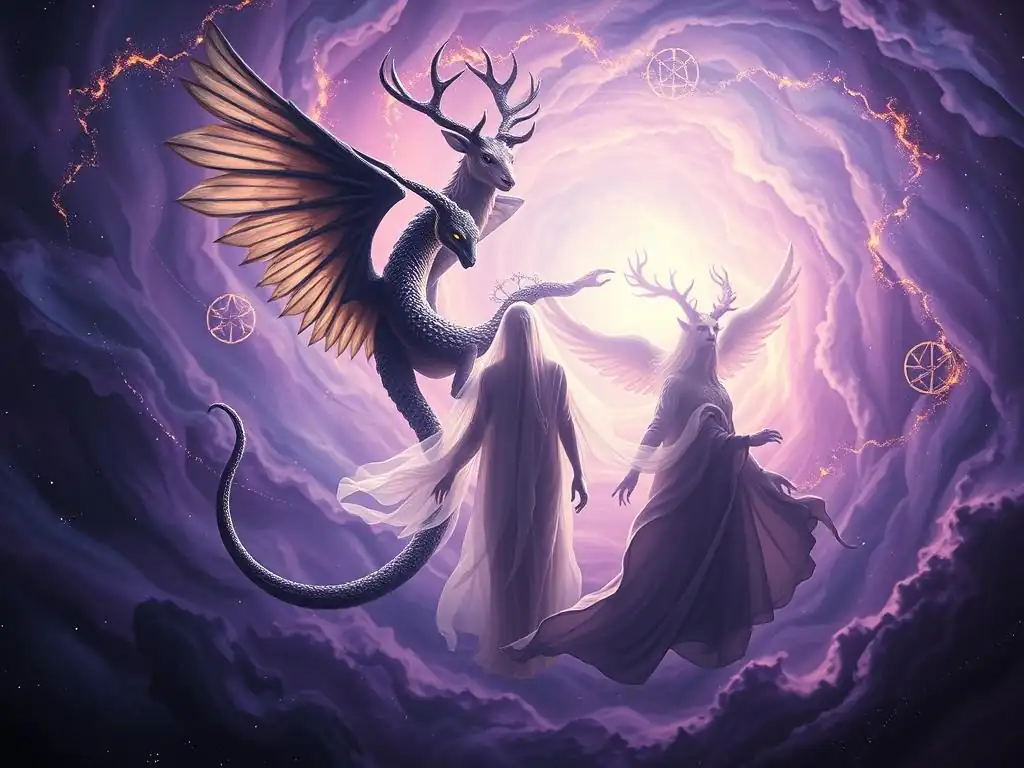
Welcome to Mythology and Legends, where the whispers of ancient tales echo through the ages. Ever wondered who shepherds souls to their final resting place? Delve into our article, Soul Keepers: Mythical Beings Guiding or Guarding the Departed's Path, and uncover the fascinating lore surrounding these spectral guides. What secrets do they hold, and what awaits beyond the veil? Explore now and unlock the mysteries of the afterlife...
- Guides to the Afterlife: Mythical Beings and Their Role in Death
- Introduction: Exploring Mythical Guides of the Afterlife
- Anubis: The Egyptian Guide to the Underworld
- Charon: Ferryman of the River Styx
- Valkyries: Choosers of the Slain in Norse Mythology
- Hermes: Messenger of the Gods and Psychopomp
- The Impact of Mythical Afterlife Guides on Contemporary Society
- Conclusion: The Enduring Legacy of Mythical Beings Guiding the Departed
-
Frequently Asked Questions
- ### What are some examples of Mythical Beings that guide souls in the afterlife, as discussed in the article?
- ### How do these Soul Keepers influence the journey of the departed?
- ### What is the significance of these Mythological Figures in understanding different cultures?
- ### Does the article suggest that these Mythical Beings are purely benevolent?
- ### How does the concept of a Mythical Being guiding the afterlife impact contemporary society?
- Final Reflection: Echoes of the Soul's Journey
- Unveil Your Inner Mythmaker: Explore the Soul's Journey
Guides to the Afterlife: Mythical Beings and Their Role in Death
Introduction: Exploring Mythical Guides of the Afterlife
Across the vast tapestry of human belief systems, the transition from life to death is often envisioned as a journey, fraught with uncertainty and requiring guidance. This universal concept has given rise to a diverse array of mythical beings guide afterlife, figures entrusted with assisting the departed soul navigate the complex path to their final resting place. These entities are far more than mere escorts; they embody cultural understandings of mortality, judgment, and the structure of the cosmos beyond the veil of existence.
The role of these mythical beings guide afterlife varies significantly from culture to culture. Some are benevolent escorts, leading souls gently to paradise. Others are stern judges, weighing deeds and determining destiny. Still others are guardians of thresholds, ensuring only the worthy or designated can pass. Regardless of their specific function, these figures serve a crucial narrative purpose, providing structure and meaning to the ultimate unknown, and offering comfort or caution to the living contemplating their own mortality.
Anubis: The Egyptian Guide to the Underworld
Anubis' Role in Weighing the Heart
In ancient Egyptian beliefs, the jackal-headed god Anubis held a pivotal role in the judgment of the dead. His most significant duty was overseeing the "Weighing of the Heart" ceremony in the Hall of Two Truths. Here, the heart of the deceased was placed on one pan of a scale, balanced against the feather of Ma'at, the goddess of truth, justice, and cosmic order, on the other. Anubis ensured the scales were true and accurate, monitoring the delicate balance that would determine the soul's fate.
If the heart was lighter than the feather, indicating a life lived in accordance with Ma'at's principles, the deceased was deemed worthy to pass into the afterlife paradise, the Field of Reeds. However, if the heart was heavy with negative deeds and transgressions, the scales would tip. The heart would then be devoured by Ammit, a fearsome creature with the head of a crocodile, the body of a lion, and the hindquarters of a hippopotamus, resulting in the soul's annihilation – a fate considered worse than death itself. Anubis’s presence symbolized the final, impartial judgment.
Anubis as Protector of the Dead
Beyond his role in judgment, Anubis was also revered as a protector. He was closely associated with mummification and burial rituals, overseeing the embalming process to ensure the body was preserved for the afterlife. Priests often wore Anubis masks during funerary rites, embodying the god's presence and power. This connection solidified his image as a guardian of the deceased, shielding them from harm and ensuring their safe passage through the dangers of the underworld.
Anubis’s jackal form is significant. Jackals were often seen in cemeteries on the edge of the desert, and this association with death and burial grounds likely contributed to his role. As a scavenger, the jackal was perceived as a creature familiar with the liminal space between the living world and the realm of the dead, making Anubis a fitting mythical being guide afterlife and guardian of its entrance. His vigilance was believed to keep malevolent forces at bay, safeguarding the vulnerable soul and its physical remains.
Charon: Ferryman of the River Styx
The Price of Passage: Charon's Obol
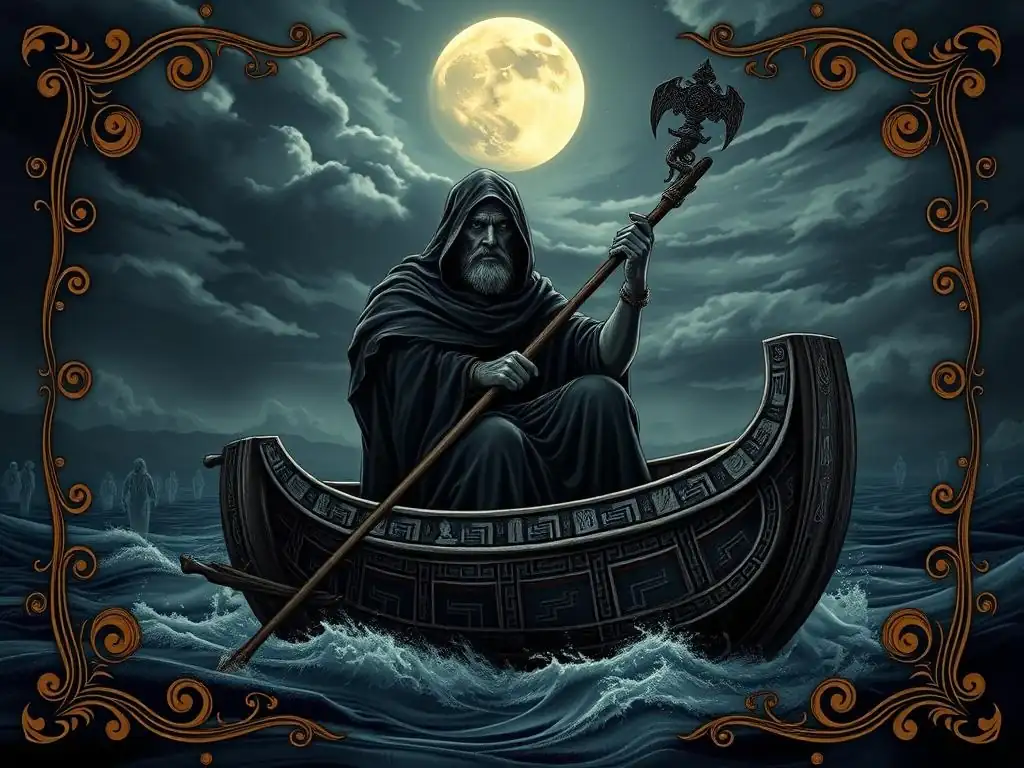
In Greek mythology, one of the most iconic mythical beings guide afterlife figures is Charon, the ferryman of the dead. His duty was to transport souls across the River Styx (or sometimes Acheron), the boundary separating the world of the living from the realm of Hades. However, this passage was not free. Souls were required to pay a fare, typically a single coin known as an obol, which was customarily placed in the mouth of the deceased before burial.
Those souls who could not pay the obol, either because they were not properly buried or their families failed to provide the coin, were condemned to wander the shores of the River Styx for eternity, unable to cross into the underworld. This belief underscored the importance of proper burial rites in Greek society and highlighted Charon's strict adherence to his role – he was a businessman of the dead, not a compassionate guide. The obol tradition is documented in various historical and archaeological contexts, with coins frequently found in ancient graves.
The River Styx and the Underworld's Boundaries
The River Styx was more than just a geographical feature in the Greek cosmos; it was a potent symbol of the insurmountable barrier between life and death. Its name, derived from the Greek word stygos, meaning "hate" or "detestation," reflected the dread associated with crossing into the underworld. Charon's ferry was the sole reliable means of traversing this formidable waterway, emphasizing his crucial function in the cosmic order.
Charon's role was strictly limited to transportation. He did not judge the souls he carried, nor did he have authority within the realm of Hades itself. His domain was the misty, desolate banks of the river and the journey across it. He was simply the gatekeeper of the threshold, a grim figure whose existence reinforced the finality and separation that death represented in Greek thought.
Valkyries: Choosers of the Slain in Norse Mythology
Selecting Warriors for Valhalla
In the vibrant mythology of the Norse, the Valkyries are powerful female figures, often depicted as shieldmaidens or winged riders, who serve the god Odin. Their primary and most dramatic role is on the battlefield, where they are the "Choosers of the Slain." Amidst the chaos of combat, the Valkyries descend to select the bravest and most worthy warriors who have fallen in battle. These chosen heroes, known as the einherjar, are deemed fit to reside in Valhalla, Odin's magnificent hall in Asgard.
The criteria for selection were paramount: only those who died with exceptional courage and skill in battle were considered. This belief instilled a powerful cultural imperative for Norse warriors to fight fearlessly, as a glorious death could lead to an honored afterlife among the gods and heroes. Sagas and Eddic poems often depict the Valkyries observing battles from above, their decision having ultimate significance for the warrior's post-mortem destiny.
Valkyries as Escorts to the Afterlife
Once the Valkyries have made their selection, their role as mythical beings guide afterlife continues. They are responsible for escorting the chosen einherjar from the battlefield to Valhalla. This journey is often depicted as a grand procession, with the Valkyries leading the souls to Odin's hall, where they will feast, drink, and train for Ragnarök, the final battle.
In Valhalla, the Valkyries continue to serve the einherjar, bringing them mead and attending to their needs. They are not merely guides but also hostesses and companions in the afterlife, highlighting the honorable status granted to the warriors they chose. This dual role of selecting and escorting emphasizes their vital connection between the mortal realm of battle and the divine realm of Odin's chosen dead.
Hermes: Messenger of the Gods and Psychopomp
Hermes' Role as a Psychopomp
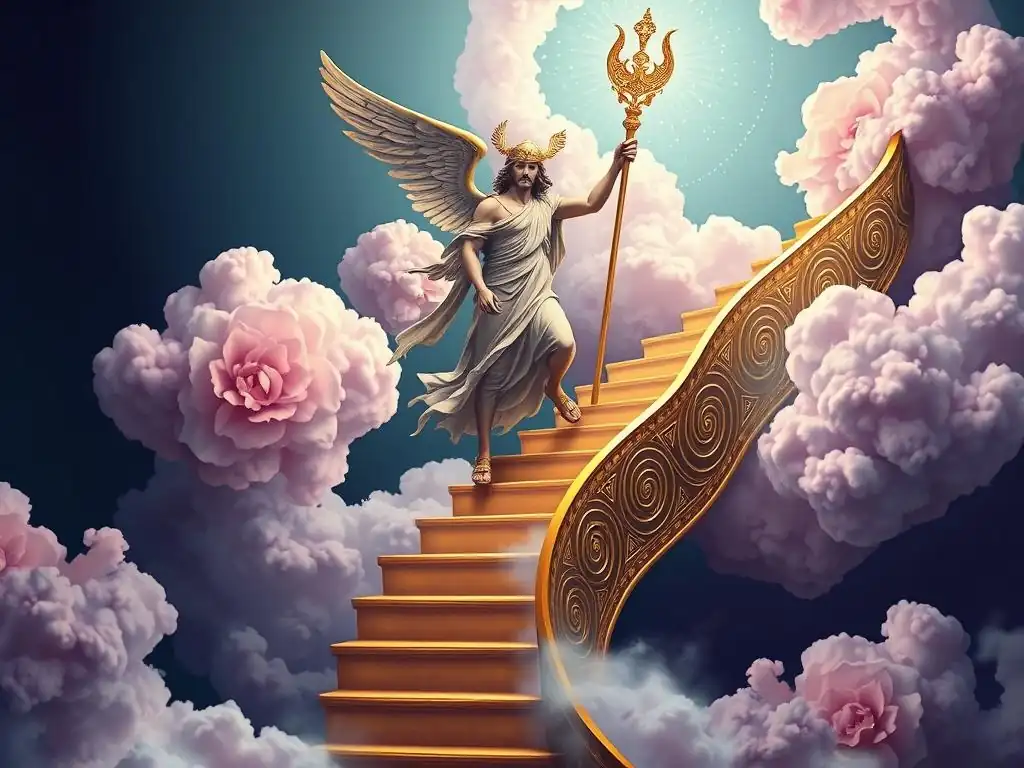
Hermes, known as Mercury in Roman mythology, is a multi-faceted Greek god, serving as the messenger of the gods, god of trade, thieves, travelers, sports, athletes, and border crossings. Among his many roles, one of the most significant is that of a psychopomp ( psychopompos), a guide of souls. Hermes is tasked with leading the souls of the deceased from the world of the living to the entrance of the underworld, the realm of Hades.
Unlike Charon, who only ferries souls across a river, Hermes' role as a psychopomp involves guiding the soul through the liminal space between life and death. He is depicted as descending into the mortal world at the moment of death to collect the soul and ensure it finds its way to the threshold of the underworld. This function aligns with his broader associations with transitions, boundaries, and movement between different realms – the divine, the mortal, and the chthonic.
Symbolic Representation of Hermes as a Guide
Hermes' attributes are highly symbolic of his ability to traverse realms and act as a guide. His most recognizable symbols are the Caduceus, a staff entwined with two snakes, and his winged sandals (talaria) and sometimes a winged helmet (petasos). The winged sandals allow him to move with incredible speed between Mount Olympus, the mortal world, and the underworld, embodying his role as a swift messenger and guide for the departed.
The Caduceus, while often associated with medicine in modern times, originally symbolized Hermes' authority and power, particularly in guiding souls. It represents balance and negotiation, qualities useful when dealing with the boundaries between life and death. These symbols collectively reinforce Hermes' identity as a dynamic figure capable of crossing boundaries and facilitating transitions, making him a fitting mythical being guide afterlife from one state of being to another.
The Impact of Mythical Afterlife Guides on Contemporary Society
Influence on Art, Literature, and Film
The powerful imagery and narrative potential of mythical beings guide afterlife have ensured their enduring presence in contemporary culture. These figures frequently appear in art, literature, and film, often reinterpreted through a modern lens. For instance, Anubis is a recurring character in fantasy novels and video games set in ancient Egypt, while Charon has been depicted in countless adaptations of Greek myths, from classical plays to modern movies like Clash of the Titans (though his depiction varies).
Valkyries have seen a surge in popularity, appearing in everything from Marvel comics and films (as part of the Thor mythology) to fantasy series and video games. Their image as fierce, independent female warriors resonates strongly with modern audiences. Even Hermes, in his psychopomp role, influences narratives involving journeys to the underworld or transitions between worlds. These examples demonstrate how these ancient figures continue to capture the imagination and serve as compelling archetypes for dealing with themes of death, destiny, and the unknown.
Psychological and Cultural Significance
Beyond their artistic influence, mythical beings guide afterlife hold deep psychological and cultural significance. For millennia, humanity has grappled with the mystery and fear surrounding death. Figures like Anubis, Charon, the Valkyries, and Hermes provide a framework for understanding this transition, offering a sense of order and predictability to the ultimate unknown. They personify death, making it less abstract and more relatable.
Culturally, these myths reflect the values and anxieties of the societies that created them. The Egyptian emphasis on ethical living reflected in Anubis's judgment, the Greek concern with proper burial rites highlighted by Charon, and the Norse reverence for courageous death embodied by the Valkyries all speak volumes about their respective worldviews. These mythical beings guide afterlife continue to serve as powerful symbols, helping us process grief, contemplate mortality, and understand diverse cultural attitudes towards the end of life.
Conclusion: The Enduring Legacy of Mythical Beings Guiding the Departed
From the sands of ancient Egypt to the frosty realms of Norse mythology, the concept of mythical beings guide afterlife is a persistent and powerful theme. Figures like Anubis, overseeing judgment and protecting the tomb; Charon, ferrying souls across the infernal river; the Valkyries, choosing and escorting fallen heroes to Valhalla; and Hermes, guiding souls to the underworld's edge, all serve as vital intermediaries between the living and the dead.
Their roles, though varied, consistently address humanity's fundamental questions about what happens after death. They provide structure, meaning, and sometimes comfort or warning, reflecting the diverse ways cultures have attempted to comprehend mortality. The enduring presence of these mythical beings guide afterlife in contemporary art and thought underscores their timeless relevance in helping us navigate the profound mystery of death and the journey beyond.
Frequently Asked Questions
### What are some examples of Mythical Beings that guide souls in the afterlife, as discussed in the article?
The article mentions several examples, including Anubis from Egyptian mythology, who weighs the heart of the deceased, and Charon, the ferryman of the River Styx in Greek mythology, who transports souls to the underworld.
### How do these Soul Keepers influence the journey of the departed?
These beings often determine the fate of the soul based on its actions in life or provide safe passage through dangerous realms of the afterlife. Their role is crucial in ensuring a smooth transition.
### What is the significance of these Mythological Figures in understanding different cultures?
They reflect a culture's beliefs about death, the afterlife, and the moral codes that govern life. Studying them provides insights into values and anxieties.
### Does the article suggest that these Mythical Beings are purely benevolent?
Not necessarily. Some, like Hades, are more neutral rulers of the underworld, while others might present challenges or trials that the soul must overcome.
### How does the concept of a Mythical Being guiding the afterlife impact contemporary society?
The ideas associated with these beings influence art, literature, and film, often providing metaphors for facing mortality and exploring ethical considerations regarding life and death.
Final Reflection: Echoes of the Soul's Journey
The enduring fascination with mythical beings guiding the afterlife speaks to a fundamental human need: to understand what lies beyond death. This exploration into the diverse roles and representations of these figures across cultures reveals not just a rich tapestry of mythology, but a persistent yearning for comfort and meaning in the face of the unknown. Their presence in countless stories, from ancient folklore to modern fantasy, underscores their continued relevance in our collective consciousness.
The power of these myths lies not just in their fantastical elements, but in their ability to articulate our deepest anxieties and hopes surrounding mortality. They offer solace, suggesting that even in death, we are not alone, that a guiding hand, however ethereal, may accompany us on our final journey. The dead are never truly gone, as long as they live in the memory of the living.
This sentiment, though not directly from a specific myth, encapsulates the enduring legacy of these soul keepers, their continued existence woven into the fabric of our cultural narratives. Their stories reflect our ongoing attempts to grapple with the mysteries of existence and the profound impact of loss.
Consider the stories you've heard, the myths you've encountered. What comfort or unease do they evoke? How do these mythical guides shape your own understanding of death and the afterlife? Let the echoes of these ancient tales resonate within you, prompting a deeper reflection on your own beliefs and the enduring power of storytelling to illuminate the human experience, even in its most profound and mysterious aspects. Embrace the mystery, and perhaps, find your own personal guide amidst the whispers of myth.
Unveil Your Inner Mythmaker: Explore the Soul's Journey
Thanks for delving into the fascinating world of soul keepers! We hope you gained a deeper understanding of these mythical guides and guardians. Now, it's time to take that knowledge further.
- Craft your own soul keeper: Imagine a being—its appearance, powers, and role in guiding souls. Share your creation in the comments below! This is your chance to bring your imagination to life.
- Dive deeper into specific mythologies: Research soul keepers in different cultures. What unique traits do they share? How do their roles vary?
- Spread the word: Share this article with a friend who loves mythology and folklore. Let's build a community of myth enthusiasts!
What unique abilities would your soul keeper possess, and what kind of journey would they guide souls on? Let's discuss!