
The Myth of the Golden Age: Comparing Visions of Paradise Lost

Welcome to Mythology and Legends, where ancient echoes resonate in the modern world. Ever wondered about the lost paradise golden age myths that shimmer in the collective memory of humanity? Before time, before sorrow, before the fall...what did these idyllic beginnings truly look like? Journey with us as we unravel the captivating parallels and profound differences in these foundational narratives, exploring the enduring human yearning for a world that once was.
Defining the Golden Age: A Universal Human Longing
Across diverse cultures and epochs, humanity has shared a compelling vision of an ideal past – a time of perfect harmony, abundance, and innocence, often referred to as a Golden Age. This concept transcends geographical and linguistic barriers, appearing in the foundational myths and folklore of civilizations worldwide.
It represents a primal yearning for a state of being free from the hardships, conflicts, and moral complexities that characterize ordinary human existence. These narratives of a lost paradise golden age myths often depict a world where nature provided bountifully without toil, where relationships between humans and the divine were direct and untroubled, and where suffering and mortality were either absent or greatly diminished.
This universal theme suggests a deep-seated human intuition about an original state of perfection or a potential for existence far superior to the present reality. Whether described as a primordial garden, a distant epoch, or a mythical land, the Golden Age serves as a powerful symbol of humanity's perceived fall from grace or a natural decline from an ideal state. Examining these golden age myths allows us to explore the shared aspirations and anxieties that connect disparate cultures, revealing common perspectives on human nature, morality, and the trajectory of history from a perceived ideal beginning.
Why Study Paradise Lost Myths? Understanding Cultural Values and Beliefs
Studying paradise lost myths offers profound insights into the cultural values, beliefs, and worldviews of the societies that created them. These narratives are not merely fanciful tales; they function as foundational texts that explain the origins of suffering, toil, death, and the present human condition.
By describing what was lost, they implicitly define what the culture cherishes or fears. For instance, a myth where paradise is lost due to disobedience highlights the cultural value placed on obedience to divine authority, while a myth describing a gradual decline might reflect a view of history as inherently degenerative or a concern about the erosion of traditional virtues.
Furthermore, these lost paradise golden age myths often contain explicit or implicit moral lessons. The reasons given for the loss of paradise – be it hubris, disobedience, the acquisition of forbidden knowledge, or simply the passage of time and the weakening of virtue – serve as cautionary tales. They illuminate a culture's understanding of sin, transgression, justice, and the consequences of human actions. Analyzing these myths comparatively allows us to identify universal ethical concerns while also appreciating the unique cultural contexts that shape their specific narratives and interpretations of the fall from an ideal state.
- Defining the Golden Age: A Universal Human Longing
- Why Study Paradise Lost Myths? Understanding Cultural Values and Beliefs
- What are the common characteristics of Golden Age myths across different cultures?
- How do Lost Paradise narratives usually depict the cause of humanity's fall from grace?
- What is the significance of the Golden Age concept in contemporary society?
- How do Golden Age myths differ from other types of creation myths?
- What role does the concept of Paradise Lost play in shaping our understanding of human nature?
Ancient Greece: The Golden Age of Cronus and the Fall
Hesiod's Account: A Detailed Look at the Greek Golden Age
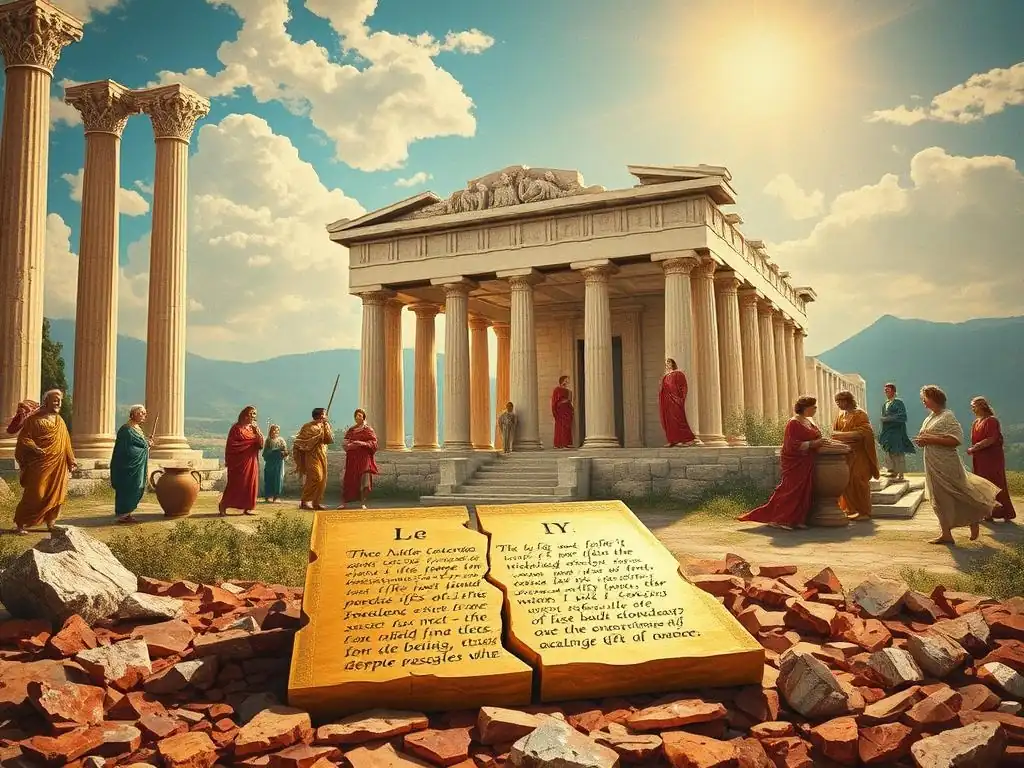
One of the most detailed accounts of a Golden Age in Greek mythology comes from the poet Hesiod's epic poem, Works and Days, written around the 8th century BCE. Hesiod describes a succession of "races" or ages of man, beginning with the "Race of Gold" (γένος χρύσεον). According to Hesiod, this race existed during the reign of Cronus, before Zeus took power. These people lived like gods, their hearts free from sorrow and untouched by toil or grief. They did not experience the ravages of old age; their bodies remained eternally youthful and vigorous.
Hesiod paints a picture of effortless existence. The fertile earth produced abundant food spontaneously, without the need for farming or labor. They lived in peace and harmony, free from war and strife.
Death for this race was not a painful struggle but rather like falling into a peaceful sleep. After death, they became benevolent spirits or guardians, dwelling on earth, protectors of mortal men, covered in mist, and givers of wealth. This depiction firmly establishes the Greek Golden Age as a time of natural perfection, ease, and close connection to the divine or semi-divine realm, serving as a poignant example among lost paradise golden age myths.
The Degradation of Humanity: From Golden to Iron
Following the Golden Age, Hesiod describes a progressive decline through subsequent ages, each representing a further step away from the initial state of perfection. The second age was the "Race of Silver," inferior in every way. These people were less noble, lived as helpless children for a hundred years, and then had short, violent adulthoods.
They failed to honor the gods and were destroyed by Zeus in his anger. Next came the "Race of Bronze," a terrible and strong people who loved war and violence above all else. They made their tools and weapons from bronze, ate no grain, and ultimately destroyed themselves through their own aggression, descending to the house of Hades.
Hesiod then introduces a partial reprieve with the "Race of Heroes," the noble generation of demigods who fought at Thebes and Troy. This age was more just than the Bronze, and many heroes, upon death, were sent by Zeus to the Isles of the Blessed at the ends of the earth, living in ease. However, this was followed by the "Race of Iron," Hesiod's own time, which he laments as the worst age.
This age is characterized by relentless toil, sorrow, injustice, and a complete lack of reverence. Children dishonor parents, guests are not welcomed, and sworn oaths are broken.
Hesiod states that in this age, the goddesses Dike (Justice) and Nemesis (Retribution), wrapped in white robes, abandon the earth and return to Olympus, leaving humanity to its miserable fate. This linear descent from gold to iron highlights the Greek concept of a world in decline, a key feature of their golden age myths.
Lessons from the Greek Myth: Justice, Hubris, and Decline
Hesiod's account of the ages of man is deeply didactic, offering stern lessons about the consequences of human behavior and the nature of the cosmos. The transition from the Golden Age to the later ages, particularly the Iron Age, is presented as a moral degradation. While the Golden Age ended with the passing of that race, the subsequent decline is explicitly linked to human impiety, violence, and injustice.
The Silver Age's destruction stemmed from their refusal to honor the gods, and the Bronze Age perished due to their own warlike nature. The Iron Age is defined by the absence of justice and piety, suggesting that these virtues are essential for maintaining a harmonious world order.
The myth underscores the Greek concern with dike (justice) and the concept of hubris (excessive pride or defiance towards the gods), though the fall is more gradual than a single act of hubris. The departure of Dike and Nemesis in the Iron Age signifies that when humanity abandons justice, it is left to suffer the natural consequences of its actions and the withdrawal of divine favor.
Hesiod's narrative serves as a lament for a lost ideal and a stark warning about the trajectory of human society if it continues down a path of impiety and injustice. These myths of a lost golden age in Greece provide a framework for understanding societal decay and the importance of virtue.
The Hebrew Bible: The Garden of Eden and Expulsion
The Genesis Narrative: A Paradise of Innocence and Abundance
The Hebrew Bible, particularly the book of Genesis (chapters 2-3), presents a distinct yet comparable vision of a primordial paradise: the Garden of Eden. This narrative describes God (Yahweh Elohim) creating the first man, Adam, and placing him in a specially prepared garden "eastward in Eden." The Garden was a place of incredible beauty and fertility, with every tree that was pleasing to the sight and good for food. Flowing from Eden was a river that watered the Garden and then divided into four major rivers, suggesting a source of life and abundance for the entire world.
Within this paradise, Adam was given the task of working and keeping the Garden, but his existence was one of ease and direct communion with his Creator. God formed Eve from Adam's side to be his companion, and together they lived in a state of complete innocence. They were naked but felt no shame, indicating a lack of self-consciousness or guilt.
They walked and talked with God in the cool of the day, enjoying an unmediated relationship. Crucially, they had access to the Tree of Life, implying the potential for eternal existence within this perfect environment. This picture of the Garden of Eden is a foundational example among lost paradise golden age myths, representing humanity's initial state of grace.
The Fall from Grace: Disobedience and Knowledge
The idyllic state of the Garden of Eden was predicated on one prohibition: God commanded Adam not to eat from the Tree of the Knowledge of Good and Evil, warning that doing so would result in death. This command set the stage for the "Fall." A serpent, described as more cunning than any other creature, tempted Eve, suggesting that God's prohibition was motivated by a fear that eating the fruit would make humans like God, knowing good and evil. The serpent denied the consequence of death, promising enlightenment instead.
Eve, seeing that the tree was good for food, a delight to the eyes, and desirable for gaining wisdom, ate the fruit and gave some to Adam, who also ate. This single act of disobedience, prompted by the desire for knowledge and a challenge to divine authority, marked the turning point. Immediately after eating, "the eyes of both were opened, and they knew that they were naked; and they sewed fig leaves together and made themselves loincloths."
This newfound knowledge brought not enlightenment in the form of becoming "like God," but rather shame, fear, and a disruption of their innocent state and their relationship with God. This transgression is the pivotal moment in this specific paradise lost myth.
Consequences of the Fall: Suffering, Mortality, and Separation from God
The immediate consequence of Adam and Eve's disobedience was the disruption of their relationship with God, leading to fear and hiding. God confronted them, and after hearing their excuses, pronounced judgments that fundamentally altered their existence and the world around them. The serpent was cursed, condemned to crawl on its belly and eat dust, and enmity was placed between it and humanity. The woman was cursed with pain in childbirth and a relationship with her husband where her desire would be for him, and he would rule over her.
The man was cursed with toil; the ground itself was cursed because of him, requiring painful labor and sweat to yield food, producing thorns and thistles. His ultimate fate was mortality: "By the sweat of your face you shall eat bread until you return to the ground, for out of it you were taken; you are dust, and to dust you shall return." To prevent them from eating from the Tree of Life in their fallen state and living forever, God expelled them from the Garden of Eden.
Cherubim and a flaming sword were placed at the east of the Garden to guard the way to the Tree of Life, signifying their separation from paradise and the potential for eternal life. These consequences illustrate the severe break from the ideal state described in this lost paradise golden age myth.
Comparing Greek and Biblical Paradises: Key Similarities and Differences
Despite their distinct cultural origins and narrative structures, the Greek myth of the Golden Age (as told by Hesiod) and the Hebrew biblical account of the Garden of Eden share several striking thematic similarities, characteristic of many lost paradise golden age myths. Both describe an initial state of human existence characterized by relative ease, abundance, and a lack of the suffering that defines ordinary human life. In both narratives, the earth provides sustenance freely, without the need for arduous labor – the Golden Race enjoyed spontaneous plenty, and Adam and Eve were surrounded by fruit trees in the Garden.
Furthermore, both accounts depict a state of innocence or moral simplicity. The Golden Race lived like gods, free from sorrow and strife, implying a lack of the vices and conflicts that plague later ages. Adam and Eve in Eden were naked and unashamed, unaware of good and evil in the way they became after eating the forbidden fruit, representing a state of pure, uncorrupted being.
Crucially, both myths culminate in the loss of this ideal state. Humanity is removed from the Golden Age or expelled from the Garden, entering a world of toil, suffering, and mortality. This shared trajectory from perfection to a fallen state is a powerful common thread in golden age myths across cultures.
Divergent Interpretations: Divine Wrath vs. Natural Decline
While both myths describe a loss of paradise, the causes and nature of this loss differ significantly, reflecting distinct theological and philosophical perspectives. In the Greek account, particularly Hesiod's, the transition from the Golden Age is presented more as a process of natural or cyclical decline, coupled with a gradual degradation of human character and increasing impiety. The Golden Race passes away, and subsequent ages become progressively worse due to their own actions (violence, lack of reverence) and the withdrawal of divine favor (Dike and Nemesis leaving).
It's a fading of glory and virtue rather than a single, specific divine punishment for a specific act. The gods are present, but the fall feels less like a direct consequence of cosmic lawbreaking and more like the inevitable decay of the world and humanity's place within it.
In contrast, the biblical narrative presents the Fall from Eden as a direct and immediate consequence of a single, deliberate act of disobedience against a personal, sovereign God. Eating the forbidden fruit is a specific transgression of a clear divine command. The loss of paradise is not a gradual decline but a swift expulsion, a judgment pronounced by God as a direct punishment for sin.
This interpretation emphasizes God's justice, the concept of human free will and responsibility, and the idea that sin has tangible, painful consequences that affect not only humanity but the entire creation. This difference highlights how paradise lost myths can reflect contrasting views on divine interaction and the nature of cosmic order.
The Role of Knowledge: A Blessing or a Curse?
A particularly fascinating point of comparison lies in the role of knowledge in the loss of the ideal state. In Hesiod's Greek account, the decline of humanity is not directly linked to the acquisition of specific knowledge. The Golden Age people live in blissful ignorance of suffering and toil, but their transition to worse ages is attributed to factors like violence, impiety, and injustice, not to gaining forbidden wisdom. Knowledge, particularly practical skills and crafts, is often seen as necessary for survival in the later, harsher ages, a tool to cope with the loss of ease.
In the biblical narrative, however, knowledge is central to the Fall. The prohibited tree is explicitly the "Tree of the Knowledge of Good and Evil." Eating its fruit leads to the opening of their eyes and the realization of their nakedness and shame.
This knowledge brings not divine power, as the serpent suggested, but a painful awareness of their own vulnerability, separation, and capacity for wrongdoing. It is the knowledge of good and evil, gained through disobedience, that fundamentally changes their state and leads to their expulsion from a paradise of innocent ignorance. This contrast reveals differing cultural perspectives on the value and danger of knowledge and its connection to humanity's ideal state within these lost paradise golden age myths.
Other Cultural Visions of a Lost Golden Age
Mesopotamian Myths: The Land of Dilmun and Early Humanity
Mesopotamian mythology, particularly Sumerian texts dating back millennia, contains echoes of a paradisiacal state, often associated with the mythical land of Dilmun. Described in various myths, Dilmun is sometimes portrayed as a pure, clean, and bright land, free from sickness, death, and the predation that characterizes the ordinary world.
Texts mention that in Dilmun, "the raven uttered no cry," "the lion killed not," and "the wolf snatched not the lamb," painting a picture of ecological harmony absent elsewhere. While not always explicitly a human golden age that was lost, Dilmun represents a divine or semi-divine ideal state, a garden-like realm associated with creation events or specific deities like Enki and Ninhursag.
Some Mesopotamian narratives also touch upon the early state of humanity before the advent of civilization and its accompanying toil and strife. Myths like the Epic of Gilgamesh hint at a more primal state for early man, like Enkidu, who lives in harmony with animals before being brought into contact with human society.
While there isn't a single, clear "fall" narrative comparable to the biblical one, the recurring motif of a pristine, harmonious realm like Dilmun or a simpler, less toilsome existence for early humanity before the complexities of urban life and kingship emerged reflects a similar longing for a lost state of ease and harmony, contributing to the global tapestry of golden age myths.
Norse Mythology: The Realm of Idunn and Eternal Youth
In Norse mythology, the concept of a golden age is often associated with the early period of the gods in Asgard, before major conflicts and the onset of the events leading to Ragnarök. The Völuspá, a key prophetic poem in the Poetic Edda, describes a time when the Æsir gods met on the Idavell plain, built temples and altars, played games, and possessed abundant gold, finding everything they needed.
This was a time of peace and innocence among the gods themselves, a divine golden age before the first war (between the Æsir and Vanir) disrupted their harmony and before the arrival of malevolent forces.
Central to maintaining the vitality and youth of the gods in Asgard is the goddess Idunn and her magical golden apples. These apples are the source of the gods' immortality and vigor. The myth where the giant Thjazi, aided by Loki, kidnaps Idunn and steals her apples directly threatens this state of eternal youth, causing the gods to age and weaken.
While this isn't a human paradise lost, the dependence of the divine realm's ideal state on Idunn's apples and the disruption caused by their loss mirrors the themes of a fragile perfection that can be lost, adding a unique Nordic perspective to lost paradise golden age myths. The eventual decline of the gods' world towards Ragnarök also reflects a movement away from this initial state of peace and plenty.
Hindu Mythology: The Satya Yuga and the Cycle of Ages
Hindu cosmology presents a profound vision of time as cyclical, moving through four great epochs or Yugas: the Satya Yuga (or Krita Yuga), Treta Yuga, Dvapara Yuga, and Kali Yuga. The Satya Yuga is considered the first and most perfect age, a quintessential golden age. In this era, righteousness (Dharma) stands on all four legs, and virtue prevails completely.
Humans are inherently truthful, virtuous, and live extraordinarily long lives (texts approximate lifespans in the hundreds of thousands or even millions of years). There is no disease, suffering, or want; the earth yields its bounty effortlessly. Humans are closer to the divine, and spiritual realization is easily attained.
As time progresses through the Yugas, Dharma gradually diminishes, losing one leg in each subsequent age. The Treta Yuga sees Dharma on three legs, Dvapara Yuga on two, and the current age, the Kali Yuga, sees Dharma standing on only one leg. With each decline, human lifespan decreases, virtue wanes, and wickedness, strife, and suffering increase.
The Kali Yuga is characterized by conflict, hypocrisy, and a great distance from the divine. While this decline is part of a cosmic cycle that will eventually lead back to a new Satya Yuga, the present reality is understood as a fallen state compared to the perfection of the initial age. This cyclical view provides a distinct framework for understanding lost paradise golden age myths within a vast cosmic timeline.
The Enduring Appeal of Paradise Lost Myths: Psychological and Societal Implications
The Psychology of Nostalgia: Yearning for a Simpler Past
The enduring appeal of lost paradise golden age myths lies, in part, in their resonance with fundamental aspects of human psychology, particularly the phenomenon of nostalgia. In times of hardship, complexity, or rapid change, there is a natural human tendency to look back on the past, often romanticizing it as simpler, purer, or more harmonious than the present. These myths tap into this deep-seated yearning for a perceived ideal state – a time free from current anxieties, where existence was easier, relationships were more straightforward, and there was a greater sense of security and belonging.
The narratives of a golden age provide a powerful archetype for this nostalgic impulse. They offer a collective dream of a time when fundamental human needs were met effortlessly, when there was no conflict between desire and fulfillment, and when life possessed a clarity and ease often absent in reality.
This psychological anchoring helps explain why these myths persist across millennia and cultures; they speak to a universal human desire for peace, security, and a return to a state of wholeness, whether real or imagined. They provide a framework for expressing discontent with the present by contrasting it with an idealized past.
Societal Critique: Idealizing the Past to Address Present Concerns
Beyond psychological comfort, paradise lost myths often function as potent tools for societal critique. By presenting a vivid picture of an ideal past, they implicitly highlight the perceived flaws, injustices, and suffering of the present.
The contrast between the Golden Age or Eden and the current reality serves to underscore what the society feels it has lost or what is wrong with its current state. If the myth attributes the loss to injustice, it critiques present injustice; if it attributes it to toil, it speaks to the hardship of labor; if it attributes it to separation from the divine, it reflects concerns about spiritual disconnectedness.
These golden age myths can, therefore, be seen as a form of social commentary, lamenting the departure from core values or warning against behaviors that led to the fall. Hesiod's portrayal of the Iron Age is a clear critique of the lack of justice and piety in his time, contrasting it sharply with the Golden Age ideal.
Similarly, the biblical narrative of the Fall highlights the consequences of pride, disobedience, and the pursuit of forbidden knowledge as sources of human suffering. By providing a benchmark of perfection, these myths of a lost golden age offer a vocabulary for identifying and articulating contemporary societal problems and aspirations for a better future, even if that future is framed as a return to past ideals.
The Golden Age as a Metaphor for Personal Growth and Transformation
While often discussed in cosmic or societal terms, the themes found in lost paradise golden age myths also resonate deeply on a personal level, serving as a metaphor for individual psychological and spiritual journeys. The concept of moving from an initial state of innocence or potential, through experiences of trial, error, or "fall" (akin to gaining difficult knowledge or facing suffering), towards a state of greater wisdom, maturity, or even redemption, mirrors the narrative arc of many personal growth journeys.
Individuals may relate to the idea of a "personal golden age" – perhaps childhood innocence or a time of perceived perfection – which is inevitably lost through the experiences of life. The struggles and consequences that follow can be seen as analogous to the toil and suffering outside of paradise.
However, just as some myths offer hope for a future restoration or a cyclical return to a better age, the personal journey can involve striving for a state of inner peace, integrity, or connection that echoes the qualities of the lost ideal. Thus, paradise lost myths provide a powerful framework for understanding not just collective history but also the individual's path through life's challenges towards a state of greater wholeness or enlightenment.
Conclusion: Reflections on the Timeless Power of Lost Paradise Golden Age Myths
The Golden Age as a Reminder of Human Potential and Imperfection
The enduring power of lost paradise golden age myths lies in their ability to capture fundamental truths about the human condition. They serve as potent reminders of both humanity's perceived potential and its inherent imperfection. The vision of a Golden Age or a Garden of Eden presents a compelling picture of what existence could be: harmonious, abundant, free from suffering, and closely connected to the divine. This ideal state speaks to our highest aspirations and the profound sense that life, in its current form, falls short of its potential.
Simultaneously, the narratives of the fall or decline acknowledge the reality of human flaws – be it disobedience, hubris, violence, or a simple inability to maintain a state of grace. These myths explain why the ideal was lost, attributing the change to factors ranging from external divine action to internal human failing or the natural course of cosmic cycles.
By doing so, golden age myths offer a framework for understanding the origins of suffering, toil, and mortality, grounding these universal experiences within a larger mythological context. They encapsulate the tension between the ideal we envision and the flawed reality we inhabit.
Finding Paradise in the Present: Reimagining the Ideal
While paradise lost myths often focus on a lament for the past, their underlying themes can also inspire visions for the future and efforts to improve the present. The values associated with the golden age – peace, justice, harmony with nature, freedom from unnecessary toil, and a sense of connection – remain potent ideals that can guide human endeavors. Instead of merely yearning for an irretrievable past, the lessons embedded in these myths can encourage societies and individuals to strive for a more just, sustainable, and peaceful world in the here and now.
Modern movements advocating for environmental protection, social justice, or simpler ways of living often echo the core values implicitly praised in myths of a lost golden age. They represent attempts to recapture aspects of that lost harmony or abundance in a contemporary context. Reimagining paradise is not necessarily about returning to a literal past, but about applying the wisdom gleaned from these ancient narratives to build a better future. The ideal state, though perhaps lost in time, can become a goal to strive for in the present, reminding us of what is truly valuable.
Further Exploration: Comparative Mythology and Utopian Literature
The study of lost paradise golden age myths opens doors to broader areas of inquiry, notably comparative mythology and utopian/dystopian literature. Comparing these narratives across diverse cultures reveals fascinating universal patterns in human thought about origins, destiny, and the nature of good and evil. It highlights how different societies grapple with similar existential questions and arrive at both convergent and divergent answers, enriching our understanding of the global human experience.
Furthermore, the concept of a lost golden age is a direct precursor to later literary and philosophical explorations of ideal societies (utopias) and their failed counterparts (dystopias). Utopian literature, from Plato's Republic to More's Utopia and beyond, often seeks to envision or construct a perfect society, essentially attempting to recreate aspects of the mythological golden age in a philosophical or political framework.
Conversely, dystopian literature explores the dangers of flawed attempts to create paradise or the consequences of losing essential human qualities, often serving as modern paradise lost myths. Exploring these connections provides deeper insights into humanity's continuous fascination with ideal states and their potential loss.
Frequently Asked Questions
What are the common characteristics of Golden Age myths across different cultures?
Golden Age myths often describe a time of perfect harmony, abundance, and lack of suffering. They typically feature a close relationship between humans and the divine, and a simpler, more natural way of life.
How do Lost Paradise narratives usually depict the cause of humanity's fall from grace?
The loss of paradise is frequently attributed to human disobedience, the introduction of evil, or a shift in the relationship between gods and humans. Often, a forbidden act leads to expulsion or a catastrophic event.
What is the significance of the Golden Age concept in contemporary society?
The idea of a Golden Age serves as a source of hope and a critique of the present, often fueling a desire for a return to simpler values or a better world. It can also inspire social and political movements.
How do Golden Age myths differ from other types of creation myths?
While creation myths explain the origin of the world, Golden Age myths focus on a specific period of perfection within that creation. They emphasize a time of flourishing and idyllic existence that is later lost.
What role does the concept of Paradise Lost play in shaping our understanding of human nature?
Paradise Lost narratives often suggest that human nature is inherently flawed or susceptible to temptation. They explore themes of free will, consequence, and the enduring longing for a lost state of innocence.
Final Reflection: Echoes of Paradise Lost in a Fractured World
The yearning for a lost golden age, a pristine paradise untouched by suffering, remains a potent force in the modern world. This persistent longing, explored through the lens of various myths and legends throughout this article, speaks to a deep-seated human need for stability and perfection in the face of constant change and inherent imperfection.
The very act of searching for a lost paradise, whether it be Eden, Atlantis, or some other idealized past, reveals a fundamental truth about our collective psyche: we are driven by the hope of regaining a state of wholeness, a connection to something greater than ourselves.
The enduring power of these myths lies not just in their fantastical narratives, but in their ability to reflect our anxieties and aspirations. They serve as both cautionary tales and sources of inspiration, reminding us of the fragility of utopia and the resilience of the human spirit. As Carl Jung famously stated, The creation of something new is not accomplished by the intellect but by the play instinct arising from inner necessity. The creative mind plays with the objects it loves.
These myths, in their playful exploration of ideal worlds, reveal the depth of our longing for something beyond the mundane, something that resonates with a deeper, more primal understanding of ourselves and our place in the universe.
Consider the implications of this search for paradise. What does it say about our present reality that we continually look to the past for solace and inspiration? What steps can you take to build a better future, not by seeking a mythical past, but by actively shaping a more fulfilling present? Let the exploration of these lost paradises not end in wistful nostalgia, but rather ignite a passion for creating a world worthy of the dreams they inspire. Embrace the challenge, and build your own paradise, one conscious choice at a time.
Uncover Your Own Paradise: Reimagine Lost Worlds
Thanks for exploring the fascinating, yet complex, realities of "Paradise Lost" with us! We hope you gained a fresh perspective on how different cultures envision their idealized pasts. Now, it's time to take that inspiration and run with it!
- Craft your own vision of paradise: Think beyond the classical myths. What elements would your ideal world include? Write a short poem, draw a sketch, or simply jot down your thoughts – let your imagination run wild!
- Share your unique perspective: Join the conversation in the comments below! Let's build a collective vision of paradise, drawing on the insights from the article and your own unique imagination.
- Explore further: Delve deeper into the mythology of your favorite culture. What other stories can illuminate the concept of paradise lost and found?
What element of a lost paradise resonates most strongly with you, and why?