
The Call to Adventure: Mythic Tropes as Narrative Engines


Welcome to Mythology and Legends, your portal to the timeless tales that shape our world. Ever wondered why so many heroes embark on seemingly impossible quests? Dive deep into our exploration of mythic adventure narrative tropes and uncover the secrets behind these captivating stories. Prepare to unravel the threads that connect cultures and discover how ancient narratives continue to fuel our imaginations today. What makes a hero's journey truly mythic? Let's find out...
- Introduction: Understanding Mythic Adventure Narrative Tropes
- Defining the Hero's Journey: The Core Structure of Adventure Narratives
- The Call to Adventure: The Initial Spark of the Mythic Quest
- Crossing the Threshold: Entering the Unknown World
- Trials, Allies, and Enemies: Navigating the World of Adventure
- Approaching the Inmost Cave: Preparing for the Ultimate Ordeal
- The Road Back: Returning to the Ordinary World
- Crossing the Return Threshold: Reintegration and Transformation
- Mythic Adventure Narrative Tropes in Comparative Mythology: Examples from Around the World
- Influences on Literature: How Mythic Adventure Narrative Tropes Shape Modern Storytelling
- Conclusion: The Timeless Resonance of Mythic Adventure Narratives
-
Frequently Asked Questions
- What are some common tropes found in mythic adventure narratives?
- Why are these mythic adventure narrative tropes so enduring across cultures?
- How does the "Call to Adventure" specifically function as a narrative engine?
- Can mythic adventure narrative tropes be found outside of traditional myths and legends?
- What is the impact of these tropes on contemporary society, beyond entertainment?
- Final Reflection: The Enduring Power of Myth in Modern Storytelling
- Unleash Your Inner Storyteller!
Introduction: Understanding Mythic Adventure Narrative Tropes
The Enduring Power of Mythic Storytelling in Literature
Mythic storytelling has served as the bedrock of human narrative for millennia, shaping how cultures understand the world, their place within it, and the challenges they face. From the epic journeys of ancient heroes like Odysseus navigating treacherous seas to the quests of figures like King Arthur seeking the Holy Grail, these foundational stories employ recurring structural elements and character archetypes – known collectively as mythic adventure narrative tropes – that resonate deeply across time and geography.
These tropes, such as the hero's call to adventure, the confrontation with a great challenge, and the eventual return transformed, provide a universal language for exploring themes of identity, destiny, sacrifice, and redemption. The enduring power lies in their ability to tap into fundamental human experiences and psychological patterns, offering frameworks for understanding the often chaotic journey of life itself.
The influence of these ancient mythic adventure narrative tropes is palpable in countless literary works throughout history. For instance, the structure found in the Odyssey, a tale roughly 2,800 years old, mirrors elements seen in much later works.
Odysseus's perilous voyage home after the Trojan War involves facing monstrous obstacles like the Cyclops Polyphemus and the Sirens, receiving aid from figures like the goddess Athena, and undergoing trials that test his character and resolve before his eventual, transformative return. This pattern of departure, initiation, and return, driven by a central quest, demonstrates how early mythic narratives established templates that authors continue to draw upon, consciously or unconsciously, in crafting compelling stories of adventure and transformation.
Why Mythic Adventure Narrative Tropes Still Matter Today
In the modern era, despite vast changes in technology and society, mythic adventure narrative tropes retain their significance because they address timeless aspects of the human condition. They provide a map for navigating the internal and external challenges that individuals face, offering archetypal figures and plotlines that help us process our own struggles, fears, and aspirations.
Whether it's the feeling of being called to a new path, the fear of confronting the unknown, the need for allies, or the struggle against internal demons, these ancient narrative patterns provide a familiar structure onto which contemporary experiences can be mapped. They offer a sense of order and meaning in a complex world, suggesting that even the most daunting journeys can lead to growth and understanding.
Furthermore, mythic adventure narrative tropes serve as a powerful tool for communication and cultural transmission. They create shared reference points and universal symbols that bridge cultural divides. A modern audience, perhaps unfamiliar with the specifics of ancient Egyptian mythology, can still recognize and relate to the core struggle of Osiris facing betrayal and undergoing a symbolic death and resurrection because the underlying pattern of loss, ordeal, and rebirth is a fundamental mythic trope.
Similarly, the contemporary popularity of superhero narratives, which often follow the hero's journey structure very closely, demonstrates the continued appetite for stories built upon these ancient foundations. These tropes provide a robust engine for generating compelling plots and relatable characters that continue to resonate deeply with audiences worldwide, proving their enduring relevance.
Defining the Hero's Journey: The Core Structure of Adventure Narratives
The Monomyth Explained: Campbell's Contribution to Narrative Theory
The concept of the Monomyth, often referred to as the Hero's Journey, was popularized by mythologist Joseph Campbell in his seminal 1949 work, The Hero with a Thousand Faces. Campbell, drawing on comparative mythology, anthropology, and psychology (particularly the work of Carl Jung), identified a recurring pattern in the narratives of heroes from diverse cultures and time periods.
He posited that this universal structure represents a fundamental human archetype – the journey of the self towards wholeness and self-discovery. The Monomyth isn't a rigid formula but rather a flexible framework describing the typical stages a hero undergoes as they leave their ordinary world, venture into a special, often supernatural realm, face trials and challenges, achieve a victory, and return transformed, bringing a boon back to their community.
Campbell's contribution was profound because it provided a lens through which to analyze and understand the underlying similarities in seemingly disparate myths and stories. He argued that these common patterns reflected universal psychological truths and the collective unconscious.
For example, the stage of "Crossing the Threshold" represents the hero's commitment to the adventure and entry into the unknown, a concept seen in narratives from the Sumerian Epic of Gilgamesh (stepping beyond the city walls into the wild) to Luke Skywalker leaving Tatooine in Star Wars. By articulating this shared structure, Campbell illuminated how mythic adventure narrative tropes function not just as plot devices, but as symbolic representations of personal and collective transformation, offering insights into human development and spiritual awakening.
Key Stages of the Hero's Journey and Their Literary Manifestations
The Hero's Journey, as outlined by Campbell and later refined by others like Christopher Vogler, typically involves a sequence of stages that can be broadly categorized into three acts: Departure, Initiation, and Return. The Departure begins in the Ordinary World, where the hero receives a Call to Adventure, which they may initially Refuse. They often receive Supernatural Aid and Cross the Threshold into the Special World, sometimes encountering Threshold Guardians.
The Initiation involves facing Trials, Allies, and Enemies, and eventually Approaching the Inmost Cave, leading to the central Ordeal where the hero confronts their greatest fear or enemy. Surviving the Ordeal brings a Reward (Seizing the Sword), such as a treasure, knowledge, or reconciliation.
The Return journey involves The Road Back, which might be a Magic Flight or require Rescue from Without. Finally, the hero Crosses the Return Threshold, integrating their experiences and becoming a Master of Two Worlds, achieving the Freedom to Live. Literary examples abound for each stage: Bilbo Baggins in The Hobbit receives his Call from Gandalf and the dwarves (Departure).
He faces trials like the spiders and Smaug (Initiation). His return to the Shire, bringing back wealth and experience, exemplifies the Return (Crossing the Return Threshold). These stages, while not always appearing in the same order or being equally emphasized, form the backbone of many stories employing mythic adventure narrative tropes, providing a reliable structure for exploring character growth and plot development.
The Call to Adventure: The Initial Spark of the Mythic Quest
Resistance to the Call: When the Hero Refuses the Adventure
The Call to Adventure is the moment the hero's ordinary world is disrupted, and they are presented with a challenge, problem, or opportunity that requires them to leave their familiar surroundings. This call can take many forms: a message, a sudden event, a personal loss, or a realization of a great injustice. However, a common and powerful element within mythic adventure narrative tropes is the hero's initial Resistance to the Call.
This refusal stems from fear, insecurity, comfort with the known, or a sense of inadequacy. The hero is reluctant to step outside their comfort zone, acknowledging the inherent danger and uncertainty of the path ahead. This refusal highlights the magnitude of the call and makes the hero's eventual acceptance all the more significant, emphasizing that the journey is not undertaken lightly but is often a response to an overwhelming need or destiny.
This reluctance is a crucial part of the narrative engine, as it demonstrates the hero's humanity and makes them relatable. For example, in the biblical story of Moses, when God calls him from the burning bush to lead the Israelites out of slavery in Egypt, Moses repeatedly offers excuses: he is not eloquent, the people won't believe him, he is unqualified. This initial refusal underscores the enormity of the task and Moses's humility, making his eventual acceptance and leadership all the more compelling.
Similarly, Luke Skywalker's initial dismissal of Obi-Wan Kenobi's plea to learn the ways of the Force and leave Tatooine illustrates this resistance, rooted in his duties on the farm and attachment to his ordinary life. This trope of refusing the call is vital for building dramatic tension and establishing the stakes of the impending adventure.
Supernatural Aid: Divine Intervention and Mentorship in Mythic Narratives
Once the hero commits to the call, or sometimes even before, they often receive Supernatural Aid – guidance, wisdom, or tools from a mentor figure or divine entity. This aid is critical because the hero is typically entering an unknown or supernatural realm where their ordinary skills and knowledge are insufficient. The mentor, often an older, wiser character, provides the hero with the necessary training, advice, magical items, or encouragement needed to face the trials ahead.
This figure represents the wisdom of the ages and the benevolent forces within the universe that support the hero's quest. Their role is to prepare the hero for the challenges to come, equipping them not just with external help but also fostering internal strength and understanding.
This trope of Supernatural Aid is a cornerstone of mythic adventure narrative tropes, appearing in virtually every culture's hero tales. In Greek mythology, the goddess Athena frequently assists heroes like Odysseus and Perseus, providing divine guidance and intervention at critical junctures. In Arthurian legend, Merlin serves as the archetypal wise mentor to King Arthur, guiding him in his youth and helping him establish his kingdom.
In The Lord of the Rings, Gandalf the Grey (and later White) is the primary supernatural aid for Frodo Baggins, offering counsel, protection, and setting him on his path to destroy the One Ring. These examples show how the mentor figure provides the necessary bridge between the ordinary world and the special world, empowering the hero to embark on their transformative journey.
Crossing the Threshold: Entering the Unknown World

Guardians of the Threshold: Overcoming Initial Obstacles
The act of Crossing the Threshold signifies the hero's definitive departure from their ordinary world and entry into the special, often dangerous or magical, realm where the adventure unfolds. This transition is rarely smooth; it is frequently guarded by Threshold Guardians. These figures or forces serve to test the hero's resolve and commitment to the journey.
They can be physical obstacles, formidable enemies, or psychological barriers that the hero must overcome, outwit, or appease to gain passage. The encounter with Threshold Guardians marks the point of no return, signifying that the hero has committed to the quest and is ready to face the challenges of the unknown.
These guardians are not always malevolent; they can also be neutral figures who simply represent the boundary between worlds. For example, in the myth of Jason and the Argonauts, crossing the Clashing Rocks (Symplegades) represents a significant threshold guarded by a deadly physical obstacle that only the Argo, guided by Athena and the help of a dove, could pass through safely. In many fairy tales, the entrance to the enchanted forest or the castle of the villain is guarded by beasts, riddles, or magical barriers.
In modern stories, this could be entering enemy territory, passing a crucial test, or making a difficult decision that irrevocably changes the hero's path. Overcoming the Threshold Guardian proves the hero's initial capability and readiness for the greater trials that lie within the special world, solidifying their commitment to the mythic adventure narrative tropes unfolding.
The Belly of the Whale: Transformation and Rebirth
Following the crossing of the threshold, the hero may experience the stage known as the Belly of the Whale. This is a moment of ultimate separation from the known world and self, a descent into darkness or a symbolic death.
It represents a point of deep transformation where the hero is swallowed by the unknown, stripped of their former identity, and forced to undergo a fundamental change before they can emerge reborn. This stage emphasizes the idea that the journey into the special world is not just external but also an internal descent into the hero's own psyche, confronting their deepest fears and vulnerabilities.
The name "Belly of the Whale" comes directly from the biblical story of Jonah, who is swallowed by a great fish after attempting to flee God's command. Inside the whale, Jonah prays for deliverance and is eventually expelled onto dry land, reborn and ready to fulfill his mission. This powerful image of being consumed and then reborn is a potent mythic adventure narrative trope.
In other myths, this stage can manifest as entering a dark cave, being trapped in an underworld, or facing a moment of despair where all seems lost. For instance, Luke Skywalker's initial defeat by Darth Vader and the revelation of their relationship in The Empire Strikes Back can be seen as a "belly of the whale" moment, a psychological low point that forces him to confront a harsh truth and undergo a significant internal shift before his eventual return.
Facing Trials and Tribulations: Testing the Hero's Resolve
Once firmly within the special world, the hero faces a series of Trials and Tribulations. These are challenges, tests, and obstacles that the hero must overcome, each designed to test their skills, courage, wisdom, and moral character. This is the main body of the hero's journey, where the stakes are high and failure is a constant possibility. These trials can range from physical battles against monsters or adversaries to solving complex riddles, navigating treacherous landscapes, or making difficult ethical choices. Each trial pushes the hero closer to their limits, forcing them to adapt, learn, and grow.
The specific nature of these trials varies greatly depending on the myth or story, but their function remains consistent: to forge the hero into the person they need to be to face the ultimate ordeal. Hercules, in Greek myth, is famous for his Twelve Labors, each a monumental task requiring immense strength, cleverness, and endurance, such as slaying the Lernaean Hydra or cleaning the Augean Stables.
In the epic Beowulf, the hero faces trials against monstrous foes like Grendel, Grendel's mother, and later a dragon, with each battle demanding courage and proving his heroic status. These trials are essential components of mythic adventure narrative tropes, building tension, developing the hero's abilities, and demonstrating the high cost of the quest.
The Importance of Allies: Building Relationships and Seeking Support
No hero undertakes a grand adventure entirely alone. The stage of Trials, Allies, and Enemies highlights the crucial role of allies – companions, friends, or helpers who provide support, guidance, and assistance to the hero. These relationships are vital for the hero's success; allies offer different skills, perspectives, and emotional support that the hero lacks. They can rescue the hero from peril, offer crucial information, or simply provide companionship in the face of loneliness and danger. The hero's ability to forge and maintain these relationships is often as important as their own individual strength or skill.
The formation of alliances is a recurring and cherished element in mythic adventure narrative tropes. In the Epic of Gilgamesh, the wild man Enkidu becomes Gilgamesh's loyal companion and friend, joining him in adventures like the fight against Humbaba, the guardian of the Cedar Forest. Enkidu's death later profoundly impacts Gilgamesh, spurring his quest for immortality.
In the Arthurian legends, the Knights of the Round Table serve as King Arthur's allies, each with their own strengths and roles in the various quests they undertake. Frodo Baggins relies heavily on his fellowship of allies – Sam, Merry, Pippin, Aragorn, Legolas, Gimli, Boromir, and Gandalf – throughout his journey to Mordor. These examples demonstrate that the hero's journey is often a collective effort, underscoring the value of community and mutual support in overcoming adversity.
Confronting Enemies and Antagonists: The Shadow Self and External Conflicts
Alongside allies, the hero inevitably encounters Enemies and Antagonists. These figures represent the forces opposing the hero's quest, whether they are monstrous creatures, villainous humans, or even internal psychological barriers. The antagonist often embodies the opposite of what the hero stands for, representing chaos, destruction, or stagnation. Confronting these enemies is not just a physical battle; it is often a symbolic confrontation with the hero's own shadow self – the repressed aspects of their personality. Overcoming the antagonist, therefore, is a victory not only over an external threat but also over the hero's own internal weaknesses and fears.
The nature of the antagonist is central to the mythic adventure narrative tropes. They are the primary source of conflict and the force that drives much of the plot. In Greek mythology, heroes frequently battle monsters like the Minotaur (Theseus) or Medusa (Perseus), who embody primal fears and challenges.
In later narratives, antagonists become more complex, such as the wicked stepmother in Cinderella stories or Darth Vader in Star Wars, who represents tyranny and the dark side, and is later revealed to be Luke's father, adding a layer of personal, internal conflict to the external struggle. The confrontation with enemies is a necessary part of the hero's journey, pushing them to their limits and forcing them to define who they are by what they fight against.
Approaching the Inmost Cave: Preparing for the Ultimate Ordeal
The Ordeal: The Hero's Greatest Challenge
Approaching the Inmost Cave is the stage where the hero draws near to the central crisis of their journey, often represented by a dangerous place like a villain's lair, a mythical underworld, or a place of profound spiritual significance. This is a period of preparation and heightened tension before the ultimate confrontation. The hero might gather their allies, make final plans, or face a preliminary test that prepares them for the climax. This stage builds anticipation for The Ordeal, the central, life-or-death crisis that the hero must face.
The Ordeal is the climax of the Initiation stage, the hero's greatest challenge, where they confront their deepest fear or face their most formidable adversary. This is the moment of ultimate sacrifice, the potential death and rebirth of the hero. It could be a physical battle, a psychological confrontation, or a spiritual test. The outcome of the ordeal determines the fate of the hero and potentially the fate of the world they are trying to save or transform. Surviving the ordeal signifies the hero's transformation; they have faced death (either literal or symbolic) and emerged changed.
Examples of The Ordeal are numerous across mythic adventure narrative tropes. In the myth of Perseus, his ordeal is confronting and slaying the Gorgon Medusa, a creature whose gaze turns men to stone. This is a literal life-or-death battle requiring courage and quick thinking.
In the story of Jesus Christ, the crucifixion and resurrection represent the ultimate ordeal – a symbolic death followed by a spiritual rebirth that has profound implications for his followers and the world. Frodo Baggins' ordeal is reaching Mount Doom and casting the One Ring into the fire, a task that tests his will and endurance to the absolute limit. This central crisis is the heart of the adventure, the moment all previous trials have prepared the hero for.
Reward (Seizing the Sword): Obtaining the Elixir or Treasure
Emerging from The Ordeal, the hero has survived and achieved a victory. The Reward, sometimes called Seizing the Sword or obtaining the Elixir, is the prize or benefit gained from overcoming the central crisis. This reward is not always a physical object; it can be knowledge, reconciliation, the rescue of a loved one, or a fundamental change in perspective. The "sword" or "elixir" symbolizes the power or wisdom the hero has gained through their struggle, which they will eventually bring back to the ordinary world. This stage signifies the successful completion of the most dangerous part of the journey.
The nature of the reward is directly linked to the hero's quest. Jason's reward after overcoming the dragon and the challenges set by King Aeetes is the Golden Fleece. This is a tangible prize that validates his quest.
In the story of Psyche and Cupid, Psyche's reward after completing her arduous tasks set by Aphrodite and even journeying to the underworld is immortality and reunion with Cupid, a spiritual and relational reward. In the Epic of Gilgamesh, though Gilgamesh ultimately fails to achieve physical immortality, his reward is the wisdom gained from his journey and confrontation with mortality, which he brings back to Uruk. The reward is the fruit of the hero's labor and sacrifice, the tangible or intangible proof that the ordeal was worthwhile, and a vital element in mythic adventure narrative tropes.
The Road Back: Returning to the Ordinary World
The Magic Flight: Escaping with the Treasure
Having obtained the reward, the hero must now begin The Road Back to the ordinary world. This return journey is not always easy; the forces that opposed the hero may still be active, or new challenges may arise. One common trope within the road back is The Magic Flight. This stage involves a perilous escape from the special world, often pursued by the forces the hero has vanquished or angered. The flight is frequently fast-paced and dangerous, requiring the hero to use their wit, newly acquired skills, or even magical assistance to evade capture or destruction.
The Magic Flight emphasizes that the hero's victory is not necessarily the end of the conflict. There might be lingering consequences or pursuing enemies. For instance, in the myth of Jason and Medea, after obtaining the Golden Fleece, Jason and Medea are pursued by Medea's father, King Aeetes.
Medea famously distracts him by scattering her brother Apsyrtus's dismembered body parts, forcing her father to stop and gather them, allowing Jason and Medea to escape. In The Lord of the Rings, after destroying the One Ring, Frodo and Sam are rescued from the slopes of Mount Doom by the Eagles, a form of magical assistance enabling their escape from a deadly situation. This trope adds excitement and reinforces the idea that the special world is not a place the hero can linger safely, highlighting the urgency of the return journey in mythic adventure narrative tropes.
Rescue from Without: External Assistance in the Return Journey
Another variation on The Road Back is Rescue from Without. This stage occurs when the hero, having completed their task and perhaps obtained the reward, finds themselves unable to return to the ordinary world on their own. They may be injured, exhausted, or trapped, requiring external assistance to make the transition back. This rescue is often provided by allies from the ordinary world, supernatural helpers, or forces that intervene to facilitate the hero's return.
This trope emphasizes that even after achieving a great victory, the hero is still vulnerable and may need help to reintegrate. It can also underscore the interconnectedness of the hero's journey with the community they left behind. In some myths, the hero is rescued by a deity or a benevolent force that guided them earlier in their quest.
For example, in the myth of Theseus and the Minotaur, after slaying the Minotaur and escaping the labyrinth, Theseus's journey home is complicated, and in some versions, divine intervention or specific aid is needed to navigate the sea or deal with subsequent challenges before reaching Athens. The Rescue from Without highlights that the hero's journey is not solely about individual achievement but also about their relationship with the wider world and the forces that support them, a key aspect of mythic adventure narrative tropes.
Crossing the Return Threshold: Reintegration and Transformation
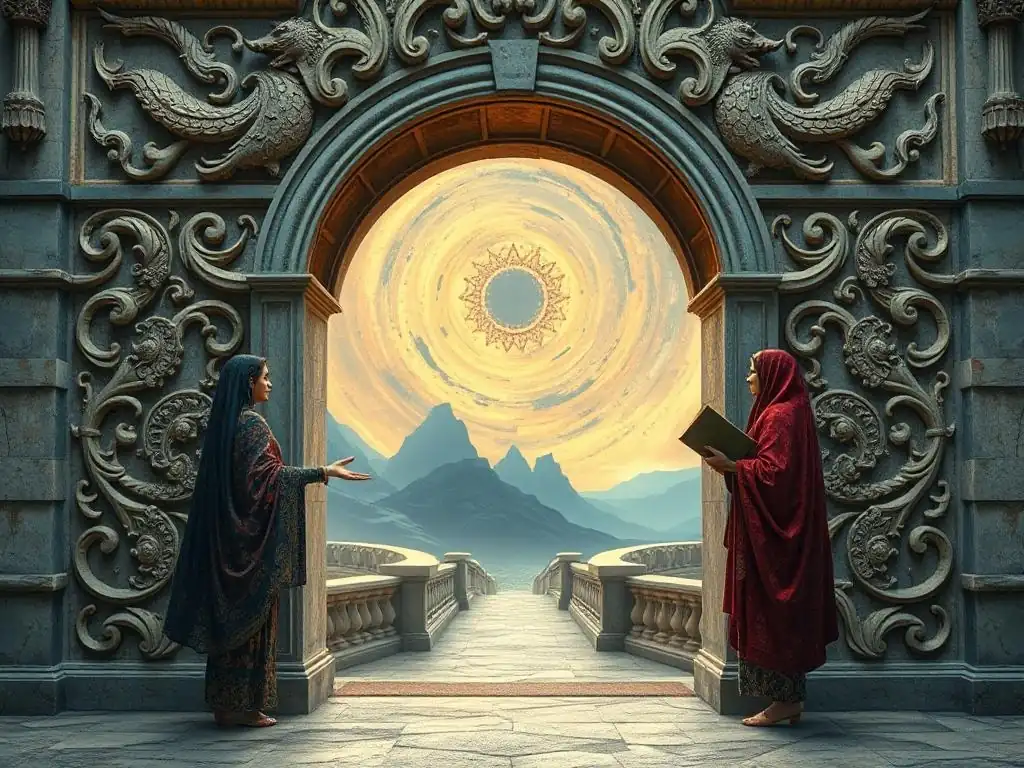
Master of Two Worlds: Balancing the Ordinary and Extraordinary
Crossing the Return Threshold is the final stage of the hero's journey, where they re-enter the ordinary world, bringing back the elixir or boon gained from the special world. However, the hero is no longer the same person who left. They have been transformed by their experiences, trials, and the knowledge they have gained.
The challenge at this stage is integration – how to apply the wisdom and power gained in the special world to their ordinary life and community. The hero must become a Master of Two Worlds, capable of navigating both the mundane realities of their home and the extraordinary lessons learned during their adventure.
This integration is often difficult. The ordinary world may not understand or accept the transformed hero, or the hero may struggle to readjust after experiencing such profound events. The hero must find a way to balance the lessons of the special world with the demands of their former life, using their newfound wisdom or power to benefit their community.
Odysseus, returning to Ithaca, must re-establish his identity and kingship, applying the cunning and resilience learned during his epic voyage to overcome the suitors who have invaded his home. He is no longer just the warrior who left for Troy but a seasoned survivor who understands the world in a deeper way. This ability to bridge the gap between the ordinary and the extraordinary is a defining characteristic of the successfully returned hero in mythic adventure narrative tropes.
Freedom to Live: The Hero's Ultimate Achievement
The final stage, often overlapping with being a Master of Two Worlds, is achieving the Freedom to Live. This is the ultimate reward for the hero's journey – liberation from the fear of death, the ability to live fully in the present moment, and the freedom to act spontaneously and authentically.
Having faced their deepest fears and overcome death (literal or symbolic) during the ordeal, the hero is no longer bound by the anxieties and limitations that constrained them in the ordinary world. They have transcended the duality of life and death, good and evil, and can live freely, contributing their unique gifts to the world.
This freedom is not necessarily about a lack of responsibility, but rather an inner peace and acceptance. The hero has come to terms with their place in the cosmos and the cyclical nature of life. They are free from the need for external validation, having found true strength and identity within.
For figures like the Buddha, achieving enlightenment (a form of the elixir) leads to liberation from the cycle of suffering and the freedom to teach and guide others. In many myths, the hero's return brings a blessing or transformation to their community – prosperity, peace, or renewed hope – which is a manifestation of their own internal freedom spreading outward. The Freedom to Live is the culmination of the hero's transformation, representing the highest state of being achieved through navigating the mythic adventure narrative tropes.
Mythic Adventure Narrative Tropes in Comparative Mythology: Examples from Around the World
Gilgamesh: The Quest for Immortality and Confrontation with Mortality
The Epic of Gilgamesh, one of the oldest known literary works, provides a rich early example of mythic adventure narrative tropes. Gilgamesh, the powerful but arrogant king of Uruk, is initially presented as a tyrannical ruler. His journey begins not with a clear call to adventure, but with the arrival of Enkidu, a wild man created by the gods to challenge him.
Their initial conflict evolves into a deep friendship, and their joint adventures, such as journeying to the Cedar Forest to defeat the monster Humbaba and later killing the Bull of Heaven, represent early trials and the formation of a crucial alliance. The death of Enkidu serves as a profound call to adventure for Gilgamesh – a confrontation with his own mortality that shatters his arrogance and propels him on a quest for eternal life.
Gilgamesh's subsequent journey to find Utnapishtim, the only human granted immortality, involves crossing perilous waters and facing numerous obstacles and wise figures who challenge his pursuit. This quest represents the journey into the unknown, the special world, driven by existential fear. While Gilgamesh ultimately fails to achieve physical immortality – even the magical plant he finds is stolen by a serpent – his journey is not in vain.
He returns to Uruk with a newfound appreciation for life, friendship, and the achievements of human civilization (represented by the mighty walls of Uruk). His reward is not eternal life, but wisdom and acceptance of his own mortality. The epic thus exemplifies mythic adventure narrative tropes centered on the hero's transformation through facing the ultimate human challenge: death.
Maui: Trickster Hero and His Exploits Across Polynesian Mythology
Maui is a prominent figure in Polynesian mythology, a trickster demigod known for his daring exploits and contributions to humanity. Unlike the traditional epic hero, Maui often operates outside conventional morality, using cunning and magic to achieve his goals, yet his stories are filled with classic mythic adventure narrative tropes. His birth and upbringing often involve being cast out or abandoned, representing an early separation from the ordinary world. His adventures are numerous and varied, reflecting a series of trials and quests undertaken not always for personal glory, but often to benefit humankind or simply out of mischievous impulse.
Examples of Maui's adventures include fishing up the islands of New Zealand from the seabed using his magical hook, snaring the sun to slow its passage across the sky (so people could have longer days), and obtaining the secret of fire from the underworld. Each of these acts involves leaving the known world, facing powerful forces or beings, employing supernatural aid (his hook, his magic), and achieving a significant outcome that affects the world.
His attempt to gain immortality for humans by entering the goddess of death, Hine-nui-te-pō, through her vagina and emerging from her mouth, represents a variation of the "Belly of the Whale" and the ultimate ordeal, though in most versions, he fails when a bird's laughter wakes the goddess, and she crushes him.
Maui's tales, while embodying trickster qualities, clearly follow the patterns of mythic adventure narrative tropes, showcasing a hero who uses unconventional means to navigate challenges and bring boons (or sometimes chaos) to the world.
Sun Wukong: The Monkey King's Journey to Enlightenment in Journey to the West
Sun Wukong, the Monkey King, from the 16th-century Chinese novel Journey to the West, is another iconic figure whose narrative is built upon mythic adventure narrative tropes, though filtered through a lens of Buddhist allegory and satire. Born from a stone, Sun Wukong seeks power and immortality, causing chaos in heaven and on earth.
His initial exploits and defiance of celestial authority represent a departure from any ordinary world and a descent into a period of trials and conflict with powerful divine and demonic forces. His punishment, being imprisoned under a mountain for 500 years, serves as a profound "Belly of the Whale" moment, a period of forced reflection and transformation before he is called upon for his true quest.
His real call to adventure comes when the Bodhisattva Guanyin arranges for him to accompany the monk Tang Sanzang on a pilgrimage to India to retrieve Buddhist scriptures. This journey is the central narrative engine, a long series of trials involving battling numerous demons and spirits who seek to eat Tang Sanzang to gain immortality.
Sun Wukong, along with his fellow disciples Zhu Bajie (Pigsy) and Sha Wujing (Sandy), acts as the primary protector and problem-solver. His supernatural aid comes from his immense power, magical abilities (like shapeshifting and cloud-somersaulting), and assistance from various Buddhist and Taoist deities.
The entire pilgrimage is a prolonged series of trials, allies, and enemies, culminating in the successful retrieval of the scriptures (the reward) and the disciples' eventual attainment of spiritual enlightenment (the ultimate transformation and "Freedom to Live"). Sun Wukong's journey exemplifies how ancient mythic adventure narrative tropes can be adapted and expanded into lengthy, complex narratives exploring themes of spiritual growth and redemption.
Influences on Literature: How Mythic Adventure Narrative Tropes Shape Modern Storytelling
Mythic Tropes in Contemporary Fantasy Literature
Contemporary fantasy literature is perhaps the most direct inheritor of mythic adventure narrative tropes. Authors in this genre consciously or unconsciously utilize the structure and archetypes found in ancient myths to craft compelling stories of heroes, quests, and magical realms.
The classic hero's journey structure is a foundational element in countless fantasy novels. A young protagonist living an ordinary life receives a call to adventure (often involving a magical item or a wise mentor), ventures into a world of magic and danger, gathers allies, faces a dark lord or monstrous enemy (the ordeal), and ultimately returns, having saved their world and undergone a profound personal transformation.
J.R.R. Tolkien's The Lord of the Rings is a prime example, heavily influenced by mythology and folklore. Frodo Baggins, the unassuming hobbit, receives the call to destroy the One Ring.
His journey to Mordor is a clear path through the special world, filled with trials (Moria, Amon Hen), allies (the Fellowship), and enemies (Orcs, Ringwraiths, Sauron). His final act on Mount Doom is the ultimate ordeal, and his return to the Shire, though bittersweet, shows him as a Master of Two Worlds, forever changed.
Similarly, J.K. Rowling's Harry Potter series follows the hero's journey closely: Harry's discovery of his magical heritage is the call, Hogwarts is the special world, his friends are allies, Voldemort is the antagonist, and each year presents trials leading to a major confrontation. These examples demonstrate how mythic adventure narrative tropes provide a robust and beloved framework for crafting epic fantasy narratives that resonate with modern readers.
Mythic Tropes in Science Fiction: Adapting Ancient Patterns
While seemingly distinct from ancient myths, science fiction also frequently employs mythic adventure narrative tropes, adapting them to futuristic or alien settings. The core pattern of a hero leaving their known world, venturing into the unknown, facing trials, and returning transformed is highly adaptable. In science fiction, the "special world" might be outer space, an alien planet, a dystopian future, or a virtual reality. The "supernatural aid" could be advanced technology, artificial intelligence, or psionic abilities. The "monsters" or "enemies" might be alien creatures, tyrannical governments, rogue robots, or existential threats to humanity.
Star Wars, created by George Lucas (who explicitly consulted Campbell's work), is a quintessential example of mythic adventure narrative tropes in science fiction. Luke Skywalker's journey from farm boy on Tatooine (ordinary world) to Jedi Knight (master of two worlds) mirrors the hero's journey almost beat for beat.
His call comes from Princess Leia's message and Obi-Wan Kenobi; the Millennium Falcon takes him across the threshold into space; he gains allies like Han Solo and Chewbacca; faces trials like the Death Star escape and confrontations with Darth Vader; and ultimately contributes to the defeat of the Empire. The film series successfully translates ancient heroic patterns into a space opera setting, proving the versatility and enduring appeal of these narrative structures across genres.
Other examples include Neo's journey in The Matrix (leaving the simulated reality for the real world) or Captain Kirk's voyages in Star Trek (exploring unknown galaxies and facing alien species as trials).
The Enduring Appeal of Mythic Adventure Narrative Tropes in Contemporary Literature
The enduring appeal of mythic adventure narrative tropes in contemporary literature across various genres, including literary fiction, young adult novels, and even non-fiction personal development narratives, lies in their deep connection to the human psyche. These patterns reflect universal experiences of growth, change, and facing challenges. Readers are drawn to stories that mirror their own lives, even in symbolic form.
The journey of a hero overcoming obstacles resonates with our own struggles to overcome personal difficulties, achieve goals, and find our place in the world. The archetypal characters – the wise mentor, the loyal companion, the formidable foe – are instantly recognizable and relatable, providing familiar anchors in unfamiliar fictional worlds.
Furthermore, these tropes offer a sense of hope and possibility. The hero's journey, despite its inherent dangers and difficulties, ultimately suggests that transformation is possible, that challenges can be overcome, and that individuals can make a difference.
In a complex and often uncertain world, stories that provide this sense of meaning and potential for positive change are incredibly powerful. Whether consciously employing Campbell's structure or instinctively following these ancient narrative currents, contemporary authors continue to tap into the rich reservoir of mythic adventure narrative tropes because they provide a compelling, meaningful, and universally understood framework for telling stories about what it means to be human and embark on the adventure of life.
Conclusion: The Timeless Resonance of Mythic Adventure Narratives
The Power of Mythic Storytelling to Reflect the Human Condition
Mythic storytelling, powered by enduring mythic adventure narrative tropes, holds immense power because it serves as a profound mirror reflecting the human condition. These narratives, passed down through generations and across cultures, articulate fundamental truths about existence: the transition from innocence to experience, the struggle against internal and external forces, the search for meaning, the inevitability of change, and the cycle of life, death, and rebirth.
They provide symbolic language and narrative frameworks for understanding complex psychological and existential realities that are difficult to express directly. By following the journey of a hero facing universal challenges, we gain insight into our own struggles, fears, and potential for growth.
The resonance of these stories lies in their archetypal nature. The hero's separation from the ordinary world speaks to moments of transition in our own lives, whether it's leaving home, starting a new job, or facing a major life change. The trials and tribulations reflect the obstacles we encounter, and the allies represent the support systems we rely on.
The confrontation with enemies can symbolize battling our own inner demons or external injustices. The return journey and transformation speak to the process of integrating lessons learned and becoming a more complete person. This deep connection to the human experience ensures that mythic adventure narrative tropes remain relevant and impactful, providing comfort, inspiration, and guidance across time.
The Future of Mythic Adventure Narrative Tropes in Literature
Given their deep roots in the human psyche and their proven adaptability, the future of mythic adventure narrative tropes in literature appears secure. As long as humans tell stories, they will likely draw upon these fundamental patterns. While specific cultural contexts and technological settings will continue to evolve, the core journey of transformation and discovery remains a compelling narrative engine. We can anticipate seeing these tropes continue to be reinterpreted, subverted, and blended with new themes and genres. Perhaps future stories will explore collective hero's journeys, where entire communities or even humanity itself embarks on a transformative quest.
Furthermore, as our understanding of psychology and society deepens, authors may find new ways to explore the nuances of these ancient patterns. The "special world" might become increasingly metaphorical, representing states of mind or societal challenges. The "monsters" could be abstract concepts like disinformation or climate change.
Regardless of the specific manifestations, the underlying structure of leaving the known, facing the unknown, undergoing transformation, and returning with new wisdom is a powerful and flexible framework. Mythic adventure narrative tropes are not static relics of the past; they are dynamic tools that will continue to shape the way we understand ourselves and the world through the power of storytelling for generations to come.
Frequently Asked Questions
What are some common tropes found in mythic adventure narratives?
These narratives often feature the hero's call to adventure, encountering supernatural or mentoring figures, and facing trials and tribulations to prove their worth.
Why are these mythic adventure narrative tropes so enduring across cultures?
These tropes tap into universal human experiences like growth, overcoming challenges, and the search for meaning, making them relatable across different cultural contexts. They create a framework for compelling storytelling.
How does the "Call to Adventure" specifically function as a narrative engine?
The "Call to Adventure" acts as the initiating incident, disrupting the hero's ordinary world and setting them on a path of transformation and conflict resolution. It's the catalyst for the entire story.
Can mythic adventure narrative tropes be found outside of traditional myths and legends?
Absolutely! These tropes are prevalent in modern literature, film, and video games, providing a familiar yet adaptable structure for contemporary storytelling. Popular franchises like Star Wars utilize them heavily.
What is the impact of these tropes on contemporary society, beyond entertainment?
These narratives often explore important themes such as morality, courage, and the balance between good and evil, influencing our understanding of ourselves and the world around us. They shape our values and aspirations.
Final Reflection: The Enduring Power of Myth in Modern Storytelling
The enduring power of myth is not a relic of the past; it is the very engine driving much of our contemporary storytelling. We are, fundamentally, creatures of narrative, and the archetypes and structures found in ancient myths continue to resonate deeply within us, shaping our expectations and desires as consumers of stories across all media. These mythic tropes, far from being outdated, provide a powerful framework for understanding and engaging with the human experience.
The exploration of these narrative engines has been a deeply personal journey, revealing how deeply ingrained these mythic structures are in our collective consciousness. The consistent reappearance of the hero's journey, the shadow self, and the transformative power of the quest across genres, from fantasy epics to superhero films, speaks volumes about our inherent need for these narratives. As Joseph Campbell so eloquently stated, The cave you fear to enter holds the treasure you seek.
This quote perfectly encapsulates the transformative potential inherent in confronting the challenges presented by these archetypal narratives, both within the stories themselves and within our own lives.
Consider the stories that resonate most deeply with you. What mythic tropes do they employ? How do these familiar structures enhance your engagement with the narrative? I urge you to actively seek out and analyze these patterns in the stories you consume. By understanding the power of these mythic tropes, you can not only become a more discerning audience but also a more effective storyteller, crafting narratives that tap into the timeless wellspring of human experience and leave a lasting impact on your audience.
Unleash Your Inner Storyteller!
Thanks for exploring the power of mythic tropes in storytelling! We hope you gained valuable insights into crafting compelling narratives. Now, it's time to put your newfound knowledge into action.
- Craft your own myth: Think about a familiar story or character. How could you reimagine it using the tropes we discussed? Start brainstorming today – even a few notes can jumpstart your creativity!
- Share your favorite myth: Which myth resonated with you most, and why? Share your thoughts in the comments below! Let's build a community of aspiring myth-makers.
- Explore related articles: Delve deeper into the world of mythology by browsing other articles on our site to expand your understanding.
What unique twist will you bring to the classic narrative structures?