
The Ramayana: Tracing the Hero's Path Through Love and Duty

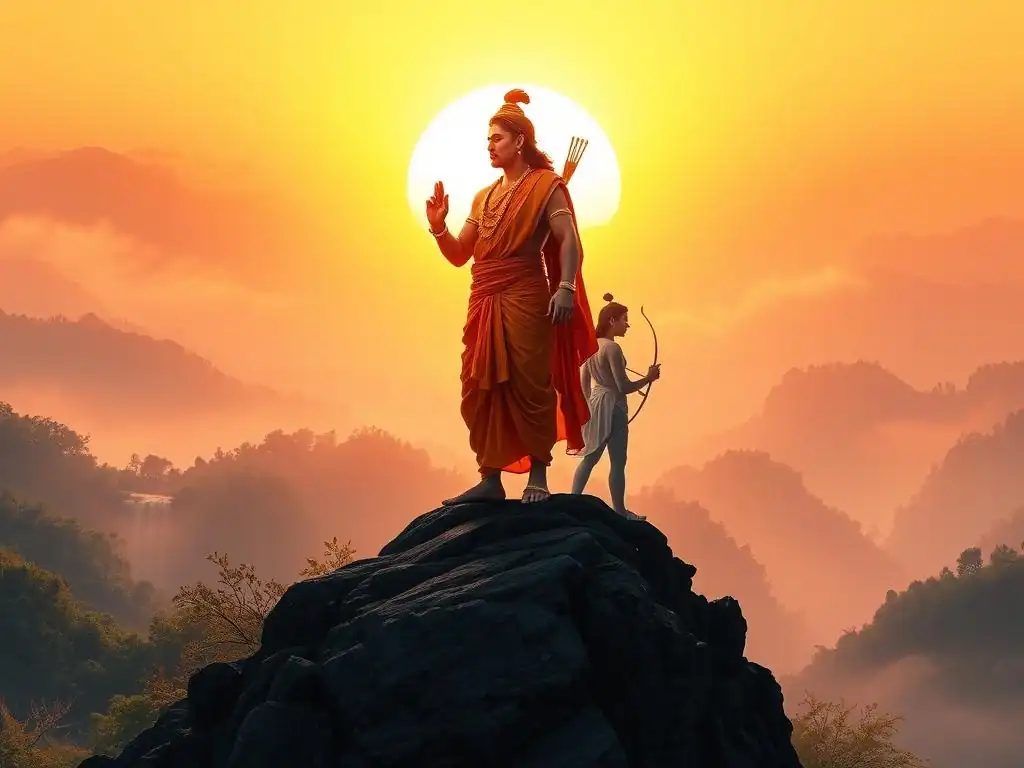
Welcome, intrepid myth-seeker! Ever wondered about the timeless allure of epic tales? Dive into the heart of "Mythology and Legends" where we unravel the threads of ancient stories. Prepare to embark on a journey of your own as we explore the Ramayana, tracing the profound Ramayana hero’s journey meaning and its enduring resonance. But what truly defines a hero’s path, and how does it echo in our world today? The answers await...
The Ramayana stands as one of the most significant epics in world literature, a cornerstone of Hindu tradition and a profound exploration of human values and cosmic order. Its narrative, centered around the life of Prince Rama, is often interpreted through the lens of the hero's journey, a universal pattern of adventure, conflict, and transformation.
Understanding the Ramayana hero’s journey meaning involves delving into its rich tapestry of characters, moral dilemmas, and spiritual insights, revealing timeless lessons about duty, love, and the eternal struggle between good and evil. This epic not only recounts the adventures of a divine prince but also serves as a moral compass, guiding millions through its depiction of ideal conduct and the consequences of deviating from the path of righteousness.
- Understanding the Hero's Journey in the Ramayana
- Rama: The Ideal King and Embodiment of Dharma
- Love and Loss: The Heart of Rama's Quest
- The Ramayana's Path of Dharma: Upholding Cosmic Order
- Allies and Adversaries: Supporting and Hindering Rama's Journey
- The Climax: The Battle for Lanka and the Triumph of Good
- The Ramayana's Enduring Legacy: Lessons for Humanity
- The Ramayana in the 21st Century: Contemporary Relevance
-
Frequently Asked Questions
- What is the Ramayana and why is it considered a hero's journey?
- How does the concept of dharma relate to Rama's hero's journey?
- What are some key obstacles Rama faces on his hero's journey?
- What is the significance of Sita in understanding the Ramayana hero's journey meaning?
- What is the overall meaning or takeaway from Rama's hero's journey?
- Final Reflection: Echoes of Rama's Journey in Our Modern World
- Unlock Your Inner Hero: Embark on a Ramayana Journey
Understanding the Hero's Journey in the Ramayana
At its core, the Ramayana follows a structure remarkably similar to the monomyth, or hero's journey, identified by mythologist Joseph Campbell. Rama, the protagonist, receives a call to adventure (his exile), crosses a threshold into an unknown world (the forest), faces trials and tribulations (battles with demons, Sita's abduction), experiences a significant ordeal (the war in Lanka), and ultimately returns transformed, bringing a boon to his people (the restoration of Dharma).
This narrative arc provides a framework for interpreting the deeper philosophical and ethical meanings embedded within the story, highlighting Rama's growth and the challenges he overcomes. The journey is not merely physical but a profound spiritual and moral odyssey.
Exploring Themes of Dharma, Karma, and Moksha
The Ramayana is deeply interwoven with the core philosophical concepts of Hinduism: Dharma, Karma, and Moksha. Dharma, often translated as righteousness, duty, or cosmic order, is arguably the most central theme, representing the path of moral and ethical conduct that characters are expected to follow. Rama is depicted as the embodiment of Dharma, his actions constantly guided by his responsibilities as a prince, husband, and eventual king. The epic vividly illustrates the consequences of adhering to Dharma (leading to peace and order) versus deviating from it (resulting in chaos and destruction, as seen with Ravana).
Karma, the principle of cause and effect, is also a pervasive theme. Characters face the results of their actions, both in this life and potentially from past lives. Ravana's abduction of Sita, for instance, is portrayed not just as a villainous act but as the culmination of past deeds and curses.
Rama's suffering and eventual triumph are also seen through the lens of karma, fulfilling divine purpose and correcting cosmic imbalance. While Moksha, liberation from the cycle of birth and death, is not the explicit immediate goal for all characters in the narrative itself, the epic's teachings on righteous living, devotion (Bhakti), and wisdom provide a path towards this ultimate spiritual aim, suggesting that living a life aligned with Dharma contributes to spiritual progress.
The Ramayana's Place in Hindu Cosmology
The Ramayana holds a unique and revered place within the vast landscape of Hindu cosmology and scripture. It is classified as an Itihasa, meaning "history" or "that which happened," placing it alongside texts like the Mahabharata as accounts of historical events, albeit imbued with mythological and spiritual significance. The epic is traditionally attributed to the sage Valmiki, who is said to have composed it based on the life events of Rama. Its composition is vast, with the Valmiki Ramayana containing approximately 24,000 verses divided into seven books (Kandas).
Beyond its literary status, the Ramayana serves as a crucial vehicle for transmitting religious and cultural values across generations. It popularizes the concept of avatars, specifically focusing on Rama as the seventh incarnation of Lord Vishnu, the preserver deity.
The epic reinforces the hierarchical structure of the cosmos, the roles of gods, demons, humans, and other beings, and the constant interplay between divine will and human action. It is not just a story but a sacred text, recited and performed in homes, temples, and public spaces, shaping the moral imagination and cultural identity of millions throughout India and Southeast Asia for millennia.
Rama: The Ideal King and Embodiment of Dharma
Rama is the central figure of the Ramayana, presented as the epitome of virtue and the ideal human being. His character arc throughout the epic serves as a practical demonstration of how one should live according to the principles of Dharma. He embodies qualities that make him a model son, brother, husband, friend, and eventually, king. His journey is fraught with challenges, yet his unwavering commitment to righteousness defines every decision he makes, even when those decisions involve immense personal sacrifice. This unwavering adherence to moral duty is a key aspect of the Ramayana hero’s journey meaning.
Vishnu's Incarnation: Rama's Divine Origins
Rama is revered in Hinduism as the seventh avatar (incarnation) of Lord Vishnu, the preserver of the universe. The epic narrates that Vishnu chose to descend to Earth in human form to combat the growing power of the demon king Ravana and restore cosmic balance. This divine origin is central to understanding Rama's significance; he is not merely a human hero but God walking among men, facing trials that test both his human resolve and divine purpose. His birth is foretold and celebrated, marked by auspicious signs.
The concept of Avatara is crucial here. Vishnu's descent is not a diminution of his divine power but a manifestation of it in a form accessible to the earthly realm, specifically to interact with and uplift humanity and combat evil. Rama's life, though marked by human experiences like joy, sorrow, love, and loss, is underscored by his inherent divinity. This dual nature – human and divine – allows him to serve as both a relatable hero and a divine exemplar, providing a template for righteous living that humans can aspire to follow.
Character Traits: Compassion, Courage, and Integrity
Rama is characterized by a constellation of virtues that define his ideal nature. Compassion is a hallmark of his personality; he grieves deeply for the suffering of others, including his enemies, and shows kindness even to those who oppose him when they repent. His courage is demonstrated repeatedly, from facing powerful demons in the forest to leading the charge against Ravana's formidable army in Lanka. He never shies away from a challenge, driven by his commitment to protect the innocent and uphold justice.
Above all, Rama embodies unwavering integrity. His promises are inviolable, his word is his bond. When his father, King Dasharatha, is bound by a rash promise to his stepmother Kaikeyi to send Rama into exile, Rama accepts the decree without hesitation or bitterness, prioritizing his father's honor and Dharma over his own right to the throne. This profound act of self-denial for the sake of duty establishes him as the ultimate example of ethical conduct and reinforces the core message of the Ramayana hero’s journey meaning related to righteous action.
The Exile: A Test of Rama's Character and Resolve
The fourteen-year exile in the forest is the crucible that refines Rama's character and sets the main narrative in motion. This period, forced upon him by courtly intrigue, is not a period of passive waiting but one of active engagement with the challenges of the wild and the forces of Adharma (unrighteousness). Accompanied by his devoted wife Sita and loyal brother Lakshmana, Rama lives a simple ascetic life, encountering various sages, demons, and forest dwellers.
This phase tests his resilience, patience, and commitment to his vows. He confronts and defeats numerous rakshasas (demons) who harass ascetics and disrupt cosmic order, establishing himself as a protector of the righteous. The exile strips him of his royal comforts and forces him to rely on his inner strength and divine nature. It is during this time, specifically in the forest of Dandakaranya, that the events leading to Sita's abduction occur, initiating the central conflict of the epic and marking a critical turning point in the Ramayana hero’s journey.
Love and Loss: The Heart of Rama's Quest
While duty and Dharma form the backbone of Rama's character, his deep love for his wife, Sita, provides the emotional core of the Ramayana narrative and fuels his most arduous trials. Their relationship is depicted as an ideal marriage, characterized by mutual respect, unwavering devotion, and profound affection. Sita is not merely a damsel in distress but a strong figure, embodying purity, loyalty, and resilience. Her abduction is the catalyst for the epic conflict and underscores the themes of separation, longing, and the fight to restore what has been unjustly taken.
Sita's Abduction: The Spark Igniting the Conflict
The abduction of Sita by Ravana, the powerful ten-headed king of Lanka, is the pivotal event that transforms Rama's exile into a quest of epic proportions. While living in the Dandakaranya forest, Sita is tricked by the demon Maricha, disguised as a golden deer, who lures Rama and then Lakshmana away from their hut. Seizing the opportunity, Ravana appears in disguise as a mendicant and, despite Sita's resistance, carries her off to his island kingdom of Lanka.
This act of Adharma is motivated by Ravana's lust and desire for revenge against Rama and Lakshmana for disfiguring his sister, Surpanakha. Sita's abduction represents a grave violation of Dharma and a direct challenge to Rama's honor and the cosmic order. It immediately plunges Rama into despair and ignites his unwavering determination to rescue his beloved wife, setting him on a path that will lead to a colossal war and the eventual restoration of Dharma.
The Power of Bhakti: Love and Devotion as Guiding Forces
The Ramayana beautifully illustrates the power of Bhakti, or devotional love, not only between Rama and Sita but also in the relationships between Rama and his followers, most notably Hanuman. The epic portrays Sita's unwavering devotion to Rama during her captivity in Lanka, refusing Ravana's advances and maintaining her purity and fidelity despite immense pressure and suffering. Her love is a source of strength in her darkest hours.
Similarly, the devotion of characters like Lakshmana and Hanuman towards Rama is a powerful driving force. Hanuman's immense strength and tireless efforts in searching for Sita and aiding Rama's army are fueled purely by his selfless love and devotion to Rama. This emphasis on Bhakti highlights the spiritual dimension of the epic, suggesting that love and devotion towards a divine principle (embodied by Rama) can empower individuals to overcome insurmountable obstacles and achieve extraordinary feats. This devotional aspect adds another layer to the Ramayana hero’s journey meaning.
Rama's Grief and Determination: Fueling the Rescue Mission
Upon discovering Sita's abduction, Rama experiences profound grief and anguish. The separation from his beloved wife causes him immense suffering, highlighting his deep human emotions despite his divine nature. This period of intense sorrow is not a sign of weakness but underscores the depth of his love for Sita and provides the powerful emotional impetus for his subsequent actions. His grief is a relatable human element in his divine journey.
However, his grief quickly transforms into resolute determination. Fuelled by his love for Sita and his commitment to punishing the perpetrator of this heinous act of Adharma, Rama vows to find and rescue her, no matter the cost. This determination leads him to forge alliances with forest dwellers, monkeys, and bears, build a bridge across the ocean, and ultimately wage war against the mightiest demon king. His personal quest to reunite with Sita becomes intertwined with his divine mission to restore Dharma, illustrating how personal motivation can align with cosmic purpose in the Ramayana hero’s journey.
The Ramayana's Path of Dharma: Upholding Cosmic Order
Dharma is not merely a concept in the Ramayana; it is an active force that shapes the plot and defines the characters' destinies. The epic serves as a grand narrative illustrating the consequences of living in accordance with or in opposition to this fundamental cosmic principle. Rama's life is the primary example of adherence to Dharma, while Ravana's represents its antithesis. The conflict between them is, at its core, a battle between Dharma and Adharma, order and chaos.
Dharma as a Guiding Principle: Rama's Moral Compass
For Rama, Dharma is the absolute guiding principle behind every action and decision. From accepting exile to protecting sages, from forming alliances to waging war, his choices are consistently measured against the standard of righteousness and duty. He prioritizes his filial duty to his father, his responsibility as a protector, and his role in upholding cosmic balance above personal desire or comfort.
This unwavering commitment is demonstrated in numerous instances. When faced with difficult choices, such as the need to potentially sacrifice personal happiness for the greater good or the demands of kingship, Rama consults with wise individuals and relies on his innate understanding of Dharma. His life is a continuous demonstration that following the path of righteousness, even when arduous, is the correct way to live and is essential for the well-being of the individual and the universe. This emphasis on righteous conduct is a central aspect of the Ramayana hero’s journey meaning.
Duty and Responsibility: Shaping Rama's Decisions
The concept of duty (Kartavya) and responsibility is intricately linked with Dharma and plays a crucial role in shaping Rama's decisions throughout the epic. As a prince, his primary duty is to his kingdom and his people; as a son, to his father; as a husband, to his wife; and ultimately, as an avatar of Vishnu, to restore cosmic order. These responsibilities often place him in difficult positions, forcing him to make choices that require sacrifice.
For example, his decision to accept exile is driven by his duty to uphold his father's word. His decision to wage war against Ravana is driven by his responsibility to rescue his wife and punish a perpetrator of Adharma. Later, as king, his decision to banish Sita (a controversial episode in some versions) is portrayed as a painful duty undertaken for the sake of his subjects' opinion and the stability of his kingdom, highlighting the immense personal cost of adhering to kingly Dharma. These instances underscore the weight of duty in the Ramayana hero’s journey.
Consequences of Adharma: Ravana's Downfall
In stark contrast to Rama's adherence to Dharma, Ravana's character exemplifies the consequences of Adharma. Despite possessing immense power, knowledge (he was a great scholar and devotee of Shiva), and material wealth, Ravana is consumed by ego, lust, and pride. His abduction of Sita, his disregard for the laws of hospitality, and his cruelty towards those who oppose him are all acts of Adharma that disrupt cosmic order.
The epic demonstrates that such deviation from righteousness ultimately leads to destruction. Ravana's power, gained through austerities and boons, is ultimately insufficient to protect him from the consequences of his unrighteous actions. His downfall is not just a defeat in battle but a cosmic rectification, illustrating the principle that Adharma cannot ultimately triumph over Dharma. His story serves as a cautionary tale about the corrupting influence of unchecked power and ego, reinforcing the central message of the Ramayana about the importance of living righteously.
Allies and Adversaries: Supporting and Hindering Rama's Journey
No hero's journey is undertaken alone. Rama's path is populated by a diverse cast of characters who either aid or obstruct his mission. These allies and adversaries are not mere plot devices; they embody various qualities and serve to highlight the virtues of Rama and the vices of his opponents. Their interactions with Rama reveal different facets of his character and the moral landscape of the epic.
Hanuman: The Embodiment of Devotion and Strength
Among Rama's most crucial allies is Hanuman, the divine Vanara (monkey) general. Hanuman is celebrated for his extraordinary strength, intelligence, loyalty, and unwavering devotion (Bhakti) to Rama. His role in the epic is indispensable; he is the one who locates Sita in Lanka after a daring leap across the ocean, burns down Ravana's city as a messenger of warning, and carries mountains to bring medicinal herbs to heal the wounded.
Hanuman's character perfectly embodies the power of selfless service and devotion. His strength is not born of ego but of his dedication to Rama. He faces seemingly impossible tasks with humility and determination, always focused on fulfilling Rama's will. His story within the Ramayana is so significant that he is revered as a major deity in his own right, representing the ideal devotee and a source of strength and courage for those who seek his aid. His contribution is vital to the successful completion of the Ramayana hero’s journey.
Lakshmana: Loyalty and Self-Sacrifice in Brotherhood
Lakshmana, Rama's younger brother, is another pivotal ally, representing unparalleled loyalty and self-sacrifice. He voluntarily accompanies Rama and Sita into exile, abandoning his own comforts and potential claim to the throne. Throughout the fourteen years, he serves Rama devotedly, protecting him, building their hut, and providing constant companionship. He never questions Rama's decisions, even when they cause personal hardship.
His loyalty is tested multiple times, notably when he is tempted by the golden deer and when he is wounded in battle. His dedication is absolute; he lives only to serve Rama. Lakshmana's character highlights the ideal relationship between brothers and the virtue of selfless service. His willingness to endure hardship and face danger for Rama's sake underscores the deep bonds of family and duty portrayed in the epic, adding a layer of personal devotion to the broader theme of the Ramayana hero’s journey meaning.
Ravana: Pride, Ego, and the Distortion of Power
Ravana, the primary antagonist, is a complex figure who embodies the destructive nature of pride and ego. He is depicted as immensely powerful, having gained boons from deities through rigorous austerities. He is a learned scholar, a skilled warrior, and the ruler of a prosperous kingdom. However, his virtues are overshadowed by his arrogance, his uncontrollable lust, and his belief in his own invincibility.
Ravana's character serves as a powerful illustration of how power and knowledge can be corrupted when unchecked by Dharma. His abduction of Sita is an act of hubris that ultimately leads to his downfall. He surrounds himself with powerful demons but is unable to command true loyalty or inspire the kind of devotion that Rama does.
His refusal to return Sita and his insistence on fighting Rama, despite warnings from his own family and advisors, demonstrate the destructive consequences of ego. He represents the forces of Adharma that Rama must overcome in his journey, highlighting the cosmic struggle at the heart of the Ramayana.
The Climax: The Battle for Lanka and the Triumph of Good
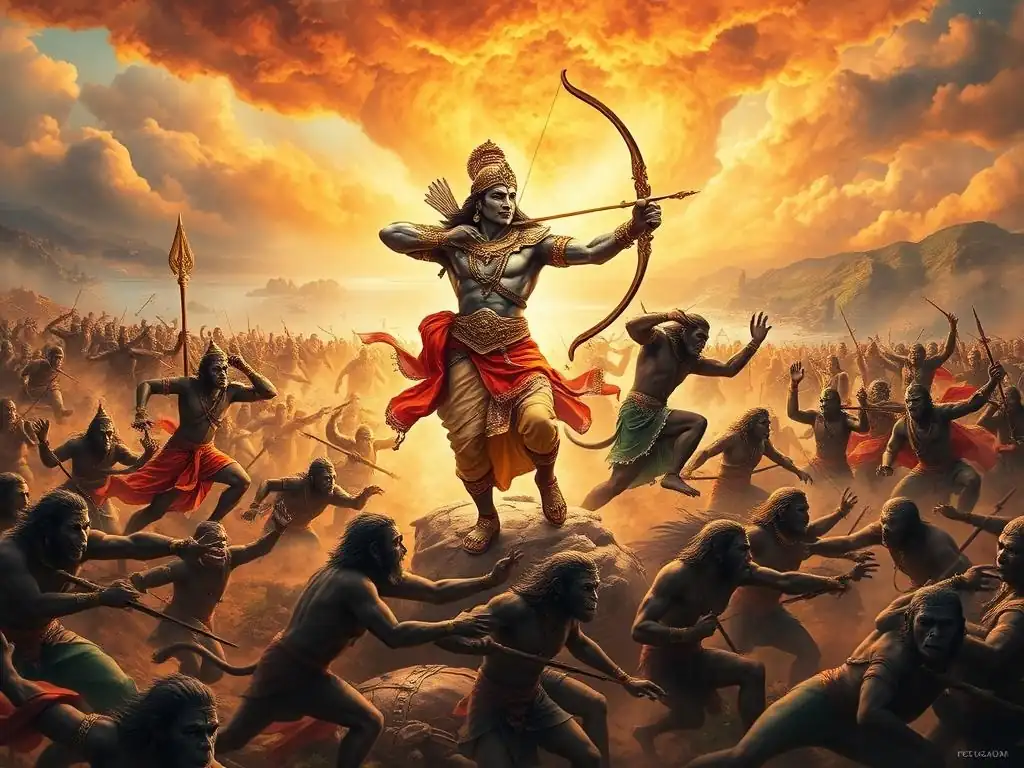
The epic reaches its climax with the colossal war fought on the island of Lanka between Rama's army, composed of Vanaras and bears, and Ravana's formidable Rakshasa forces. This conflict is not merely a battle for the recovery of Sita but a representation of the cosmic struggle between Dharma and Adharma, good and evil. The fate of the world order hangs in the balance.
The War Between Good and Evil: A Cosmic Struggle
The war in Lanka is depicted as a conflict with cosmic implications. Deities and celestial beings watch from above, and the outcome is seen as determining the balance of the universe. Rama represents the forces of righteousness, aided by divine power and righteous allies. Ravana represents the forces of unrighteousness, supported by demonic power and dark magic. The battles are fierce and destructive, involving superhuman feats and powerful weapons.
This struggle mirrors the internal battles faced by individuals between their higher and lower natures. The external war in Lanka is a macrocosm of the internal war within each being. The victory of Rama signifies the triumph of Dharma over Adharma, order over chaos, and righteousness over evil. It is a necessary step in restoring balance to the world, a key outcome of the Ramayana hero’s journey.
Restoring Dharma: The Victory's Moral Significance
Rama's victory over Ravana and the subsequent recovery of Sita are not simply a happy ending but an event of profound moral and cosmic significance. The defeat of Ravana signifies the punishment of Adharma and the re-establishment of righteous rule. With Ravana vanquished, the world is freed from his tyranny, and the sages and innocent beings who suffered under his rule can live in peace.
Rama's return to Ayodhya and his eventual coronation as king mark the beginning of Ram Rajya, the ideal reign characterized by justice, prosperity, and peace, where Dharma flourishes. This period is often cited as the benchmark for good governance in Hindu tradition. The victory in Lanka and the subsequent restoration of order highlight the Ramayana hero’s journey meaning: the struggle and sacrifice are necessary to uphold righteousness and ensure the well-being of the world.
The Use of Divine Weapons and Strategic Warfare
The war in Lanka involves not only conventional warfare but also the extensive use of divine weapons (astras) granted by deities, strategic planning, and extraordinary feats of strength and magic. Both sides employ powerful weapons capable of mass destruction or specific effects, such as the Brahma Astra or the Nagapasha. The battles showcase various strategies, from building the bridge (Setu) across the ocean to utilizing aerial combat and magical illusions.
While divine intervention and magical elements are prominent, the epic also emphasizes the importance of human effort, strategic thinking, and the courage of the warriors. Rama and his generals, like Sugriva and Angada, plan their campaigns, utilize their resources effectively, and demonstrate leadership on the battlefield. This blend of divine power and human endeavor underscores the idea that while cosmic forces are at play, human action and adherence to Dharma are essential for achieving victory.
The Ramayana's Enduring Legacy: Lessons for Humanity
Centuries after its composition, the Ramayana continues to resonate deeply with people across the globe, particularly in India and Southeast Asia. Its stories are told and retold, its characters revered, and its teachings studied. The epic's enduring legacy lies in its universal themes, its profound moral lessons, and its ability to provide guidance for living a meaningful and righteous life.
The Ramayana as a Guide to Ethical Living
The Ramayana serves as a comprehensive guide to ethical living, illustrating through its characters and narrative the principles of Dharma in action. It provides models for ideal relationships – the devoted husband and wife (Rama and Sita), the loyal brothers (Rama, Lakshmana, Bharata, Shatrughna), the ideal master and servant (Rama and Hanuman), and the just ruler and obedient subjects.
The epic teaches the importance of truthfulness, integrity, compassion, forgiveness, patience, and self-control. It warns against vices like lust, anger, greed, pride, and ego, demonstrating their destructive consequences through the character of Ravana. The dilemmas faced by characters and their resolutions offer practical insights into navigating complex moral situations, making the Ramayana a timeless source of ethical instruction. Understanding the Ramayana hero’s journey meaning is often tied to internalizing these ethical principles.
The Pursuit of Moksha: The Ultimate Goal of Life
While the immediate narrative of the Ramayana focuses on earthly events like exile, abduction, and war, the underlying philosophy points towards the ultimate goal of Moksha, liberation from the cycle of birth and death. By depicting Rama as a divine being and emphasizing the importance of Dharma, devotion, and righteous action, the epic subtly guides the reader towards spiritual understanding.
Living a life aligned with Dharma, cultivating virtues, practicing devotion, and ultimately realizing the divine nature of reality are presented as paths towards spiritual liberation. Rama's journey, culminating in his return to his divine abode after his earthly mission is complete, symbolizes the soul's journey towards union with the divine. The epic suggests that by following the example of Rama and living righteously, individuals can progress towards their own ultimate spiritual goal.
The Ramayana's Impact on Indian Culture and Beyond
The cultural impact of the Ramayana on India is immeasurable. Its stories are woven into the fabric of daily life, influencing art, literature, music, dance, theatre, festivals (like Diwali, celebrating Rama's return), and even political thought (the concept of Ram Rajya). Millions of people know its characters and narratives from childhood, passed down through generations.
Beyond India, the Ramayana has spread throughout Southeast Asia, adapted into local versions in countries like Thailand (Ramakien), Cambodia (Reamker), Indonesia (Kakawin Ramayana), Malaysia, and others. These versions, while retaining the core narrative, often incorporate local customs, beliefs, and artistic styles, demonstrating the epic's adaptability and universal appeal. Its themes of good versus evil, loyalty, love, and duty resonate across diverse cultures, cementing its place as a global epic.
The Ramayana in the 21st Century: Contemporary Relevance
Despite its ancient origins, the Ramayana remains remarkably relevant in the modern world. Its exploration of universal human experiences and moral dilemmas continues to offer valuable insights for navigating the complexities of contemporary life. The epic's themes of leadership, justice, responsibility, and the consequences of unchecked power are particularly pertinent in today's global society.
Adapting Ancient Wisdom to Modern Challenges
The ancient wisdom contained within the Ramayana can be adapted to address modern challenges. Its teachings on Dharma provide a framework for ethical decision-making in personal and professional life. The emphasis on righteous governance offers lessons for political leaders. The epic's portrayal of resilience and perseverance in the face of adversity provides inspiration for overcoming personal and societal obstacles.
For instance, the concept of Ram Rajya can be interpreted as a call for just and equitable governance in modern democracies. The challenges Rama faces in balancing personal relationships with public duty resonate with the pressures faced by leaders today. The Ramayana encourages introspection and the cultivation of inner virtues as essential tools for navigating a complex and often chaotic world, highlighting the practical Ramayana hero’s journey meaning for modern life.
Interpretations and Re-tellings in Film, Literature, and Theatre
The enduring appeal of the Ramayana is evident in its continuous reinterpretation across various media in the 21st century. It has been adapted into numerous films, television series (the 1987 Indian TV series Ramayan by Ramanand Sagar achieved unprecedented viewership), animated features, stage plays, and countless books and graphic novels. These adaptations often explore different facets of the story, offer new perspectives on characters, or place the narrative in contemporary settings.
These modern retellings introduce the epic to new audiences and allow for explorations of its themes through a contemporary lens. Some versions might focus on Sita's perspective, others on Ravana's motivations, or the social structures depicted. This constant re-imagining testifies to the epic's richness and its ability to speak to the concerns and artistic sensibilities of different eras, keeping the Ramayana hero’s journey alive for new generations.
Reflecting on the Ramayana's Message of Hope and Resilience
Ultimately, the Ramayana offers a powerful message of hope and resilience. Rama's journey, marked by immense suffering, loss, and struggle, culminates in the triumph of good and the restoration of order. The epic teaches that even in the darkest times, adhering to Dharma, maintaining faith, and striving for righteousness can lead to victory and peace.
The resilience of characters like Sita, who maintains her dignity and purity despite captivity, and the unwavering faith of Hanuman, who overcomes obstacles through devotion, serve as inspirations. The Ramayana reassures its readers that while the path of righteousness may be challenging, it is ultimately the path that leads to fulfillment and the restoration of balance, both in the individual life and in the world. Reflecting on the Ramayana hero’s journey meaning offers profound lessons on overcoming adversity through virtue and perseverance.
Frequently Asked Questions
What is the Ramayana and why is it considered a hero's journey?
The Ramayana is an ancient Indian epic narrating the life of Rama and his quest to rescue his wife, Sita. It's a hero's journey because Rama faces trials, receives help, and ultimately transforms, fulfilling his dharma.
How does the concept of dharma relate to Rama's hero's journey?
Dharma, meaning duty or righteousness, is central to the Ramayana. Rama's journey is driven by his commitment to uphold his dharma as a prince, husband, and king, even when faced with difficult choices.
What are some key obstacles Rama faces on his hero's journey?
Rama faces numerous obstacles, including exile from his kingdom, the abduction of Sita by Ravana, and battles against demons. These challenges test his courage, loyalty, and adherence to dharma.
What is the significance of Sita in understanding the Ramayana hero's journey meaning?
Sita's purity and unwavering devotion to Rama are integral. Her abduction sparks Rama's quest, highlighting the themes of love, sacrifice, and the fight against evil, which are all parts of the hero's journey.
What is the overall meaning or takeaway from Rama's hero's journey?
Rama's journey demonstrates the importance of righteousness, duty, and unwavering commitment to one's values. It teaches about overcoming adversity and the ultimate triumph of good over evil, offering timeless lessons.
Final Reflection: Echoes of Rama's Journey in Our Modern World
The timeless tale of Rama resonates deeply with our contemporary struggles, reminding us that the conflict between love and duty is a universal human experience. Rama's journey, far from being a relic of ancient India, continues to offer profound insights into the complexities of moral choices and the enduring power of perseverance in the face of adversity. His story challenges us to examine our own lives and the choices we make, highlighting the often-blurred lines between personal desires and societal expectations.
The Ramayana's impact on cultural and social landscapes is undeniable; its influence stretches across millennia and continents, shaping artistic expressions, philosophical thought, and ethical frameworks. The epic's enduring popularity speaks to its ability to tap into fundamental human emotions and dilemmas. The Ramayana is not merely a story; it is a mirror reflecting the human condition.
This quote encapsulates the enduring relevance of Rama's journey, showcasing how his struggles with righteousness, temptation, and loss continue to resonate with audiences across time and cultures. It's a story that compels us to consider the sacrifices we make for those we love and the responsibilities we bear towards society.
Consider Rama's unwavering commitment to dharma, his duty. What sacrifices do you make in your own life for the greater good? What internal battles do you face between personal desires and societal expectations? The Ramayana isn't just a story to be read; it's a journey to be undertaken, a reflection to be engaged in. Embrace the challenge of defining your own path, guided by the echoes of Rama's epic journey, and discover the strength and wisdom that lie within you.
Unlock Your Inner Hero: Embark on a Ramayana Journey
Thanks for joining us on this exploration of the epic Ramayana! We hope you gained a deeper appreciation for the timeless themes of love, duty, and heroism woven throughout this ancient tale. Now it's time to take your journey further.
- Delve deeper into the Ramayana: Explore different interpretations and adaptations of the epic – perhaps a different translation, a retelling in another medium, or even a scholarly analysis. This will allow you to discover new layers of meaning and perspective.
- Share your thoughts and reflections: What resonated most with you in the story? Which character inspired you the most? Let’s discuss the epic in the comments below!
- Discover the parallels between the Ramayana's values and your own life: How can you integrate themes of courage, righteousness, and unwavering love into your daily actions?
What aspect of the Ramayana’s heroic journey will you carry with you today?