
Heidegger's Mythic Roots: Rethinking Being Through Ancient Stories


Welcome to Mythology and Legends, where ancient echoes resonate through the ages. Ever wondered how the whispers of myth influence even the most profound philosophical thought? Prepare to delve into the fascinating intersection of ancient narrative and modern philosophy as we explore Heidegger's mythic roots. Can the study of ancient stories unlock a deeper understanding of Being itself? Join us as we unravel this intriguing connection...
- Introduction: Exploring the Intersection of Heidegger, Myth, and Ancient Thought
- The Influence of Ancient Greek Myth on Heidegger's Concepts
- Heidegger and the Myth of the Hero: Confronting Existence
- The Concept of Heimat (Homeland) and its Mythic Resonance
- Myth as a Source of Meaning: Countering Nihilism in Heidegger's Work
- Criticisms and Alternative Interpretations of Heidegger's Mythic Leanings
- Heidegger’s Myths and Philosophy: A Re-Evaluation of Being
-
Frequently Asked Questions
- What is the central argument connecting Heidegger's philosophy to mythology?
- How does the article explore the influence of specific myths on Heidegger's thought?
- Why is it important to consider myths when studying Heidegger's philosophy?
- What are some potential criticisms of linking Heidegger's philosophy to mythology?
- In what ways might Heidegger's philosophy reinterpret or challenge traditional interpretations of mythology?
- Final Reflection: Echoes of Being: Heidegger's Myths and Our Modern World
- Unveil Your Inner Mythmaker: Dive Deeper into Being
Introduction: Exploring the Intersection of Heidegger, Myth, and Ancient Thought
Heidegger’s Philosophy: A Brief Overview of Being and Time
Martin Heidegger's philosophy, particularly as articulated in his seminal work Being and Time (1927), fundamentally reoriented Western thought by posing the question of the meaning of Being ( Sein). Rather than focusing on beings ( Seiende)—the entities that exist—Heidegger sought to understand the nature of existence itself. He approached this through an analysis of human existence, which he termed Dasein (literally "being-there").
Dasein is unique because it is the only being for whom its own being is an issue; it is conscious of its existence and constantly engages with the question of what it means to be. Key concepts introduced include thrownness (Dasein's arbitrary entry into the world), being-towards-death (the fundamental awareness of finitude), and the distinction between authentic and inauthentic existence.
Inauthentic existence is characterized by being absorbed in the "they" ( das Man), conforming to societal norms and losing one's individuality, while authentic existence involves confronting one's finitude and taking ownership of one's possibilities. This existential analysis provides the groundwork for his later investigations into language, technology, and, significantly, the role of ancient thought and myth in understanding Being.
Heidegger's philosophical project was deeply critical of the Western metaphysical tradition, which he argued had forgotten the original question of Being, reducing it to the study of individual entities. He believed that this "forgetting of Being" ( Seinsvergessenheit) began with Plato and continued through modern science and technology, leading to a world where entities are viewed merely as resources or objects for control.
His later works increasingly turned to poetry, language, and pre-Socratic thinkers as potential pathways to a more original understanding of Being, one that he felt was closer to the ancient Greek experience. This turn highlights the profound connection Heidegger saw between philosophical inquiry and modes of thought that predate formal logic and systematic metaphysics, suggesting an undercurrent of mythical or pre-rational understanding in the very foundations of Western thought, central to exploring Heidegger’s myths and philosophy.
The Underappreciated Role of Myth in Heidegger’s Thinking
While often associated with existentialism and phenomenology, the role of myth and ancient narratives in shaping Heidegger's thought is frequently underplayed. Heidegger himself engaged extensively with Greek tragedy, pre-Socratic fragments, and etymology, often interpreting these sources in ways that diverge from traditional philological or historical accounts.
He was not interested in myth as mere historical artifact or primitive belief system, but rather as a fundamental mode of revealing truth ( aletheia) that stands in contrast to later, more conceptual or logical forms of understanding. For Heidegger, ancient myths and the language of the early Greek thinkers contained an experiential connection to Being that had been lost in subsequent philosophical development.
This engagement is evident in his lectures and essays where he dissects terms like phusis (nature), logos (reason/speech), and aletheia (unconcealment/truth), tracing their meanings back to what he perceived as their original, more potent senses rooted in a pre-philosophical, arguably mythic, worldview. He saw the transition from this early mode of thought to later metaphysics as a departure from a more profound attunement to Being.
Exploring Heidegger’s myths and philosophy reveals his conviction that myth provided a framework through which early humans experienced the world not as a collection of objects, but as a dynamic, unfolding process of emergence and concealment, a perspective he sought to recover in his own philosophy to counter the perceived emptiness of modern technological existence.
Bridging Ancient Narratives and Modern Existentialism
Heidegger's work attempts to bridge the gap between ancient modes of thought, including myth, and the concerns of modern existentialism, particularly the human condition of Dasein. He saw the existential anxieties and questions of meaning faced by Dasein—thrownness, finitude, freedom, anxiety—as issues that were perhaps addressed, albeit in a different idiom, by ancient myths and tragedies.
For instance, the Greek tragedies, with their exploration of fate, human limitations, and the encounter with the divine or cosmic forces, can be seen as grappling with fundamental aspects of existence that resonate with Heidegger's analysis of Dasein's confrontation with its own possibilities and limitations.
By drawing parallels between the insights embedded in ancient narratives and his philosophical concepts, Heidegger suggests that myth offers a non-propositional, experiential understanding of Being that complements or even precedes philosophical articulation. He argues that the power of myth lies in its ability to reveal fundamental truths about the human condition and the nature of reality through storytelling and symbolic representation, rather than through logical argumentation.
This approach underscores the interdisciplinary nature of Heidegger’s myths and philosophy, demonstrating how philosophical inquiry can draw insights from seemingly disparate domains like ancient folklore and tragedy to illuminate the perennial questions of existence.
The Influence of Ancient Greek Myth on Heidegger's Concepts
Aletheia: Unveiling Truth Through Mythological Revelation
Heidegger's reinterpretation of the Greek concept of aletheia is perhaps one of the most significant points of contact between his philosophy and ancient thought, bordering on the mythic. Traditionally translated as "truth" in the sense of correctness or correspondence between a statement and reality ( adaequatio intellectus et rei), Heidegger argued that the original meaning of aletheia was "unconcealment" or "unhiddenness" ( Unverborgenheit).
He traced this interpretation back to the pre-Socratic period, suggesting that for early Greeks, truth was not primarily a property of propositions but an event—the emergence of beings from concealment into the open. This unconcealment, he proposed, was not a constant state but a dynamic process, often associated with the appearance of phenomena within the clearing ( Lichtung) of Being.
Heidegger posited that this understanding of aletheia as unconcealment was more akin to a spontaneous revelation, similar to how divine presence or the forces of nature might manifest in a mythic worldview, rather than a static logical state. He contrasts this with the later, propositional understanding of truth that became dominant in Western metaphysics, which he saw as a departure from this more fundamental experience of reality.
For Heidegger, the pre-Socratic engagement with aletheia involved a direct, almost visceral encounter with the unconcealing power of Being, a mode of apprehension that he believed was deeply intertwined with their understanding of phusis (nature) as a self-unfolding, revealing process. This interpretation provides a key example of how Heidegger’s myths and philosophy intersect, where he finds echoes of a primordial understanding of truth within the conceptual landscape of early Greek thought, which he links to a pre-rational, revelatory mode of experience.
The Significance of Logos and Mythos in Understanding Heidegger
Heidegger's philosophy also engages with the complex relationship between logos and mythos, two fundamental Greek terms that have shaped Western thought. Logos is typically translated as reason, word, speech, or account, while mythos refers to story, narrative, or myth. In classical Greece, particularly with the rise of philosophy and rhetoric, logos often came to be seen as superior to mythos, representing rational discourse and truth in contrast to mere stories or fables.
Heidegger, however, does not simply dismiss mythos in favor of logos. Instead, he suggests that the original relationship was more complex and that the later elevation of logos and marginalization of mythos contributed to the "forgetting of Being."
For Heidegger, logos in its earliest sense was not merely logic or reason but a way of gathering and revealing, a kind of primordial saying that allowed things to appear in their Being. He saw this early logos as intimately connected with, rather than opposed to, the revelatory power of mythos. Myth, in this light, is not false or irrational but another, perhaps more fundamental, way in which reality is disclosed to human understanding.
Heidegger’s myths and philosophy suggest that mythos can reveal aspects of Being that are inaccessible to purely logical or scientific logos, particularly the existential dimensions of human life and the enigmatic nature of the world. His analysis implies that a complete understanding of Being requires an attunement to both modes of disclosure, recognizing the unique capacity of myth to convey truths about existence through narrative and symbolic form.
Heidegger's Interpretation of Pre-Socratic Philosophers and their Mythic Worldview
Heidegger extensively studied and interpreted the fragments of pre-Socratic philosophers such as Heraclitus and Parmenides, viewing them not as primitive scientists or proto-metaphysicians, but as thinkers who stood closer to an original experience of Being. He saw their language and concepts as retaining a connection to a worldview where the distinction between philosophical inquiry, poetic utterance, and mythic understanding was not yet rigidly defined.
For example, he interpreted Heraclitus's concept of Logos not as a rational principle of the universe, but as the unifying, strife-filled gathering that allows beings to emerge and withdraw. Similarly, he read Parmenides's poem not as a treatise on logic, but as a profound meditation on the unconcealment of Being (the Way of Truth) versus the concealment (the Way of Seeming).
Heidegger argued that the pre-Socratics' thinking was deeply rooted in their experience of phusis—not just nature as the physical world, but as the dynamic, self-unfolding emergence of beings. This understanding of phusis, he contended, was closely aligned with the way reality was experienced and expressed in early Greek myths, where divine and natural forces were intertwined and revealed themselves through powerful, often unpredictable, events.
By focusing on the language and context of these early thinkers, Heidegger attempted to recover a sense of the world as it was experienced before the rise of systematic philosophy and science, a world saturated with a kind of mythic resonance. This approach is fundamental to understanding Heidegger’s myths and philosophy, highlighting his belief that the origins of Western thought were intertwined with a pre-rational, myth-informed understanding of reality.
Heidegger and the Myth of the Hero: Confronting Existence
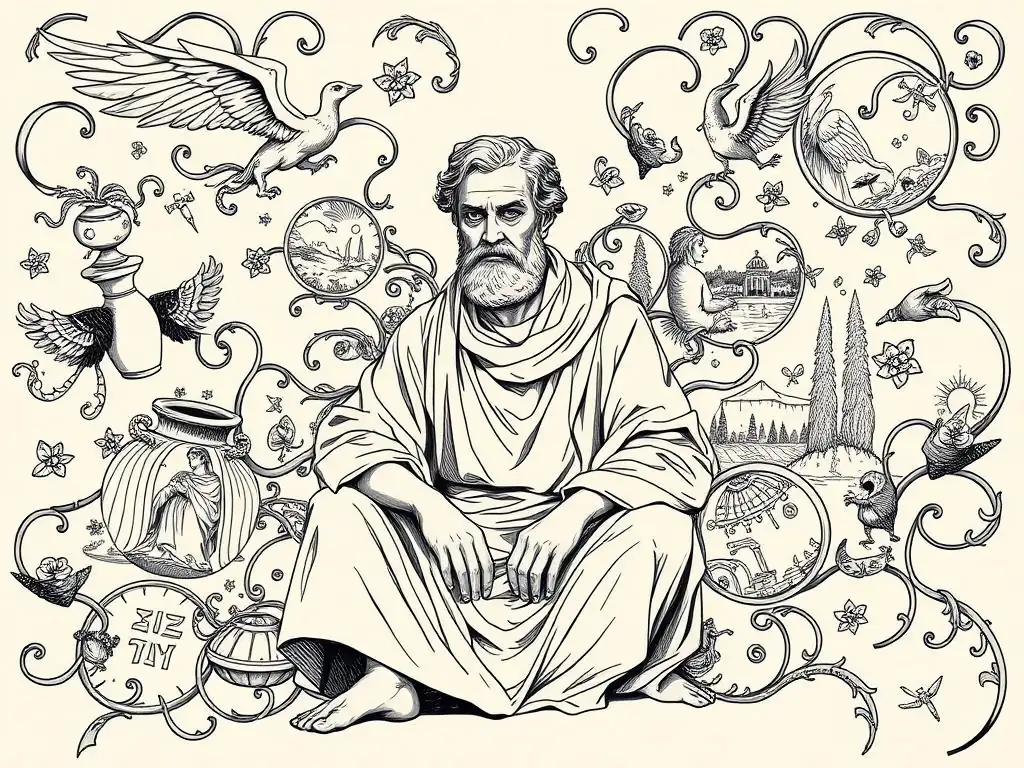
The Hero’s Journey: A Metaphor for Dasein's Struggle for Authenticity
The structure inherent in many mythic narratives, often described as the Hero's Journey, offers a compelling metaphorical lens through which to view Heidegger's concept of Dasein's struggle for authenticity. The hero, called from the ordinary world, faces trials, confronts death or profound challenges, and ultimately returns transformed. This mirrors Dasein's potential journey from inauthentic existence within the "they"—the comfortable, unthinking conformity of everyday life—to authentic existence. Authenticity, for Heidegger, is not about becoming extraordinary in a conventional sense, but about confronting one's own finitude (being-towards-death) and taking resolute hold of one's possibilities in the face of anxiety.
The hero's departure from the known world can be likened to Dasein's experience of anxiety ( Angst), which pulls it out of its absorption in the world of concern and the "they," revealing the groundlessness of its existence. The trials faced by the hero parallel Dasein's struggle against falling (being lost in the public interpretation of reality) and its confrontation with its own limitations and possibilities.
The hero's ultimate transformation or realization resonates with Dasein's achievement of authentic selfhood—not a fixed state, but a resolute orientation towards its own being and its finite future. While Heidegger did not explicitly map the Hero's Journey onto Dasein's structure, the parallels reveal how mythic narratives can articulate, in symbolic form, the fundamental existential dynamics that Heidegger describes philosophically, illustrating a point of convergence for Heidegger’s myths and philosophy.
Mythic Archetypes and Heidegger’s Notion of Mortality
Mythic archetypes, such as the warrior, the sage, the trickster, or figures who confront death or the underworld, resonate with Heidegger's analysis of Dasein's being-towards-death and its encounter with fundamental aspects of existence. These archetypal figures often embody different ways of confronting fate, mortality, and the unknown. The warrior faces death directly in battle; the sage seeks wisdom in the face of existential questions; figures like Orpheus or Hercules journey to the underworld, representing a confrontation with the ultimate limit of human life.
Heidegger argues that Dasein's most fundamental characteristic is its being-towards-death, the constant, though often unacknowledged, awareness of its own finitude. This awareness is not merely biological but an existential understanding that colors all of Dasein's possibilities.
Mythic archetypes provide cultural and narrative frameworks for understanding these deep-seated human experiences. They offer symbolic representations of confronting limitations, facing the unknown, and grappling with the transient nature of life.
For example, the myth of Sisyphus, condemned to eternally push a boulder uphill, can be seen as a stark depiction of the absurdity and futility that Dasein might experience in the face of its finite existence and the lack of ultimate external meaning. By examining these archetypes, we see how ancient myths articulated, through narrative and symbol, the very existential concerns that Heidegger analyzes philosophically, demonstrating another layer of connection within Heidegger’s myths and philosophy.
The Myth of Oedipus and Dasein's Encounter with Fate
The Greek tragedy of Oedipus Rex, a pivotal myth in Western culture, offers a powerful illustration of themes central to Heidegger's philosophy, particularly Dasein's encounter with thrownness and fate. Oedipus is "thrown" into a specific lineage and destiny he did not choose—prophesied to kill his father and marry his mother. Despite his efforts to escape this fate, his actions unwittingly fulfill the prophecy.
This resonates with Heidegger's concept of thrownness ( Geworfenheit), which describes Dasein's being cast into a world and circumstances not of its own making, equipped with a specific history and set of possibilities that are given rather than chosen. Oedipus's struggle highlights the tension between human freedom and the constraints imposed by one's facticity or thrownness.
Furthermore, Oedipus's eventual self-blinding and exile can be interpreted as a form of resolute self-disclosure, a painful but necessary confrontation with the truth of his existence and his fate, however horrifying. This echoes Dasein's call to authenticity, which often involves confronting uncomfortable truths about oneself and one's situation.
The myth demonstrates that even in the face of seemingly unavoidable fate, there is a space for how one responds to that fate—Oedipus's response is one of confronting the truth, however devastating, rather than living in ignorance. The Oedipus myth thus serves as a potent, albeit tragic, narrative exploration of the existential predicament of Dasein caught between freedom and thrownness, illustrating how deeply ancient narratives can illuminate the philosophical terrain of Heidegger’s myths and philosophy.
The Concept of Heimat (Homeland) and its Mythic Resonance
Heimat as a Lost Paradise: Exploring Nostalgia and Belonging
Heidegger's later philosophy, particularly his reflections on dwelling and language, engages with the concept of Heimat, often translated as "homeland" or "dwelling place." This concept carries significant mythic resonance, frequently evoking images of a lost paradise, a state of original belonging and harmony with the world that has been disrupted by modernity.
For Heidegger, Heimat is not merely a geographical location but a deeper sense of rootedness, familiarity, and being-at-home in the world, characterized by a harmonious relationship with one's environment, community, and the fundamental aspects of existence. This sense of belonging is often portrayed in myths and folklore as an idyllic past, a golden age, or a sacred space from which humanity has fallen or been exiled.
Heidegger's exploration of Heimat is imbued with a sense of nostalgia for a perceived loss of this rootedness in the modern technological age. He argued that modern technology, with its emphasis on control, calculation, and the reduction of the world to resources, uproots Dasein from its natural dwelling and obscures the poetic, revealing aspects of reality.
The yearning for Heimat can be seen as a longing for a time or state where human existence was more intimately attuned to Being, a state often depicted in myths as a period of closer proximity to the divine or the origins of the world. This connection between the philosophical concept of Heimat and the mythic trope of a lost paradise highlights how Heidegger’s myths and philosophy converge in their critique of modernity and their search for a more grounded mode of existence.
The Role of Myth in Constructing a Sense of Place and Identity
Myths play a crucial role in the construction of a sense of place and collective identity, providing narratives that connect individuals to their land, history, and community. Creation myths, origin stories, and tales of ancestral heroes or sacred landscapes imbue places with meaning and significance, transforming mere geographical locations into Heimat. These narratives explain how a people came to be, their relationship to the land they inhabit, and their place in the cosmic order.
They provide a shared symbolic universe that fosters a sense of belonging and continuity across generations. For instance, the myths surrounding Mount Olympus for the ancient Greeks or the Dreamtime narratives for Indigenous Australians are integral to their cultural identity and their relationship with their environment.
Heidegger, in his reflections on dwelling ( Wohnen), emphasized the importance of building and cultivating a meaningful relationship with one's environment, seeing authentic dwelling as a way of preserving the earth and being open to the sky, the divinities, and mortals—the "fourfold" ( Geviert). While he did not explicitly analyze specific origin myths, his concern with the loss of authentic dwelling in modernity resonates with the function of myth in establishing a sacred and significant connection to place.
Myths provide the foundational stories that allow a community to dwell meaningfully within a landscape, anchoring their identity in shared narratives and symbolic meanings. This function of myth aligns with Heidegger's search for ways to overcome the placelessness and alienation of modern existence, underscoring the importance of cultural narratives, including myths, in shaping the experience of Heimat, a key element in understanding Heidegger’s myths and philosophy.
Heidegger's Critique of Modernity and the Disenchantment of the World
Heidegger's later philosophy is marked by a profound critique of modern technology and its impact on human existence and the understanding of Being. He argued that modern technology is not merely a set of tools but a way of revealing or "enframing" ( Gestell) that reduces everything, including nature and human beings, to standing reserve ( Bestand)—resources to be ordered, managed, and consumed.
This technological enframing, he contended, represents the culmination of the forgetting of Being, leading to a world that is increasingly devoid of mystery, depth, and sacredness—a disenchanted world. This critique finds parallels in mythic narratives that lament the loss of a golden age, the departure of the gods, or the taming of wild, unpredictable forces.
The "disenchantment of the world," a concept associated with Max Weber but resonant with Heidegger's concerns, describes the process by which scientific rationalization and technological control strip the world of its magical, spiritual, and mythic qualities. Heidegger saw this as a dangerous state where humanity loses its capacity to be open to the unpredictable, revealing power of Being, instead imposing a rigid, calculative framework upon reality.
His search for alternative modes of revealing, such as art, poetry, and a renewed engagement with original language and thought (including what he saw as the mythic undercurrents in early Greek philosophy), can be seen as an attempt to counter this disenchantment and find ways for Being to unconceal itself anew. This critical stance towards modernity and the search for alternative modes of understanding are central themes connecting Heidegger’s myths and philosophy.
Myth as a Source of Meaning: Countering Nihilism in Heidegger's Work

The Limitations of Reason: Myth as a Complementary Mode of Understanding
Heidegger's critique of Western metaphysics and the dominance of calculative thinking implies a recognition of the limitations of reason as the sole means of accessing truth and meaning. He argued that while logical and scientific reason excel at understanding and manipulating beings, they fail to grasp the question of Being itself.
Reason, particularly in its modern form, operates within a framework that already presupposes the existence of entities and focuses on their properties and relations, often overlooking the fundamental mystery of why there is something rather than nothing. This limitation leads, in Heidegger's view, to a form of nihilism, where existence is perceived as ultimately groundless and meaningless when viewed solely through a rational-calculative lens.
Myth, for Heidegger, offers a complementary mode of understanding that operates differently from reason. Myths do not provide logical explanations or verifiable facts; instead, they offer symbolic narratives that articulate fundamental human experiences, cosmic forces, and the relationship between humanity and the divine or the natural world. They engage the imagination and provide a framework of meaning that can address questions about purpose, origin, and destiny in ways that reason cannot.
While Heidegger does not advocate for a return to pre-rational belief, he suggests that engaging with the revelatory power of mythic thought is essential for a more complete understanding of Being, one that transcends the limitations of purely rational approaches. This perspective is vital for grasping the significance of Heidegger’s myths and philosophy as a counterpoint to the perceived meaninglessness of modern life.
Heidegger's Engagement with Poetry and its Mythic Imagination
Heidegger's later work turned increasingly to poetry, particularly the work of Friedrich Hölderlin, viewing it as a privileged site where language moves beyond mere representation to become a vehicle for the unconcealment of Being. Poetry, like myth, operates through evocative language, symbolism, and rhythm, creating a world of meaning that is not reducible to propositional statements.
Heidegger saw authentic poetry as a "saying" that names the holy and reveals the relationship between gods and mortals, earth and sky—the fourfold. This capacity of poetry to gather and reveal aspects of reality that remain hidden to ordinary language and scientific description aligns it closely with the function of myth.
Heidegger's interest in poetry's mythic imagination stems from his belief that both modes of expression tap into a more original, pre-conceptual understanding of the world. He saw in the poet's use of language a power to bring beings into presence, to establish a clearing where Being can manifest itself. This stands in contrast to technological language, which he saw as merely ordering and classifying entities.
By engaging with poetry's capacity for symbolic revelation and its connection to fundamental aspects of existence, Heidegger finds resources for countering the nihilistic tendencies of modernity. He suggests that poetry and myth, through their unique ways of saying and revealing, can help Dasein recover a sense of wonder and meaning in a world increasingly dominated by calculative thought, underlining the intertwined nature of Heidegger’s myths and philosophy in his later reflections.
Heidegger's Analysis of Hölderlin's Poetry and its Connection to Myth
Heidegger's extensive interpretations of the poetry of Friedrich Hölderlin (1770-1843) serve as a prime example of his engagement with language that he perceived as deeply connected to mythic themes and the question of Being. Hölderlin's poetry often grapples with the departure of the Greek gods, the search for the sacred in a seemingly godless age, and the role of the poet as a mediator between the divine and the human.
Heidegger saw in Hölderlin's work a profound awareness of the "holy lack," the absence of the gods, which for Heidegger signaled the state of the modern world after the forgetting of Being. Yet, Hölderlin's poetry also held the promise of a future arrival of the divine, a re-enchantment of the world.
Heidegger interpreted Hölderlin's poetic language as a response to this condition, a "naming" that prepares the way for the return of the holy. He saw Hölderlin's invocation of Greek gods and myths not as mere literary allusion but as a genuine attempt to recover a sense of the sacred and to question the foundations of modern existence.
For Heidegger, Hölderlin's poetry revealed how language, when used authentically, can open up a dimension of reality that is closed to purely rational or technological thought—a dimension where Being can reveal itself. This deep analysis of Hölderlin's engagement with mythic themes and the divine demonstrates Heidegger's belief in the power of poetic language, akin to myth, to address the fundamental questions of existence and counter the pervasive nihilism he diagnosed in the modern world, cementing the connection between Heidegger’s myths and philosophy.
Criticisms and Alternative Interpretations of Heidegger's Mythic Leanings
The Dangers of Romanticizing the Past: A Critical Perspective
Heidegger's engagement with ancient Greek thought and his valorization of pre-Socratic philosophy and modes of understanding often draw criticism for potentially romanticizing the past. Critics argue that Heidegger's interpretations can be anachronistic, imposing his own philosophical concerns onto historical periods and figures without sufficient regard for the actual historical context and diverse perspectives within those times. His tendency to interpret terms like aletheia or phusis in ways that diverge significantly from standard philological or historical accounts is sometimes seen as imposing a modern philosophical agenda onto ancient texts, potentially distorting their original meaning.
Furthermore, focusing on a perceived "golden age" of thought or dwelling, rooted in a connection to myth or a specific understanding of Being, risks overlooking the complexities, conflicts, and less idealized aspects of those historical periods. For example, ancient Greece was not a monolithic culture, and the transition from mythic to philosophical thought was a gradual and contested process.
Critics worry that Heidegger's nostalgic view of the past, while serving his critique of modernity, can lead to an uncritical acceptance of certain historical narratives and potentially obscure the social and political realities of those times. This perspective highlights a key debate in the study of Heidegger’s myths and philosophy, questioning whether his approach is a genuine recovery of lost insight or a selective, idealized construction.
Existentialist Interpretations of Heidegger's Work
While Heidegger himself later distanced his philosophy from existentialism, many of his core concepts, particularly those developed in Being and Time, have been interpreted and utilized by existentialist thinkers. Existentialist interpretations tend to focus on Heidegger's analysis of Dasein's freedom, anxiety, authenticity, and being-towards-death, emphasizing the human condition and the individual's responsibility in creating meaning in a meaningless world.
From this perspective, the "mythic" elements in Heidegger's work might be seen primarily as symbolic representations of these fundamental existential structures rather than as pointing to a distinct mode of understanding or a critique of Western metaphysics rooted in historical modes of thought.
For existentialists like Jean-Paul Sartre, who drew heavily on Being and Time, the emphasis is on radical freedom and the absence of a predetermined essence or nature for humanity. While Sartre acknowledges the concept of "facticity" (akin to thrownness), his philosophy places greater emphasis on Dasein's capacity for self-creation through choice.
An existentialist reading might see the hero's journey or figures like Oedipus as illustrating the human struggle with freedom and responsibility in the face of external constraints, rather than as revealing a specific "mythic" understanding of Being itself. This highlights a divergence in how Heidegger’s myths and philosophy are understood, with existentialism focusing more on the subjective human experience rather than the ontological question of Being.
Reconciling Heidegger's Philosophy with Contemporary Ethical Concerns
A significant area of criticism and alternative interpretation concerns the ethical and political implications of Heidegger's philosophy, particularly in light of his brief but controversial involvement with Nazism. Critics question whether a philosophy that critiques universal reason and champions a form of rootedness ( Heimat) and a specific historical destiny can be reconciled with contemporary ethical concerns for universal human rights, pluralism, and democratic values.
His emphasis on a unique "destining" of Being ( Seinsgeschick) and his critique of abstract, universal morality have led some to argue that his philosophy lacks a robust ethical framework capable of addressing modern challenges.
Reconciling Heidegger’s myths and philosophy with contemporary ethics requires careful consideration. Some interpreters attempt to extract the ontological insights from his work while rejecting his problematic political stances. Others argue that his critique of calculative thinking and his focus on authentic dwelling can provide valuable resources for environmental ethics or a critique of technological society, independent of his historical failings.
However, the potential for his concepts of rootedness and destiny to be co-opted for exclusionary or nationalistic purposes remains a point of contention. This ongoing debate underscores the difficulty in separating Heidegger's philosophical insights, including his engagement with myth and ancient thought, from the broader historical and political context in which they were developed.
Heidegger’s Myths and Philosophy: A Re-Evaluation of Being
The Enduring Relevance of Myth in Understanding Heidegger's Thought
Despite the criticisms and complexities, the engagement with myth and ancient narratives remains an enduringly relevant aspect of understanding Heidegger's thought. His attempt to retrieve a sense of aletheia as unconcealment, his analysis of the relationship between logos and mythos, and his interpretation of pre-Socratic thinkers all point to a sustained effort to access modes of understanding that predate the dominant Western metaphysical tradition. For Heidegger, these pre-philosophical, potentially mythic, ways of thinking offered a glimpse into a more fundamental relationship with Being that has been obscured over centuries.
Studying Heidegger’s myths and philosophy reveals his profound concern with the limitations of purely rational or scientific approaches to reality and his search for alternative pathways to truth and meaning. His work suggests that myth, poetry, and original language are not simply relics of the past but contain within them a capacity to reveal aspects of existence—such as finitude, freedom, belonging, and the mystery of Being—that are crucial for human self-understanding and for countering the perceived emptiness of modern life.
Engaging with the mythic roots of his philosophy provides a deeper appreciation of his critique of modernity and his call for a renewed attunement to Being.
How Heidegger’s Focus on Myth Informs Our Understanding of Existence
Heidegger's focus on myth and ancient thought informs our understanding of existence by highlighting the diverse ways in which reality can be revealed and experienced. By contrasting the propositional truth of logic and science with the unconcealing power he associated with early Greek thought and myth, Heidegger challenges the notion that reason is the sole or primary access to truth. He suggests that existence is not merely a collection of facts to be analyzed but a dynamic process of revealing and concealing, best approached with openness and attunement rather than just calculation and control.
Heidegger’s myths and philosophy invite us to consider how narrative, symbolism, and evocative language shape our understanding of ourselves and the world. The mythic narratives he implicitly or explicitly references—from the struggle of Oedipus to the yearning for Heimat—speak to fundamental human experiences of thrownness, fate, mortality, and belonging. By seeing these experiences reflected in ancient stories, we gain a richer, more layered understanding of the human condition. His work encourages us to look beyond purely rational explanations and consider how mythic modes of thought continue to influence our conceptual frameworks and our existential orientation towards Being.
Conclusion: Heidegger and Mythology in Ongoing Dialogue
The relationship between Heidegger's philosophy and mythology is not a closed chapter but an ongoing dialogue. Scholars continue to debate the extent and nature of myth's influence on his thought, the validity of his interpretations of ancient texts, and the implications of his myth-inflected concepts for contemporary philosophy and ethics. While Heidegger did not offer a systematic philosophy of myth, his persistent engagement with ancient modes of thought, his critique of modern reason, and his search for alternative ways of revealing Being underscore the significance of mythic imagination in his philosophical project.
Ultimately, exploring Heidegger’s myths and philosophy offers valuable insights into the enduring power of ancient narratives to illuminate the most profound questions of human existence. His work serves as a reminder that philosophy, in its quest to understand Being, can find fertile ground in the rich symbolic landscape of myth and folklore, suggesting that the insights contained within these ancient stories remain relevant for rethinking our place in the world and confronting the challenges of modernity.
Frequently Asked Questions
What is the central argument connecting Heidegger's philosophy to mythology?
The central argument suggests that Heidegger's philosophical concepts, particularly regarding Being, are deeply rooted in ancient myths and narratives, influencing his understanding of existence.
How does the article explore the influence of specific myths on Heidegger's thought?
The article likely examines how specific myths from various cultures provided archetypal frameworks for Heidegger's concepts of Dasein, temporality, and the relationship between humanity and Being.
Why is it important to consider myths when studying Heidegger's philosophy?
Understanding the mythic underpinnings of Heidegger's work can offer new insights into his sometimes obscure and complex philosophical language, making his ideas more accessible.
What are some potential criticisms of linking Heidegger's philosophy to mythology?
Critics might argue that connecting Heidegger to myths is an oversimplification, potentially misrepresenting the rigor and originality of his philosophical contributions.
In what ways might Heidegger's philosophy reinterpret or challenge traditional interpretations of mythology?
Heidegger's work may offer a modern philosophical lens through which to re-examine traditional myths, highlighting their enduring relevance to contemporary concerns about existence and meaning.
Final Reflection: Echoes of Being: Heidegger's Myths and Our Modern World
Heidegger's exploration of ancient myths isn't a dusty relic of academic history; it's a vital lens through which to understand our contemporary anxieties about technology, authenticity, and the very nature of existence. His engagement with pre-Socratic thought and the poetic language of ancient stories offers a powerful critique of our technologically driven world, a world often characterized by a forgetting of Being itself. This forgetting, Heidegger argued, has profound consequences for how we live and relate to the world around us.
The enduring influence of Heidegger's work on myth lies in its ability to challenge our assumptions about the relationship between humanity and nature, technology and existence. His insights resonate deeply with contemporary ecological concerns and the growing awareness of the limitations of a purely instrumental approach to the world. Only a God can save us,
Heidegger famously declared, not as a theological statement, but as a stark recognition of our own limitations in the face of the overwhelming power of technology and the potential for self-destruction. This quote, though controversial, highlights the urgency of his message and its continued relevance in a world grappling with existential threats.
Consider, then, the stories you tell yourself, the narratives that shape your understanding of the world. How do these narratives reflect a preoccupation with technology, a detachment from nature, or a sense of alienation?
Take a moment to reflect on Heidegger's challenge: to reclaim a deeper understanding of Being, not through abstract philosophical systems, but through the evocative power of myth and the careful attention to the world around us. By engaging with these ancient stories, we can begin to re-imagine our relationship with ourselves, with others, and with the world, and perhaps, find a more authentic way of being.
Unveil Your Inner Mythmaker: Dive Deeper into Being
Thanks for exploring the fascinating connection between Heidegger's philosophy and ancient myths! You've now gained a new perspective on the concept of Being – and how stories shape our understanding of existence. Ready to take the next step?
- Craft your own myth: Inspired by Heidegger's insights and the ancient tales we explored, try writing a short myth that explores your own understanding of Being. What symbols resonate with you? What story do you want to tell?
- Share your thoughts: Join the conversation in the comments below! What resonated most with you from this article? What questions do you still have about the interplay of philosophy and mythology?
- Explore further: Delve deeper into the works of Heidegger, exploring his other writings and the diverse interpretations of his philosophy. Consider reading some of the ancient myths referenced in the article.
What ancient story resonates most deeply with your personal understanding of Being, and why?