
The Memory Keepers: Preserving Culture Through Spoken Word


Welcome to Mythology and Legends, where ancient whispers echo in the digital age. Ever wondered how tales, passed down through generations, shape our understanding of the world? The Memory Keepers: Preserving Culture Through Spoken Word explores how oral traditions preserve global stories, offering a fascinating glimpse into the power of spoken narratives. Uncover the secrets hidden within these enduring voices and discover the profound impact of folklore on our modern lives. What untold stories will you find within?
- The Enduring Power of Oral Traditions in Global Storytelling
- How Oral Traditions Preserve Global Stories and Cultural Identity
- The Key Elements of Effective Oral Storytelling
- Challenges Faced in Preserving Oral Traditions
- Case Studies: Examples of Successful Oral Tradition Preservation
- The Future of Oral Traditions: Ensuring Continued Relevance
- Conclusion: The Vital Role of Oral Traditions in Shaping Our World
-
Frequently Asked Questions
- What exactly are oral traditions, and why are they important?
- How do oral traditions help preserve global stories?
- What are some examples of how oral traditions impact contemporary society?
- What are some challenges faced by oral traditions in the modern world?
- How can we help preserve and promote oral traditions for future generations?
- Final Reflection: The Enduring Power of the Spoken Word
- Unveil Your Family's Legacy: Share Your Stories!
The Enduring Power of Oral Traditions in Global Storytelling
Understanding the Significance of Spoken Word in Cultural Preservation
Oral traditions represent humanity's oldest form of communication and cultural transmission. Before the advent of writing systems, knowledge, history, values, and beliefs were passed down through generations solely by spoken word. This method wasn't merely about recounting facts; it involved performance, ritual, and community participation, embedding stories deeply within the social fabric. These narratives served as living libraries, containing everything from creation myths and epic histories to practical skills like farming techniques and medicinal knowledge. The very survival and identity of a community often depended on the accurate and vibrant preservation of these spoken narratives.
The significance of the spoken word in cultural preservation is profound, acting as the foundation upon which many societies built their understanding of the world. For instance, studies by UNESCO estimate that thousands of languages spoken today still rely heavily on oral traditions, especially among indigenous communities. These traditions are not static; they adapt and evolve with the community, reflecting changing circumstances while maintaining a core connection to the past.
The act of listening, remembering, and retelling reinforces communal bonds and ensures that collective memory is not lost. It is through these dynamic processes that oral traditions preserve global stories, keeping cultural heritage alive against the pressures of modernization and external influences.
Oral Traditions: A Bridge Between Past, Present, and Future
Oral traditions function as a vital bridge connecting past generations with the present and future. They carry the wisdom, experiences, and historical consciousness of ancestors, making them accessible and relevant to contemporary listeners. This intergenerational dialogue is crucial for maintaining cultural continuity and identity. The stories told around a fire, during ceremonies, or simply in daily life are not just entertainment; they are lessons in ethics, social structure, history, and cosmology. They provide a framework for understanding one's place in the world and within their community.
The role of oral traditions as a bridge is particularly evident in societies where historical records are scarce or non-existent in written form. For example, many Indigenous cultures in North America or Australia have complex histories and genealogies stretching back thousands of years, maintained almost entirely through oral transmission.
Elders, often referred to as "memory keepers," bear the crucial responsibility of accurately recounting these histories, ensuring that the knowledge is passed down without significant loss. This continuous flow of narrative ensures that the past remains a living part of the present, guiding future generations and demonstrating how oral traditions preserve global stories with remarkable resilience.
How Oral Traditions Preserve Global Stories and Cultural Identity
The Role of Storytellers in Maintaining Cultural Heritage
Storytellers are the custodians and navigators of oral traditions. They are highly respected individuals within their communities, often possessing exceptional memory, rhetorical skills, and a deep understanding of their culture's history, values, and spiritual beliefs. These individuals are not just passive conduits of information; they are active interpreters and performers, capable of adapting stories to specific audiences and occasions while maintaining the core narrative and its essential meaning. Their role is multifaceted, encompassing historian, teacher, spiritual guide, and entertainer.
The responsibility of storytellers in maintaining cultural heritage is immense. They are tasked with the accurate transmission of vast amounts of information, from intricate genealogical lines that can span dozens of generations to complex mythological cycles explaining the origins of the world. In many cultures, becoming a storyteller requires years of rigorous training, memorization, and apprenticeship under an elder master.
This dedication ensures the fidelity of the tradition. The vitality of a culture's oral traditions is often directly linked to the health and respect afforded to its storytellers, highlighting how these dedicated individuals ensure oral traditions preserve global stories for posterity.
Transmission of Knowledge: Oral Traditions vs. Written Records
The transmission of knowledge through oral traditions differs significantly from the methods employed by written records. While written texts offer permanence and wide distribution, oral traditions are dynamic and context-dependent. Oral transmission relies heavily on memory, repetition, and mnemonic devices like rhythm, rhyme, and formulaic phrases. The performance aspect, including tone of voice, gestures, and audience interaction, adds layers of meaning that are often lost in written form. Knowledge in oral cultures is frequently embedded within narrative structures, making it more engaging and easier to remember than abstract facts or figures.
Comparing oral traditions and written records reveals distinct strengths. Written records provide a fixed point of reference, resistant to the subtle changes that can occur over time in oral accounts. However, oral traditions offer flexibility and adaptability, allowing stories to remain relevant to changing social contexts.
They also foster a strong sense of community, as the act of sharing stories is often a collective experience. Furthermore, oral traditions can transmit knowledge in languages that may not have a written form, preserving linguistic diversity. While written documentation is invaluable, it cannot fully capture the richness, performance, and community engagement inherent in oral traditions preserve global stories.
The Importance of Linguistic Diversity in Oral Storytelling
Linguistic diversity is intrinsically linked to the preservation of oral storytelling traditions. Each language embodies a unique worldview, a specific way of categorizing experiences, and a particular set of cultural references. When a language is lost, the oral traditions embedded within it are also severely endangered, often disappearing entirely. The nuances of meaning, the specific vocabulary used to describe natural phenomena, social relationships, or spiritual concepts, and the very rhythm and sound of the language are integral to the stories.
The global decline in linguistic diversity poses a significant threat to oral traditions. According to estimates, a language dies every two weeks, and with it, potentially centuries of accumulated knowledge and narrative. Supporting linguistic preservation efforts is therefore crucial for safeguarding oral storytelling. Many indigenous languages, for example, contain extensive oral pharmacopoeias, detailed ecological knowledge, and complex social histories that have never been translated or documented in other languages. Protecting these languages is essential if oral traditions preserve global stories in their authentic and complete forms, ensuring that unique cultural heritages are not erased.
The Key Elements of Effective Oral Storytelling
Memory and Memorization Techniques in Oral Traditions
Memory is the cornerstone of oral traditions. Master storytellers possess exceptional memory capacities, often developed through rigorous training from a young age. This isn't simply rote memorization; it involves understanding the structure, themes, and emotional core of the narratives. Various techniques are employed to aid recall, including the use of formulaic phrases, repetition of key lines or motifs, and the structuring of narratives around familiar patterns or journeys. Rhyme, rhythm, and song are also powerful mnemonic devices used in many oral traditions, making the stories easier to remember and perform.
Beyond these techniques, the act of storytelling itself reinforces memory. Regular performance and retelling solidify the narrative in the storyteller's mind and in the collective memory of the community. In some cultures, specific locations or objects are associated with parts of a story, serving as physical cues for recall – a technique known as "memory palaces" or "method of loci." The pressure to accurately transmit vital information, whether historical accounts or medicinal knowledge, also sharpens mnemonic skills. These sophisticated memory techniques are fundamental to how oral traditions preserve global stories across vast expanses of time.
Performance and Ritual in Oral Storytelling
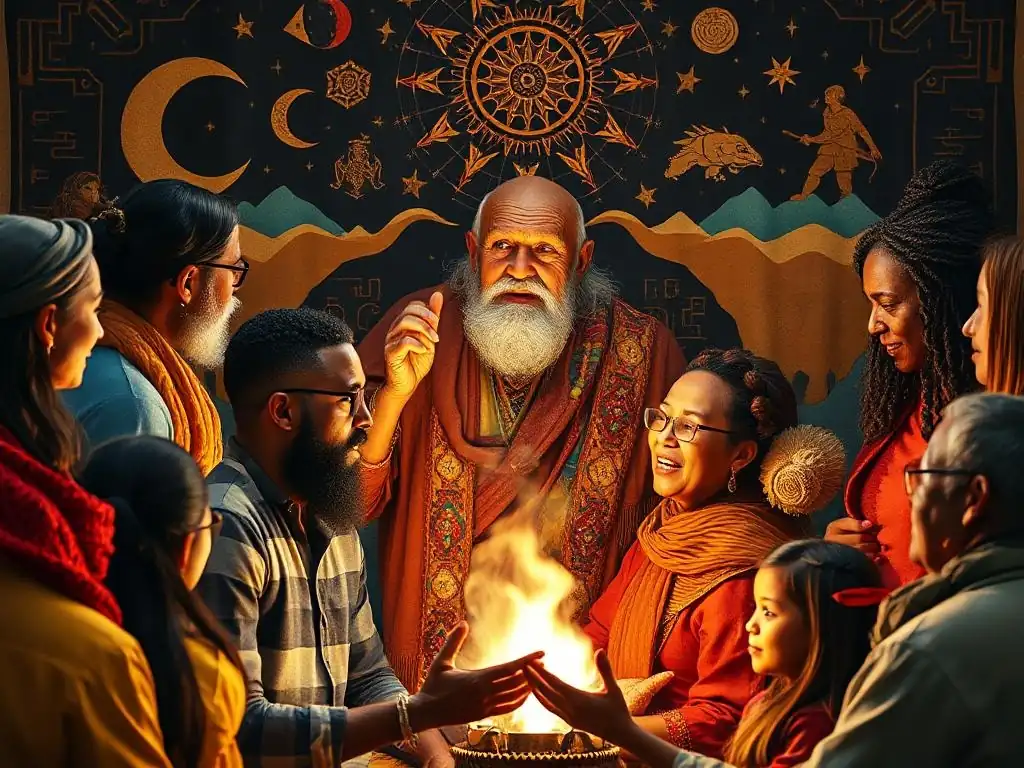
Oral storytelling is inherently a performance art. It involves more than just speaking words; it encompasses vocal inflection, gestures, facial expressions, and movement. The storyteller brings the narrative to life, engaging the audience emotionally and intellectually. The setting and context are also crucial; stories might be told around a fire, during a communal feast, at a sacred site, or as part of a specific ceremony or ritual. These elements create a powerful, immersive experience that deepens the impact of the narrative and aids in its transmission.
Ritual often plays a significant role in oral storytelling, particularly for origin myths, historical accounts, or spiritual narratives. Specific stories may only be told at certain times of the year, during particular life cycle events (like births, initiations, or deaths), or at sacred locations. The performance might involve music, dance, or the use of symbolic objects.
This integration of storytelling with ritual elevates the narrative from mere entertainment to a profound cultural act, reinforcing its importance and sacredness. This performative and ritualistic dimension is key to understanding how oral traditions preserve global stories not just as information, but as lived cultural experiences.
Adapting Oral Traditions to Contemporary Audiences
While authenticity is vital, oral traditions are not static relics; they must adapt to remain relevant to contemporary audiences. This adaptation can take many forms, from incorporating modern references or experiences into existing narratives to finding new platforms for sharing stories. Storytellers may adjust the pace or style of their delivery to suit a modern audience's attention span or introduce elements that resonate with current social or environmental concerns. The core narratives, however, often retain their original structure and thematic depth.
Adapting oral traditions also involves making them accessible to people outside the originating community. This might include translation into other languages, performance in new settings like schools or theaters, or the use of digital media. However, such adaptation must be handled with care and respect, ensuring that the stories are not diluted, misrepresented, or appropriated. Collaboration with and leadership from the originating community are essential. Successful adaptation ensures that the wisdom and beauty contained within these narratives continue to enrich lives, demonstrating that oral traditions preserve global stories while evolving with the times.
Challenges Faced in Preserving Oral Traditions
Impact of Globalization on Indigenous Languages and Storytelling
Globalization presents a significant threat to the survival of indigenous languages and, consequently, their associated oral storytelling traditions. The dominance of major global languages (like English, Spanish, Mandarin) in media, education, and commerce often leads to the marginalization and decline of minority languages. Younger generations in indigenous communities may prioritize learning and speaking the dominant language to access better economic or educational opportunities, leading to a break in the intergenerational transmission of their native tongue.
When a language is no longer actively spoken, the intricate vocabulary, grammatical structures, and cultural nuances that are integral to its oral traditions begin to erode. Stories lose their original form and meaning when translated or told in a less expressive language. Furthermore, the cultural values and social structures that supported traditional storytelling practices may be disrupted by global influences. This erosion of linguistic and cultural foundations makes it increasingly difficult for oral traditions preserve global stories specific to these communities, risking the loss of invaluable human heritage.
The Digital Age: Threats and Opportunities for Oral Traditions
The digital age presents a double-edged sword for the preservation of oral traditions. On one hand, digital technologies offer unprecedented opportunities for documenting, archiving, and disseminating oral histories. Audio and video recordings can capture the performance aspect of storytelling, while digital archives can make these recordings accessible to researchers and future generations. Online platforms and social media can also provide new avenues for storytellers to share their narratives with wider audiences, potentially revitalizing interest among younger community members.
However, the digital age also poses threats. The rapid pace of digital communication and entertainment can compete with the slower, more contemplative nature of traditional storytelling. There is also the risk of cultural appropriation, where stories shared online are taken out of context or used without permission or proper attribution. Furthermore, ensuring equitable access to technology and digital literacy within communities that hold rich oral traditions remains a challenge. Navigating these complexities is crucial to leverage technology effectively so that oral traditions preserve global stories in meaningful and ethical ways.
Documenting and Archiving Oral Histories: Ethical Considerations
Documenting and archiving oral histories is a vital, yet ethically complex, endeavor. While creating recordings and transcripts can safeguard stories from being lost, it raises important questions about ownership, access, and intellectual property. Traditionally, many oral narratives are considered communal property, or their telling might be restricted to specific individuals, genders, or times. Simply recording and archiving them in a public database can violate these traditional protocols and potentially expose sacred or sensitive information.
Ethical documentation practices require genuine partnership and free, prior, and informed consent from the communities and individuals involved. Decisions about what is recorded, how it is stored, who has access, and how it can be used must be made in collaboration with community elders and cultural authorities. Repatriation of existing archival materials back to communities is also a growing area of focus. Ensuring that documentation efforts empower communities and respect their cultural protocols is paramount for ethical archiving, reinforcing the principle that oral traditions preserve global stories under the guidance and control of their originators.
Case Studies: Examples of Successful Oral Tradition Preservation
The Maori of New Zealand: Preserving Whakapapa Through Oral Genealogy
The Māori people of New Zealand have a profound and intricate oral tradition centered around whakapapa, or genealogy. Whakapapa is far more than just a list of ancestors; it is the foundation of Māori identity, connecting individuals to their land, tribes ( iwi), sub-tribes ( hapū), and the wider cosmos. Reciting whakapapa is a vital practice in formal settings, establishing relationships, asserting identity, and demonstrating knowledge of tribal history and lore. This oral tradition is meticulously maintained and passed down through generations.
Maintaining whakapapa orally requires incredible skill and memory. It is often recited in a rhythmic, chanted form, aiding memorization and performance. Knowledge keepers learn extensive lines of descent, tribal histories, migration narratives, and links to significant places and events, all interconnected through whakapapa. This practice ensures that the historical record, as understood by Māori, remains vibrant and accessible. The continued strength of whakapapa demonstrates how oral traditions preserve global stories unique to the Māori experience, binding individuals to their ancestral past and collective identity.
The Role of Kaumātua (Elders) in Passing Down Stories
Kaumātua, the elders within Māori communities, play an indispensable role in preserving whakapapa and other oral traditions. They are the primary repositories of tribal knowledge, history, and cultural practices. Kaumātua are responsible for teaching younger generations the correct recitation of whakapapa, explaining its significance, and imparting the stories and histories associated with each ancestral line. This teaching often happens informally within families but also in more structured settings like wānanga (learning institutions) centered on traditional knowledge.
The authority and respect accorded to Kaumātua are crucial for the continuity of oral traditions. Their wisdom and memory are trusted sources of truth within the community. The process of learning from a Kaumātua is often a lengthy apprenticeship, requiring dedication and respect from the student. This direct, intergenerational transmission ensures that the nuances and depth of the oral traditions are accurately conveyed. The dedication of Kaumātua is a powerful example of how specific individuals ensure oral traditions preserve global stories for their people.
Community Involvement in Storytelling Events at Marae
Marae, the traditional Māori meeting grounds, are central to community life and vital spaces for the performance and preservation of oral traditions. Storytelling events, including the recitation of whakapapa, tribal histories ( kōrero tuku iho), and mythological narratives, are integral parts of gatherings at the marae, such as pōwhiri (welcome ceremonies) or tangi (funerals). These events provide formal settings where oral knowledge is shared, validated, and reinforced among community members.
Community involvement in these events is key. Attending a gathering at the marae is an opportunity for people of all ages to hear the stories of their ancestors, learn about their history, and connect with their identity. Younger members participate by listening, observing, and eventually taking on roles in welcoming speeches or performances that incorporate oral elements. The collective experience of sharing stories at the marae strengthens communal bonds and ensures that the oral traditions remain a living, vibrant part of Māori culture. These community-centered practices highlight how oral traditions preserve global stories within their specific cultural context.
The Griots of West Africa: Maintaining History and Culture Through Song and Narrative
In many parts of West Africa, particularly within the Manding cultures (including Mali, Guinea, Senegal, and Gambia), the griot (also known as jeli or jali) serves as a professional historian, storyteller, praise singer, musician, and advisor. Griots belong to a hereditary caste and undergo extensive training from childhood, learning vast historical epics, genealogies of ruling families, social customs, and musical traditions. They are the living archives of their societies, preserving centuries of history and cultural knowledge through performance.
The repertoire of a griot can be astonishingly large, encompassing the history of empires like the Mali Empire, founded in the 13th century, and the genealogies of noble families stretching back hundreds of years. They perform using traditional instruments like the kora (a 21-string harp-lute), balafon (xylophone), or ngoni (lute), weaving music and song into their narratives. Their performances are not just historical accounts; they are also social commentary, praise singing for patrons, and keepers of cultural values. The griots' dedication to their craft is a powerful illustration of how oral traditions preserve global stories and complex societal histories.
Adapting to Modern Mediums: Radio, Podcasts, and Digital Archives
While traditional performance remains central, some griots and cultural institutions are adapting to modern mediums to ensure their traditions reach contemporary audiences and are preserved for the future. Radio programs and podcasts feature griots performing historical narratives and traditional songs, making this rich cultural heritage accessible to listeners far beyond their immediate communities. This allows younger generations, who may live in urban areas or abroad, to connect with their ancestral history.
Furthermore, initiatives are underway to create digital archives of griot performances and historical accounts. These projects often involve recording master griots and transcribing their narratives. While capturing the full essence of a live performance is challenging, these archives provide invaluable resources for research and education. They also offer a safeguard against the potential loss of knowledge as elder griots pass on. By embracing technology cautiously and strategically, griots and their communities are finding new ways to ensure oral traditions preserve global stories in the 21st century.
Intergenerational Storytelling Projects Through Music and Performance
To ensure the continuity of the griot tradition, many communities are implementing intergenerational projects focused on music and performance. These initiatives pair elder griots with younger apprentices, providing structured learning environments where traditional knowledge and performance skills are passed down. These projects often culminate in public performances, allowing the apprentices to showcase their learning and gain experience, while also celebrating the tradition within the community.
These projects frequently incorporate both the historical narratives and the musical elements that are integral to the griot's art. Learning to play the kora or balafon is as important as memorizing the historical epics. By focusing on both aspects, these programs ensure that the tradition is passed on in its holistic form. Such intergenerational efforts are vital for the future of the griots, demonstrating a proactive approach to ensuring oral traditions preserve global stories by nurturing the next generation of memory keepers.
The Future of Oral Traditions: Ensuring Continued Relevance
Education and Awareness Programs to Promote Oral Storytelling
Ensuring the future of oral traditions requires dedicated education and awareness programs. These initiatives can be implemented within communities, schools, and public institutions. Teaching children traditional stories in their native language, incorporating storytelling into school curricula, and creating community-based workshops can help revitalize interest and skills in oral narration among younger generations. These programs can also educate wider society about the value and importance of oral traditions as legitimate forms of history, literature, and cultural expression.
Awareness campaigns can highlight the unique contributions of oral traditions to global heritage and the risks they face. Museums, cultural centers, and libraries can host exhibitions and events featuring storytellers. Online platforms and educational resources can share information about diverse oral traditions from around the world. By fostering appreciation and understanding, these programs can create an environment where oral traditions are recognized, respected, and supported, thereby helping to ensure oral traditions preserve global stories for generations to come.
Supporting Indigenous Storytellers and Cultural Practitioners
Direct support for indigenous storytellers and cultural practitioners is paramount for the survival of oral traditions. These individuals often face economic challenges and lack resources to continue their vital work. Providing financial assistance, grants, and stipends can enable them to dedicate more time to teaching, performing, and mentoring. Establishing cultural centers or schools run by the communities themselves provides dedicated spaces for teaching and practicing oral traditions.
Support also includes recognizing the intellectual property rights of communities over their oral narratives. Ensuring that storytellers and communities have control over how their stories are documented, shared, and used is essential. Partnerships with academic institutions or archives should be based on principles of respect, reciprocity, and community ownership. By empowering and resourcing the keepers of these traditions, we directly contribute to the strength and continuity of the narratives, ensuring that oral traditions preserve global stories from the source.
As discussed earlier, technology offers powerful tools for the preservation and sharing of oral traditions, provided they are used ethically and appropriately. Creating high-quality audio and video recordings of storytellers performing their narratives can capture the ephemeral nature of oral performance. Developing digital archives with robust metadata and access protocols controlled by originating communities ensures long-term preservation and respectful access.
Furthermore, technology can be used to create educational resources, interactive maps linking stories to places, or virtual reality experiences that immerse users in the cultural context of the narratives. Online platforms can facilitate intergenerational learning within diaspora communities or connect storytellers with wider audiences. Mobile apps can deliver stories in native languages directly to users. By carefully selecting and implementing technological solutions in partnership with communities, we can significantly enhance the ability of oral traditions preserve global stories in the digital age.
Conclusion: The Vital Role of Oral Traditions in Shaping Our World
Oral traditions are far more than simple stories; they are complex systems of knowledge, history, culture, and identity that have shaped human societies for millennia. They embody the collective memory and wisdom of countless generations, passed down through the power of the spoken word and the dedication of memory keepers. From the intricate genealogies of the Māori to the vast historical epics of the West African griots, these traditions demonstrate a remarkable capacity to preserve and transmit vital information without the need for written text.
Reaffirming the Importance of Listening and Learning from Oral Narratives
In a world increasingly dominated by written text and digital media, reaffirming the importance of listening to and learning from oral narratives is crucial. Oral traditions offer unique perspectives, deep cultural insights, and alternative ways of understanding history and the world. Engaging with these narratives requires active listening, patience, and a willingness to embrace different forms of knowledge transmission.
It reminds us that wisdom resides not only in books but also in the voices of elders and the collective memory of communities. By valuing and supporting oral traditions, we ensure that these invaluable living libraries continue to enrich our understanding of human diversity and the myriad ways in which oral traditions preserve global stories, connecting us all to the rich tapestry of human experience.
Frequently Asked Questions
What exactly are oral traditions, and why are they important?
Oral traditions are ways of passing down cultural knowledge, stories, and history through spoken word, songs, and performances. They are vital for preserving cultural identity and heritage, especially in communities without written records.
How do oral traditions help preserve global stories?
Oral traditions act as a living archive, ensuring that stories are passed down from generation to generation. This helps preserve unique cultural perspectives and ensures that global narratives are not lost over time.
What are some examples of how oral traditions impact contemporary society?
Oral traditions influence various aspects of modern life, from literature and art to music and storytelling. They also inform ethical values and social norms within communities.
What are some challenges faced by oral traditions in the modern world?
Globalization, urbanization, and the dominance of written media pose significant threats to the survival of oral traditions. The loss of native languages also contributes to the decline.
How can we help preserve and promote oral traditions for future generations?
Supporting indigenous communities, documenting and archiving oral narratives, and integrating them into education are crucial. Encouraging intergenerational knowledge transfer is also essential.
Final Reflection: The Enduring Power of the Spoken Word
The preservation of oral traditions is not merely a historical exercise; it is a vital act of cultural survival in our increasingly digital world. The stories, songs, and knowledge passed down through generations represent the heart and soul of countless communities, and their continued existence is crucial for maintaining cultural identity and fostering understanding across diverse populations. The loss of these traditions represents an irreplaceable loss of human experience and wisdom.
The impact of oral traditions extends far beyond the immediate community; they shape our understanding of history, mythology, and the human condition itself. These narratives provide a powerful lens through which we can examine our past, present, and future, offering invaluable insights into the complexities of human experience. As the great storyteller, Joseph Campbell, once said: Myth is a potent instrument for the understanding of the human condition.
This rings profoundly true when considering the enduring power of stories passed down through generations, shaping values, beliefs, and cultural practices. The stories we tell ourselves, and those told to us, define who we are.
Consider the stories you've heard from your family, your community, your culture. What lessons have they imparted? What values have they instilled? I urge you to actively seek out and engage with the oral traditions of your own heritage and those of others. Record the stories of your elders, share your own experiences, and become a keeper of memory yourself. By actively participating in the preservation and transmission of these invaluable narratives, we ensure that the rich tapestry of human experience continues to thrive for generations to come.
Thanks for taking the time to explore the power of preserving cultural heritage through spoken word! You've now learned about the vital role storytelling plays in keeping traditions alive. Ready to make a difference?
- Record a story: Capture a cherished memory, family recipe, or cultural practice on audio or video and share it! This is your primary action – help us build a living archive of voices.
- Share this article: Spread the word! Let others discover the joy and importance of preserving their family's unique stories.
- Join the conversation: What unique cultural story from your family is waiting to be shared? Let's hear it in the comments below!
What story will you share to keep your cultural heritage vibrant for generations to come?