
Comparing Epic Heroes: Odysseus, Rama, and the Long Road Home.


Welcome to Mythology and Legends, a portal to the world's most enduring stories. Ever wondered what connects the trials of ancient heroes across continents? Dive into our exploration of the Odysseus Rama homecoming journey, uncovering the shared human experiences woven into these epic tales. What drove these legendary figures, and what can their struggles teach us today? Begin your journey now...
- Comparing Epic Heroes: Odysseus and Rama's Journeys Home
- Introduction: Exploring the Heroic Quests of Odysseus and Rama
- Odysseus: The Cunning King's Journey to Ithaca
- Rama: The Righteous Prince's Return to Ayodhya
- Odysseus vs. Rama: A Comparative Analysis of Their Journeys
- The Role of Women in the Journeys of Odysseus and Rama
- The Enduring Legacy of Odysseus and Rama: Lessons for Modern Audiences
- Conclusion: Reflecting on the Timeless Power of Homecoming Narratives
-
Frequently Asked Questions
- How does the "homecoming journey" motif connect Odysseus and Rama in their respective epics?
- What are some key differences in the reasons for Odysseus's and Rama's prolonged absences from home?
- In what ways do their "homecoming journeys" reflect the values of their respective cultures?
- What role do divine interventions and supernatural elements play in both Odysseus's and Rama's "homecoming journeys"?
- How do Odysseus and Rama exemplify the ideal "hero" figure within their respective cultural contexts, especially in relation to their "homecoming journeys"?
- Final Reflection: The Enduring Power of the Homecoming
- Unveil Your Inner Hero: Embrace the Epic Journey!
Comparing Epic Heroes: Odysseus and Rama's Journeys Home
Introduction: Exploring the Heroic Quests of Odysseus and Rama
The Enduring Appeal of Epic Homecoming Stories
Stories of heroes overcoming immense challenges to return to their origins hold a powerful, universal appeal across cultures and millennia. These narratives tap into fundamental human desires for belonging, stability, and the restoration of order after periods of chaos or displacement. The concept of a "homecoming journey" transcends mere physical return; it often signifies a journey of self-discovery, transformation, and the re-establishment of identity within a familiar context. Epics like Homer's Odyssey and Valmiki's Ramayana are prime examples, detailing the arduous paths taken by their protagonists, Odysseus and Rama, to reclaim their rightful places and families.
The resonance of these tales lies in their exploration of themes such as perseverance, loyalty, resilience, and the definition of true heroism. Readers and listeners throughout history have found inspiration and meaning in the struggles and eventual triumphs of these figures. The Odysseus Rama homecoming journey narratives, though separated by vast geographical and cultural distances, share a common core that speaks to the human spirit's capacity to endure hardship and strive towards a cherished goal – the return to a beloved home and the restoration of a disrupted life.
Setting the Stage: Introducing Odysseus, Rama, and Their Quests
Odysseus, the king of Ithaca, is a central figure in Greek mythology, renowned for his cunning intelligence and eloquence. His epic journey, chronicled in the Odyssey, begins after the Trojan War, a conflict that lasted a decade. What should have been a relatively short voyage back to his island kingdom turned into a twenty-year odyssey filled with monstrous encounters, divine wrath, and existential threats. His quest is driven by a deep longing for his wife, Penelope, his son, Telemachus, and his homeland, Ithaca, which he hasn't seen in two decades.
Across the world in ancient India, Prince Rama of Ayodhya is the protagonist of the Ramayana, an epic that details his life, exile, and eventual return to his kingdom. Rama, an embodiment of dharma (righteousness), is forced into a fourteen-year exile in the forest due to a complex royal intrigue. His journey home is precipitated by the abduction of his wife, Sita, by the demon king Ravana, leading to a monumental war.
Unlike Odysseus, Rama's "homecoming" is not just a physical return after a long absence but also the culmination of fulfilling his destiny and re-establishing moral order in his kingdom. Both heroes embark on epic quests that test their limits, define their character, and ultimately lead them back to their rightful places.
Odysseus: The Cunning King's Journey to Ithaca
Odysseus's Cleverness and Resilience: Defining Characteristics
Odysseus is perhaps best known for his metis, a Greek term encompassing cunning, intelligence, and practical wisdom. This quality is his primary tool for survival and success throughout his arduous journey. Unlike the brute strength of heroes like Achilles, Odysseus relies on strategic thinking and deception to overcome seemingly insurmountable obstacles. His famous ruse with the Trojan Horse, which ended the decade-long war, is a testament to his unparalleled intellect. This cleverness is repeatedly demonstrated on his journey home, from tricking the Cyclops Polyphemus to navigating the treacherous paths laid out by gods and monsters.
Beyond his intelligence, Odysseus possesses extraordinary resilience. He endures the loss of his entire crew (approximately 600 men over the course of the journey), spends years held captive by goddesses like Calypso (seven years) and Circe (one year), faces the horrors of the Underworld, and survives numerous deadly encounters.
Despite despair and hardship, he maintains an unwavering determination to return to Ithaca. His resilience is not just physical but also mental; he adapts to changing circumstances, learns from his mistakes, and never gives up hope, even when faced with divine opposition from Poseidon, god of the sea, who relentlessly pursues him for blinding his son, Polyphemus.
Key Challenges and Trials Faced by Odysseus on His Journey
Odysseus's journey home is a catalog of mythological perils, each testing a different aspect of his character and his crew's loyalty. Upon leaving Troy, his ships are blown off course, initiating a series of misadventures. One early, significant challenge involves the Cicones, where his men's greed leads to a costly battle and significant losses.
Later, the encounter with the Lotus-Eaters threatens to rob his men of their desire for home, requiring Odysseus to physically drag them back to the ships. These early trials highlight the dangers of indiscipline and the constant threat of external and internal forces derailing the Odysseus Rama homecoming journey concept.
Further trials include navigating the dangerous straits between Scylla, a six-headed monster, and Charybdis, a whirlpool, where Odysseus is forced to sacrifice six of his men to save the rest. The stay on the island of the Sun God Helios proves catastrophic when his hungry crew slaughters sacred cattle, incurring divine wrath that results in the destruction of his final ship and the loss of all remaining men. These events underscore the high stakes and the heavy toll Odysseus's journey exacts, leaving him utterly alone at several points.
The Cyclops Encounter and Its Significance
Perhaps the most iconic challenge is the encounter with the Cyclops Polyphemus on the island of the Cyclopes. Trapped in the giant's cave with several of his men, Odysseus faces imminent death by being eaten. Instead of relying on force, which would be futile against the immense creature, Odysseus devises a cunning plan. He first intoxicates Polyphemus with potent wine, then blinds him with a heated stake while the giant is asleep. When other Cyclopes ask who has harmed him, Polyphemus replies, "Nobody," a name Odysseus cleverly used to identify himself.
This episode is significant for several reasons. It is a prime example of Odysseus's metis triumphing over brute strength. It also demonstrates his leadership, albeit one that sometimes leads to costly mistakes, as his boastful revelation of his true name upon escaping incurs the wrath of Poseidon, Polyphemus's father. The encounter highlights the dangers of pride and sets the stage for many of the subsequent divine obstacles Odysseus faces on his Odysseus Rama homecoming journey.
Temptations and Betrayals: Navigating Calypso and Circe
Odysseus also faces trials that are not overtly violent but equally perilous: temptations that threaten to make him forget his goal of returning home. The sorceress Circe transforms some of his men into pigs, and Odysseus must use his wits and divine aid (from Hermes) to rescue them and resist her magic. He and his remaining crew then spend a year on her island, Aiaia, living in relative comfort until his men remind him of their true purpose.
Following his visit to the Underworld, Odysseus is shipwrecked and washes ashore on the island of Ogygia, home to the nymph Calypso. Calypso, captivated by Odysseus, offers him immortality and eternal youth if he will stay with her forever. He remains there for seven years, held captive by her love and the absence of any means to leave.
Despite the comforts and the offer of divinity, Odysseus is depicted weeping on the shore, longing for his mortal life, his wife, and his home in Ithaca. His eventual release, orchestrated by Zeus at the urging of Athena, underscores the divine forces at play and Odysseus's deep-seated desire to complete his Odysseus Rama homecoming journey.
Odysseus's Ultimate Triumph: Reclaiming His Kingdom and Family
After twenty long years, Odysseus finally reaches Ithaca, disguised as a beggar with the help of Athena. His return is not immediately a joyous reunion; he finds his palace overrun by arrogant suitors vying for Penelope's hand and his throne, squandering his wealth. His initial task is to assess the situation, identify loyal allies (like the swineherd Eumaeus and the cowherd Philoetius), and formulate a plan to reclaim his kingdom and family.
The climax of his return involves the famous archery contest proposed by Penelope, where she promises to marry the suitor who can string Odysseus's great bow and shoot an arrow through twelve axe heads. None of the suitors can even string the bow. Odysseus, still in disguise, asks for a turn, and to the suitors' shock, he strings the bow effortlessly and makes the impossible shot.
This act is the signal for the bloody slaughter of the suitors, a brutal but necessary step to cleanse his palace and restore order. His identity is then revealed, first to his loyal servants, then to his son Telemachus, and finally, after a subtle test involving their bed, to his faithful wife Penelope. His triumph is complete when he re-establishes peace in Ithaca, solidifying his reign and reuniting his family, successfully concluding his epic Odysseus Rama homecoming journey.
Rama: The Righteous Prince's Return to Ayodhya
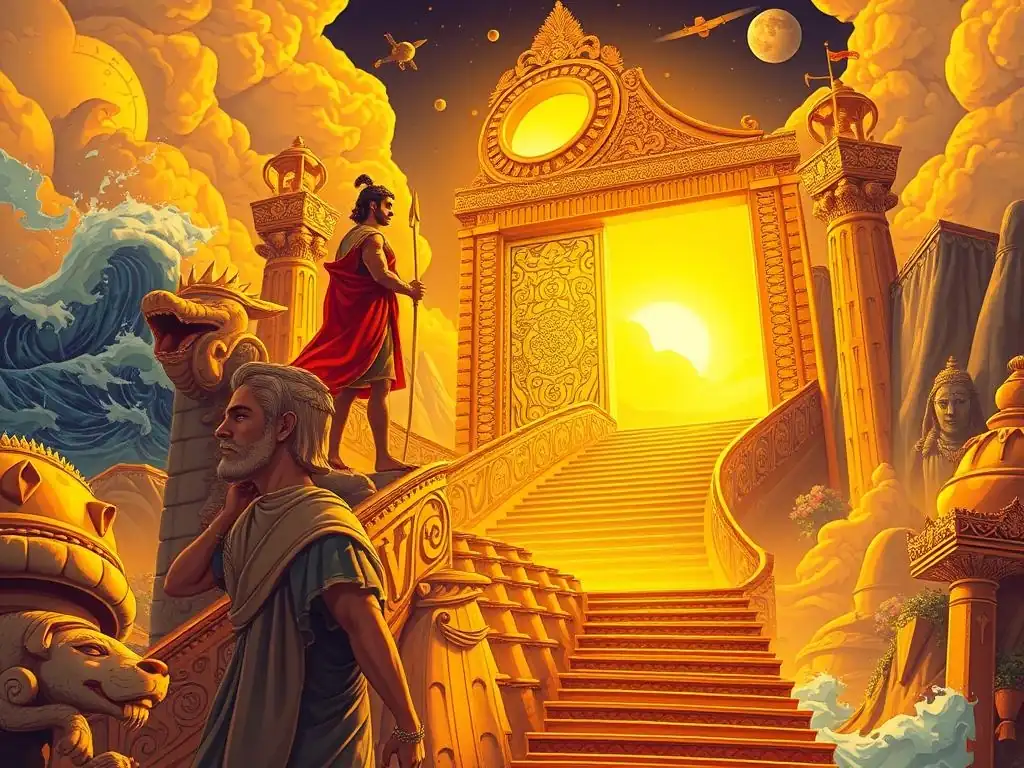
Rama's Virtue and Dharma: Core Principles of His Character
Rama is portrayed in the Ramayana as the epitome of dharma, a complex concept encompassing righteousness, duty, moral law, and virtuous conduct. He is depicted as an ideal son, brother, husband, and ruler, embodying virtues such as truthfulness, compassion, humility, and unwavering adherence to moral principles. Even when faced with personal suffering, such as his unjust exile from Ayodhya, Rama accepts his fate without bitterness, viewing it as his duty to honor his father's promise, however flawed.
His character is defined by his commitment to upholding justice and protecting the virtuous. Throughout his exile and subsequent war against Ravana, Rama's actions are guided by his adherence to dharma. He shows compassion even to his enemies when appropriate and consistently chooses the path of righteousness, even when it is difficult or requires personal sacrifice. This steadfast adherence to moral principles is the driving force behind his entire journey, including his eventual return to Ayodhya, as it represents the restoration of dharma to the kingdom.
Obstacles and Adversaries in Rama's Journey
Rama's journey is set in motion by his fourteen-year exile, a consequence of a boone granted to his stepmother Kaikeyi by his father, King Dasharatha. This initial displacement from his rightful place is the foundational obstacle. During his exile in the forest, accompanied by his devoted wife Sita and loyal brother Lakshmana, they face various demons and rakshasas who disrupt the peace of the ascetics and forest dwellers. These encounters serve to highlight Rama's prowess as a warrior and protector.
The most significant adversary is Ravana, the powerful demon king of Lanka. Ravana's abduction of Sita, driven by lust and a desire for revenge against Rama and Lakshmana, transforms Rama's journey into a quest to rescue his beloved wife and punish the unrighteous ruler. This act sets the stage for the epic conflict that forms the core of the latter half of the Ramayana, a massive war requiring Rama to forge alliances with vanaras (monkey people) and bears, led by figures like Hanuman and Sugriva.
The Abduction of Sita and the War Against Ravana
The abduction of Sita is the pivotal event that escalates Rama's exile into a full-blown epic conflict. Ravana, disguised as a mendicant, tricks Sita and carries her off to his island kingdom of Lanka. This act of injustice and violation of dharma compels Rama to embark on a mission to rescue her, a task that seems almost impossible given the distance and Ravana's formidable power. The search for Sita involves traversing vast landscapes and facing numerous challenges, including overcoming the grief of separation and the daunting task of locating her.
The subsequent war against Ravana is a grand-scale conflict involving massive armies of vanaras and rakshasas. Key battles are fought, demonstrating the martial skills of Rama, Lakshmana, and their allies, particularly Hanuman. The war culminates in a final, epic duel between Rama and Ravana, where Rama, with divine weapons and guided by dharma, finally defeats the demon king. This victory is not just a personal triumph for Rama but represents the victory of good over evil and the restoration of cosmic order, paving the way for his Odysseus Rama homecoming journey back to Ayodhya.
Loyalty and Sacrifice: Hanuman's Role in Rama's Quest
A critical figure in Rama's quest is Hanuman, the devoted general of the vanara army and son of the wind god. Hanuman's loyalty to Rama is absolute and unwavering, bordering on divine reverence. He undertakes perilous missions, including leaping across the vast ocean to find Sita in Lanka, a feat requiring immense strength and devotion. His discovery of Sita provides crucial intelligence and hope, and he even attempts to rescue her or at least disrupt Ravana's forces by setting Lanka ablaze.
Hanuman's actions are marked by incredible feats of strength, intelligence, and selflessness. He serves as Rama's messenger, spy, and most formidable warrior ally. His role is not merely that of a helper but of a key enabler of Rama's success. The bond between Rama and Hanuman exemplifies the ideals of loyalty and service within the framework of dharma. Hanuman's sacrifices and unwavering dedication are indispensable to Rama's victory and the eventual Odysseus Rama homecoming journey.
Rama's Coronation: Establishing Dharma and Order in Ayodhya
Following the defeat of Ravana and Sita's rescue, Rama, Sita, and Lakshmana, along with their allies, begin their journey back to Ayodhya. Their return, after fourteen years of exile, is a moment of immense joy and celebration for the people of Ayodhya, who had long awaited their beloved prince's return. Upon reaching the kingdom, Rama is formally crowned king, marking the beginning of his reign.
Rama's coronation is not just a political event; it signifies the re-establishment of dharma and righteous rule in Ayodhya. His reign is often referred to as "Rama Rajya," an ideal period characterized by justice, prosperity, peace, and the well-being of all subjects. Rama rules wisely, adhering strictly to moral principles and ensuring the welfare of his people. His Odysseus Rama homecoming journey culminates in the restoration of order, not just within his family and kingdom, but on a cosmic level, fulfilling his divine purpose and setting an example of ideal kingship guided by dharma.
Odysseus vs. Rama: A Comparative Analysis of Their Journeys
Similarities in the Narrative Structure of Their Epics
Despite their distinct cultural origins, the Odyssey and the Ramayana share striking similarities in their narrative structures, reflecting common patterns in heroic myths. Both epics follow a protagonist who is displaced from his home and must undertake a long, arduous journey to return and reclaim his rightful place. Both heroes face a series of trials and obstacles, often involving supernatural beings, powerful adversaries, and tests of character. The structure typically involves separation, initiation into a challenging world, and eventual return and reintegration.
Both narratives also feature a clear goal: the return to home, family, and kingdom. For Odysseus, it is Ithaca, Penelope, and his throne. For Rama, it is Ayodhya, Sita, and his right to rule. The journeys are fraught with peril, and both heroes suffer significant losses along the way, including the deaths of loyal companions (Odysseus loses all his men; Rama loses allies in battle). The successful completion of their respective Odysseus Rama homecoming journey narratives leads to the restoration of order and stability in their respective worlds.
The Importance of Divine Intervention in Both Journeys
Divine forces play crucial roles in shaping the destinies and aiding the heroes in both epics. In the Odyssey, gods like Athena are powerful advocates for Odysseus, guiding him, offering assistance, and interceding on his behalf with other deities, particularly Zeus. Conversely, Poseidon acts as a persistent antagonist, hindering Odysseus's return at every turn. The gods are active participants, influencing events, imposing trials, and sometimes offering direct aid or advice, such as Hermes helping Odysseus against Circe.
Similarly, the Ramayana is replete with divine intervention. Rama himself is considered an avatar (incarnation) of the god Vishnu, giving his quest a cosmic significance. Gods and divine beings often appear to offer guidance, provide celestial weapons, or assist key figures like Hanuman. The war against Ravana involves divine forces aligning against the demon king, who represents adharma (unrighteousness). Both the Odysseus Rama homecoming journey narratives illustrate a world where the human sphere is deeply intertwined with the divine, and the heroes' successes are often contingent upon divine favor or overcoming divine opposition.
The Theme of Loyalty and Perseverance in the Face of Adversity
Loyalty is a central theme explored through various characters in both epics. Penelope's unwavering loyalty to Odysseus for twenty years, despite the pressure from suitors and the belief that he is dead, is a cornerstone of the Odyssey. Telemachus's loyalty to his father and his efforts to protect his legacy also highlight this theme. Odysseus, in turn, remains loyal to his desire for home and family despite temptations like immortality offered by Calypso.
In the Ramayana, loyalty is exemplified by Lakshmana, who accompanies Rama into exile and serves him devotedly, and most prominently by Hanuman, whose entire being is dedicated to Rama. Sita's fidelity to Rama, even while imprisoned by Ravana, is another powerful depiction of loyalty. Both heroes, Odysseus and Rama, demonstrate extraordinary perseverance. They face seemingly insurmountable odds, endure immense suffering and loss, yet they never abandon their ultimate goal – the return to their homes and the restoration of their lives. This unwavering determination is a defining characteristic of their heroic Odysseus Rama homecoming journey arcs.
Contrasting Heroic Qualities: Cunning vs. Righteousness
While both are epic heroes, their primary defining characteristics differ significantly, reflecting the cultural values embedded in their respective narratives. Odysseus's heroism is largely defined by his metis – his cunning, intelligence, and adaptability. He is a master strategist, a skilled orator, and capable of deception when necessary. His survival often depends on outsmarting his opponents rather than overpowering them, as seen in the Cyclops episode or his handling of the suitors.
Rama, on the other hand, is defined by his dharma – his absolute adherence to righteousness, truth, and moral duty. His heroism stems from his unwavering virtue, his compassion, and his commitment to upholding cosmic order. He faces challenges head-on, relying on his strength and divine favor, but always within the bounds of dharma. His actions are meant to set an example of ideal conduct. This contrast between Odysseus's pragmatic, often deceptive cleverness and Rama's idealistic, righteous conduct highlights different cultural ideals of heroism and the nature of the Odysseus Rama homecoming journey.
Odysseus's Pragmatism vs. Rama's Idealism
Odysseus embodies a pragmatic approach to problem-solving. He is willing to use trickery, disguise, and even calculated risk to achieve his goals. His decisions are often driven by necessity and the immediate need for survival or success, sometimes leading to morally ambiguous actions, such as the brutal slaughter of the suitors and even disloyal servants. His focus is intensely personal: reclaiming his specific home, family, and throne.
Rama represents a more idealistic heroism. His actions are always aligned with his understanding of dharma, even when it leads to personal hardship or difficult choices, such as the controversial banishment of Sita later in the epic (though this part varies in different versions). His quest is not just personal but also cosmic; his return to Ayodhya signifies the triumph of righteousness over unrighteousness and the restoration of moral order for the entire world. This difference in focus – personal survival and restoration versus cosmic order and moral example – distinguishes their respective Odysseus Rama homecoming journey narratives.
Differences in the Nature of Their Enemies and Challenges
The challenges faced by Odysseus are often monstrous or supernatural obstacles encountered during his travels – Cyclopes, Sirens, Scylla and Charybdis, divine wrath, and the temptations of powerful goddesses. His primary human adversaries (the suitors) are faced only upon his return. His struggle is primarily against external forces of nature, myth, and divine opposition that prevent his physical return home.
Rama's main adversary is a powerful, intelligent, and morally corrupt king, Ravana, supported by an army of rakshasas. While supernatural elements are present (flying chariots, divine weapons, shape-shifting demons), the core conflict is a war between opposing armies, representing the struggle between dharma and adharma. Rama's challenges are less about navigating mythological landscapes and more about confronting a human-like (albeit demonic) antagonist who embodies the opposite of his own virtuous principles. This difference shapes the nature of their struggles and their respective Odysseus Rama homecoming journey.
The Role of Women in the Journeys of Odysseus and Rama
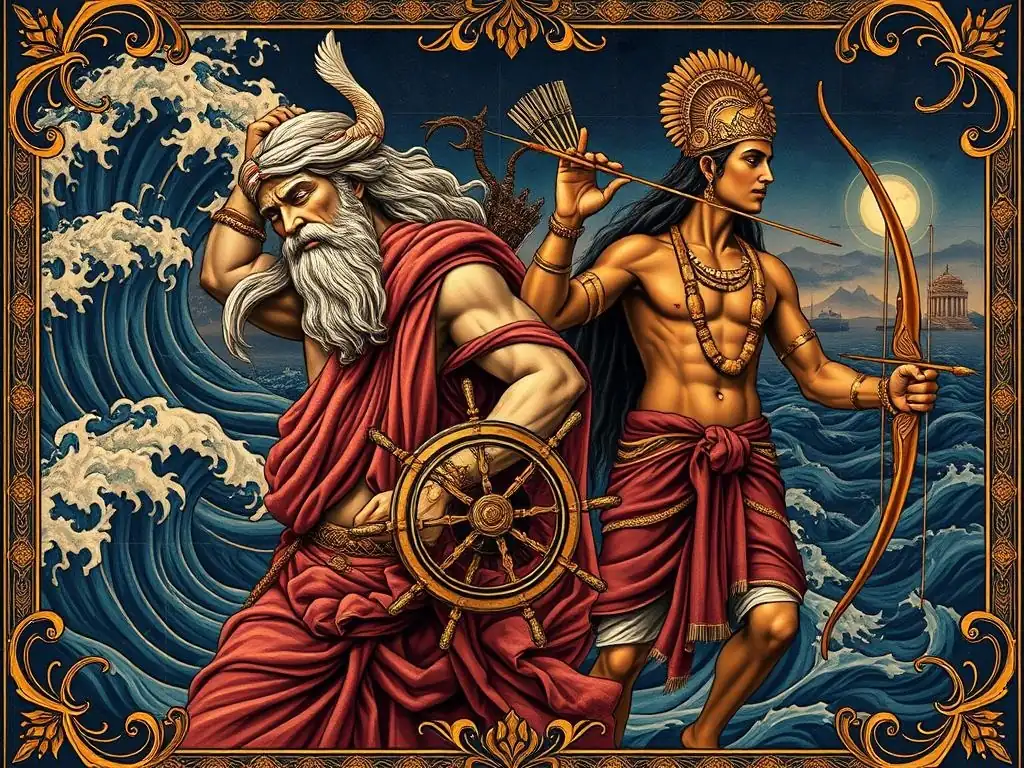
Penelope's Steadfastness and Loyalty
Penelope, Odysseus's wife, is a figure of immense strength and loyalty in the Odyssey. For twenty years, she fends off scores of persistent suitors who have invaded her palace, consuming Odysseus's wealth and pressuring her to remarry. She employs various strategies to delay her decision, most famously her ruse of weaving a burial shroud for her father-in-law Laertes by day and secretly unraveling it by night. This scheme successfully buys her three years before it is discovered.
Penelope's steadfastness is not passive; she actively maintains order in the palace as best she can under duress and protects her son Telemachus. Her loyalty is tested repeatedly, but she remains devoted to the hope of Odysseus's return. Her final test for Odysseus, asking her servant to move their marriage bed (which Odysseus knows is built around an olive tree and cannot be moved), is a brilliant piece of characterization that confirms his identity and their deep bond. Penelope's role is crucial; her faithfulness provides the ultimate motivation for Odysseus's arduous Odysseus Rama homecoming journey.
Sita's Purity and Devotion
Sita, Rama's wife, is depicted as an ideal of purity, devotion, and fidelity in the Ramayana. She willingly accompanies Rama into exile, sharing his hardships in the forest. Her abduction by Ravana is the catalyst for the major conflict of the epic. While held captive in Lanka, Sita faces immense pressure and threats from Ravana to yield to him, but she remains absolutely devoted to Rama, refusing all his advances.
Sita's purity and unwavering faith are central to her character. After her rescue, however, her virtue is questioned by some, leading to the controversial Agni Pariksha (fire ordeal) in some versions, where she enters a fire to prove her purity, validated by the god Agni.
Later in life, due to public gossip, Rama makes the difficult decision to banish her, highlighting the harsh demands of kingship and dharma, even on personal relationships. Despite these trials, Sita's devotion to Rama and her own moral integrity remain absolute, though her journey is marked by suffering that raises complex questions about duty and justice within the narrative of Rama's Odysseus Rama homecoming journey.
Comparing the Agency and Influence of Female Characters
Comparing Penelope and Sita reveals differences in their narrative roles and agency. Penelope, while physically confined, exhibits considerable agency through her strategic delaying tactics and her ultimate test of Odysseus. She manages the household affairs under extreme pressure and actively participates in the climax of the story by setting the archery challenge. She is portrayed as intelligent, resourceful, and equal to Odysseus in her own way.
Sita, while a figure of immense spiritual strength and moral purity, often appears more passive in the face of external events, particularly during her captivity. Her agency is primarily expressed through her internal resistance to Ravana and her unwavering devotion. Her fate is largely determined by the actions of male characters (Ravana's abduction, Rama's rescue, Rama's later banishment).
However, her very existence and virtue are central to the plot and motivation of Rama's quest. Both women are crucial to their respective Odysseus Rama homecoming journey narratives, serving as the beloved figures the heroes strive to return to, embodying ideals of wifely virtue and loyalty, though their means of influencing events and their ultimate fates differ.
The Enduring Legacy of Odysseus and Rama: Lessons for Modern Audiences
The Archetype of the Heroic Journey and Its Relevance Today
The stories of Odysseus and Rama are foundational examples of the "hero's journey" archetype, a narrative pattern identified by mythologist Joseph Campbell. This pattern involves a hero who leaves the ordinary world, ventures into a world of adventure, faces crucial trials, achieves a victory, and returns transformed. Both the Odyssey and the Ramayana fit this structure remarkably well: the call to adventure (the end of the Trojan War/exile), the road of trials (monsters, gods, war), the climax (slaughter of suitors/defeat of Ravana), and the return (to Ithaca/Ayodhya).
This archetypal structure resonates deeply because it mirrors fundamental human experiences of growth, challenge, and transformation. Modern audiences can still find relevance in these ancient tales. The struggles of Odysseus and Rama against adversity, their moments of doubt and despair, and their ultimate triumphs offer timeless insights into the human condition. The concept of an Odysseus Rama homecoming journey, a quest to find one's way back to stability and belonging after facing chaos, remains a powerful metaphor for navigating life's challenges and seeking personal fulfillment.
The Importance of Home, Family, and Moral Values
A core message in both epics is the profound importance of home and family. For Odysseus, his ultimate goal is not wealth or glory (though he has achieved both) but the simple, fundamental desire to return to his wife, son, and kingdom. The twenty years of hardship are endured for this singular purpose. The reunion with Penelope and Telemachus is presented as the true culmination of his journey, more significant than any victory over monsters or gods.
Similarly, Rama's journey is driven by his duty to his father, his love for Sita, and his eventual return to Ayodhya to rule righteously. The protection of family (Sita, Lakshmana) and the restoration of his ancestral home and kingdom are paramount. Beyond personal ties, both epics emphasize moral values.
Odysseus's journey highlights the consequences of hubris and disrespect for the gods, while celebrating cleverness and resilience. Rama's epic is a profound exploration of dharma, duty, righteousness, and the ideal conduct for individuals and rulers. These themes of prioritizing home, family, and living according to a moral code remain highly relevant in contemporary society, offering enduring lessons from the Odysseus Rama homecoming journey narratives.
The Continuing Influence of Odysseus and Rama in Literature and Art
The legacies of Odysseus and Rama extend far beyond their original epic forms. Both heroes and their stories have profoundly influenced literature, art, and culture for thousands of years. Homer's Odyssey is a cornerstone of Western literature, inspiring countless retellings, adaptations, and allusions, from classical dramas to modern novels and films. Figures like James Joyce's Leopold Bloom in Ulysses are modern echoes of the wandering hero. The themes of journey, identity, and return continue to be explored in contemporary works.
The Ramayana holds a central place in South Asian culture, influencing literature, theater, dance, sculpture, and religious practices across India and Southeast Asia. It has been retold in numerous languages and adapted into popular television series, movies, and comic books. The figures of Rama, Sita, and Hanuman are revered and remain powerful cultural icons. The enduring presence of these heroes and their Odysseus Rama homecoming journey tales in various art forms demonstrates their timeless power and their ability to speak to new generations across diverse cultural landscapes.
Conclusion: Reflecting on the Timeless Power of Homecoming Narratives
The Universal Appeal of Stories About Perseverance and Redemption
The epic journeys of Odysseus and Rama, culminating in their long-awaited homecomings, resonate universally because they speak to fundamental aspects of the human experience. Everyone faces challenges, experiences separation, and yearns for a place of belonging and peace. These narratives celebrate the power of perseverance – the ability to endure hardship, overcome obstacles, and continue striving towards a goal despite setbacks. Both heroes face moments where success seems impossible, yet they find the inner strength or external aid to continue their quests.
Furthermore, these stories often contain elements of redemption or restoration. Odysseus must reclaim his identity and his home, cleansing it of corruption. Rama's return signifies the restoration of dharma and righteous rule after a period of chaos and unrighteousness. This theme of overcoming past struggles and achieving a state of balance or purity is deeply satisfying and hopeful. The Odysseus Rama homecoming journey is not just a physical return but a process of restoring order, identity, and moral balance.
Odysseus, Rama, and the Enduring Human Desire for Home
Ultimately, the core of both the Odyssey and the Ramayana lies in the powerful, enduring human desire for home. Home represents security, identity, family, and belonging. It is the place where one is truly oneself, surrounded by those who know and love them. The immense suffering and sacrifice undertaken by both Odysseus and Rama underscore just how vital this concept is. Their journeys illustrate that the path back to home can be fraught with difficulty, requiring courage, cunning, righteousness, and perseverance.
By comparing the Odysseus Rama homecoming journey, we see how different cultures articulate similar fundamental truths about heroism, duty, and the ties that bind us to our origins. These ancient epics remind us that the journey may be long and hard, filled with monsters and trials, but the destination – the return to a cherished home and the embrace of loved ones – is a driving force that has motivated heroes and ordinary people alike for millennia.
Their stories continue to inspire, offering timeless lessons about the values worth fighting for and the profound meaning found in the simple act of coming home.
Frequently Asked Questions
How does the "homecoming journey" motif connect Odysseus and Rama in their respective epics?
Both The Odyssey and The Ramayana feature epic heroes facing significant obstacles and extended periods of travel before returning home to reclaim their rightful place. The shared theme emphasizes perseverance and loyalty.
What are some key differences in the reasons for Odysseus's and Rama's prolonged absences from home?
Odysseus's journey is prolonged by the wrath of Poseidon and various mythical creatures, representing external forces. Rama's exile is due to internal political intrigue and a promise made by his father, focusing on duty.
In what ways do their "homecoming journeys" reflect the values of their respective cultures?
Odysseus's journey reflects the Greek emphasis on intellect, cunning, and hospitality. Rama's journey emphasizes duty, righteousness (Dharma), and devotion, central to Hindu culture.
What role do divine interventions and supernatural elements play in both Odysseus's and Rama's "homecoming journeys"?
Both narratives involve divine assistance and interference. Gods and goddesses actively influence events, either helping or hindering the heroes in their struggles to return home.
How do Odysseus and Rama exemplify the ideal "hero" figure within their respective cultural contexts, especially in relation to their "homecoming journeys"?
Odysseus embodies the resourceful and adaptable hero, while Rama embodies the virtuous and righteous hero. Both heroes' journeys showcase their commitment to their people and values, making them ideal figures in their cultures.
Final Reflection: The Enduring Power of the Homecoming
The epic journeys of Odysseus and Rama, separated by millennia and vastly different cultures, resonate deeply with our modern understanding of perseverance and the enduring human desire for home. These tales aren't mere historical artifacts; they are powerful metaphors for the struggles we all face in navigating life's challenges and the profound longing for belonging that defines our existence. The obstacles they overcome – monstrous creatures, treacherous seas, and internal demons – mirror the trials we encounter on our own personal journeys.
The enduring influence of these narratives lies in their ability to tap into universal themes of loss, resilience, and the ultimate triumph of the human spirit. These stories continue to shape our understanding of heroism, not just through physical prowess, but through unwavering commitment, unwavering loyalty, and the capacity for both profound love and devastating loss. The journey home is as important as the journey itself,
a sentiment echoed across cultures and time, speaks to the transformative power of the homecoming, a concept central to both the Odyssey and the Ramayana.
Consider your own journey. What obstacles have you faced? What does "home" mean to you? Perhaps it's not a physical place, but a feeling, a community, a state of being. Let the stories of Odysseus and Rama inspire you to persevere through your own trials, to embrace the challenges that shape you, and to never lose sight of the importance of your own personal homecoming, however you define it. The journey may be long and arduous, but the reward – the sense of belonging, peace, and fulfillment – is worth the fight.
Unveil Your Inner Hero: Embrace the Epic Journey!
Thanks for joining us on this incredible journey through the epics of Odysseus, Rama, and their epic returns home! You’ve gained a deeper understanding of the timeless themes of perseverance, loyalty, and the enduring power of the human spirit. Now, it's your turn to take action.
- Craft your own hero's journey: Think about your own personal “homecoming” – what challenges do you face, and what qualities will you need to overcome them? Write a short reflection or even begin sketching your own epic tale.
- Share your favorite hero moment: Which aspect of these heroes' stories resonated most with you? Discuss it in the comments below – let's build a community of epic enthusiasts!
- Explore a new myth: Dive deeper into the world of mythology. Research a lesser-known hero or delve into a different culture’s epic tales. The adventure never ends!
What qualities of these legendary heroes will you incorporate into your own journey?