
Mythical Voyages: Epic Journeys Across Seas and Stars in Ancient Tales

Welcome to Mythology and Legends!
Dare to navigate the uncharted waters of ancient imagination? Prepare to embark on a thrilling voyage into the heart of myth and legend, where gods and mortals alike sailed the seas of fate. Our journey begins with an ancient seafaring mythology exploration, uncovering the captivating stories that shaped civilizations. What secrets lie hidden beneath the waves of these epic tales? Dive in and discover the answers…
Exploring Ancient Seafaring Mythology: An Introduction
Ancient civilizations across the globe, from the Mediterranean to the Pacific, the Arctic, and beyond, shared a profound connection with the sea and the stars. These vast, mysterious realms were not merely geographical features or celestial bodies but were imbued with deep spiritual and symbolic meaning. Mythical voyages, epic journeys undertaken across treacherous waters or through the star-strewn cosmos, form a cornerstone of ancient storytelling, reflecting humanity's innate drive for exploration, understanding, and connection with the divine.
These narratives provide invaluable insights into the worldviews, fears, hopes, and values of the people who created them, offering a window into their relationship with the natural world and the unknown. The study of ancient seafaring mythology exploration allows us to trace common human experiences and divergent cultural interpretations across diverse historical contexts.
This exploration delves into the rich tapestry of myths that depict journeys over water and through the heavens. We will examine how different cultures conceptualized these voyages, the challenges faced by the mythical travelers, and the supernatural forces they encountered or relied upon. From the perilous return of Odysseus across the Aegean to the cosmic journey of Ra's solar boat, these tales are more than just adventure stories; they are foundational narratives that explain origins, define cultural identity, and articulate fundamental truths about life, death, and the cosmos.
Understanding these ancient narratives is crucial for appreciating the enduring power of myth and its role in shaping human consciousness and cultural history. The field of ancient seafaring mythology exploration is vast, revealing universal themes alongside unique cultural specificities.
- What role did ancient seafaring mythology play in exploration?
- How did different cultures depict sea gods in their mythologies?
- What were some common motifs found in ancient seafaring myths?
- How did ancient sailors use mythology to understand and navigate the seas?
- What is the lasting impact of ancient seafaring myths on contemporary society?
The Allure of the Unknown: Why Seas and Stars Captivated Ancient Civilizations
The Sea as a Source of Life and Peril in Ancient Myths
The sea, a vast and dynamic force, has always been central to human existence, providing sustenance through fishing and trade routes while simultaneously posing existential threats through storms, shipwrecks, and unknown depths. This duality is vividly reflected in ancient myths. The sea is often depicted as a capricious deity or domain, capable of immense generosity or terrifying destruction.
For coastal and island-dwelling cultures, the ocean was the lifeblood of their economy and connectivity, facilitating movement and exchange across distances that land travel could not match. Yet, it was also a boundary, separating known lands from the mysterious, often dangerous, unknown.
Across various mythologies, the sea is personified by powerful gods such as Poseidon in Greek myth, Njörðr in Norse lore, or Tangaroa in Polynesian traditions. These deities held sway over the waves, controlling weather, currents, and the creatures of the deep. Sailors would offer prayers and sacrifices to appease these gods, hoping for safe passage.
The sea's unpredictable nature fostered tales of monstrous inhabitants – kraken, sea serpents, or vengeful spirits – that embodied its perils. For instance, historical accounts and legends from the North Atlantic frequently mention giant squid or sea serpents, reflecting a genuine fear of the vast, unexplored ocean depths. The exploration of ancient seafaring mythology consistently highlights this tension between the sea as a nurturer and a destroyer.
The Stars as Guides and Divine Realms in Ancient Narratives
Long before modern navigation technology, the stars served as indispensable guides for travelers, particularly those journeying across featureless landscapes or vast oceans. The predictable patterns of celestial bodies provided a reliable compass and calendar, allowing ancient peoples to orient themselves and track time. This practical utility naturally led to the stars being viewed with reverence and awe, often associated with divine beings, cosmic order, and the afterlife. The heavens were seen as the abode of gods, the destination of souls, or the canvas upon which cosmic dramas unfolded.
Mythological narratives frequently depict the stars as more than just points of light; they are characters, constellations representing heroes, animals, or objects of myth, woven into the fabric of creation stories and epic tales. The movement of planets was often interpreted as the activity of powerful deities influencing human affairs. For example, in ancient Mesopotamia, detailed astronomical observations were linked to complex astrological systems, with the movements of Jupiter ("Marduk") or Venus ("Ishtar") holding significant religious and political weight.
The North Star, or Polaris, held particular importance for many cultures as a fixed point in the night sky, a constant guide. This celestial reliance is a recurring theme in ancient seafaring mythology exploration, illustrating the interconnectedness of earthly journeys and the cosmic dome.
Common Themes in Ancient Seafaring Mythology Exploration
The Hero's Journey on Water: Trials, Tribulations, and Transformations
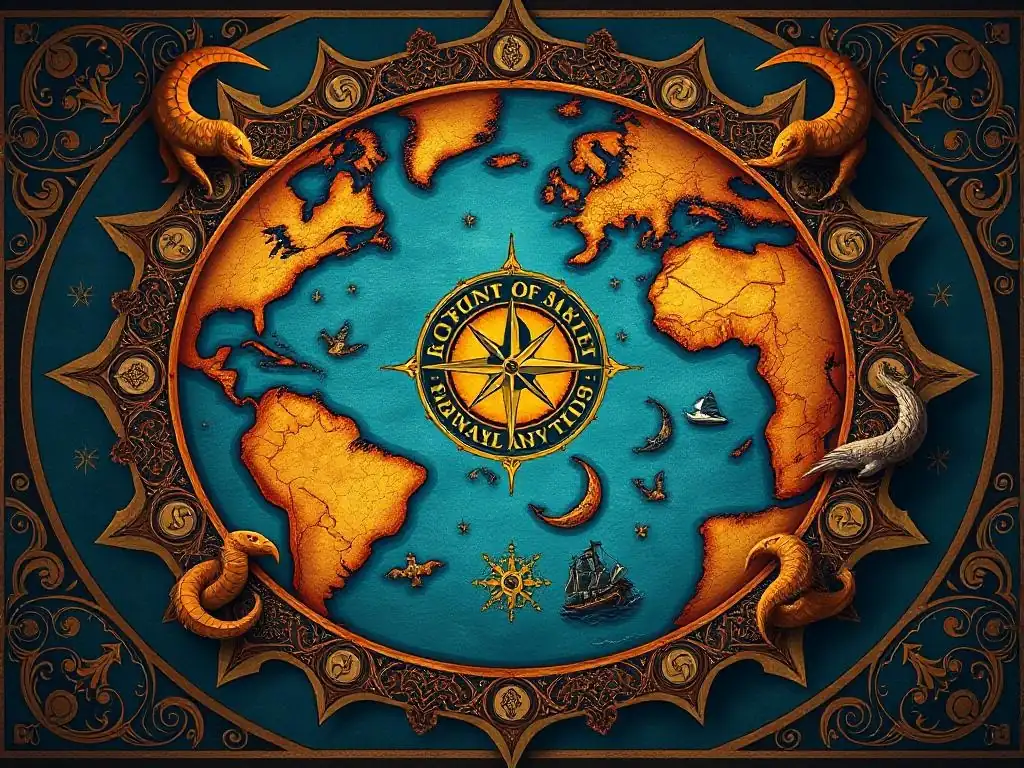
A pervasive theme in ancient seafaring mythology is the hero's journey, adapted for the maritime setting. This narrative arc typically involves a protagonist embarking on a perilous sea voyage, facing numerous trials, often losing companions or possessions, and ultimately returning home (or reaching a destination) transformed by the experience. The sea acts as a crucible, testing the hero's courage, resilience, and resourcefulness. Unlike land-based journeys where familiar landmarks might offer comfort, the open ocean presents a constant, unpredictable challenge.
These water-based journeys are fraught with specific dangers: violent storms, treacherous currents, getting lost far from land, and encountering hostile forces, both natural and supernatural. The hero must rely on skill, cunning, divine favor, or sometimes sheer luck to survive. The trials often strip the hero down to their core, forcing introspection and growth.
Odysseus's decade-long struggle to return to Ithaca in Homer's Odyssey is a prime example, featuring encounters with monsters, sorceresses, and the wrath of a sea god, all contributing to his transformation from a proud warrior to a wiser, more humble leader. This archetype is fundamental to understanding ancient seafaring mythology exploration.
Encounters with Mythical Creatures of the Deep: [Leviathan, Sirens, Isonade]
The mysterious depths of the ocean were fertile ground for the imagination, giving rise to tales of awe-inspiring and terrifying creatures. These beings often represented the inherent dangers and unknowable aspects of the sea. Encounters with such monsters served as major obstacles in mythical voyages, testing the mettle of heroes and demonstrating the power of the oceanic realm.
- Leviathan: A monstrous sea serpent mentioned in Hebrew scripture (Job 41, Psalm 74:14, Isaiah 27:1). It is often depicted as a primordial creature of chaos, so immense and powerful that only God can subdue it. While not always a direct obstacle in a hero's voyage in the same way as the Sirens, the concept of Leviathan embodies the overwhelming, untamable force of the ocean itself, a constant potential threat lurking beneath the waves in the broader context of ancient seafaring mythology exploration.
- Sirens: In Greek mythology (famously in Homer's Odyssey), the Sirens were seductive creatures (often depicted as part-bird, part-woman or part-fish, part-woman) whose enchanting songs lured sailors to their death on rocky shores. Their danger lay not in physical combat but in psychological temptation and manipulation, representing the allure of the unknown leading to destruction. Odysseus famously had his crew tie him to the mast so he could hear their song without succumbing.
- Isonade: A massive, shark-like sea monster from Japanese mythology, said to live off the coast of Matsuura and other areas. The Isonade is described as having a tail covered in hooks, which it uses to snag and drag ships or pull sailors from boats into the water. It is also said to cause great storms simply by wagging its tail. Tales of the Isonade reflect the very real dangers faced by fishermen and coastal communities from large marine predators and unpredictable ocean conditions, becoming mythologized symbols within Japanese ancient seafaring mythology exploration.
These examples, among countless others like Scylla and Charybdis (Greek), the Kraken (Norse/Scandinavian folklore), or various sea dragons (East Asian), highlight the universal human tendency to personify the dangers of the deep through monstrous forms.
While facing earthly perils, ancient mariners also looked upwards for guidance. Celestial navigation was a crucial skill, enabling voyages across vast, open waters where no land was in sight for days or weeks. Mythologies often intertwined this practical skill with divine influence. The stars and constellations were not just markers but were frequently seen as placed there by gods, representing deities, heroes, or sacred animals. Navigating by them was, in a sense, navigating by the divine will or cosmic order.
In many myths, successful voyages are attributed not only to the hero's skill but also to divine aid. Gods might send favorable winds, calm stormy seas, or provide mystical guidance. Conversely, divine wrath (like Poseidon's anger towards Odysseus) could manifest as devastating storms or navigational confusion.
Polynesian myths, for instance, tell of ancestral heroes who were skilled navigators guided by the stars, sometimes explicitly taught by or aided by gods of the sky or sea. This reliance on both practical celestial knowledge and perceived divine favor underscores the holistic worldview of ancient peoples, where the material and spiritual realms were deeply interconnected, a key insight from ancient seafaring mythology exploration.
Cross-Cultural Analysis of Epic Sea Voyages in Mythology
The Odyssey: A Greek Tale of Homecoming and Resilience
Homer's Odyssey, composed likely in the 8th century BCE, is perhaps the most famous epic poem of ancient seafaring mythology. It recounts the ten-year struggle of the Greek hero Odysseus, king of Ithaca, to return home after the Trojan War. His journey is a canonical example of the hero's journey cycle played out entirely on the sea, filled with encounters with mythical beings, divine interference, and profound personal challenges. The narrative vividly portrays the dangers of ancient maritime travel in the Mediterranean.
The Odyssey reflects the importance of the sea to the ancient Greeks, a thalassocracy with numerous islands and coastal city-states heavily reliant on maritime trade and travel. The relatively small, oar-powered ships of the era were vulnerable to weather and the limited navigational tools available meant staying close to shore or relying heavily on celestial observation when out of sight of land.
Odysseus's trials – facing the Cyclops, the Sirens, Scylla and Charybdis, and the wrath of Poseidon – are not just fantastical elements but amplify the very real dangers faced by ancient mariners: hostile encounters, irresistible natural forces, and the constant threat of shipwreck. The poem's enduring popularity highlights its universal themes of perseverance, cunning, and the longing for home, set against the dramatic backdrop of ancient seafaring mythology exploration.
Key Seafaring Elements in Homer's Odyssey
The Odyssey is replete with details illustrating ancient Greek seafaring. The description of ships – typically fifty-oared vessels (penteconters) or larger ships of burden – their construction, launching, beaching, and maintenance provides insight into the technology of the time. The narrative frequently mentions sailing by specific constellations (like the Pleiades or the Bear) for direction. The importance of wind direction is paramount; Odysseus is often becalmed or blown off course by unfavorable winds, which are sometimes sent by gods or controlled by figures like Aeolus, the keeper of the winds.
Furthermore, the poem details the challenges of securing provisions, finding safe harbors, and repairing damaged vessels in unfamiliar and often hostile territories. The journey highlights the isolation and vulnerability of being at sea, far from the support of one's community. Odysseus's encounters with various peoples on his journey, some hospitable (like the Phaeacians), others dangerous (like the Laestrygonians), reflect the unpredictable nature of interactions during ancient maritime travel and trade. These elements ground the mythical adventures in the practical realities of ancient seafaring mythology exploration.
The Role of Poseidon in Odysseus's Sea Journey
Poseidon, the Greek god of the sea, earthquakes, and horses, plays a central antagonistic role in Odysseus's journey. His wrath is incurred when Odysseus blinds Poseidon's son, the Cyclops Polyphemus. This act unleashes divine fury that dogs Odysseus for a decade, directly causing many of his hardships at sea. Poseidon stirs up massive storms, drives Odysseus off course repeatedly, and prevents him from reaching Ithaca.
The portrayal of Poseidon emphasizes the ancient Greek belief in the anthropomorphic forces controlling the natural world, particularly the powerful and often terrifying sea. His arbitrary anger and immense power over the waves illustrate the vulnerability of mortals to divine will.
Odysseus's struggle against Poseidon is not just a physical battle against storms but a spiritual and psychological one, forcing him to confront his own hubris and rely on the aid of other gods (like Athena) or his own cunning to survive. This divine conflict is a critical component of the narrative structure and a key feature in analyzing ancient seafaring mythology exploration.
Polynesian mythology is deeply intertwined with epic sea voyages. Originating from a common ancestral group, Polynesian peoples undertook astonishing voyages across thousands of miles of open ocean to settle islands scattered across the vast Pacific. Their myths recount the journeys of demigods and heroes who discovered islands, navigated using sophisticated knowledge of stars, currents, waves, and birds, and interacted with powerful sea deities. Figures like Māui, the demigod hero found in myths across various Polynesian cultures (including Māori, Hawaiian, and Samoan versions), are often depicted as undertaking significant sea journeys, sometimes even fishing up islands from the ocean floor.
These myths are not purely fantasy; they are cultural repositories of practical knowledge essential for survival and navigation. They encode information about star paths, ocean currents, and the characteristics of different islands. The ability to navigate vast distances without instruments using traditional methods, known as "wayfinding," was a sacred skill, often passed down through generations of master navigators.
Myths emphasize the spiritual connection between the people, their canoes, the ocean, and the sky, viewing voyages as not just physical journeys but spiritual quests guided by ancestral knowledge and divine favor. This focus on practical skill intertwined with spiritual belief is a hallmark of Polynesian ancient seafaring mythology exploration.
The Significance of Wayfinding in Polynesian Culture
Wayfinding is the traditional Polynesian art and science of navigation without instruments, relying instead on observation of natural signs. This includes reading the stars (their positions, rising and setting points), the sun, the moon, ocean swells and waves (patterns reflecting distant landmasses), cloud formations, the flight paths of birds, and the presence of marine life. This complex system allowed navigators to maintain a sense of direction and location over thousands of miles of open ocean.
In Polynesian culture, wayfinding was more than a practical skill; it was a profound cultural practice linked to identity, ancestry, and cosmology. Master navigators held esteemed positions, their knowledge considered sacred. Myths often explain the origins of stars and constellations in terms of voyages or divine actions, directly linking the celestial realm to the practical art of navigation. The revival of traditional voyaging in recent decades, using canoes like the Hokule'a, has demonstrated the efficacy of these ancient methods and reinforced the deep cultural significance of wayfinding as a legacy of ancient seafaring mythology exploration.
Gods and Goddesses of the Sea in Polynesian Legends
Polynesian mythologies feature a rich pantheon of deities associated with the sea, waves, wind, and marine life, reflecting the ocean's central role in their lives. Tangaroa (or variants like Kanaloa in Hawaii, Takaroa in Māori) is a principal god, often associated with the ocean, creation, and fertility. He is sometimes depicted as the origin of all life or as a powerful ruler of the underwater world.
Other deities include those associated with specific aspects of the sea, like waves, tides, or specific marine creatures. For example, Pele, the Hawaiian goddess of volcanoes and fire, has a complex relationship with the sea, sometimes battling with sea deities or shaping the coastline with her volcanic activity.
The Shark God (various names across islands) is another significant figure, often revered and sometimes feared, representing the power and danger of the ocean's inhabitants. These deities are not distant figures but are actively involved in the lives of humans, influencing voyages, providing guidance, or unleashing their power, underscoring the spiritual dimension inherent in Polynesian ancient seafaring mythology exploration.
Norse Sagas: Viking Exploration and the Sea of Monsters
Norse mythology and the sagas of the Viking Age (roughly 8th to 11th centuries CE) are replete with tales of daring sea voyages and exploration. The Vikings were renowned seafarers, their longships enabling raids, trade, and settlement across the North Atlantic, reaching as far as North America (Vinland). Their mythology reflects this maritime culture, featuring gods associated with the sea and voyages, and terrifying monsters lurking in the cold, dark waters.
Norse cosmology includes the concept of Miðgarðr (Midgard), the human world, surrounded by a vast, often dangerous ocean. Beyond this ocean lay Útgarðr (Utgard), the realm of giants and monsters. Sea voyages were not just journeys between lands but often journeys into the liminal space between the known world and the realm of chaos and giants.
The sagas, while often grounded in historical events, frequently incorporate mythical elements, including encounters with sea monsters and the favor or wrath of gods like Thor (controller of storms and protector against giants and monsters) or Njörðr (god of the sea, wind, and wealth from the sea). This blend of historical exploration and mythical peril defines Norse ancient seafaring mythology exploration.
The Longship as a Symbol of Viking Power and Exploration
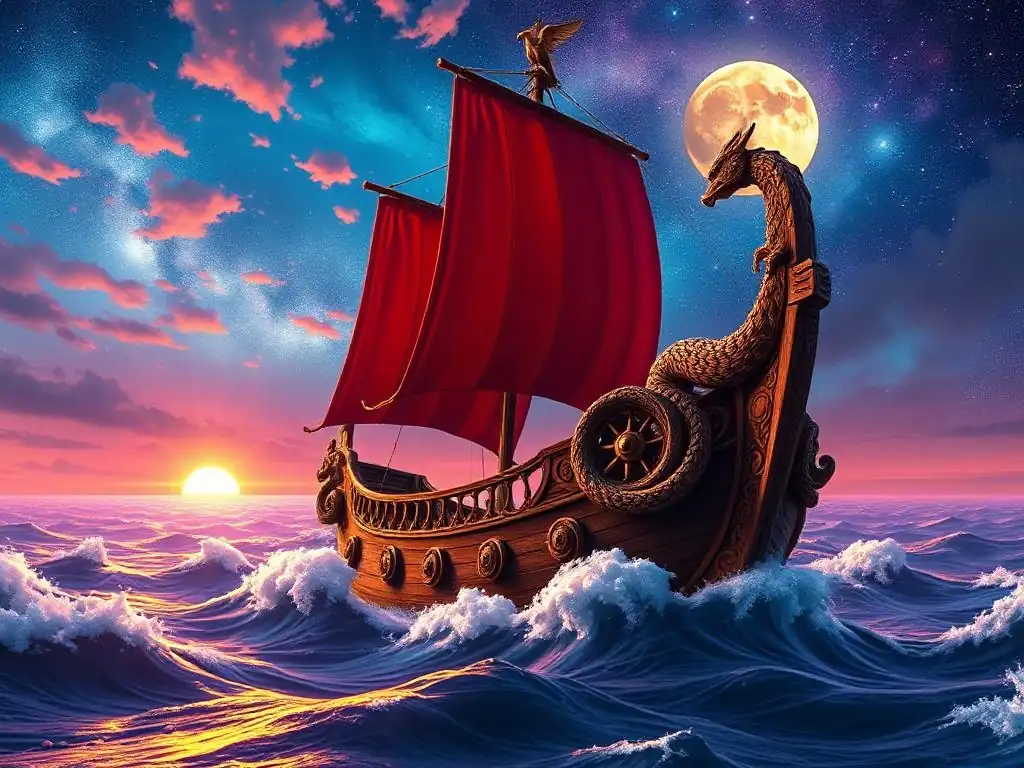
The Viking longship (e.g., the knarr for cargo, the longship for warfare and exploration) was a marvel of ancient naval engineering. Its shallow draft allowed it to navigate rivers and land on beaches, while its sturdy construction and sail/oar power enabled voyages across open seas, including the notoriously rough North Atlantic. The longship was more than just a vessel; it was a central symbol of Viking identity, power, and their adventurous spirit.
In Norse sagas and art, ships are often depicted with elaborate carvings, sometimes representing fearsome creatures or protective spirits. Burial rituals frequently included ships, signifying their importance in transporting the deceased to the afterlife. The ability to build and command these ships was a source of pride and essential for their way of life. The longship facilitated the historical Viking Age of exploration, which in turn fueled the myths and legends of voyages to distant, often dangerous lands, reinforcing its status as an icon within ancient seafaring mythology exploration.
Encounters with Sea Monsters in Norse Mythology: Jormungandr
Norse mythology features several formidable sea monsters, reflecting the dangers of the northern waters. The most famous is Jörmungandr, the Midgard Serpent, a colossal serpent that encircles the entire world, biting its own tail. Jörmungandr is a child of Loki and the giantess Angrboða and is a central figure in Ragnarök, the twilight of the gods, where it is prophesied to battle Thor.
While Jörmungandr doesn't typically appear as a creature encountered by everyday sailors in sagas (it's a cosmic entity), its presence as the world-encircling serpent symbolizes the vast, dangerous, and chaotic nature of the ocean surrounding the human world. Less cosmic but still fearsome are tales of the Kraken, a giant cephalopod said to dwell off the coasts of Norway and Greenland, capable of dragging down ships.
These tales, documented in later folklore but rooted in Viking Age fears, personified the unknown perils of the deep sea and added a layer of mythical terror to the very real dangers faced by Viking mariners, contributing significantly to the body of Norse ancient seafaring mythology exploration.
The Starry Canvas: Celestial Journeys in Ancient Tales
Egyptian Mythology: Ra's Solar Boat and the Nightly Voyage Through the Underworld
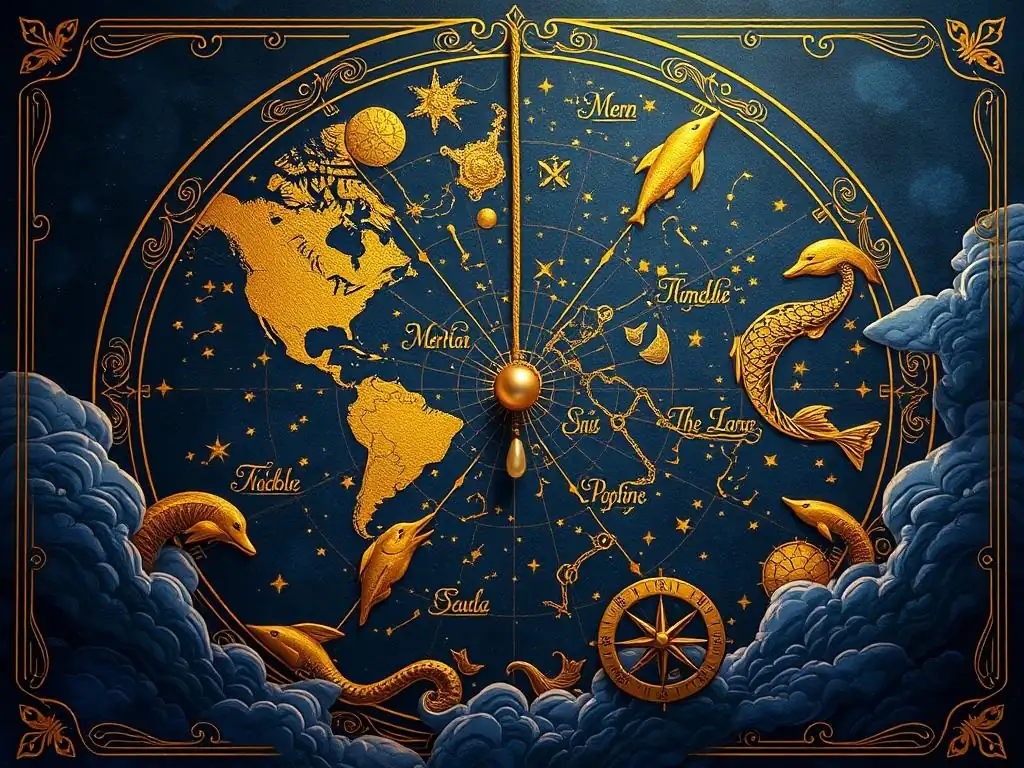
In ancient Egyptian mythology, the most prominent celestial journey is that of the sun god Ra. Each day, Ra is believed to travel across the sky in his solar boat, the Mandjet (Boat of Millions of Years), bringing light and life to the world. This daily journey is a cycle of creation and renewal. However, the journey is not complete with sunset. As the sun sets in the west, Ra transitions to his night boat, the Mesektet, and begins a perilous voyage through the Duat, the underworld.
This nightly passage through the Duat was fraught with dangers, including encounters with demons and the serpent Apophis, Ra's arch-enemy, who seeks to swallow the sun and plunge the world into eternal darkness. Ra, aided by a retinue of other gods and the souls of the justified dead, must battle these forces to ensure he can rise again in the east the next morning.
This cosmic journey mirrors the earthly cycle of life, death, and rebirth and was central to Egyptian religious beliefs and funerary practices. The concept of a divine boat navigating celestial or underworld waters is a unique take on ancient seafaring mythology exploration within a cosmic context.
Ra's Daily Journey Across the Sky and its Symbolic Meaning
Ra's journey across the sky in his solar boat was the fundamental rhythm of the Egyptian cosmos. His appearance in the east symbolized birth and creation, his zenith at noon represented the peak of power and life, and his setting in the west signified death and transition. The solar boat itself was a potent symbol of continuity and the journey of life. Just as the sun traversed the sky daily, so too did the deceased hope to join Ra on his eternal voyage, achieving immortality.
This daily cycle was not taken for granted; it required the cosmic order (Ma'at) to be maintained and the active participation of deities. The journey was a constant battle against forces of chaos. The meticulous tracking of the sun's path and the construction of temples aligned with solar events underscored the centrality of Ra's journey to Egyptian life and religion. It was a visible, daily reminder of the divine power that sustained the world, a cosmic prototype for earthly journeys and a key element in understanding Egyptian ancient seafaring mythology exploration, albeit on a celestial sea.
The Challenges and Dangers of the Night Voyage
The night voyage of Ra through the Duat was far more perilous than his daytime passage. The underworld was depicted in texts like the Book of Gates or the Amduat as a realm divided into twelve hours, each presenting unique challenges and inhabitants. Ra's boat navigated subterranean rivers, encountered monstrous creatures, and faced the constant threat of Apophis. This serpent, representing chaos and non-existence, would attempt to disrupt the boat's passage and devour Ra.
The successful completion of the night journey, culminating in Ra's rebirth at dawn, required not only Ra's power but also the assistance of his divine crew (including Sia, Hu, Heka) and the souls of the deceased who had passed judgment. This nightly battle and rebirth symbolized the triumph of order over chaos, light over darkness, and life over death.
The intricate depictions of the Duat and Ra's journey through it in tombs and papyri highlight the profound significance of this celestial voyage in Egyptian eschatology and its place in the broader study of ancient seafaring mythology exploration, extending the concept to a cosmic scale.
Hindu Mythology: The Churning of the Ocean of Milk and the Celestial Realm
Hindu cosmology features numerous narratives involving celestial realms and cosmic events, often depicted with watery metaphors. One of the most significant is the Samudra Manthan, the Churning of the Ocean of Milk. This epic event, described in major Hindu texts like the Mahabharata and Puranas, involves the Devas (gods) and Asuras (demons) collaborating to churn the cosmic ocean to obtain Amrita, the nectar of immortality.
Using Mount Mandara as the churning stick and the serpent king Vasuki as the rope, the Devas and Asuras churned the vast Ocean of Milk for a thousand years. This cosmic act brought forth various treasures, including divine beings, celestial objects, precious jewels, and ultimately, the Amrita. However, it also released Halahala, a potent poison that threatened to destroy the universe, which was consumed by Lord Shiva to save creation.
This narrative, while not a "voyage" in the sense of a ship crossing water, uses the metaphor of a cosmic ocean and a massive, collaborative effort upon it to describe a fundamental act of creation and the struggle between divine and demonic forces within the celestial realm. It represents a cosmic form of ancient seafaring mythology exploration, where the 'sea' is the very fabric of the cosmos.
The Significance of the Ocean of Milk in Hindu Cosmology
The Ocean of Milk (Kshira Sagara) is a central concept in Hindu cosmology, often depicted as a vast, primordial ocean surrounding the universe. It is considered the abode of Vishnu, who is often shown reclining on the serpent Shesha within this ocean. The Ocean of Milk represents purity, potentiality, and the unmanifest state of the cosmos before creation.
The act of churning this ocean is a metaphor for the process of creation and the bringing forth of manifest reality from the unmanifest. It symbolizes the dynamic interaction between opposing forces (gods and demons) that is necessary for cosmic evolution and the generation of both beneficial and harmful elements. The treasures yielded from the churning represent the various aspects of the manifest world. Understanding the symbolism of the Ocean of Milk is crucial for interpreting this key Hindu narrative and its place within the broader context of ancient seafaring mythology exploration, where the ocean becomes a cosmic stage.
The Role of Gods and Demons in the Cosmic Struggle
The Samudra Manthan highlights the eternal struggle between the Devas and Asuras, representing forces of light/order and darkness/chaos, respectively. Although they collaborate in the churning for a shared goal (immortality), their inherent rivalry leads to conflict over the distribution of the Amrita. This struggle is overseen and mediated by the Trimurti (Brahma, Vishnu, Shiva) and other powerful deities.
Vishnu plays a crucial role, not only as the one whose abode is the ocean but also by taking the form of Kurma, the giant tortoise, to support Mount Mandara during the churning. He also later assumes the form of Mohini, the enchantress, to trick the Asuras and ensure the Amrita is distributed primarily among the Devas.
Shiva's act of consuming the Halahala poison demonstrates his role as the preserver who absorbs negativity. This narrative illustrates the complex interplay of divine and demonic forces in maintaining cosmic balance and achieving creation's goals, presenting a unique perspective within ancient seafaring mythology exploration on a cosmic scale.
Ancient Seafaring Mythology Exploration: Lasting Impact and Modern Interpretations
The Enduring Appeal of Mythical Voyages
The stories of mythical voyages across seas and stars continue to resonate deeply with audiences today. Their enduring appeal lies in their exploration of universal human themes: the desire for adventure and discovery, the confrontation of fears (of the unknown, of death, of forces beyond control), the struggle for survival, the longing for home or a destination, and the quest for knowledge or spiritual fulfillment. These narratives tap into archetypal patterns of journey and transformation that are fundamental to the human experience.
Furthermore, these myths often feature larger-than-life heroes, terrifying monsters, and divine interventions, elements that provide excitement and wonder. They offer a sense of awe at the vastness and mystery of the cosmos and the deep sea. The structure of the journey narrative, with its clear beginning, middle (trials), and end (resolution or return), is inherently satisfying. The continued fascination with ancient seafaring mythology exploration in popular culture attests to the timeless power of these epic tales.
How Ancient Sea and Star Myths Influence Contemporary Art and Literature
The rich imagery and compelling narratives of ancient sea and star myths have been a constant source of inspiration for contemporary art, literature, film, and music. From modern fantasy novels and science fiction epics to visual art and musical compositions, the themes and characters of these myths are continually reinterpreted and reimagined. Authors draw on the hero's journey structure, the symbolism of the sea as a place of trial or transformation, and the stars as a realm of destiny or divine power.
For instance, the figure of the Kraken has appeared in numerous books and films (like 20,000 Leagues Under the Seas or the Pirates of the Caribbean franchise). The Sirens continue to be a symbol of dangerous temptation in literature and art. Concepts like Ra's solar boat or the cosmic ocean have inspired fantastical settings in various media. Modern exploration narratives, even in space, often echo the challenges and sense of wonder found in ancient seafaring mythology exploration. This constant recycling and adaptation demonstrate the vitality and relevance of these ancient stories in shaping modern creative expression.
Psychological Interpretations of Archetypal Voyage Narratives
Psychological interpretations, particularly those informed by Jungian psychology, view mythical voyages as symbolic representations of inner journeys and psychological processes. The sea can symbolize the unconscious mind – vast, mysterious, and potentially turbulent – while the voyage represents the process of individuation, the quest for wholeness and self-discovery. The challenges and monsters encountered during the journey can be seen as externalizations of internal conflicts, fears, or suppressed aspects of the psyche that must be confronted and integrated.
The destination or homeland often symbolizes the achieved self or a state of psychological integration. Celestial journeys can represent the aspiration towards higher consciousness or connection with the spiritual self. These psychological readings offer a deeper understanding of why these ancient narratives hold such universal resonance, suggesting that they speak to fundamental aspects of human psychology and the universal quest for meaning and identity. Analyzing ancient seafaring mythology exploration through this lens reveals shared human experiences across millennia.
Conclusion: The Legacy of Mythical Voyages Across Seas and Stars
From the perilous waters navigated by Odysseus to the cosmic ocean churned by gods and demons, and the star paths followed by Polynesian ancestors or the sun god Ra, mythical voyages across seas and stars are a fundamental element of ancient storytelling across cultures. These narratives reflect not only the practical realities and dangers of ancient travel but also the profound spiritual and cosmological beliefs of the people who created them.
They embody humanity's innate curiosity, its courage in the face of the unknown, and its enduring quest for understanding its place in the vastness of the world and the cosmos.
The legacy of ancient seafaring mythology exploration lives on, influencing our art, literature, and understanding of ourselves. These epic journeys remind us that exploration is not just about charting external territories but also about navigating the inner landscape of the human spirit. They are testaments to the power of myth to capture fundamental truths about life, death, and the eternal cycle of journey and return. The study of these ancient tales continues to offer rich insights into the shared heritage and diverse expressions of the human imagination.
Frequently Asked Questions
What role did ancient seafaring mythology play in exploration?
Mythical voyages often served as inspiration and justification for real-world exploration. Tales of legendary islands and sea monsters fueled the desire to discover new lands and understand the unknown oceans.
How did different cultures depict sea gods in their mythologies?
Sea gods varied greatly across cultures, ranging from benevolent protectors like Poseidon to destructive forces like Leviathan. They often represented the power and unpredictability of the sea environment.
What were some common motifs found in ancient seafaring myths?
Common motifs included heroic voyages, encounters with mythical creatures (like sirens and krakens), and journeys to the underworld across the sea. These motifs often symbolized trials and transformations.
Sailors relied on myths to explain natural phenomena, such as storms and currents. They also invoked sea deities for protection and safe passage, offering sacrifices and prayers.
What is the lasting impact of ancient seafaring myths on contemporary society?
These myths continue to influence literature, art, and popular culture, shaping our understanding of the sea and its mysteries. They also offer insights into the beliefs and values of ancient civilizations.
Final Reflection: Charting the Uncharted Waters of Myth
The enduring power of ancient seafaring myths resonates deeply with our modern world, reminding us of humanity's innate curiosity and our persistent yearning to explore the unknown. These tales, far from being relics of a bygone era, offer profound insights into the human condition, reflecting our anxieties, aspirations, and unwavering spirit of adventure. They continue to shape our understanding of storytelling, cultural identity, and the very nature of exploration itself.
The impact of these ancient narratives on our cultural landscape is undeniable; they've seeped into our collective consciousness, influencing everything from literature and film to art and even our scientific endeavors. These myths, with their fantastical creatures and perilous voyages, provide a framework for understanding our relationship with the sea, a powerful force both revered and feared. The sea, once it casts its spell, holds one in its net of wonder forever.
– Jacques Cousteau. This quote perfectly encapsulates the enduring allure of these stories, their ability to capture the imagination and inspire a sense of awe and mystery.
Now, consider the voyages you undertake in your own life – the personal journeys of self-discovery, the challenges you face, and the uncharted territories you navigate. The heroes and heroines of these ancient myths, with their courage, resilience, and unwavering determination, offer a powerful example of how to confront adversity and embrace the unknown.
Let their tales inspire you to embark on your own epic journey, to explore your own inner seas and discover the hidden treasures within. Embrace the spirit of exploration, the courage to venture beyond the familiar, and the unwavering belief in the power of the human spirit to overcome any obstacle.
Embark on Your Own Mythical Adventure!
Thanks for joining us on this epic journey through ancient tales of sea and stars! We hope you've been inspired by the incredible voyages and mythical heroes we've explored. Ready to delve deeper into these fascinating worlds?
- Craft your own mythical creature: Let your imagination run wild and design a unique being inspired by the creatures we discussed. Share your creation in the comments – let's build a mythical bestiary together!
- Explore the constellations mentioned in the article: Use a stargazing app or chart to locate them in the night sky. Imagine the stories our ancestors told under those very same stars.
- Share this article with a friend who loves mythology and epic adventures – let's spread the wonder!
What mythical journey will you embark on next?