
Arthurian Geography: Fact, Fiction, and the Landscapes of Camelot and Beyond

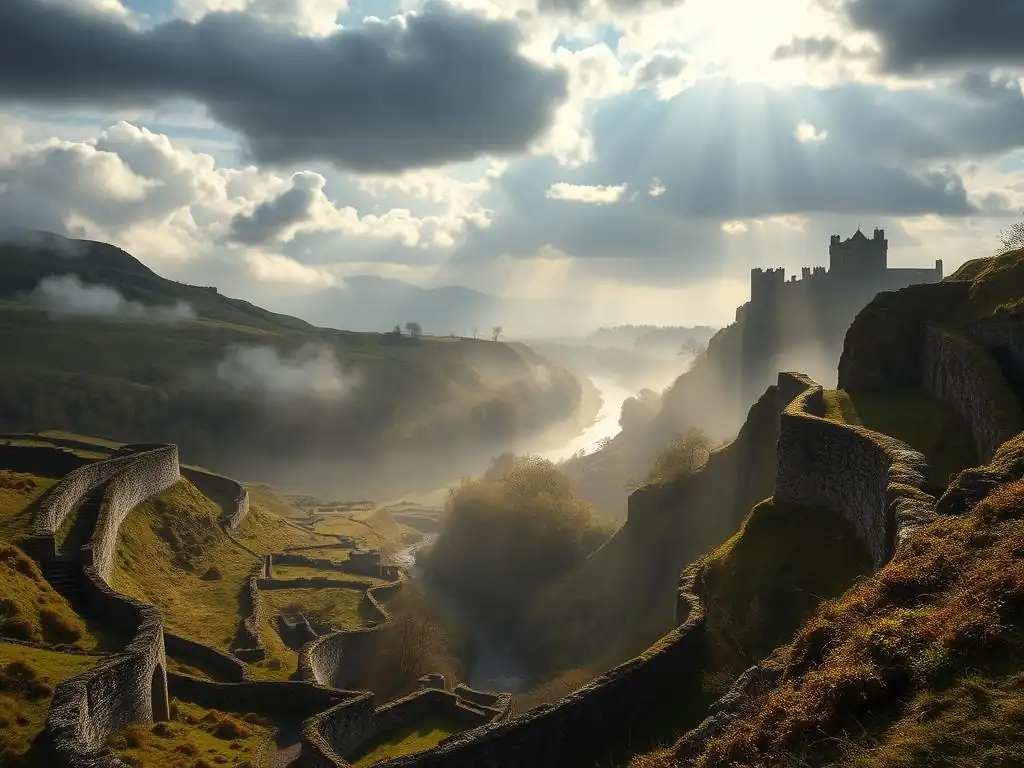
Welcome, intrepid explorer!
Delve into the captivating world of Mythology and Legends, where whispers of ancient tales echo through the ages. Ever wondered if Camelot truly existed? Prepare to journey through Arthurian landscapes, medieval Britain locations, and uncover the potential realities hidden within the fantastical narratives of King Arthur. Could these legendary places be more than just figments of imagination? Read on, and let's unravel the mysteries together...
- Introduction: Exploring the Mythical and Real Arthurian Landscapes
- Camelot: The Heart of Arthurian Legend - Myth or Reality?
- Beyond Camelot: Mapping the Wider Arthurian World
- Arthurian Landscapes in Literature and Popular Culture
- The Impact of Arthurian Legends on British Identity and Landscape Perception
- Conclusion: The Enduring Legacy of Arthurian Landscapes
-
Frequently Asked Questions
- What are some of the real-world locations often associated with Arthurian legends and specifically linked to Arthurian landscapes?
- How much of the geography described in Arthurian legends is based on historical fact versus pure fiction?
- Why is medieval Britain so central to the narrative and Arthurian landscapes portrayed in Arthurian legends?
- How do different cultural interpretations influence the understanding and depiction of Arthurian landscapes?
- What is the ongoing impact of the perceived Arthurian landscapes on contemporary society, and how do they continue to inspire?
- Final Reflection: Echoes of Camelot: Reimagining Arthurian Landscapes
- Unveil the Magic: Explore Arthurian Britain Today!
Introduction: Exploring the Mythical and Real Arthurian Landscapes
The Enduring Allure of Arthurian Legends and Their Settings
The tales of King Arthur and his Knights of the Round Table have captivated imaginations for centuries, weaving a rich tapestry of chivalry, magic, and adventure. Central to this enduring appeal are the evocative settings where these dramas unfold. These Arthurian landscapes, from the bustling court of Camelot to the mystical Isle of Avalon, are not merely backdrops but active participants in the narratives, shaping events and embodying the spirit of the age.
The power of these stories lies not just in the characters or plots, but in the tangible (or seemingly tangible) geography that roots them in a sense of place, even if that place exists primarily in the realm of myth. Exploring these medieval Britain locations associated with Arthur allows us to bridge the gap between legend and history, seeking traces of the fabled past in the physical world.
These legendary locations have been passed down through generations of storytellers, evolving with each retelling. From the early Welsh poems and chronicles to the elaborate French romances and later English works, the geography of the Arthurian world has expanded and shifted.
This constant reimagining speaks to the deep human desire to connect myth with reality, to find the extraordinary within the familiar terrain. It is this interplay between the fantastical elements of the legends and the potential grounding in actual medieval Britain locations that fuels the fascination with Arthurian geography, inviting us to embark on a journey across landscapes both real and imagined.
Blurring the Lines: Fact vs. Fiction in Arthurian Geography
One of the most compelling aspects of studying Arthurian landscapes is the inherent ambiguity between historical fact and literary fiction. While King Arthur himself remains a figure debated by historians – potentially based on a post-Roman British leader who fought against Saxon invaders in the late 5th or early 6th century – the locations associated with him often have roots in real places.
Early texts like the Historia Brittonum (circa 9th century) mention battles fought by Arthur, some of which can be linked to specific geographical areas in Britain. However, later, more detailed narratives, such as Geoffrey of Monmouth's Historia Regum Britanniae (circa 1136) and the subsequent romances, elaborate significantly on these places, adding layers of myth and fantasy that obscure their historical basis.
The challenge for those interested in Arthurian landscapes is sifting through these layers to identify potential medieval Britain locations that might have inspired the legends or were later associated with them. Archaeological evidence, historical records, and place-name studies offer clues, but definitive proof linking specific sites directly to a historical Arthur remains elusive.
Instead, we find places with significant historical importance during the relevant period, sites that fit the geographical descriptions in the texts, or locations that developed strong local traditions connecting them to the Arthurian myths over centuries. This ongoing investigation highlights the dynamic relationship between history, folklore, and the physical landscape, where the power of narrative can transform real places into legendary ones.
Camelot: The Heart of Arthurian Legend - Myth or Reality?
Defining Camelot: More Than Just a Castle
Camelot is arguably the most iconic location in the Arthurian legends, serving as King Arthur's court, the seat of the Round Table, and the symbol of his idealized kingdom. Yet, despite its central importance in later romances, Camelot is conspicuously absent from the earliest Arthurian accounts.
Early Welsh texts mention Arthur's court being at Caerleon, or sometimes Carlisle, but the name "Camelot" first appears in the works of Chrétien de Troyes in the late 12th century. Chrétien's description in Lancelot, the Knight of the Cart is vague, depicting a magnificent castle and court, but giving little geographical detail beyond suggesting it is a place of great importance and beauty.
Over time, Camelot evolved in literature to become the quintessential image of Arthur's reign – a place of peace, justice, and chivalric ideals, often depicted as a splendid city or a powerful fortress. Sir Thomas Malory, in his monumental Le Morte d'Arthur (published 1485), often places Camelot at Winchester, a historically significant city in England.
This literary development cemented Camelot's status as the heart of the Arthurian world, a utopian vision of kingship and knighthood. The lack of a consistent location in the texts and its late appearance have led many scholars to view Camelot primarily as a literary invention, a symbolic place representing the height of Arthur's power and the ideals he embodied, rather than a specific historical medieval Britain location.
Potential Locations for Camelot in Britain: A Historical Investigation
Despite the scholarly consensus that Camelot is likely a literary creation, the desire to find a real-world counterpart persists. Numerous sites across Britain have been proposed as potential inspirations or locations for Camelot, based on historical significance, archaeology, or local folklore. These investigations often focus on sites that show evidence of high-status occupation or military importance during the post-Roman period (roughly 5th to 7th centuries), a time frame often associated with a potential historical Arthur. While none offer definitive proof, they provide fascinating glimpses into the possible Arthurian landscapes that might have contributed to the legend.
Identifying a single, undisputed location for Camelot remains one of the great puzzles of Arthurian studies. The candidates range from impressive hillforts with evidence of post-Roman activity to sites with strong Roman connections or later medieval castles that became associated with the legend. Each proposed site brings its own set of arguments, often based on interpretations of scanty historical records, archaeological findings, or the evolution of local traditions linking the place to the legendary king. This search for the 'real' Camelot underscores the deep human need to ground myth in tangible medieval Britain locations.
Cadbury Castle: A Strong Contender for Camelot's Location
One of the most compelling candidates for Camelot is Cadbury Castle in Somerset. This impressive Iron Age hillfort, located near South Cadbury village, was the subject of extensive archaeological excavations led by Leslie Alcock in the late 1960s. The excavations revealed significant evidence of large-scale refortification and high-status activity on the hilltop during the late 5th and early 6th centuries – precisely the period associated with a potential historical Arthur. The site was transformed into a major stronghold, with massive timber-faced ramparts enclosing an area of approximately 18 acres (about 7 hectares).
Archaeologists uncovered evidence of a large timber hall, suggesting a royal or elite presence, along with imported pottery from the Mediterranean, indicating long-distance trade and high status. While no inscription or artifact explicitly names Arthur, the scale of the fortifications and the evidence of significant power concentrated here during the post-Roman period make Cadbury Castle a prime example of the kind of powerful stronghold a leader like Arthur might have commanded.
Furthermore, local folklore has long associated Cadbury Castle with Camelot, predating the modern archaeological interest. The name itself, potentially derived from "Cadbury" meaning "Cada's fort" or possibly linked to the Welsh caer (fort) and a personal name, doesn't directly translate to Camelot, but its impressive nature and strategic location in the West Country, a region often central to Arthurian tales, lend weight to its claim as a significant Arthurian landscape.
Other Potential Sites: Viroconium Cornoviorum and Its Roman Legacy
Another site sometimes proposed as a possible inspiration for Camelot, or at least a major Arthurian center, is Viroconium Cornoviorum, the ruins of a large Roman city near Wroxeter in Shropshire. While geographically distant from the West Country focus of some legends, Viroconium was one of the largest Roman settlements in Britain, covering over 180 acres (about 73 hectares) at its peak. Unlike many Roman towns that were abandoned after the Roman withdrawal, archaeological evidence suggests that parts of Viroconium remained occupied and were even reorganized in the post-Roman period.
Excavations have revealed evidence of a large timber building constructed within the ruins of the Roman bathhouse complex in the 5th or 6th century. This structure, sometimes interpreted as a possible hall for a post-Roman British ruler or elite, suggests that Viroconium retained some importance as a center of power after the end of Roman rule.
While this site lacks the strong folkloric connections to Arthur that Cadbury Castle possesses, its scale as a former Roman city and evidence of continued high-status occupation during the relevant period make it a plausible candidate for one of the significant medieval Britain locations that might have served as a base for a powerful British leader, perhaps influencing the later literary descriptions of a grand court like Camelot.
The Symbolic Significance of Camelot in Arthurian Lore
Beyond its potential as a physical place, Camelot holds immense symbolic weight within the Arthurian legends. It represents the pinnacle of Arthur's reign, a golden age of peace, justice, and chivalry. The image of the Round Table, housed within Camelot, symbolizes equality among knights and the pursuit of a common, noble purpose. Camelot is the setting for many of the most famous Arthurian events, including the arrival of Lancelot, the quest for the Holy Grail, and the seeds of the kingdom's eventual downfall due to internal strife and external threats.
As a concept, Camelot embodies the ideals that Arthur strove for – a unified Britain governed by righteousness and strength. Its eventual decline and fall mirror the tragic arc of Arthur's story, serving as a poignant reminder of the fragility of even the noblest endeavors. This symbolic dimension is arguably more important than identifying a specific historical location, as it allows Camelot to function as a universal archetype of an ideal society or kingdom, a powerful element that contributes significantly to the enduring appeal of the Arthurian landscapes and the legends themselves.
Beyond Camelot: Mapping the Wider Arthurian World
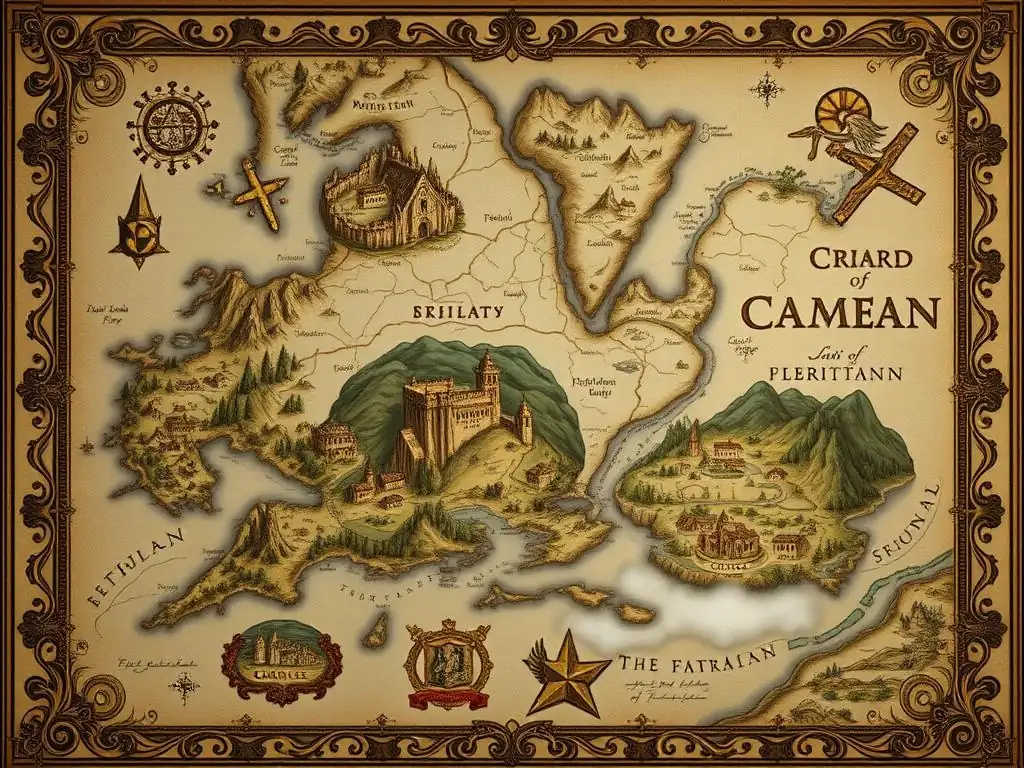
The Forest of Brocéliande: A Realm of Magic and Mystery
While Camelot represents the heart of Arthur's kingdom, the Arthurian world extends far beyond its walls, encompassing mystical forests, ancient castles, and enchanted islands. The Forest of Brocéliande is one such place, deeply embedded in the magical and supernatural elements of the legends.
First mentioned in the late 12th-century romances of Chrétien de Troyes, Brocéliande is consistently depicted as a place of wonder and danger, a wild, untamed landscape where the veil between the mortal and magical realms is thin. It is a forest where extraordinary events occur, where knights get lost, and where powerful enchanters and fey beings reside.
Brocéliande is not typically located in Britain within the major romances but is firmly placed in Brittany (northwestern France), a region with strong historical and cultural ties to Britain and a rich Celtic heritage. This geographical placement highlights the continental influence on the Arthurian legends as they developed in the works of French poets like Chrétien. The descriptions of Brocéliande emphasize its ancientness, its deep woods, and its mysterious lakes and fountains, making it a quintessential example of a magical forest in medieval literature and a key Arthurian landscape associated with enchantment and the supernatural.
Brocéliande's Connection to Merlin and the Lady of the Lake
The Forest of Brocéliande is most famously associated with the enchanter Merlin and the mysterious Lady of the Lake. According to many versions of the legend, it is in Brocéliande that Merlin, blinded by his love or fascination, teaches his magical secrets to the Lady of the Lake (sometimes called Viviane or Nimue).
In a tragic twist, the Lady then uses this knowledge to imprison Merlin, often within a tree, a rock, or a magical tower of air, from which he cannot escape, though he may still be able to speak or influence events. This narrative adds a poignant layer to the magical forest, making it the site of Merlin's final, ironic fate.
The Lady of the Lake herself is also intrinsically linked to Brocéliande. She is often depicted as a powerful sorceress who resides within the forest, sometimes in a magical castle hidden beneath a lake. She is the foster mother of Lancelot, raising him in her enchanted domain, and she is the one who bestows the sword Excalibur upon Arthur. Her presence reinforces Brocéliande's identity as a place connected to the fey world and deep, ancient magic, making it one of the most evocative and purely mythical Arthurian landscapes.
Identifying Brocéliande: Paimpont Forest in Brittany
While the literary Brocéliande is steeped in magic, there is a real forest in Brittany that has long been identified as its counterpart: the Paimpont Forest (Forêt de Paimpont). Located west of Rennes, this substantial forest covers over 16,000 acres (approximately 65 square kilometers) and possesses an ancient, mystical atmosphere that aligns with the literary descriptions. The association between Paimpont and Brocéliande dates back to medieval times, strengthened by the region's Celtic traditions and the popularity of Arthurian tales in Brittany.
The Paimpont Forest is home to numerous sites that local tradition and tourist promotion link to the legends, including the "Tomb of Merlin," the "Fountain of Youth" (Barenton), and the "Val sans Retour" (Valley of No Return), associated with Morgan le Fay. While archaeological evidence doesn't confirm these specific legendary events, the forest's ancient trees, hidden valleys, and mysterious standing stones create a landscape that perfectly fits the image of a magical realm.
Paimpont Forest serves as a powerful example of how literary Arthurian landscapes can become associated with real-world medieval Britain locations (or in this case, a closely related Celtic region), drawing visitors seeking to experience the atmosphere of the mythic past.
Tintagel Castle: Birthplace of Arthur and a Symbol of Royal Lineage
Tintagel Castle, perched dramatically on a windswept headland on the north coast of Cornwall, is perhaps the most physically impressive and popularly accepted Arthurian landscape associated with a specific event: Arthur's conception and birth. Geoffrey of Monmouth, in his Historia Regum Britanniae, tells the story of how Uther Pendragon, aided by Merlin's magic, was transformed to resemble Gorlois, the Duke of Cornwall, allowing him to enter Tintagel Castle and lie with Gorlois's wife, Ygerna (Igraine), who conceived Arthur that night. This narrative firmly links Tintagel to the very origins of the legendary king.
The site itself has a rich history. Archaeological excavations have revealed significant evidence of high-status occupation during the 5th to 7th centuries, including structures, fortifications, and a remarkable quantity of imported pottery from the Mediterranean, indicating its importance as a trading hub and a center of power for the rulers of Dumnonia (the post-Roman kingdom covering Cornwall and parts of Devon).
Although the dramatic castle ruins visible today date primarily from the 13th century (built by Richard, Earl of Cornwall, who deliberately associated the site with the Arthurian legends), the earlier findings confirm that Tintagel was indeed a place of considerable importance during the proposed Arthurian period, making it a plausible candidate for a significant medieval Britain location in the historical landscape, even if the legendary birth story is fictional.
The Dramatic Landscape of Tintagel and Its Historical Importance
The physical setting of Tintagel is integral to its mystique and its connection to the Arthurian legend. The castle ruins are split between the mainland and a rugged island, connected only by a narrow land bridge (now a modern footbridge replacing the medieval one). This isolated, defensible position, surrounded by sheer cliffs and the powerful Atlantic waves, gives Tintagel an aura of ancient strength and inaccessibility, perfectly fitting the description of a ducal stronghold in the legends. The harsh beauty of the Cornish coast adds to the dramatic appeal of this Arthurian landscape.
Historically, the archaeological evidence from the 5th-7th centuries at Tintagel points to a high-status site, likely a residence or stronghold for the rulers of Dumnonia. The discovery of thousands of sherds of imported pottery, glassware, and amphorae from as far away as the Byzantine Empire and North Africa indicates that the inhabitants were wealthy and connected to extensive trade networks.
This historical reality provides a tangible link to the kind of powerful rulers who might have existed in post-Roman Britain and whose lives could have inspired elements of the Arthurian tales. While the story of Uther and Ygraine is part of the myth, the site of Tintagel itself is a real and historically significant medieval Britain location that played a role in the complex history of the period.
Other Notable Arthurian Locations
Beyond the most famous sites like Camelot, Brocéliande, and Tintagel, the Arthurian legends are peppered with numerous other locations across Britain and Brittany, each contributing to the vast tapestry of the mythic geography. These places range from battlefields mentioned in early chronicles to sites that became associated with specific events or characters in later romances. Exploring these additional Arthurian landscapes helps to complete the picture of the legendary world and its potential connections to real medieval Britain locations.
These sites often have historical significance that predates or coincides with the period associated with Arthur, suggesting that the legends were woven into the existing historical and geographical fabric of Britain. Their inclusion in the narratives highlights the storytellers' use of recognizable or historically important places to lend a sense of authenticity and scale to the unfolding events. From the legendary resting places of heroes to the sites of pivotal battles, these locations are vital components of the Arthurian geographical imagination.
Avalon: The Isle of Apples and Arthur's Final Resting Place
Avalon is the mysterious island where King Arthur is taken after being mortally wounded at the Battle of Camlann. It is often depicted as a magical, ethereal place, a paradise or land of the blessed, where wounds can be healed and time may pass differently. The name "Avalon" is often linked to Welsh or Celtic words for "apple," suggesting an association with orchards and fertility, perhaps hinting at an ancient mythological significance. In Geoffrey of Monmouth's account, Avalon is ruled by the sorceress Morgan le Fay and her sisters, who possess healing powers.
Avalon represents the ultimate destination for the mortally wounded king, a place of transition between the mortal world and something beyond. Its nature is deliberately ambiguous, existing more as a concept or a magical realm than a clearly defined physical location. This makes identifying a real-world Avalon particularly challenging, as it functions primarily as a symbolic Arthurian landscape representing the mystery surrounding Arthur's end and the hope of his eventual return.
Glastonbury Tor: A Potential Avalon?
Glastonbury in Somerset has long been associated with Avalon, particularly its prominent hill, Glastonbury Tor, and the ruins of Glastonbury Abbey. This association gained significant traction in the late 12th century, following the publication of Geoffrey of Monmouth's work and, crucially, the reported discovery in 1191 by monks at Glastonbury Abbey of a burial site containing a lead cross inscribed "Here lies buried the famous King Arthur with Guinevere his second wife, in the Isle of Avalon."
While modern historians and archaeologists largely view this discovery as a politically motivated fabrication by the monks to increase the abbey's prestige and attract pilgrims after a devastating fire, it cemented Glastonbury's place in the Arthurian myths.
Glastonbury Tor, with its distinctive terraced sides and the solitary St. Michael's Tower at its summit, is a striking landmark rising from the Somerset Levels (which were more extensively flooded in the past, making the Tor appear more island-like). The area has a long history of religious significance, dating back to pre-Christian times, and the Abbey was one of the most important monastic institutions in medieval England.
This combination of a historically significant religious site, a striking natural feature that could be perceived as an island, and the powerful medieval claim of finding Arthur's grave made Glastonbury a primary candidate for Avalon in the popular imagination, transforming it into a significant Arthurian landscape and pilgrimage site.
Caerleon: A Roman Fortress and a Possible Arthurian Capital
Caerleon, located in South Wales, was the site of Isca Augusta, a major Roman legionary fortress and one of the most important military bases in Roman Britain, established around AD 75. Covering an area of approximately 50 acres (around 20 hectares), it housed the II Augusta legion for over 200 years. Its impressive scale and strategic importance made it a natural choice for early chroniclers seeking a grand capital for a powerful British ruler.
Geoffrey of Monmouth is the most prominent source linking Caerleon to Arthur, describing it as a magnificent city with impressive Roman ruins, making it suitable for Arthur's court and the coronation site. He details its grand palaces, churches, and the presence of the Round Table there.
While there is no archaeological evidence directly linking Arthur to Caerleon, the survival of substantial Roman remains – including an amphitheatre, barracks, and baths – would have made it a highly visible and impressive site in the post-Roman period, a fitting backdrop for a powerful king's court in a literary account. Caerleon thus represents a tangible medieval Britain location whose historical grandeur was repurposed within the Arthurian narrative to serve as a key royal center before the emergence of Camelot in later tales.
Arthurian Landscapes in Literature and Popular Culture
The Evolution of Arthurian Settings Through the Ages
The portrayal of Arthurian landscapes has evolved dramatically over the centuries, reflecting the changing tastes, geographical knowledge, and thematic interests of different eras and authors. Early Welsh texts and chronicles, such as the Annales Cambriae or Culhwch and Olwen, mention specific, often identifiable, places in Britain associated with Arthur's battles or court, grounding the legends in a more localized, historical geography. These are primarily medieval Britain locations like battle sites or early British strongholds.
The French romances of the 12th and 13th centuries, including those by Chrétien de Troyes and the Vulgate Cycle, expanded the Arthurian world significantly. They introduced new, often more fantastical, landscapes like the Forest of Brocéliande and the magical realm of Camelot, which became less tied to specific historical geography and more to symbolic or allegorical meanings.
Sir Thomas Malory's Le Morte d'Arthur synthesized many earlier traditions, often placing events in recognizable English locations like Winchester or Salisbury, further integrating the mythical geography with real medieval Britain locations familiar to his audience. Later writers, from Tennyson in the Victorian era to modern fantasy authors, have continued to reinterpret and reimagine these landscapes, sometimes grounding them in specific British locations, sometimes creating entirely new, fantastical realms inspired by the Arthurian template.
The Influence of Arthurian Geography on Modern Fantasy
The Arthurian landscapes have exerted a profound influence on the development of modern fantasy literature. The archetypal elements of the Arthurian world – the hidden magical forest, the mysterious island realm, the imposing castle stronghold, the ancient ruins hinting at a lost golden age – have become staples of the fantasy genre. Authors drawing inspiration from Arthur often utilize similar geographical motifs to create their own secondary worlds, populating them with knights, wizards, and mythical creatures.
The concept of a central, idealized kingdom (like Camelot), surrounded by wild, dangerous, or magical territories (like Brocéliande), is a common structure in fantasy world-building, directly echoing the Arthurian model. The quest narrative, frequently involving journeys across diverse and often perilous Arthurian landscapes, also forms a core element of fantasy plots. The very idea of finding enchantment or hidden history in seemingly ordinary medieval Britain locations or their equivalents in fictional worlds is a legacy of the Arthurian myths.
The Lord of the Rings: Echoes of Arthurian Landscapes
J.R.R. Tolkien's The Lord of the Rings, a foundational work of modern fantasy, demonstrates significant echoes of Arthurian landscapes and themes. While Tolkien drew on a wide range of mythologies, the structure and geography of Middle-earth show clear parallels with the Arthurian world. Minas Tirith, the besieged capital of Gondor, functions in some ways like a later, beleaguered Camelot – a symbol of a noble but fading kingdom facing overwhelming darkness. The Shire represents a pastoral, idealized homeland, not unlike the peaceful areas under Arthur's protection before the onset of conflict.
Furthermore, the journey of the Fellowship takes them through diverse landscapes that mirror Arthurian geographical archetypes: ancient, magical forests (like Fangorn, echoing Brocéliande's sense of deep, untamed nature), formidable fortresses (like Helm's Deep or Isengard, akin to powerful castles in Arthurian tales), and mysterious, ethereal realms (like Lothlórien, bearing some resemblance to the mystical nature of Avalon).
The presence of ancient ruins scattered throughout Middle-earth, vestiges of earlier, greater ages (like Arnor or Gondolin), strongly resonates with the real and legendary ancient sites that populate the Arthurian landscapes of Britain, hinting at a glorious past that informs the present struggle.
The Impact of Arthurian Legends on British Identity and Landscape Perception
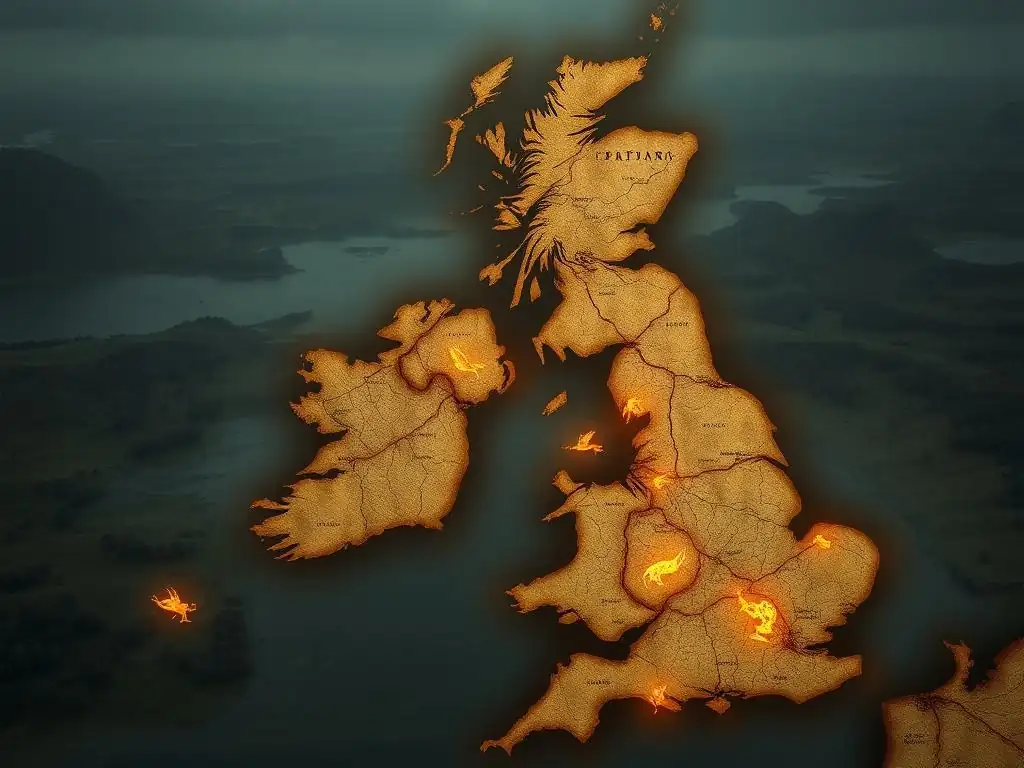
Arthurian Tourism: Exploring the Real and Imagined Locations
The enduring appeal of the Arthurian legends has given rise to a significant form of cultural tourism focused on exploring the Arthurian landscapes. Sites historically or traditionally associated with King Arthur and his knights attract thousands of visitors annually, eager to connect with the mythic past. Places like Tintagel Castle, Glastonbury Tor, Cadbury Castle, and even the Paimpont Forest in Brittany serve as focal points for those seeking to walk in the footsteps of legend.
This tourism blends historical interest with imaginative engagement. Visitors are often drawn by the dramatic scenery and historical significance of sites like Tintagel, while simultaneously seeking the aura of magic and myth. Local businesses and heritage organizations often embrace the Arthurian connection, offering guided tours, exhibitions, and information that highlight the links between the physical medieval Britain locations and the legendary events. This phenomenon demonstrates the powerful way in which myth can shape our perception of place and motivate travel, turning ancient sites into popular tourist destinations based on their association with a beloved story.
Preserving the Arthurian Heritage: Protecting Mythic Sites
The popularity of Arthurian landscapes also raises important questions about preservation and interpretation. Many of the sites associated with Arthur are ancient monuments, such as Iron Age hillforts, Roman ruins, or medieval castles, which require careful protection and management. Heritage organizations like English Heritage and the National Trust in the UK play a crucial role in maintaining sites like Tintagel and Cadbury Castle, balancing public access with the need to conserve archaeological remains and natural environments.
Interpreting these sites for visitors involves navigating the complex relationship between historical evidence and legendary association. While acknowledging the myths is essential to understanding why these places are considered Arthurian landscapes, it is also important to present the available historical and archaeological evidence accurately.
Educational efforts aim to inform visitors about the real history of these medieval Britain locations during the post-Roman period, allowing them to appreciate both the factual past and the layers of myth that have accumulated over centuries. This ongoing effort is vital to preserving not just the physical sites, but also the rich cultural heritage associated with the Arthurian legends and their connection to the British landscape.
Conclusion: The Enduring Legacy of Arthurian Landscapes
The Power of Place in Shaping the Arthurian Narrative
The Arthurian landscapes, whether real or imagined, are fundamental to the power and longevity of the legends. They provide a grounding for the stories, offering a sense of place that makes the fantastical elements more believable and the historical hints more intriguing.
From the strategic hillforts and Roman ruins that might have inspired early accounts to the mystical forests and enchanted islands of later romances, the geography of the Arthurian world is as dynamic and multifaceted as the legends themselves. These medieval Britain locations (and their continental counterparts) are not just passive backdrops; they are active participants in the narrative, reflecting the themes of strength, mystery, and the interplay between the natural and supernatural worlds.
The enduring quest to find the 'real' Arthurian sites underscores the deep human need to connect myth with the physical world. It highlights how stories can imbue landscapes with meaning, transforming hills, forests, and ruins into places of pilgrimage and imagination. The fluidity between historical medieval Britain locations and purely mythical Arthurian landscapes allows the legends to remain adaptable and resonant, capable of being reinterpreted across different eras and cultures.
The Enduring Appeal of Arthurian Landscapes on the Imagination
Ultimately, the appeal of Arthurian landscapes lies in their ability to capture the imagination. They offer glimpses into a romanticized past, a world of chivalry and magic that contrasts with the complexities of modern life. Whether visiting the dramatic cliffs of Tintagel, contemplating the mystical aura of Glastonbury Tor, or reading about the enchanted depths of Brocéliande, people are drawn to these places because they embody the spirit of the Arthurian tales.
These landscapes serve as powerful anchors for the legends, keeping them alive in the collective consciousness. They invite us to explore the boundaries between history and myth, reality and fantasy. As long as the stories of King Arthur continue to be told, the fascination with the Arthurian landscapes – the castles, forests, and islands of Britain and beyond – will undoubtedly endure, inspiring new generations to seek out the traces of legend in the real world and to imagine the possibilities of a world shaped by magic and heroism.
Frequently Asked Questions
What are some of the real-world locations often associated with Arthurian legends and specifically linked to Arthurian landscapes?
Many places in medieval Britain are claimed as Arthurian sites. Examples include Glastonbury Tor (linked to Avalon), Tintagel Castle (Arthur's supposed birthplace), and Cadbury Castle (often identified as Camelot), all contributing to the Arthurian landscapes.
How much of the geography described in Arthurian legends is based on historical fact versus pure fiction?
It's a blend. While some locations may have historical roots in medieval Britain, much of the Arthurian geography is fictionalized or embellished over time, creating a romanticized view.
Why is medieval Britain so central to the narrative and Arthurian landscapes portrayed in Arthurian legends?
Medieval Britain provides the historical and cultural backdrop. The stories are rooted in the perceived history and landscape of that era, shaping the Arthurian landscapes and giving the legends a sense of place.
How do different cultural interpretations influence the understanding and depiction of Arthurian landscapes?
Different cultures and retellings may emphasize or reimagine the Arthurian landscapes differently. This affects how specific locations are perceived and their significance within the overall Arthurian geography, for example Welsh vs. English.
What is the ongoing impact of the perceived Arthurian landscapes on contemporary society, and how do they continue to inspire?
The romanticized view of Arthurian landscapes continues to inspire tourism, art, and literature. Places associated with Arthurian legends attract visitors and reinforce the enduring appeal of medieval Britain and the tales of King Arthur.
Final Reflection: Echoes of Camelot: Reimagining Arthurian Landscapes
The enduring power of the Arthurian legend isn't just a matter of fantastical tales; it's a testament to the enduring allure of place, a powerful reminder that the landscapes we inhabit shape our narratives and, in turn, are shaped by them. The very stones and valleys of medieval Britain, whether real or imagined, continue to resonate with the echoes of King Arthur, his knights, and their quests. This enduring connection highlights the potent interplay between history, myth, and the geographical spaces that cradle both.
Exploring the geographical realities behind the Arthurian mythos reveals not only the historical context of the legends but also the enduring influence of landscape on storytelling and cultural identity. The very act of searching for Camelot, whether in the misty valleys of Cornwall or the rolling hills of Wales, speaks to our deep-seated human need to connect with the past, to find meaning in the places that have witnessed centuries of human experience. The land itself is a character in the Arthurian story, a silent witness to the triumphs and tragedies of its inhabitants.
This quote encapsulates the profound relationship between the Arthurian narrative and the physical world it inhabits.
Consider the landscapes you inhabit. What stories do they whisper? What legends, both real and imagined, are woven into their fabric? Let the exploration of Arthurian geography inspire you to look closer at the places around you, to uncover the hidden narratives embedded within them, and to appreciate the enduring power of place in shaping our collective memory and individual identities. Let the quest for Camelot continue, not just in the pursuit of a physical location, but in the exploration of the rich tapestry of stories that define our world.
Unveil the Magic: Explore Arthurian Britain Today!
Thanks for joining us on this journey through the legendary landscapes of King Arthur! We hope you've gained a deeper appreciation for the real-world inspirations behind the myths and legends. Now it's time to bring the magic to life!
- Explore the real locations: Research and plan a visit to some of the actual castles, forests, and landscapes mentioned in Arthurian tales. Consider Tintagel Castle, Cadbury Castle, or the mystical forests of Cornwall.
- Delve deeper into the history: Research the historical figures and events that may have inspired the Arthurian legends. What surprised you most about the historical context?
- Share your discoveries: Post pictures on social media of locations you visit that connect to the Arthurian mythos, using #ArthurianLandscapes and tagging @MythologyAndLegends (replace with your actual social media handle).
What hidden Arthurian secrets do you think are still waiting to be uncovered?