
The Psychology of Fate: Destiny vs. Choice in Mythic Narratives

Welcome to Mythology and Legends, where we delve into the timeless stories that shape our understanding of the world. Ever wondered if our lives are guided by an unseen hand or shaped by our own choices? In this article, we embark on a journey through mythic narratives to explore the age-old question of fate vs. free will. Prepare to unravel the psychological threads woven into these ancient tales and discover how they continue to resonate with us today. Are you ready to confront your destiny?
Defining Fate, Destiny, and Free Will in the Context of Myth
In the vast tapestry of global mythology, the concepts of fate, destiny, and free will serve as foundational pillars upon which countless narratives are built. Fate, often perceived as an unalterable sequence of events predetermined by a higher power or cosmic force, represents the idea that an individual's path is set from birth, regardless of their actions.
Destiny, while sometimes used interchangeably with fate, can also carry the nuance of a predetermined outcome or goal, suggesting a specific end point that one is fated to reach, though perhaps with some flexibility in the journey itself. These concepts stand in stark contrast to free will, which posits that individuals possess the power to make independent choices, initiate actions, and ultimately shape their own future, unbound by predestination.
The tension between these forces – the immutable decree of fate versus the assertive power of individual choice – forms the core of the enduring debate surrounding fate vs. free will in myth.
Understanding these definitions is crucial for analyzing how different cultures grapple with the question of human agency within a seemingly ordered or predetermined cosmos. Mythological figures, from tragic heroes attempting to escape their prophesied doom to tricksters deliberately subverting established order, embody these concepts. The narrative power lies in exploring the consequences of actions taken in spite of or in accordance with what is believed to be fated.
Is the hero's ultimate end a result of their brave (or foolish) decisions, or were those decisions themselves merely the unfolding of a script written long ago? This fundamental question of fate vs. free will drives much of the psychological drama and moral complexity found in ancient stories, offering timeless insights into the human condition and our perception of control over our own lives.
The Enduring Appeal of the Fate vs. Free Will Debate in Mythic Storytelling
The conflict between fate and free will resonates deeply with the human psyche because it mirrors our own lived experience. We often feel a sense of agency, the ability to choose our actions and influence outcomes, yet we also encounter circumstances that seem beyond our control – unforeseen events, inherent talents or limitations, the actions of others, or simply bad luck.
Myth provides a framework to explore this tension on a grand, cosmic scale, using gods, prophecies, and supernatural forces to personify the forces that might dictate or constrain human lives. This allows audiences to vicariously explore fundamental questions about responsibility, consequence, and the nature of reality itself.
Furthermore, the debate between fate vs. free will taps into core psychological needs and anxieties. Do our lives have inherent meaning or purpose (destiny), or are we entirely responsible for creating our own meaning through our choices (free will)? The idea of fate can be comforting, suggesting that a plan exists and that challenges are part of a larger design, relieving the burden of absolute responsibility.
Conversely, the concept of free will is empowering, asserting our capacity for self-determination and moral accountability. Mythic narratives that explore this dynamic, such as the tragic attempts to avert a prophecy or the heroic struggles against seemingly insurmountable odds, provide a stage upon which these universal psychological conflicts are played out, offering both catharsis and contemplation to the reader or listener across generations and cultures.
- Defining Fate, Destiny, and Free Will in the Context of Myth
- The Enduring Appeal of the Fate vs. Free Will Debate in Mythic Storytelling
- What is the central conflict explored in "The Psychology of Fate: Destiny vs. Choice in Mythic Narratives"?
- How do different cultures approach the concept of fate in their mythologies?
- Why is the debate between fate and free will relevant to contemporary society?
- What psychological insights can be gained from analyzing the portrayal of fate in myths?
- Can characters ever truly escape their predetermined fate in mythological narratives?
Fate and Predestination: Examining the Power of Destiny in Myth
Ancient Greek Perspectives on Fate: The Moirai and Inevitable Destiny
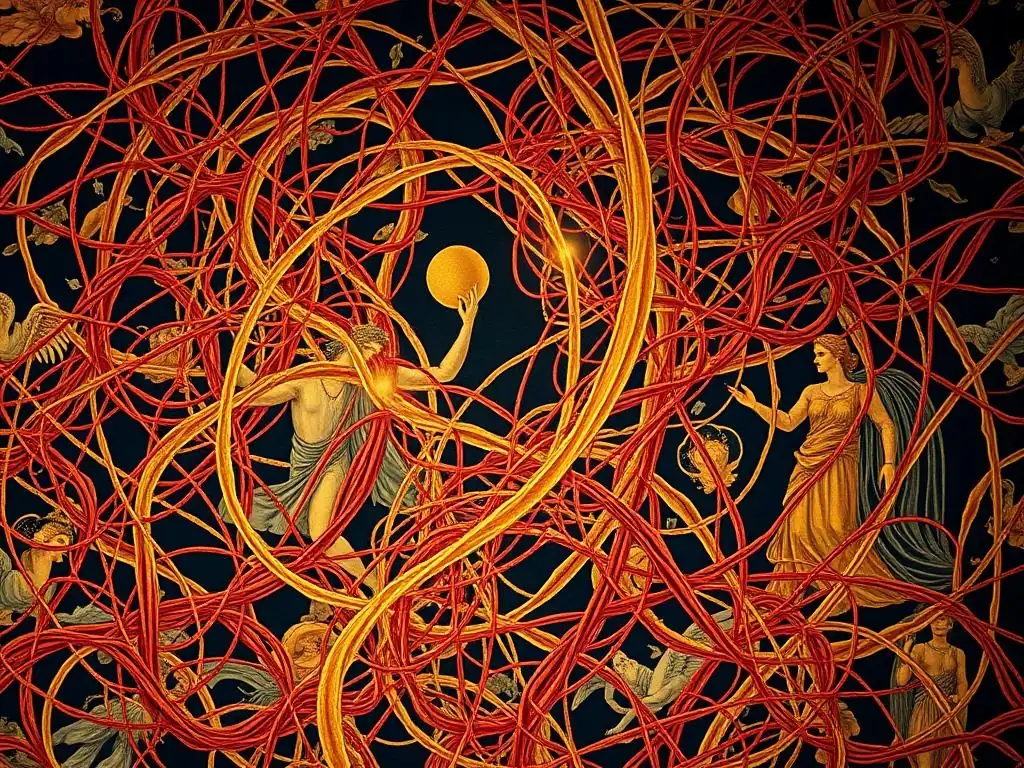
In ancient Greek mythology, fate was a potent, often terrifying force, personified by the Moirai, or Fates. These three sisters – Clotho (the spinner of the thread of life), Lachesis (the measurer of the thread), and Atropos (the cutter of the thread) – were believed to determine every individual's destiny from birth, including the span of their life and the major events within it. Even the Olympian gods, including Zeus himself, were often depicted as subject to the decrees of the Moirai.
This suggests a worldview where the ultimate power lay not with the deities of the pantheon, but with an impersonal, inexorable cosmic order. The concept of fate vs. free will in this context heavily leaned towards the power of destiny, with human choices often seen as merely fulfilling a predetermined script.
The myth of Oedipus Rex is perhaps the most famous Greek example illustrating the seemingly inescapable nature of fate. Despite elaborate efforts by his parents, King Laius and Queen Jocasta, to avert a prophecy that their son would kill his father and marry his mother, Oedipus unknowingly fulfills every detail.
His very actions taken to escape his fated path – being abandoned, being adopted, leaving his adoptive home to avoid harming them, killing a stranger on the road (who was Laius), and marrying the queen of Thebes (Jocasta) – are the instruments of his destiny. This narrative powerfully demonstrates the Greek perspective that while individuals might exercise apparent free will, their choices are ultimately guided or overridden by a predetermined fate, highlighting the tragic futility of struggling against what is ordained.
Norse Mythology and the Loom of Wyrd: Weaving the Threads of Fate
In Norse mythology, the concept of fate is embodied by Wyrd, a complex term often translated as fate, destiny, or doom. Wyrd is not a linear progression like the Greek Moirai's thread, but rather a web or matrix of interconnected events, past, present, and future, woven by the Norns – Urd (That Which Has Come To Pass), Verdandi (That Which Is Passing Into Being), and Skuld (That Which Shall Be).
Like the Moirai, the Norns reside at the roots of the cosmic tree Yggdrasil and are believed to determine the fate of both gods and mortals. While individual actions contribute to the weaving of Wyrd, the overall pattern and significant events, including the ultimate destiny of the gods themselves in Ragnarok, seem predetermined.
The Norse view of fate vs. free will is often seen as slightly more nuanced than the Greek, allowing for individual action within the constraints of Wyrd, even if the final outcome is set. Heroes and gods alike are aware of their inevitable doom (Ragnarok), yet they choose to fight bravely and meet their end with honor. This suggests a form of agency – the choice of how one faces their fate – even if the fate itself cannot be averted.
The sagas are replete with instances where characters are bound by oaths or prophecies, yet their individual courage, cunning, or folly contribute to the specific way in which their Wyrd unfolds. The emphasis is less on escaping fate and more on living a life worthy of remembrance within its confines.
Exploring the Concept of Predestination in Eastern Mythologies: Hindu Karma and Dharma
Eastern mythologies and philosophies also explore concepts akin to fate and destiny, often intertwined with principles like Karma and Dharma in Hinduism. Karma, meaning "action" or "deed," is the universal law of cause and effect, where an individual's actions in this life and previous lives determine their future circumstances and rebirths.
While this might seem like predestination, the crucial element is that the cause is the individual's own free will – their choices and actions create their future Karma. Thus, while the effects of past actions are fated, the present offers the opportunity to create new, positive Karma through righteous action.
Dharma, on the other hand, refers to one's duty, righteousness, or the natural order of the universe. It represents the path one is meant to follow based on their nature, social role, and stage of life. Fulfilling one's Dharma is seen as acting in accordance with the cosmic order, which can be interpreted as aligning with one's destiny.
However, the choice to act according to one's Dharma or deviate from it rests with the individual, introducing the element of free will. The interplay between Karma (the consequences of past choices) and Dharma (the path of righteous choice in the present) offers a sophisticated perspective on fate vs. free will, suggesting a balance where past actions shape current circumstances, but present choices determine future outcomes, allowing for both predetermined elements and significant personal agency within the cycle of existence.
Free Will and Agency: The Hero's Choice in the Face of Destiny
The Hero's Journey: A Framework for Examining Agency and Choice
Joseph Campbell's monomyth, or the Hero's Journey, provides a compelling framework for analyzing the interplay of fate vs. free will in countless myths and stories. While the overarching structure of the journey (Call to Adventure, Crossing the Threshold, Tests, Allies, and Enemies, Ordeal, Reward, The Road Back, Resurrection, Return with the Elixir) might seem like a fated path, each stage is punctuated by critical moments of choice.
The hero must first choose to answer the call, choose to cross the threshold into the unknown, choose to trust allies, choose to confront the central ordeal, and choose to return and share their wisdom. These are not passive steps; they are active decisions that require courage, determination, and a willingness to embrace agency in the face of adversity.
Consider a hero like Luke Skywalker in Star Wars (heavily influenced by the monomyth). While he seems destined for greatness due to his lineage and connection to the Force, his journey is defined by choices: choosing to leave Tatooine with Obi-Wan, choosing to trust Han Solo, choosing to attempt the rescue of Princess Leia, choosing to learn the ways of the Force, and ultimately, choosing to confront Darth Vader and the Emperor.
These choices are not trivial; they involve risk, sacrifice, and moral deliberation. The Hero's Journey, therefore, highlights how perceived destiny often serves as a catalyst or backdrop against which the hero's free will is tested and forged, demonstrating that even within a seemingly fated structure, individual choices are paramount to the hero's development and the eventual outcome of the narrative.
Challenging Fate: Examples of Mythic Heroes Who Defy Predestination: Oedipus Rex
While the Greek myth of Oedipus Rex is often cited as the epitome of inescapable fate, it paradoxically also serves as a powerful, albeit tragic, example of a hero attempting to defy predestination through apparent free will. The prophecy states he will kill his father and marry his mother.
In response, his parents abandon him (a choice), and later, upon hearing a similar prophecy from the Oracle of Delphi, Oedipus chooses to leave Corinth (where he believes his parents live) specifically to avoid fulfilling the dark prediction. His subsequent actions – killing a man at a crossroads in self-defense and solving the Sphinx's riddle to become king of Thebes and marry the recently widowed queen – are all results of his active decisions, driven by his desire to escape the fated outcome.
The tragic irony lies in the fact that these very choices, born out of a desperate assertion of free will, are precisely the actions that lead him to fulfill the prophecy. He killed Laius, his biological father, at the crossroads, and married Jocasta, his biological mother.
Oedipus's story doesn't show him successfully changing his fate, but rather demonstrates the chilling possibility that free will is an illusion, and that even our most determined efforts to steer our own course are merely predetermined steps on a fated path. This narrative deeply explores the psychological tension of fate vs. free will, leaving the audience to ponder whether Oedipus was a victim of destiny or if his own flawed character and choices sealed his doom, highlighting the profound philosophical questions embedded within myth.
The Psychological Impact of Believing in Free Will vs. Determinism
Belief in either free will or determinism (a form of fate or predestination) has significant psychological implications for individuals. People who strongly believe in free will tend to report higher levels of life satisfaction, self-efficacy, and a greater sense of control over their lives.
This belief structure often correlates with increased motivation to pursue goals, make healthy choices, and persevere through challenges, as they perceive their efforts as directly influencing outcomes. Studies, such as hypothetical scenarios presented to participants, suggest that priming individuals to disbelieve in free will can, in some contexts, lead to decreased helpfulness and increased cheating, indicating that the belief in agency is linked to moral responsibility and prosocial behavior.
Conversely, a strong belief in determinism or fate can lead to feelings of helplessness or passivity. If everything is predetermined, why bother striving or making difficult choices? However, for some, this belief can also be a source of comfort, alleviating anxiety about the unknown future and providing a framework for accepting difficult circumstances as part of a larger, fated plan.
Psychologically, the ongoing debate of fate vs. free will in myth and philosophy reflects a fundamental human need to understand our place in the universe and the extent to which we are masters of our own destiny or simply actors playing a part in a cosmic drama. Our personal stance on this question can profoundly influence our motivation, resilience, and sense of responsibility.
The Interplay of Fate and Choice: Finding Balance in Mythic Narratives
Fate as a Catalyst for Choice: How Destiny Shapes Character Development
In many mythic narratives, fate is not merely an endpoint but serves as a powerful catalyst that forces characters to make pivotal choices, thereby driving their psychological and moral development. A prophecy of doom or a fated encounter doesn't necessarily strip characters of agency; instead, it often presents them with a critical juncture where their reaction, their decision, defines who they are. Consider the myth of Perseus. His grandfather, Acrisius, receives a prophecy that his grandson will kill him, a clear instance of fated doom.
To avoid this, Acrisius imprisons his daughter Danaë, an act driven by fear of fate. However, Zeus intervenes (perhaps fate again, or divine will), and Perseus is born. Acrisius then puts Danaë and baby Perseus in a chest set adrift at sea.
This fated beginning, the result of an attempt to escape destiny, directly leads to a series of situations where Perseus must exercise choice. He chooses to protect his mother, chooses to accept the challenge of killing Medusa (a task given to him by a deceitful king, Polydectes, who wanted Danaë), chooses to seek help from the Graeae and nymphs, and chooses to use cunning and courage to overcome impossible odds.
His fated lineage and the prophecy hanging over him create the circumstances, but his responses – his bravery, resourcefulness, and eventual decision to return home – are products of his agency. Thus, fate provides the stage and the initial conflict, but the hero's choices are what fill the narrative with meaning and demonstrate the complex interplay between fate vs. free will.
The Illusion of Control: Exploring the Limits of Free Will in Myth
While some myths highlight choice, others delve into the unsettling possibility that free will is largely an illusion, and that characters are merely playing out a script written by fate or the gods. This theme is prevalent in stories where characters believe they are making independent decisions, only for those actions to inadvertently lead them precisely where destiny intended. The myth of Sisyphus is a poignant example.
Punished by the gods for his deceitfulness, Sisyphus is fated to eternally push a boulder uphill, only for it to roll back down each time it nears the summit. His struggle is immense, his effort constant, yet the outcome is fixed – perpetual, futile labor.
Another instance can be seen in narratives where divine intervention or trickery manipulates events so subtly that characters perceive their actions as self-directed. In some versions of the Trojan War myths, the gods actively interfere in battles, influencing the outcome through whispers, illusions, or direct physical intervention, while the human warriors believe they are fighting based on their own skill and courage.
These myths explore the limits of free will, suggesting that even when we feel most in control, external forces – whether fate, gods, or cosmic law – might be subtly guiding our steps. The exploration of this "illusion of control" adds a layer of philosophical depth to the fate vs. free will debate, prompting reflection on the true extent of human agency.
The Role of Prophecy: Foreknowledge and its Influence on Decision-Making
Prophecy is a common narrative device in mythology that directly engages the question of fate vs. free will. Foreknowledge of a future event, whether a glorious triumph or a tragic downfall, presents characters with a unique challenge. Does knowing the future empower them to change it, or does it merely inform them of their fated path, perhaps even compelling them to act in ways that ensure its fulfillment?
The reaction to prophecy is a key indicator of how a myth explores agency. Consider Cassandra, cursed by Apollo to utter true prophecies but never to be believed. Her knowledge of Troy's fated destruction is absolute, yet her inability to convince others highlights the powerlessness of foreknowledge against collective disbelief or perhaps, against a fate that cannot be averted.
In other myths, characters receive prophecies and actively try to thwart them, as seen with Oedipus, or attempt to fulfill them. The Argonauts' quest for the Golden Fleece involves several prophecies and oracles guiding their journey. Jason's actions are often a response to these divine or fated pronouncements.
The psychological impact of prophecy is profound: it introduces anxiety, hope, or resignation, all of which influence subsequent decisions. Does the prophecy represent an unchangeable fate, or is it a warning or a map that allows for strategic choices? Myths featuring prophecy often leave the audience pondering whether the characters' actions were freely chosen responses to the foretold future or if the prophecy itself subtly manipulated them into making the "correct" (fated) choices, keeping the fate vs. free will dynamic central to the plot.
Psychological Interpretations of Fate vs. Free Will in Mythology
Jungian Archetypes: The Shadow and the Hero's Confrontation with Destiny
Carl Jung's analytical psychology offers valuable insights into the psychological underpinnings of the fate vs. free will debate as depicted in mythology, particularly through the lens of archetypes. The Hero archetype, central to the monomyth, is inherently linked to the struggle for individuation – the process of developing a distinct personality. This journey often involves confronting external challenges that can be interpreted as manifestations of fate or destiny, as well as internal conflicts represented by the Shadow archetype.
The Shadow contains repressed aspects of the self, including weaknesses, fears, and instincts. The hero's confrontation with the Shadow can be seen as an internal battle for agency, a struggle to integrate darker aspects of the psyche rather than being unconsciously driven by them, which might feel like being subject to an uncontrollable, internal "fate."
Furthermore, the concept of synchronicity in Jungian thought – meaningful coincidences that seem acausally connected – can be seen as a modern psychological parallel to the ancient idea of fate or destiny guiding events. While not predestination, synchronicity suggests an underlying order or connectedness in the universe that goes beyond simple cause and effect, echoing the feeling that some events are "meant to be."
From a Jungian perspective, the mythic struggle between fate and free will represents the individual's psychological task of navigating the tension between external forces (which may feel fated) and the internal imperative towards self-realization and conscious choice. The hero's journey is not just an external adventure, but an internal one, where overcoming the Shadow and integrating the self is the ultimate act of asserting psychological free will against deterministic internal forces.
Existentialism and Myth: Finding Meaning in a World Governed by Fate or Chance
Existentialist philosophy, which emphasizes individual freedom, responsibility, and the search for meaning in a seemingly absurd or meaningless universe, finds powerful resonance with mythic narratives exploring fate vs. free will. Existentialism posits that "existence precedes essence," meaning individuals are born without inherent purpose (no fated destiny) and must create their own meaning through their choices and actions.
This perspective views the individual as radically free, burdened by the responsibility that comes with that freedom. Myths that depict characters grappling with predetermined fates or facing arbitrary, chaotic forces (chance) can be interpreted through an existentialist lens as explorations of how humans confront the absence of inherent meaning or control.
For example, the myth of Sisyphus, as interpreted by Albert Camus, becomes an existentialist allegory. While Sisyphus is fated to eternal, meaningless labor, Camus argues that his defiance lies in his consciousness of his fate and his continued effort. In the moment he walks back down the mountain, he is free, choosing to embrace his absurd reality.
This interpretation shifts the focus from the fated outcome to the individual's attitude and choice within that fate. Mythic heroes who face insurmountable odds or tragic destinies but choose to act with courage, integrity, or rebellion embody the existentialist assertion of freedom and the creation of meaning through action, even in the face of a universe that may be governed by indifferent fate or random chance.
Modern Psychological Perspectives on Determinism and Personal Agency
Modern psychology approaches the fate vs. free will debate through empirical research, often examining the extent to which our behavior is determined by genetic, environmental, and neurological factors versus the degree to which we exercise conscious control. While neuroscience reveals that many decisions involve complex brain processes that occur before conscious awareness, and behavioral genetics points to significant inherited predispositions (e.g., twin studies showing correlations in personality traits, with approximately 40-50% variance attributed to genetics), the subjective experience of making choices remains a powerful aspect of human psychology.
Research in areas like self-determination theory emphasizes the psychological need for autonomy – the feeling of being in control of one's actions and decisions – as crucial for well-being and motivation. Even if absolute free will is debated philosophically, the belief in personal agency has tangible psychological benefits.
Cognitive psychology studies how we perceive choices and make decisions, often highlighting biases and heuristics that influence our perceived control. Ultimately, modern psychology tends to view human behavior as a complex interaction between deterministic factors and conscious, intentional processes, suggesting that while our choices may be constrained by biology and environment, the capacity for reflection, planning, and goal pursuit represents a significant form of personal agency, echoing the nuanced interplay of fate vs. free will found in many mythic narratives.
Cultural Variations in the Fate vs. Free Will Narrative
Western Conceptions of Individualism and Its Influence on Free Will
Western cultures, particularly those influenced by Enlightenment thought and Protestant ethics, tend to place a strong emphasis on individualism, personal autonomy, and self-reliance. This cultural value system significantly influences the portrayal of fate vs. free will in Western mythology, literature, and popular culture. Narratives often celebrate the heroic individual who overcomes external obstacles (which can symbolize fate or oppressive systems) through sheer will, determination, and independent choice. The American Dream narrative, for instance, is deeply rooted in the belief that individual effort and choice determine success, minimizing the role of predetermined circumstances or societal structures.
Mythic heroes in Western traditions, from Prometheus stealing fire from the gods (an act of defiance against divine order/fate) to characters in modern fantasy who choose their own path despite prophecies, often embody this individualistic assertion of free will. The focus is frequently on the individual's struggle against destiny or external constraints, highlighting themes of rebellion, self-creation, and personal responsibility.
While Western myths certainly contain elements of fate (like the Greek Moirai), the cultural emphasis on the individual often frames the narrative as a test of the hero's character and their capacity to exert agency in spite of or within the confines of destiny.
Eastern Philosophical Traditions and the Acceptance of Fate: Taoism and Wu Wei
In contrast to the Western emphasis on individual assertion against fate, some Eastern philosophical traditions, such as Taoism, present a perspective that values alignment with the natural order of the universe (the Tao) rather than forceful assertion of individual will. The concept of Wu Wei, often translated as "non-action" or "effortless action," does not mean doing nothing, but rather acting in accordance with the natural flow of things, without striving against the current. This approach can be interpreted as a form of accepting one's place within a larger, perhaps fated or predetermined, cosmic pattern.
In this view, wisdom lies not in battling against destiny (fate vs. free will as a conflict), but in understanding the natural course of events and aligning one's actions harmoniously with it. This acceptance doesn't necessarily negate choice, but it reframes it.
Choices are made, but they are ideally made from a place of understanding and non-resistance, flowing with the Tao rather than attempting to impose one's isolated will upon it. While concepts like Karma introduce personal accountability for actions, traditions emphasizing Wu Wei suggest that true freedom and effectiveness come from recognizing and working with the forces of destiny or the natural order, rather than attempting to conquer them through sheer individual will.
How Cultural Beliefs Shape the Interpretation of Mythic Narratives
The varying cultural perspectives on individualism, community, cosmic order, and the nature of reality profoundly shape how the fate vs. free will narrative is constructed and interpreted within different mythologies. A culture that highly values individual achievement and autonomy is likely to produce myths where the hero's triumph over fate is celebrated as the ultimate expression of human potential. Conversely, a culture that emphasizes social harmony, duty, or cosmic interconnectedness may tell stories where wisdom lies in understanding one's fated role or accepting circumstances beyond individual control, finding freedom within limitations.
Consider the different interpretations of suffering or misfortune. In a culture emphasizing fate, hardship might be seen as a predetermined test or consequence of past lives (as in Karma), leading to acceptance or efforts to improve future circumstances through present actions.
In a culture emphasizing free will and control, misfortune might be viewed as a failure of individual effort or a problem to be actively fought against and overcome. These cultural lenses influence not only the plot points of myths but also the moral lessons derived from them, demonstrating that the universal human question of fate vs. free will is answered in diverse and culturally specific ways through the power of storytelling.
The Enduring Relevance of Fate vs. Free Will in Contemporary Society
Fate vs. Free Will in Modern Literature and Film: The Matrix and Harry Potter
The timeless debate of fate vs. free will continues to be a central theme in contemporary literature and film, reflecting its ongoing psychological and philosophical relevance. Blockbusters like The Matrix directly engage with this question. Neo, the protagonist, is identified as "The One," a prophesied figure destined to save humanity from the simulated reality of the Matrix.
This prophecy introduces the element of fate. However, Neo's journey is defined by his choices: choosing the red pill, choosing to defy the Agents, choosing to believe in himself, and ultimately, choosing to sacrifice himself. The Oracle herself states that being The One is a choice, not a predetermined state, blurring the lines between destiny and agency.
Similarly, the Harry Potter series explores the tension between fate and free will through the prophecy concerning Harry and Lord Voldemort. The prophecy states, "either must die at the hand of the other for neither can live while the other survives." This seems to seal their fates.
However, Dumbledore and Harry repeatedly emphasize the importance of choices. Dumbledore tells Harry, "It is our choices, Harry, that show what we truly are, far more than our abilities."
Harry's path is guided by the prophecy, but his decisions – whom to trust, whether to fight, how to use his power, and his ultimate sacrifice – are presented as acts of free will that determine the specific unfolding and eventual resolution of the fated conflict. These modern narratives demonstrate that the psychological appeal of the fate vs. free will debate remains potent, offering audiences a chance to explore these complex ideas through compelling characters and plots.
The Psychological Implications of Believing in Fate in the Modern World
In the modern world, where scientific explanations often replace supernatural ones, the concept of fate might manifest as belief in determinism driven by genetics, environment, or socioeconomic factors. However, the psychological implications of believing in some form of external control over one's life persist. As mentioned earlier, a strong belief in fate or determinism can potentially impact motivation and perceived responsibility.
For instance, someone who believes their success or failure is fated might be less inclined to put in effort or take responsibility for their circumstances. Data from psychological studies sometimes indicates correlations between deterministic beliefs and lower academic performance or reduced willingness to help others, though the relationship is complex and not universally agreed upon.
Conversely, a belief in fate can also provide a coping mechanism, helping individuals accept uncontrollable events like illness, loss, or systemic injustice. Attributing difficult circumstances to fate might reduce feelings of guilt or personal failure and provide a sense of peace or resignation.
In a world that often feels chaotic and unpredictable, the idea that some things are simply "meant to be" can offer comfort and a framework for making sense of life's challenges. The psychological impact of believing in fate vs. free will is multifaceted, influencing how individuals perceive their agency, cope with adversity, and navigate the complexities of modern life, reflecting the enduring human need to understand the extent of our control.
Conclusion: Reconciling Destiny and Choice in Our Own Lives
The timeless debate of fate vs. free will, so vividly explored in mythologies across cultures and ages, remains profoundly relevant to our contemporary lives. While we may not attribute events to the Moirai or Wyrd, we still grapple with the extent to which our lives are shaped by circumstances beyond our control – our genetic makeup, our upbringing, economic conditions, random events – versus the power of our own choices and efforts.
The psychological challenge lies in reconciling the undeniable influence of external and internal factors that seem predetermined with our subjective experience of making conscious decisions and feeling responsible for our actions.
Perhaps the wisdom embedded in myth lies not in providing a definitive answer to whether fate or free will is dominant, but in illustrating their complex interplay. Many myths suggest that while certain conditions or ultimate outcomes may be fated, the journey, the response to challenges, and the development of character are shaped by individual choices.
We may not control the hand we are dealt (fate), but we have agency in how we play it (free will). Understanding this dynamic, as portrayed in ancient stories, can offer a framework for navigating our own lives – acknowledging the constraints imposed by circumstances while embracing the empowering truth that our choices, our responses, and our actions hold significant power in shaping our experience and creating meaning, standing as a testament to the enduring human capacity for agency in the face of the unknown.
Frequently Asked Questions
What is the central conflict explored in "The Psychology of Fate: Destiny vs. Choice in Mythic Narratives"?
The central conflict revolves around the tension between predetermined fate and the capacity for individual free will as depicted in myths and legends. These narratives often explore whether characters can truly alter their destinies or if they are bound to a preordained path.
How do different cultures approach the concept of fate in their mythologies?
Different cultures exhibit varied perspectives. Some emphasize inevitable destiny, where fate is an unchangeable force. Others allow for a degree of agency and choice, suggesting individuals can influence their outcomes, though consequences still exist.
Why is the debate between fate and free will relevant to contemporary society?
This debate remains relevant because it addresses fundamental questions about human responsibility, morality, and the extent to which we control our lives. It impacts our understanding of justice, personal accountability, and the meaning of existence.
What psychological insights can be gained from analyzing the portrayal of fate in myths?
Analyzing these portrayals can provide insights into human coping mechanisms, our anxieties about the unknown, and our desire for both security and control. It helps us understand how cultures grapple with the uncertainties of life.
Can characters ever truly escape their predetermined fate in mythological narratives?
The answer is complex and varies greatly. Sometimes, characters seemingly fulfill their fates despite their attempts to avoid them, highlighting the power of inexorable destiny. Other times, characters successfully defy or alter their fates, demonstrating the potential of human agency.
Final Reflection: Weaving the Tapestry of Destiny and Choice
The age-old debate between fate and free will remains profoundly relevant today, shaping our understanding of personal responsibility, societal structures, and even our individual choices. We grapple with this dichotomy daily, from the grand narratives of our lives to the seemingly insignificant decisions that shape our moments. The tension between predetermined paths and the power of self-determination continues to fuel philosophical discourse and artistic expression, making it a timeless and crucial area of exploration.
The exploration of fate and free will in mythic narratives, as explored throughout this article, reveals a fascinating interplay between these seemingly opposing forces. These stories, passed down through generations, offer a powerful lens through which we can examine our own beliefs and experiences. They highlight the enduring human need to reconcile the feeling of control with the acceptance of unpredictable events. Myth is the ultimate expression of our need to understand the world and our place in it.
This quote underscores the enduring power of these narratives to illuminate the human condition and our ongoing struggle to define our relationship with destiny.
Consider the weight of your own choices. Are you a weaver meticulously crafting the tapestry of your life, or are you a leaf carried along by the currents of fate? Perhaps, and this is the most compelling aspect of this exploration, the answer lies somewhere in between.
Embrace the power of your choices while acknowledging the influence of unforeseen circumstances. By understanding the intricate dance between fate and free will, as presented through the lens of mythic narratives, you can navigate your own life with greater awareness, resilience, and ultimately, a deeper appreciation for the complexity of the human experience.
Unlock Your Narrative: Embrace the Power of Choice
Thanks for exploring the fascinating interplay between fate and free will in mythology! We hope you gained a deeper understanding of how these ancient stories continue to shape our perspectives. Now it's time to weave your own narrative.
- Craft your own mythic hero's journey: Consider a character facing a defining choice. What internal conflicts will they grapple with? How will their decisions shape their destiny? Write a short scene outlining their struggle and the path they choose.
- Share your thoughts! What character in mythology best embodies your own approach to life's choices – guided by fate or driven by personal agency? Discuss your perspective in the comments below.
- Explore further: Dive deeper into the mythologies that resonated with you most. Research similar narratives from other cultures to see how these themes play out in different contexts.
So, are you ready to rewrite your own narrative, one choice at a time?