
Thor's Hammer: More Than a Weapon, A Symbol of Norse Strength

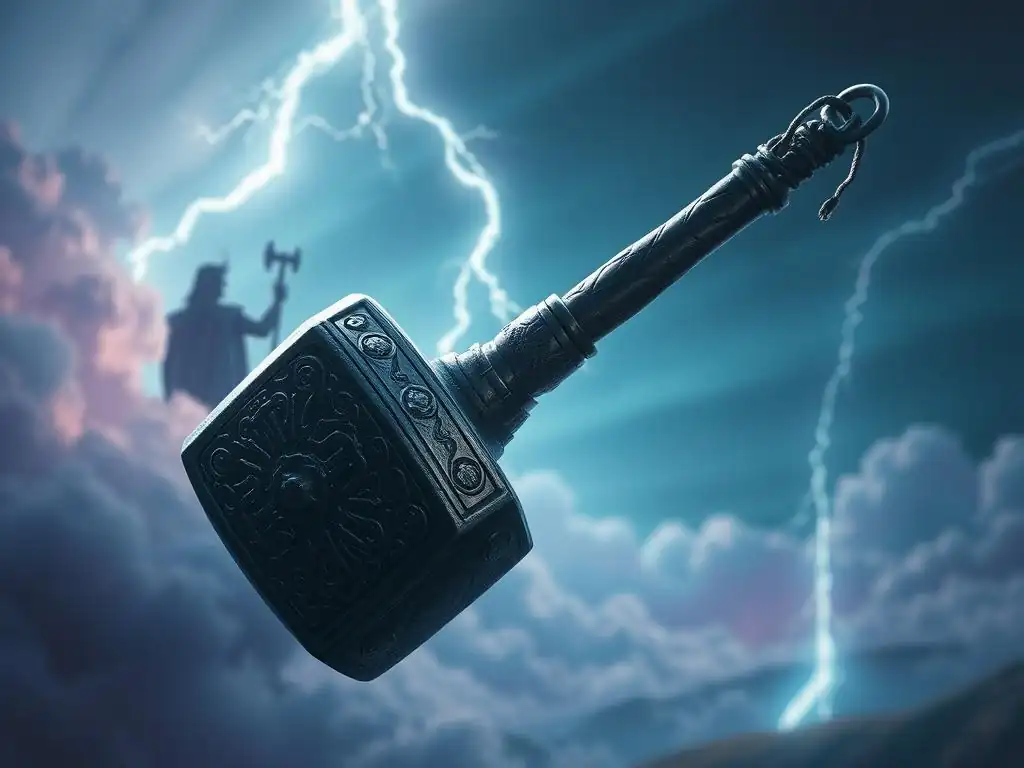
Welcome to Mythology and Legends, where ancient tales come alive. Ever wondered what secrets are hidden within the powerful symbols of the Vikings? Dive into the captivating world of Norse tradition and explore the profound Norse mythology symbol meanings behind icons like Thor's Hammer. Uncover the hidden narratives and enduring power of these ancient emblems, and begin your journey into the rich tapestry of Norse and Celtic lore...
Thor's hammer, Mjolnir, stands as one of the most recognizable and powerful symbols in Norse mythology. Far more than just a simple weapon, this mighty hammer is intricately linked to the god of thunder, Thor, and represents a multitude of concepts vital to the ancient Norse worldview. Its presence permeates the Eddas and sagas, portraying it not only as a tool for defeating giants and monsters but also as an instrument of blessing, sanctification, and protection.
The enduring legacy of Mjolnir extends beyond the historical and mythological texts. Today, it remains a potent icon, appearing frequently in popular culture, from comic books and movies to jewelry and art. Understanding Mjolnir is key to grasping many Norse mythology symbol meanings, as it embodies core values and beliefs held by the people who worshipped Thor and the other Norse gods. Its multifaceted nature makes it a fascinating subject for exploring the rich tapestry of Norse folklore.
The Hammer of Thor: An Iconic Image in Popular Culture
Mjolnir's image has transcended its mythological origins to become a globally recognized symbol, largely due to its prominent portrayal in various media. Modern interpretations, particularly in superhero narratives, have solidified its status as an emblem of immense power and heroism. This widespread exposure has introduced millions to the concept of Thor's hammer, even if their understanding is limited to its role as a formidable weapon capable of incredible feats.
While popular culture often focuses on Mjolnir's destructive capabilities and its ability to return to Thor's hand, these portrayals often capture only a fraction of its mythological significance. Nevertheless, this iconic imagery serves as a vital bridge, sparking interest in the deeper layers of Norse mythology symbol meanings associated with the hammer and encouraging further exploration into the ancient beliefs and stories.
Beyond the Battlefield: Exploring Mjolnir's Deeper Meaning
To truly appreciate Mjolnir, one must look beyond its function as a weapon of war. In the original Norse myths, the hammer held profound ritualistic and symbolic importance. It was used to hallow, to bless, and to consecrate, playing a role in ceremonies from marriages to funerals. This aspect reveals Mjolnir's connection not just to destruction, but also to creation, order, and the cyclical nature of life and death.
Exploring these lesser-known facets of Mjolnir's mythology offers a richer understanding of Norse mythology symbol meanings. It highlights the hammer's connection to fertility, the protection of the community, and the establishment of law and order. By examining these roles, we gain insight into the values that were central to the Norse people and how they perceived the forces that shaped their world.
- The Hammer of Thor: An Iconic Image in Popular Culture
- Beyond the Battlefield: Exploring Mjolnir's Deeper Meaning
- ### What is the primary significance of Thor's Hammer (Mjolnir) in Norse mythology?
- ### Beyond its role as a weapon, what other aspects of Norse culture does Mjolnir symbolize?
- ### Are there any specific beliefs or rituals associated with Mjolnir beyond its use in battle narratives?
- ### How has the symbol of Thor's Hammer evolved or been reinterpreted in contemporary society?
- ### Where can I learn more about the symbol meanings behind other elements within Norse mythology, beyond Thor's Hammer?
Mjolnir: The Creation and Powers of Thor's Hammer
The Dwarven Craftsmanship of Mjolnir: A Tale of Skill and Deception
The creation of Mjolnir is a famous tale found in the Skáldskaparmál section of Snorri Sturluson's Prose Edda. The story recounts a wager between Loki and the dwarves, specifically the sons of Ivaldi and the brothers Brokkr and Sindri. Loki, after commissioning treasures from the sons of Ivaldi (including Skidbladnir and Gungnir), bet his head that Brokkr and Sindri could not forge items as wondrous. Accepted the challenge, Brokkr and Sindri set about their task, but Loki, in the form of a fly, attempted to sabotage their work.
Despite Loki's interference, which caused the handle of Mjolnir to be shorter than intended, the brothers succeeded in creating three magnificent treasures: the golden ring Draupnir, the golden boar Gullinbursti, and the hammer Mjolnir. Presented to the gods, Mjolnir was deemed the greatest treasure, capable of striking any target, returning to the thrower's hand, and shrinking to fit inside a tunic. This origin story emphasizes the incredible skill of dwarven smiths and the unpredictable nature of Loki, while also explaining the hammer's unique, albeit slightly flawed, design.
The Power to Command Lightning and Thunder: Mjolnir's Destructive Capabilities
Mjolnir is most famously associated with Thor's control over lightning and thunder, reflecting his role as the god of storms. While the myths don't explicitly state that Mjolnir generates lightning, Thor's use of the hammer is consistently accompanied by these powerful atmospheric phenomena. When Thor swings Mjolnir, the sky often erupts with thunderous roars and flashes of lightning, terrifying his enemies, particularly the giants (Jötnar), who are often depicted as foes of the ordered world.
The hammer's primary function in combat is its immense striking power, capable of shattering mountains and crushing the skulls of giants. Thor uses it relentlessly to defend Asgard and Midgard from threats, showcasing its unparalleled destructive force. This power is not just physical; it is also symbolic of the might of the gods and their ability to protect the cosmos from chaos, reinforcing the Norse mythology symbol meanings tied to divine strength and protection.
The Blessing and Sanctification: Mjolnir's Role in Rituals
Beyond its use in battle, Mjolnir held significant power in rituals and ceremonies. The hammer was used to hallow or consecrate objects, places, and even people. This practice is mentioned in various myths, such as Thor using Mjolnir to bless the funeral pyre of Baldr, or potentially to revive his goats, Tanngrisnir and Tanngnjóstr. This indicates Mjolnir's connection to life, death, and regeneration.
Furthermore, the hammer's blessing power was invoked to sanctify significant events. It played a role in weddings, ensuring fertility and good fortune for the couple, and potentially in land consecration, marking boundaries and invoking divine protection over settled areas. This ritualistic use highlights Mjolnir's multifaceted nature, representing not just martial power but also the divine power to bring order, blessings, and prosperity to the world.
Norse Mythology Symbol Meanings: Mjolnir as a Cultural Icon
Protection and Strength: Mjolnir as a Ward Against Evil
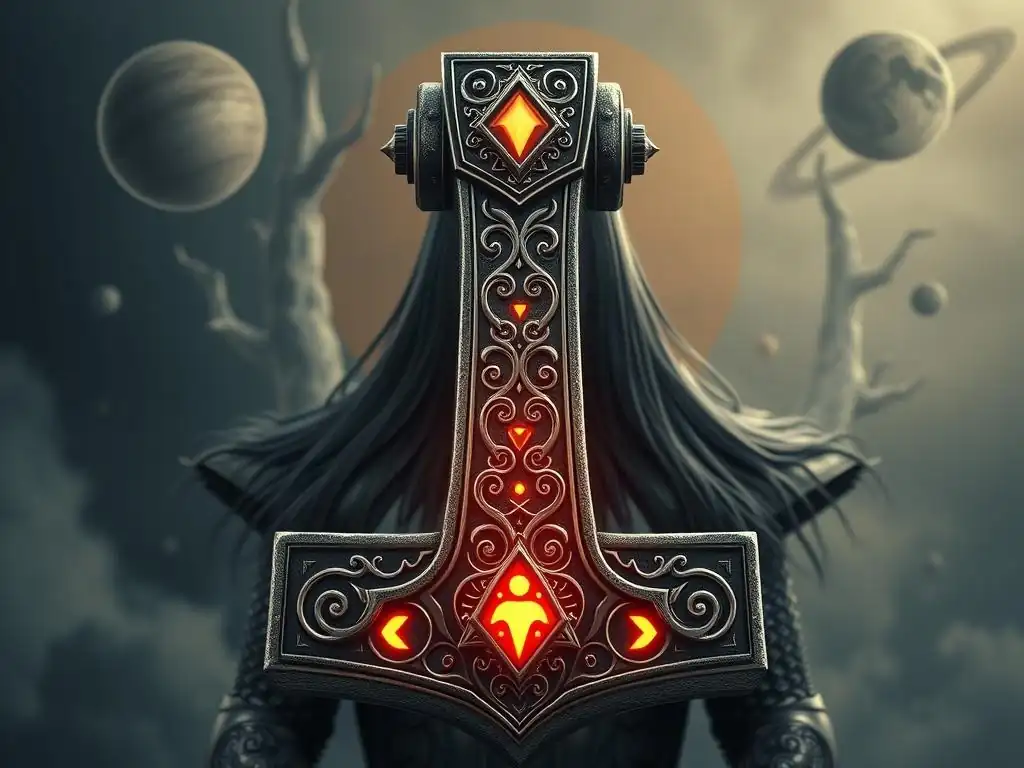
One of the most prominent Norse mythology symbol meanings associated with Mjolnir is its function as a powerful ward against evil and chaos. Thor, wielding Mjolnir, is the primary defender of Asgard, the realm of the gods, and Midgard, the realm of humans, against the forces of the Jötnar and other monstrous beings. The hammer's very presence is said to deter these malevolent forces, providing a sense of security and stability to the cosmos.
Archaeological evidence from the Viking Age supports this protective symbolism. Hundreds of Mjolnir amulets have been found in graves and settlement sites across Scandinavia, the British Isles, and Eastern Europe. These miniature hammers, made from various materials like silver, bronze, iron, and amber, were worn by both men and women, suggesting they were viewed as personal talismans offering protection, strength, and good fortune to the wearer against seen and unseen dangers.
Fertility and Prosperity: Mjolnir's Connection to the Land
While often overlooked in modern interpretations, Mjolnir also carried strong associations with fertility and prosperity, linking it to agricultural cycles and the well-being of the land. Thor, as the god of thunder and rain, played a crucial role in ensuring good harvests. Rain brought by storms was essential for crops, and Mjolnir's association with thunder and lightning connected it directly to these life-giving forces.
The hammer's use in blessing ceremonies, including marriages and potentially land consecration, further reinforces this link. By hallowing the land or a union with Mjolnir, ancient Norse people may have sought to invoke Thor's power to ensure fruitfulness and abundance. This aspect broadens the understanding of Norse mythology symbol meanings, showing Mjolnir not just as a weapon of war, but also as a tool for invoking natural forces essential for survival and prosperity.
Law and Order: Thor's Hammer as a Symbol of Justice
Thor, while known for his strength and sometimes impulsive nature, was also seen as a guardian of order and justice within the Norse worldview. Mjolnir, as his primary tool, thus became implicitly linked to the maintenance of law and the punishment of those who threatened the established order, particularly the chaotic giants. Thor's battles were often framed as upholding the boundaries between the civilized realms and the wild forces of chaos.
In some interpretations, the hammer's ability to strike true and return might symbolize the inescapable consequences of violating the natural or social order. While not explicitly detailed in the myths as a gavel of justice in a court setting, Mjolnir's role in defending the gods and humans from destructive forces aligns it with the broader concept of divine justice and the restoration of balance. This contributes another layer to the complex Norse mythology symbol meanings embodied by the hammer.
Mjolnir in Norse Rituals and Beliefs
The Hammer Rite: Using Mjolnir in Marriage Ceremonies
Historical and mythological sources suggest that Mjolnir played a role in Viking Age marriage ceremonies, sometimes referred to as a "hammer rite." While detailed accounts are scarce, it is believed that a hammer amulet or symbol representing Mjolnir was placed in the lap of the bride during the ceremony. This act was likely intended to invoke Thor's blessing upon the union, specifically seeking fertility and good fortune for the couple.
This practice underscores Mjolnir's association with creation and prosperity, contrasting with its more commonly known function as a weapon of destruction. The placement of the hammer in the bride's lap symbolically connected the marriage to the power of the thunder god, seeking his favor for the continuation of the family line and the well-being of the household. It highlights the practical application of Norse mythology symbol meanings in daily life and significant life events.
Mjolnir Amulets: Wearing the Hammer for Protection
As mentioned earlier, Mjolnir amulets were extremely popular during the Viking Age, perhaps second only to the cross in areas where Norse and Christian cultures interacted. These small pendants, crafted from various materials, were worn around the neck as personal protective charms. Their widespread discovery across Viking settlements and burial sites speaks volumes about the belief in Mjolnir's power to ward off harm and bring good luck.
The variety in size, material, and craftsmanship of these amulets indicates they were accessible to different social classes. Wearing a Mjolnir amulet was a tangible expression of faith in Thor and his protective abilities, a way for individuals to carry a piece of the god's power with them. This practice solidified Mjolnir's status as a potent and personal Norse mythology symbol meaning protection, strength, and connection to the divine.
Mjolnir's Symbolism in Viking Age Art and Jewelry
Beyond amulets, the motif of Mjolnir appeared in various forms of Viking Age art and jewelry. It was incorporated into rings, bracelets, and even larger decorative items. Depictions of Thor himself, often wielding his hammer, were found on runestones and other stone carvings, such as the Altuna Runestone in Sweden, which shows Thor fishing for the Midgard Serpent, hammer in hand.
These artistic representations served multiple purposes. They reinforced religious beliefs, acted as status symbols (especially if made from precious metals), and visually communicated important Norse mythology symbol meanings to a largely illiterate population. The presence of Mjolnir in such varied artifacts demonstrates its central place in Viking Age culture and spirituality, showcasing its enduring relevance beyond mere weapon status.
Thor and Mjolnir: The God of Thunder and His Inseparable Weapon
Thor's Character: Strength, Courage, and Protection of Mankind
Thor is arguably the most popular god in the Norse pantheon, particularly among common people and warriors. He embodies immense physical strength, unwavering courage, and a fierce dedication to protecting Asgard and Midgard from their enemies, primarily the giants. Unlike the cunning Odin or the mischievous Loki, Thor is often depicted as straightforward, powerful, and reliable, a champion of the ordered world against chaos.
His character resonates with themes of self-reliance, bravery in the face of overwhelming odds, and the defense of one's community. Thor's popularity is evidenced by the numerous place names derived from his name (like Thor's day, Thursday) and the widespread use of his hammer as a personal symbol. His role as protector makes him a central figure in understanding the defensive Norse mythology symbol meanings.
Mjolnir is not merely a tool wielded by Thor; it is presented as an extension of his divine power and authority. The hammer is essential for him to fully utilize his strength and command over storms. Without Mjolnir, Thor is significantly weakened, as demonstrated in the myth of Þrymskviða (The Lay of Thrym), where the giants steal the hammer, leaving Thor vulnerable and unable to defend the realms effectively.
The hammer's unique properties – its immense force, ability to return, and perhaps its connection to lightning – are intrinsically linked to Thor's nature as the thunder god. It amplifies his inherent abilities and serves as the primary instrument through which he exerts his will upon the cosmos, reinforcing his status as a powerful and essential deity. This symbiotic relationship is central to the Norse mythology symbol meanings of both Thor and Mjolnir.
The Interdependence of God and Weapon in Norse Mythology
The myths consistently portray Thor and Mjolnir as deeply interdependent. Thor's power is amplified and focused through the hammer, while Mjolnir's significance and power are tied entirely to being the weapon of the mighty Thor. Neither is complete or fully effective without the other. This interdependence highlights a common theme in mythology where powerful artifacts are intrinsically linked to their wielders, granting them specific abilities and responsibilities.
This relationship underscores the idea that power is not just inherent but also derived from the tools and symbols associated with an entity. Mjolnir is powerful because it is Thor's hammer, and Thor is defined, in large part, by his possession and use of Mjolnir. This dynamic interplay is a fascinating aspect of their story and contributes significantly to the rich layers of Norse mythology symbol meanings.
Mjolnir's Influence on Modern Interpretations of Norse Mythology
Mjolnir in Literature, Film, and Video Games
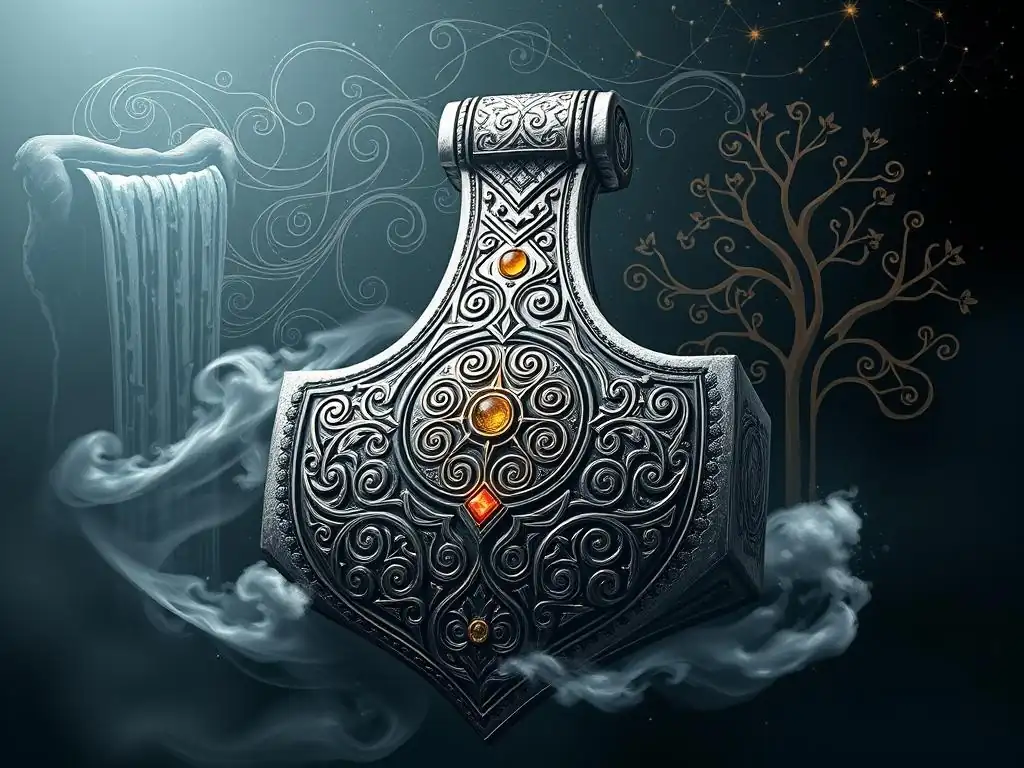
Mjolnir has experienced a significant resurgence in popular culture, largely driven by adaptations of Norse mythology in various media. Comic books, starting in the 1960s, introduced a version of Thor and Mjolnir to a global audience. More recently, major film franchises have brought these characters to the forefront of mainstream entertainment, portraying Mjolnir as an almost invincible weapon central to the hero's identity and power.
Beyond film, Mjolnir features prominently in fantasy literature, video games, and even television series, often retaining its core attributes of immense power and being tied to a worthy wielder. While these interpretations often diverge from the original myths, focusing heavily on the action and superhero aspects, they keep the image and name of Mjolnir alive, sparking interest in the deeper lore and Norse mythology symbol meanings for new generations.
The Resurgence of Norse Paganism and Mjolnir's Significance
In recent decades, there has been a noticeable resurgence of interest in Norse paganism, often referred to as Heathenry or Asatru. For adherents of these modern faiths, Mjolnir holds deep religious and cultural significance. It is not merely a mythological artifact but a sacred symbol representing their connection to the gods, their ancestors, and the values they associate with the ancient Norse.
Mjolnir amulets are commonly worn by modern Heathens as a sign of their faith and as personal talismans of protection. The hammer is also used in rituals and ceremonies, echoing its historical use in hallowing and blessing. This modern practice demonstrates the enduring power of Norse mythology symbol meanings, showing how ancient symbols can be reinterpreted and hold profound relevance in contemporary spiritual practices.
Mjolnir as a Symbol of Identity and Heritage for Modern Norse Pagans
For many modern Norse pagans and individuals interested in their Scandinavian or Germanic heritage, Mjolnir serves as a powerful symbol of identity. It represents a connection to the past, a link to the strength and resilience attributed to the Viking Age people, and an emblem of cultural pride. Wearing or displaying Mjolnir can be a public declaration of one's faith or heritage.
This use of Mjolnir as a marker of identity highlights how mythological symbols can transcend their original religious context to become cultural touchstones. It embodies qualities like strength, protection, and heritage, resonating with individuals seeking connection to their roots or alignment with the values they perceive Mjolnir to represent. The hammer thus continues to evolve as a powerful symbol within the landscape of Norse mythology symbol meanings.
Comparing Mjolnir to Other Powerful Weapons in Mythology
Examining Mjolnir alongside powerful weapons from other mythologies reveals common themes and unique characteristics among divine or legendary artifacts. These comparisons help to highlight what makes Mjolnir distinct within the broader context of world mythology.
Mjolnir vs. Excalibur
Comparing Mjolnir to Excalibur, the legendary sword of King Arthur in Arthurian legend, reveals key differences in their primary symbolism. Excalibur is fundamentally a symbol of kingship, legitimacy, and righteous authority. Its obtaining from the stone or the Lady of the Lake marks Arthur as the chosen ruler, and its loss often signifies a decline in his power or the end of an era. While a formidable weapon, its core meaning revolves around sovereignty and divine right to rule.
In contrast, Mjolnir's primary Norse mythology symbol meanings are centered on strength, protection, consecration, and the power over natural forces like thunder. While it signifies Thor's authority as a god, it is less about rulership over a kingdom and more about defending the cosmic order and bringing blessings. Excalibur is often tied to a specific, divinely appointed human leader, whereas Mjolnir is the intrinsic tool of a powerful deity defending the universe.
Mjolnir vs. Vajra
A more direct comparison can be made between Mjolnir and the Vajra, a key ritual object and weapon in Hinduism and Buddhism, often associated with the god Indra, the king of the gods and god of thunder and rain in Vedic Hinduism. Like Mjolnir, the Vajra is a powerful, indestructible weapon associated with thunder, lightning, and divine authority. Indra uses the Vajra to slay demons and maintain cosmic order, much like Thor uses Mjolnir against giants.
The parallels are striking: both are divine weapons linked to thunder gods, used for protection and order, and possess immense power. However, the Vajra also holds deep symbolic meaning in esoteric Buddhism, representing indestructibility and spiritual power, the union of opposites, and the attainment of enlightenment. While Mjolnir has ritual uses, the Vajra's symbolism extends more explicitly into profound philosophical and spiritual concepts beyond physical power, adding a layer not typically associated with the Norse hammer's primary Norse mythology symbol meanings.
Mjolnir vs. Gungnir
Comparing Mjolnir to another significant weapon within Norse mythology itself, Odin's spear Gungnir, also highlights distinct roles. Gungnir, forged by the same dwarves as Mjolnir (the sons of Ivaldi), is said to always hit its mark and never miss. It is Odin's primary weapon and a symbol of his authority, wisdom (often gained through conflict), and connection to fate and war. Odin's use of Gungnir, particularly in throwing it over armies, marks them for sacrifice to him (Valhalla).
While both are divine weapons of immense power wielded by principal gods, Gungnir is more closely tied to Odin's domain of war, death, magic, and sovereignty over the gods. Mjolnir, on the other hand, is the hammer of the protector of gods and men, more directly involved in the physical defense of the realms and associated with the raw, powerful forces of nature like thunder. Gungnir represents Odin's strategic and sometimes fearsome authority, whereas Mjolnir embodies Thor's brute strength and protective might, illustrating varied Norse mythology symbol meanings even within the same pantheon.
Conclusion: The Enduring Symbolism of Mjolnir
Thor's hammer, Mjolnir, is far more than a simple weapon in Norse mythology; it is a multifaceted symbol embodying a wide array of Norse mythology symbol meanings. From its origins forged by skilled dwarves to its use in cosmic battles against giants, Mjolnir represents immense power, protection, and the defense of the ordered world. Its association with thunder and lightning connects it to the potent forces of nature, essential for both destruction and the life-giving rain needed for fertility.
The historical and ongoing use of Mjolnir as an amulet and in rituals highlights its significance beyond warfare, linking it to blessings, sanctification, and the well-being of communities and individuals. Its enduring presence in popular culture and modern religious practices demonstrates the lasting impact of Norse mythology and the power of its symbols to resonate across centuries, adapting and finding new relevance in contemporary contexts.
Mjolnir's Continued Relevance in a Modern World
In a modern world grappling with challenges of chaos, uncertainty, and the search for identity, the symbolism of Mjolnir continues to hold relevance. As a symbol of strength and protection, it offers a sense of resilience and the ability to face adversity. Its connection to order and defense against destructive forces can resonate with individuals seeking stability and security.
For those exploring their heritage or finding spiritual paths outside mainstream religions, Mjolnir provides a tangible link to ancient beliefs and values. Its adaptability, moving from ancient rituals to modern jewelry and digital media, speaks to the universal appeal of its core meanings: power, protection, and the enduring fight against chaos. This ensures Mjolnir remains a potent symbol within the landscape of Norse mythology symbol meanings.
The Enduring Power of Myth: Mjolnir as a Symbol of Hope and Resilience
The story of Mjolnir and Thor is a testament to the enduring power of myth. Myths provide narratives that help people understand their world, their challenges, and their place within the cosmos. Mjolnir, as a central element in these stories, embodies hope – the hope that chaos can be held at bay, that the innocent can be protected, and that strength and courage can prevail.
Its symbolism of resilience is evident in its ability to always return to Thor's hand, signifying the cyclical nature of struggle and renewal, the idea that even after battle, the power to defend and rebuild remains. Mjolnir stands as a powerful reminder that symbols from ancient mythologies can continue to inspire, provide comfort, and offer profound insights into the human condition and the timeless struggle between order and chaos.
Frequently Asked Questions
### What is the primary significance of Thor's Hammer (Mjolnir) in Norse mythology?
Mjolnir, often referred to as Thor's Hammer, is primarily a symbol of protection and strength. It represents Thor's power to defend Asgard and Midgard from giants and other threats.
### Beyond its role as a weapon, what other aspects of Norse culture does Mjolnir symbolize?
Besides being a weapon, Mjolnir also symbolizes blessings, consecration, and good fortune. It was often used in rituals and ceremonies to invoke Thor's protection and bring prosperity.
### Are there any specific beliefs or rituals associated with Mjolnir beyond its use in battle narratives?
Yes, Mjolnir was used in marriage ceremonies to bless the union with fertility and strength. It also served as a symbol of safe passage and protection against harm.
### How has the symbol of Thor's Hammer evolved or been reinterpreted in contemporary society?
In modern times, Mjolnir is often seen as a symbol of Norse heritage and identity. It is also used as a symbol of strength and courage in various subcultures and artistic expressions.
### Where can I learn more about the symbol meanings behind other elements within Norse mythology, beyond Thor's Hammer?
Websites like Mythology and Legends offer comprehensive resources on Norse myths and folklore. These resources delve into the various symbols and their meanings, including those associated with gods, creatures, and objects.
Final Reflection: The Enduring Legacy of Mjolnir
The enduring power of Norse mythology resonates deeply in modern culture, and few symbols capture this resonance as powerfully as Thor's hammer, Mjolnir. Its image, instantly recognizable, transcends the realm of ancient legend, appearing everywhere from comic books to video games, demonstrating the enduring strength and relevance of Norse symbolism. This enduring appeal speaks to a fundamental human need for stories of strength, responsibility, and the struggle against overwhelming odds.
Mjolnir's influence extends far beyond mere pop culture appearances; it represents a potent symbol of worthy power, righteous strength, and the consequences of wielding such might. The hammer's weight, both literal and metaphorical, forces us to consider the responsibility that comes with great power. He who holds the hammer, if he be worthy, shall possess the power of Thor.
This simple statement encapsulates the core message of Mjolnir – power is not simply about strength, but about the moral compass guiding its use. The hammer's continued presence in our collective consciousness speaks to our ongoing fascination with these themes, a fascination that transcends time and cultural boundaries.
Consider, for a moment, the weight of your own actions, the power you wield in your daily life, however small it may seem. What responsibility do you carry? How do you ensure that your strength is used for good, for the betterment of yourself and those around you?
Mjolnir serves not only as a symbol of Norse mythology, but as a potent reminder of the ethical considerations inherent in wielding any kind of power. Let the enduring legacy of Thor's hammer inspire you to reflect on your own strength, your own responsibility, and the impact you have on the world around you.
Unleash Your Inner Norse Warrior!
Thanks for exploring the mighty legend of Thor's hammer with us! You've gained a deeper understanding of its significance beyond mere weaponry. Now it's time to put that knowledge to use.
- Craft your own symbolic representation of strength: Whether it's a drawing, a poem, or even a small piece of crafted jewelry, embody the spirit of Mjolnir in a creative way. This is your chance to connect with the power and symbolism on a personal level.
- Share your thoughts and interpretations: Join the conversation! Leave a comment below and let us know what resonated most with you about Thor's hammer and its meaning. Did it inspire you in unexpected ways?
- Explore other powerful Norse legends: Delve deeper into the rich tapestry of Norse mythology. Discover the stories of Odin, Freya, and the other fascinating figures who shaped this vibrant culture.
Ready to unleash your own inner Norse warrior? What symbol of strength will you create today?