
The Symbolism of the World Serpent: Cosmic Boundaries and Chaos

Welcome, curious seeker!
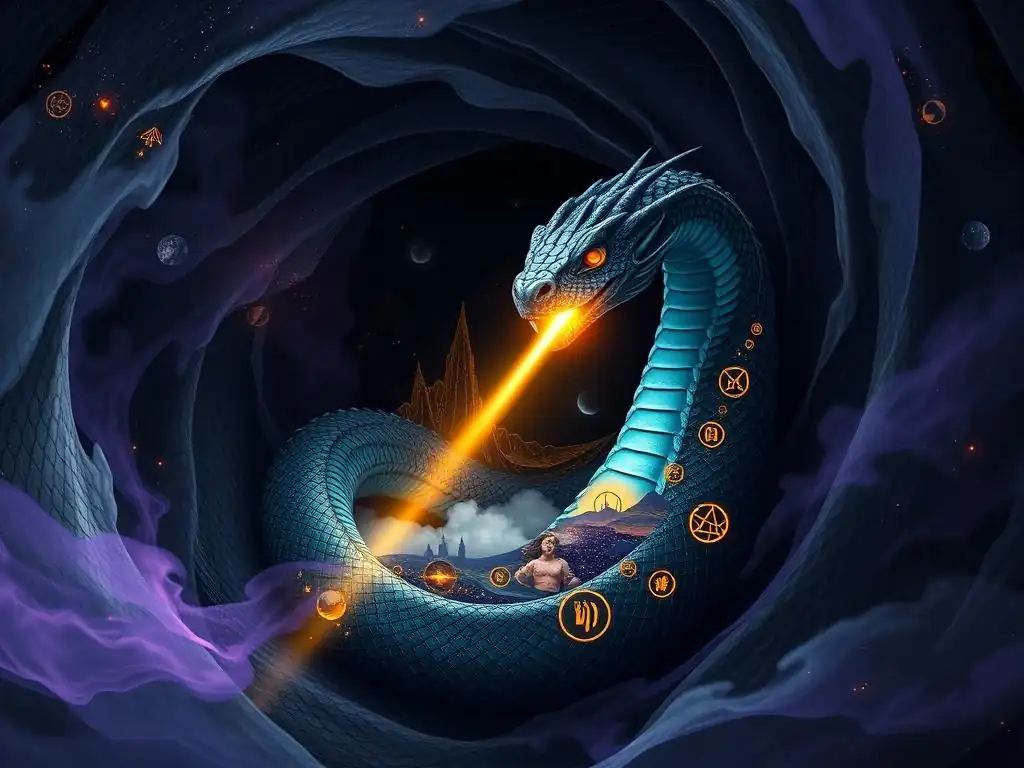
Delve into the mesmerizing realm of Mythology and Legends, where ancient tales whisper secrets of the cosmos. Are you ready to unravel the enigmatic symbolism of the World Serpent – that colossal being entwined with creation, destruction, and the very boundaries of existence? Prepare to journey through folklore and discover the profound world serpent symbolism meaning and its enduring presence in literature and media. The answers you seek lie just a scroll away...
- Introduction to World Serpent Symbolism
- The World Serpent as a Cosmic Boundary
- Chaos and Destruction Embodied: The Serpent's Destructive Power
- Cultural Variations in World Serpent Symbolism
- The Psychological Interpretation of the World Serpent
- World Serpent Symbolism in Literature and Art
- The World Serpent: A Symbol of Duality and Interconnectedness
-
Frequently Asked Questions
- What is the World Serpent, and where does it appear in mythology?
- What does the World Serpent symbolize?
- What is the Ouroboros, and how does it relate to the World Serpent?
- What is the significance of the World Serpent in Norse mythology (Jormungandr)?
- How has the symbolism of the World Serpent impacted contemporary society?
- Final Reflection: Unraveling the World Serpent's Timeless Wisdom
- Unravel the Mysteries: Dive Deeper into World Serpent Lore
Introduction to World Serpent Symbolism
Exploring the Universal Motif of the World Serpent
Across diverse cultures and epochs, the figure of a colossal serpent or dragon encircling the world appears as a powerful and persistent motif. This archetypal image, often referred to as the World Serpent, embodies profound and sometimes contradictory meanings. It frequently symbolizes the ultimate boundary of the known world, the edges of the cosmos, and the primordial forces that both sustain and threaten existence. Understanding the World serpent symbolism meaning requires examining its role in creation narratives, apocalyptic myths, and its psychological resonance within human consciousness.
The presence of this motif in mythologies geographically separated by vast distances suggests a shared human attempt to grapple with fundamental concepts: the structure of the universe, the cyclical nature of time, and the ever-present tension between order and chaos. From the icy seas of Norse sagas to the sun-drenched deserts of ancient Egypt, the World Serpent serves as a potent symbol, reflecting deep-seated anxieties and understandings about the forces that shape reality. Its enduring power lies in its ability to represent both the protective embrace of the cosmos and the terrifying potential for its dissolution.
The World Serpent in Mythology and Legend: An Overview
The concept of a World Serpent manifests in various forms across global mythologies, each with unique characteristics yet sharing core symbolic functions. In Norse mythology, Jörmungandr, the Midgard Serpent, lies in the ocean encircling the world, its tail in its mouth. Ancient Egyptian myths feature Apep (or Apophis), a colossal serpent of chaos constantly battling the sun god Ra. In Hindu and Buddhist cosmologies, the Nāga, sometimes depicted as immense serpents, hold significant roles, occasionally associated with cosmic waters or supporting the world.
Further examples include Leviathan in Abrahamic traditions, a monstrous sea creature often associated with chaos and the primordial ocean, mentioned in texts like the Book of Job (Chapter 41) and Isaiah (Chapter 27, Verse 1). Australian Aboriginal Dreamtime includes the Rainbow Serpent, a powerful creator being often associated with water and the shaping of the landscape. While their specific roles and attributes vary—some are forces of chaos, others guardians or creators—the common thread is their immense scale, their connection to the boundaries or foundations of the world, and their profound symbolic weight.
The World Serpent as a Cosmic Boundary
Defining the Limits: The Serpent's Role in World Creation Myths
In many ancient cosmologies, the World Serpent plays a crucial role in defining the physical or conceptual limits of the created universe. It acts as a primordial boundary, separating the ordered world from the formless void or chaos that existed before creation. This boundary function is essential for establishing the structure and stability of the cosmos, providing a container within which life and order can exist. The serpent's circular form often emphasizes this enclosing and defining aspect, creating a distinct inside and outside.
Consider the Babylonian creation epic, the Enuma Elish, where the primordial goddess Tiamat, a monstrous sea serpent or dragon, represents the chaotic salt waters. Her defeat and division by the god Marduk lead to the creation of the heavens and the earth from her body. While not strictly a serpent encircling the world, Tiamat embodies the chaotic, unbounded primal state that must be overcome and structured to form the cosmos, illustrating the serpent's association with the fundamental, often chaotic, elements from which the ordered world is derived and against which it is defined.
Jörmungandr: The Norse World Serpent Encircling Midgard
Perhaps the most iconic representation of a World Serpent as a cosmic boundary is Jörmungandr, also known as the Midgard Serpent, from Norse mythology. The offspring of Loki and the giantess Angrboda, Jörmungandr was cast into the great ocean encircling Midgard, the realm of humans. There, it grew so immense that it could bite its own tail, forming a complete circle around the world. This act literally delineates the boundary of the human world, separating it from the primordial, chaotic outer realms and the vast, untamed sea.
Jörmungandr's presence maintains a delicate balance; its stirring causes great tides and storms. Its encirclement symbolizes the fragile stability of Midgard, constantly threatened by the chaotic forces it contains. The Prose Edda, compiled by Snorri Sturluson around the 13th century, recounts tales of Thor's encounters with Jörmungandr, highlighting the serpent's immense size and power, and its role as both a protector (by holding the world together) and a constant potential threat to the established order. This dual nature is key to understanding World serpent symbolism meaning in the Norse context.
Ouroboros: The Eternal Cycle and Symbolic Self-Consumption
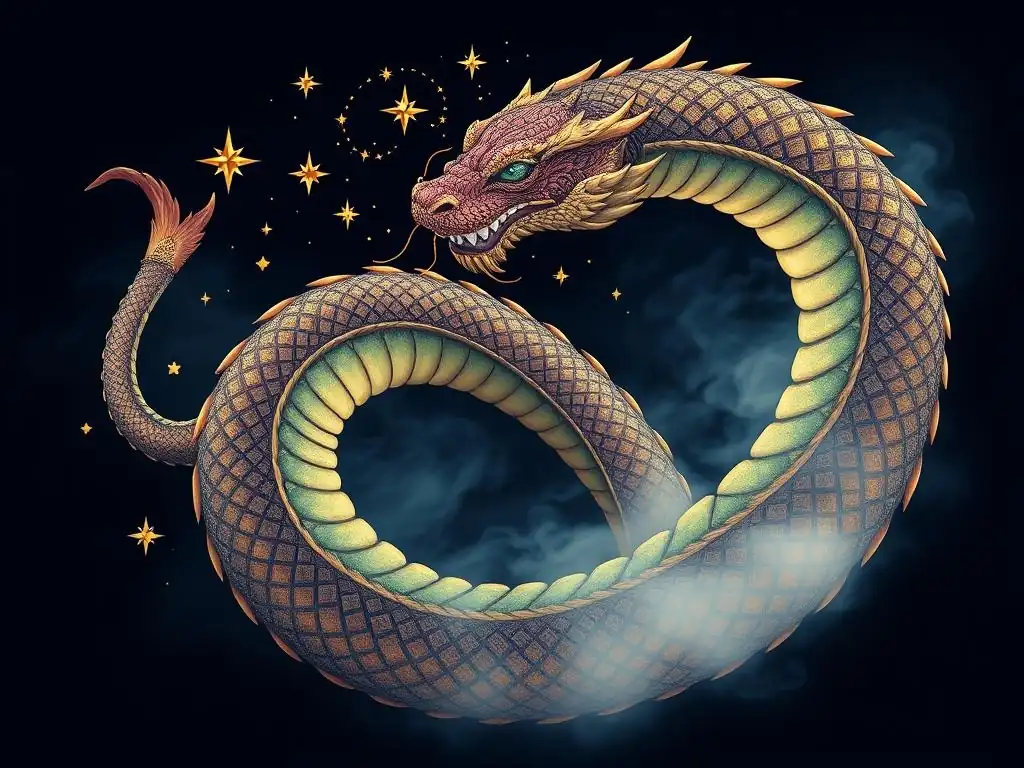
The Ouroboros, an ancient symbol depicting a serpent or dragon eating its own tail, is closely related to the World Serpent motif and powerfully represents cyclicality and eternal return. While not always explicitly a world-encircling serpent in every depiction, its closed loop signifies wholeness, infinity, and the cycle of life, death, and rebirth. The act of self-consumption suggests a closed system, a universe that is self-contained and perpetually renewing itself.
Originating in ancient Egypt, possibly as early as the 16th century BC, the Ouroboros appeared in funerary texts and later became prominent in Hermeticism and alchemy. Its image adorned sarcophagi and magical papyri, symbolizing the cyclical nature of time and the cosmos. The Greek term "Ouroboros" translates to "tail-eater." This powerful visual metaphor encapsulates the idea of the end returning to the beginning, representing cosmic unity and the perpetual regeneration of existence, a fundamental aspect of World serpent symbolism meaning related to time and continuity.
Chaos and Destruction Embodied: The Serpent's Destructive Power
Apocalyptic Visions: The World Serpent's Role in Ragnarok and Other End-Times Narratives
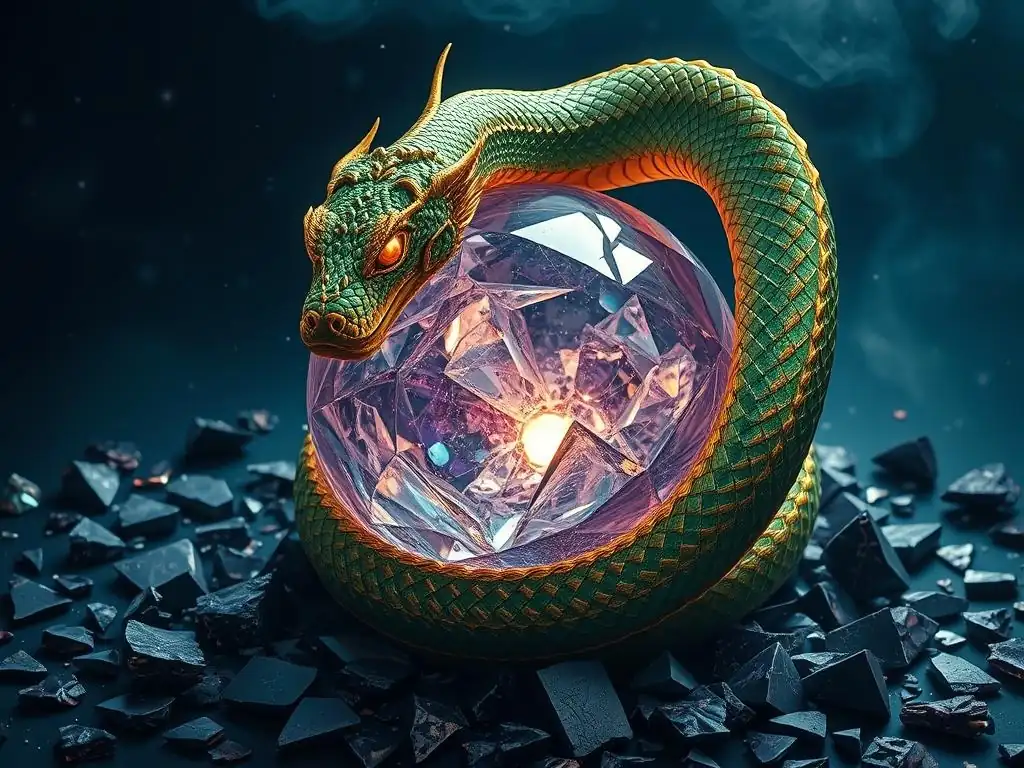
While the World Serpent often serves as a boundary, it is equally, if not more, associated with chaos and the potential for ultimate destruction. In many mythologies, the stirring or unleashing of the World Serpent signals the unraveling of the cosmic order and the advent of an apocalypse. Its immense power represents the untamed, destructive forces that lie beneath the surface of reality, capable of dissolving the boundaries it once defined.
The most famous example is Jörmungandr's role in Ragnarök, the Twilight of the Gods in Norse mythology. Prophecy dictates that during Ragnarök, Jörmungandr will release its tail from its mouth, causing immense floods and poisoning the seas and sky with its venom. It will then battle Thor, resulting in mutual destruction. This event marks a pivotal moment in the cosmic cycle, signifying the collapse of the current world order, demonstrating the World serpent symbolism meaning related to ultimate, cataclysmic change.
The Serpent as a Force of Untamed Nature and Primal Energy
The World Serpent often embodies the raw, untamed forces of nature – the unpredictable power of the ocean, earthquakes, storms, and volcanic activity. Its colossal size and primal form connect it to the fundamental energies that shaped the world but which remain beyond human control. This association positions the serpent as a symbol of the wild, chaotic aspects of the natural world that can overwhelm human civilization and order.
In myths, the serpent's movements or awakening frequently trigger natural disasters, emphasizing its connection to telluric forces and the deep, often destructive, power of the earth and sea. The sheer physical scale attributed to these beings – Jörmungandr encircling the world, Apep threatening to swallow the sun boat – underscores their representation of forces far exceeding human capacity to contain or understand, highlighting the World serpent symbolism meaning as a manifestation of nature's terrifying grandeur.
Apep: The Egyptian Serpent of Chaos and the Eternal Struggle Against Ra
In ancient Egyptian mythology, Apep (also known as Apophis) is the quintessential embodiment of cosmic chaos and destruction. Depicted as a colossal serpent, Apep resides in the Duat, the underworld, and his sole purpose is to prevent the sun god Ra's passage through the night, thereby attempting to plunge the cosmos into eternal darkness. This struggle is cyclical and eternal; every night, Ra and his retinue of protective deities battle Apep, and every morning, Ra is reborn, having temporarily vanquished the serpent.
Apep represents the antithesis of Ma'at, the Egyptian concept of cosmic order, truth, and justice. He embodies everything that threatens stability: darkness, chaos, and non-existence. The rituals performed by Egyptian priests daily and during festivals were partly aimed at assisting Ra in his nightly battle against Apep, demonstrating the profound fear and respect given to this force of chaos. This constant, cyclical conflict between Ra and Apep is central to understanding the World serpent symbolism meaning in Egyptian thought, representing the perpetual struggle to maintain order against the ever-present threat of dissolution.
Cultural Variations in World Serpent Symbolism
The Serpent in Ancient Near Eastern Mythology: Leviathan in Jewish Tradition
The motif of a monstrous, chaotic sea serpent is also prominent in Ancient Near Eastern mythologies, influencing later traditions. In Canaanite mythology, the god Baal defeats Yam, the god of the sea, often depicted as a serpent or dragon, to establish cosmic order. This primordial conflict between a storm god and a sea monster is a common theme in the region. In Jewish tradition, Leviathan is a fearsome sea creature mentioned in various biblical and post-biblical texts.
Biblical descriptions, such as those in Psalm 74:14 and the Book of Job (Chapter 41), portray Leviathan as a powerful, untamable creature associated with the sea and chaos. Isaiah 27:1 specifically calls Leviathan "the fleeing serpent" and "the twisting serpent," stating that God will slay the dragon that is in the sea.
Later Jewish tradition, particularly in rabbinic literature and folklore, describes Leviathan as one of the primordial monsters created by God, often designated for consumption by the righteous in the messianic era. While not always depicted as world-encircling, Leviathan embodies the chaotic, primal forces of the sea that must be subdued by divine power, contributing a specific layer to World serpent symbolism meaning within this cultural context.
World Serpent Representations in Asian Mythologies: Naga in Hindu and Buddhist Cosmology
In Hindu and Buddhist mythologies, the Nāga are serpentine beings, often depicted as powerful, sometimes benevolent, sometimes dangerous. They inhabit the underworld or watery realms and are associated with springs, rivers, and oceans. While individual Nāga vary in size, some are described as immense, with cosmic significance. In Hindu cosmology, the god Vishnu is often depicted reclining on Ananta Shesha, a colossal Nāga with multiple heads, who floats on the primordial waters and upon whom the universe rests.
Ananta Shesha (whose name means "Endless Remainder") represents the infinite and the cosmic ocean upon which creation unfolds. He is said to support all the planets of the universe on his hoods. When Shesha uncoils, the universe is created; when he coils back, the universe ceases to exist. This depiction of an immense, cosmic serpent supporting the world illustrates a variation of the World Serpent motif, where the serpent is less a boundary of chaos and more the foundational substance or support of the ordered cosmos, adding a dimension of cosmic support to the World serpent symbolism meaning.
Serpent Deities in Indigenous Cultures: Rainbow Serpent in Australian Aboriginal Dreamtime
Many Indigenous cultures around the world feature powerful serpent deities or spirits associated with creation, water, and the land. A prominent example is the Rainbow Serpent from Australian Aboriginal Dreamtime stories. The Rainbow Serpent is a major creator being, responsible for shaping the landscape, creating waterholes, rivers, and mountains as it moved across the land in the Dreamtime. It is often associated with rain and water, essential elements in the Australian environment.
The Rainbow Serpent can be both benevolent, bringing life-giving rain, and destructive, causing floods and storms when angered. It resides in waterholes and controls the water cycle. Its presence is often linked to the fertility of the land. The Rainbow Serpent's immense scale and its role in shaping and sustaining the world connect it to the World Serpent archetype, though its symbolism is deeply rooted in the specific ecology and spirituality of Australia, representing the interconnectedness of land, water, and life, and adding a unique layer to the global understanding of World serpent symbolism meaning.
The Psychological Interpretation of the World Serpent
Carl Jung and the Archetype of the Serpent: The Shadow Self
From a psychological perspective, particularly within the framework of Carl Jung's analytical psychology, the serpent is a potent archetype. Jung saw archetypes as universal, archaic patterns and images derived from the collective unconscious. The serpent archetype is complex and often paradoxical, representing instinct, healing, wisdom, temptation, and transformation. When applied to the World Serpent, its immense scale and boundary-setting/chaos-bringing roles can be interpreted in relation to the psyche.
The World Serpent, as an archetype, can symbolize the vast, often unconscious forces within the individual psyche. It might represent the "shadow self" – the repressed aspects of personality, including primal instincts, fears, and desires. Encircling the conscious ego, the World Serpent could signify the boundary between the conscious mind and the vast, powerful, and potentially overwhelming realm of the unconscious, highlighting the deep psychological layers of World serpent symbolism meaning.
The Serpent as a Symbol of Transformation and Renewal
Despite its association with chaos and destruction, the serpent is also a powerful symbol of transformation, healing, and renewal across many cultures. This symbolism stems from the serpent's ability to shed its skin, appearing reborn. This natural process became a metaphor for shedding the old self, undergoing a period of vulnerability, and emerging renewed.
In the context of the World Serpent, this transformative aspect can be interpreted on a cosmic or psychological level. The apocalyptic role of figures like Jörmungandr or Apep, while destructive, also clears the way for a new beginning – Ragnarök is followed by the rebirth of the world in Norse myth, and Ra's daily victory over Apep ensures the continuation of the cycle.
Psychologically, confronting the "World Serpent" of the unconscious can lead to profound personal transformation and integration of previously hidden aspects of the self, revealing a complex and dynamic World serpent symbolism meaning that encompasses both destruction and renewal.
The World Serpent as a Representation of the Unconscious and its Potential for Both Destruction and Healing
Expanding on the Jungian perspective, the World Serpent can be seen as a powerful symbol of the unconscious mind itself – vast, mysterious, and containing both immense creative and destructive potential. Just as the unconscious holds repressed fears and traumas (potential for chaos/destruction), it also holds the source of intuition, creativity, and self-knowledge (potential for healing/renewal).
The serpent's dual nature – being both a boundary and a force of chaos, a bringer of destruction and a symbol of renewal – mirrors the dual nature of the unconscious. Ignoring or repressing the unconscious can lead to its chaotic eruption (like Apep attacking Ra or Jörmungandr uncoiling). Integrating its contents, however, can lead to psychological wholeness and healing, much like the serpent symbol in medicine (the Rod of Asclepius) or the transformative process symbolized by the Ouroboros. This highlights the complex and multifaceted World serpent symbolism meaning when viewed through a psychological lens.
World Serpent Symbolism in Literature and Art
Literary Examples: The Serpent in Milton's Paradise Lost
The powerful imagery of the serpent as a force challenging divine order and boundaries finds a significant literary expression in John Milton's epic poem Paradise Lost, first published in 1667. While Satan primarily takes the form of a serpent to tempt Eve, the underlying symbolism resonates with the ancient archetype of a powerful, chaotic force attempting to breach divine boundaries and corrupt the created world. Satan, the ultimate rebel against God's established order, uses the serpent form to introduce chaos and disobedience into the perfect, bounded world of Eden.
Milton's depiction draws heavily on biblical tradition but imbues the serpent with immense rhetorical power and cunning. Satan's choice of the serpent is strategic; its association with primal forces and its liminal nature (neither fully on land nor in water) makes it an ideal vehicle for his insidious plot to disrupt the divinely ordained cosmos. The serpent's role in Paradise Lost underscores the World serpent symbolism meaning related to the introduction of chaos, the challenging of boundaries, and the fall from a state of order into one of struggle and mortality.
Artistic Depictions: Medieval Depictions of Jörmungandr on Rune Stones
Visual representations of the World Serpent are found in various artistic traditions, offering insights into how these beings were perceived and integrated into cultural narratives. In Norse art, particularly on Viking Age rune stones dating primarily from the 9th to 11th centuries, depictions of Jörmungandr are relatively common. These carvings often show the serpent intertwined with other mythological figures or scenes, notably Thor's fishing expedition where he attempts to catch the serpent.
Examples include the Altuna Runestone (Sweden, c. 1050 AD) and the Ardre Picture Stone VIII (Gotland, Sweden, 8th/9th century), which feature depictions believed to represent Thor's encounter with Jörmungandr. These artistic renderings visually capture the serpent's immense size and its presence in the world's waters, reinforcing its role as the boundary of Midgard. The detailed carvings provide tangible evidence of the importance of Jörmungandr in the Viking worldview and contribute to our understanding of the visual aspect of World serpent symbolism meaning.
The Enduring Influence of the World Serpent on Modern Art and Literature
The potent and multifaceted World Serpent motif continues to influence modern art, literature, and popular culture. Authors and artists draw upon its rich symbolism of cosmic boundaries, chaos, and transformation to explore contemporary themes. In fantasy literature, colossal serpents or dragons often serve as ancient, powerful entities connected to the fabric of the world, sometimes guardians, sometimes destroyers.
Examples can be found in various forms of media, from fantasy novels and comic books to video games and films, where serpentine creatures of immense scale embody primal power or existential threats. The Ouroboros symbol, in particular, remains popular in art and design, representing cycles, unity, and infinity. This continued presence demonstrates the deep resonance of the World Serpent archetype in the collective imagination, proving that the World serpent symbolism meaning remains relevant in exploring fundamental human concerns about the universe and our place within it.
The World Serpent: A Symbol of Duality and Interconnectedness
The Balance Between Order and Chaos: The Serpent's Dual Nature
One of the most compelling aspects of World Serpent symbolism is its inherent duality. The serpent often simultaneously represents the boundary that maintains cosmic order and the chaotic force that threatens to dissolve it. This paradoxical nature reflects a fundamental understanding in many mythologies that order and chaos are not entirely separate entities but are deeply intertwined and interdependent.
The World Serpent embodies the tension between these two forces. Its presence as a boundary creates the space for order to exist, yet its primal nature and potential for destruction represent the ever-present possibility of a return to chaos. This delicate balance is crucial for the dynamic nature of the cosmos; without the potential for chaos (represented by the serpent), order might become stagnant, while unchecked chaos would lead to non-existence. This duality is central to grasping the full World serpent symbolism meaning.
The Serpent as a Symbol of the Interconnectedness of All Things
The circular form often associated with the World Serpent, particularly the Ouroboros and Jörmungandr biting its tail, powerfully symbolizes the interconnectedness of all things in the cosmos. The closed loop suggests that the beginning is linked to the end, the inside to the outside, and that all elements of the universe are part of a single, continuous whole.
This symbolism implies that the boundaries the serpent defines are not rigid separations but are part of a unified system. The forces of order and chaos, creation and destruction, are not external enemies but intrinsic aspects of the cosmic process, linked together within the serpent's embrace. This understanding of interconnectedness adds a layer of holistic meaning to World serpent symbolism meaning, suggesting that the universe is a vast, cyclical, and interconnected entity.
Concluding Thoughts on the Enduring Significance of the World Serpent
The World Serpent, in its myriad forms across global mythologies, is far more than just a monstrous figure. It is a complex and enduring symbol that speaks to fundamental human perceptions of the cosmos, time, and the forces that govern existence. Its role as both a cosmic boundary and a force of chaos encapsulates the inherent tension between order and disorder that is a constant feature of the universe and the human psyche.
From Jörmungandr's encircling embrace to Apep's nightly assault on the sun boat, the World Serpent embodies primal power, the cyclical nature of existence, and the delicate balance upon which reality rests. Its continued appearance in modern culture testifies to its archetypal power and its ability to resonate with our deepest understandings and anxieties about the world. Exploring the World serpent symbolism meaning provides a window into the diverse ways humanity has sought to map the boundaries of the known and confront the chaos that lies beyond.
Frequently Asked Questions
What is the World Serpent, and where does it appear in mythology?
The World Serpent, also known as the Midgard Serpent or Ouroboros, is a mythological creature depicted as an enormous serpent encircling the world or existing in the cosmic ocean. It appears in various mythologies, most notably in Norse mythology as Jormungandr and in ancient Egyptian symbolism as the Ouroboros.
What does the World Serpent symbolize?
The World Serpent primarily symbolizes cosmic boundaries, eternity, and the cyclical nature of existence. Its encircling form often represents the limits of the known world and the continuous cycle of creation and destruction.
What is the Ouroboros, and how does it relate to the World Serpent?
The Ouroboros is a specific representation of the World Serpent, often depicted as a snake eating its own tail. It symbolizes self-devouring and regeneration, representing the eternal cycle of life, death, and rebirth. It's a powerful emblem of infinity.
What is the significance of the World Serpent in Norse mythology (Jormungandr)?
In Norse mythology, Jormungandr is a gigantic serpent residing in the ocean surrounding Midgard (Earth). Its existence is intrinsically linked to Ragnarok, the Norse apocalypse, where it will rise from the sea and battle Thor, ultimately leading to their mutual destruction.
How has the symbolism of the World Serpent impacted contemporary society?
The World Serpent's symbolism continues to resonate in contemporary society through art, literature, and popular culture. It often represents existential themes, the fragility of the world, and the interconnectedness of all things, prompting reflection on our place in the cosmos.
Final Reflection: Unraveling the World Serpent's Timeless Wisdom
The enduring power of the world serpent symbol resonates deeply with our modern anxieties about ecological collapse and societal upheaval. Its image, a potent blend of creation and destruction, chaos and order, continues to offer a profound mirror to our own times, reflecting our struggles to navigate a world teetering on the precipice of both immense potential and terrifying uncertainty.
The world serpent's cyclical nature, its constant swallowing and rebirth, speaks to the cyclical nature of life itself, a truth often lost in our linear, progress-obsessed society. The serpent that eats its own tail is a symbol of eternity, of the cyclical nature of time and the universe.
This ancient wisdom reminds us that endings are not necessarily the end, but rather a necessary prelude to new beginnings, a crucial lesson as we grapple with the challenges of climate change and social inequality. The serpent's dual nature, both terrifying and awe-inspiring, forces us to confront the uncomfortable truths about our own capacity for both destruction and creation.
Consider the serpent's coiled form, a potent symbol of hidden potential and untapped energy. What dormant powers lie within you, waiting to be unleashed? What cycles of destruction and renewal are you currently navigating in your own life? Embrace the wisdom of the world serpent; allow its symbolism to guide you towards a deeper understanding of the interconnectedness of all things, and the cyclical nature of growth and decay. Let its image inspire you to act with both courage and compassion, to confront the challenges of our time with the understanding that even from chaos, new life can emerge.
Unravel the Mysteries: Dive Deeper into World Serpent Lore
Thanks for exploring the fascinating symbolism of the World Serpent with us! We hope you gained a new appreciation for its complex role in mythology and its enduring impact on our understanding of cosmic order and chaos. Ready to take your understanding further?
- Delve into related mythologies: Research the specific cultural interpretations of the World Serpent – how does its symbolism vary across different traditions? What unique stories resonate most with you?
- Share your insights: Discuss your favorite interpretations or surprising connections you discovered in the comments below. Let's build a community of World Serpent enthusiasts!
- Create your own symbolic representation: Design a piece of art, write a short story, or even craft a poem inspired by the World Serpent's power and mystery.
What unique perspectives on the World Serpent's symbolism have you uncovered, and how might these influence your own creative expression?