
The Soul's Journey: Afterlife Voyages in Ancient Beliefs

Welcome to Mythology and Legends, where we unravel the threads of ancient narratives that continue to shape our world. What awaits us beyond the veil? Prepare to embark on a fascinating exploration of ancient afterlife beliefs journeys, a realm brimming with perilous trials and profound transformations. Dare to delve deeper and uncover the secrets of the soul's passage.
- Exploring Ancient Afterlife Beliefs and Journeys
- Egyptian Afterlife: The Journey Through the Duat
- Greek Underworld: Hades and the River Styx
- Norse Afterlife: Valhalla and Helheim
- Mesoamerican Afterlife Beliefs: Xibalba and Mictlan
- Comparative Analysis of Ancient Afterlife Journeys
- The Enduring Influence of Ancient Afterlife Beliefs
- Conclusion: The Timeless Appeal of Afterlife Voyages
-
Frequently Asked Questions
- What are some common themes found in ancient afterlife beliefs regarding the soul's journey?
- How did different cultures depict the landscape of the afterlife in their beliefs about the soul's journey?
- What role did gods and goddesses play in guiding or judging souls during their afterlife voyages in ancient belief systems?
- How did ancient rituals and funerary practices prepare the deceased for their journey to the afterlife?
- In what ways do ancient afterlife beliefs about the soul's journey continue to influence contemporary society and culture?
- Final Reflection: Echoes of the Afterlife in Our Modern World
- Unveil Your Ancient Wisdom: Explore the Afterlife's Mysteries
Exploring Ancient Afterlife Beliefs and Journeys
Introduction to Ancient Cultures and their Views on the Afterlife
Across the vast tapestry of human history, one of the most enduring and universal questions has been: what happens after death? Ancient cultures developed complex and often elaborate systems of belief to answer this profound query. These systems weren't merely abstract philosophical concepts; they were deeply integrated into daily life, influencing everything from funerary practices and religious rituals to moral codes and societal structures.
For many ancient peoples, death was not an end but a transition, a passage into another realm, often requiring a perilous and significant journey. These ancient afterlife beliefs journeys provided a framework for understanding mortality and offered a sense of continuity beyond the physical world.
These ancient beliefs about the afterlife journey reflect humanity's innate desire to comprehend the unknown and find meaning in the cycle of life and death. Civilizations as diverse as the Egyptians, Greeks, Norse, and various Mesoamerican cultures each crafted unique narratives about the soul's fate after the body perished.
While the specifics varied wildly – from sun boats navigating cosmic waters to rivers requiring ferrymen, or trials through treacherous underworlds – the common thread was the concept of a soul or spirit embarking on a significant voyage. Understanding these ancient afterlife beliefs journeys offers invaluable insight into the values, fears, and hopes of the people who conceived them, revealing their perspectives on justice, destiny, and the eternal.
The Significance of Afterlife Journeys in Mythology and Legends
The concept of the soul's journey to the afterlife is a cornerstone of countless myths, legends, and religious texts from antiquity. These narratives served multiple crucial functions within their societies. Firstly, they provided comfort and structure in the face of the inevitable reality of death, offering a predictable (though challenging) path for the deceased.
Secondly, they often reinforced moral and ethical standards; the nature of one's life frequently determined the ease or difficulty of the journey and the ultimate destination in the afterlife. A life well-lived might lead to a pleasant eternal realm, while wickedness could condemn the soul to trials or unpleasant fates.
Moreover, these accounts of ancient afterlife beliefs journeys were fundamental to identity and worldview. They shaped funerary rites, dictating how the living should prepare the dead for their passage and how they should honor their ancestors.
Myths detailing heroic descents into the underworld, such as that of Orpheus or Inanna, also explored themes of love, loss, and the boundaries between life and death, further cementing the cultural significance of these otherworldly voyages. These epic narratives not only entertained but also educated, serving as vital cultural touchstones that transmitted core beliefs and values across generations, illustrating the profound impact of ancient beliefs about the afterlife journey on human culture.
Egyptian Afterlife: The Journey Through the Duat
The ancient Egyptians developed one of the most detailed and enduring conceptions of the afterlife journey, meticulously documented in texts known collectively today as the Book of the Dead. More accurately translated as the Book of Coming Forth by Day, this collection of spells, hymns, and instructions was not a single book but a compilation of papyri, tomb paintings, and coffin inscriptions created over roughly a thousand years, from around 1550 BCE to 50 BCE.
Its primary purpose was to serve as a guide and protective manual for the deceased soul, known as the ba, as it navigated the perilous journey through the Duat, the Egyptian underworld. The spells provided passwords to overcome guardians, knowledge of deities, and declarations of innocence needed for the final judgment.
Specific chapters within the Book of the Dead detail the challenges and transformations the soul must undergo. For example, Spell 17 is a complex cosmogonic text explaining the nature of the gods and the universe relevant to the afterlife. Spell 30B, often inscribed on scarab amulets placed over the heart, is a plea for the heart not to testify against the deceased during the judgment.
The sheer volume and variety of spells (over 200 known) indicate the Egyptians' belief in preparing the deceased with comprehensive knowledge and magical protection for their ancient afterlife beliefs journeys. Coffins and tombs were often decorated with maps of the Duat and illustrations of the journey, visually reinforcing the path the soul was expected to take.
Anubis and the Weighing of the Heart Ceremony: Judgment in the Afterlife
Central to the Egyptian journey through the Duat was the pivotal moment of judgment: the Weighing of the Heart ceremony. This event took place in the Hall of Two Truths, presided over by the great god Osiris, lord of the underworld and resurrection. The jackal-headed god Anubis, the god of mummification and the afterlife, guided the deceased soul and placed their heart on one pan of a scale.
On the other pan rested the feather of Ma'at, the goddess of truth, justice, and cosmic order. The heart, believed to be the seat of the soul and one's conscience, had to balance perfectly with the feather.
Thoth, the ibis-headed god of writing and knowledge, stood ready to record the outcome. If the heart was heavy with wrongdoing, failing the test, it would be devoured by the monstrous goddess Ammit, a creature with the head of a crocodile, the body of a lion, and the hindquarters of a hippopotamus. This second death meant eternal oblivion, the ultimate punishment.
However, if the heart balanced with the feather of Ma'at, the deceased was declared "true of voice" or "justified" and welcomed into the Field of Reeds, the Egyptian paradise, a perfect, eternal version of earthly life. This ceremony underscored the moral dimension of the Egyptian ancient afterlife beliefs journeys, emphasizing that one's actions in life directly determined their fate after death.
Challenges and Trials Faced by the Soul in the Duat
The journey through the Duat was fraught with peril, not a simple stroll to paradise. The Book of the Dead vividly describes the challenges and trials the soul must overcome. The underworld was conceptualized as a dark, winding path, often traversed by the sun god Ra's boat during its nightly journey. The deceased soul might join this cosmic voyage or navigate independently. Along the way, the soul encountered various obstacles:
- Terrifying demons and monsters seeking to impede or devour the soul.
- Fiery gates guarded by fearsome entities requiring specific passwords or spells to pass.
- Lakes of fire or other hazardous landscapes.
- Mysterious figures or deities who might help or hinder the passage.
The spells in the Book of the Dead were designed to arm the deceased with the knowledge and magical power to overcome these specific trials. For instance, spells existed to protect the soul from being eaten by various creatures, to allow passage through guarded portals, or to enable transformation into different forms (like a bird) to escape danger. Successfully navigating these challenges and passing the Weighing of the Heart were essential steps in the complex ancient afterlife beliefs journeys envisioned by the Egyptians, culminating in eternal life in the Field of Reeds alongside the gods.
Greek Underworld: Hades and the River Styx
Charon the Ferryman: Crossing the River of Souls
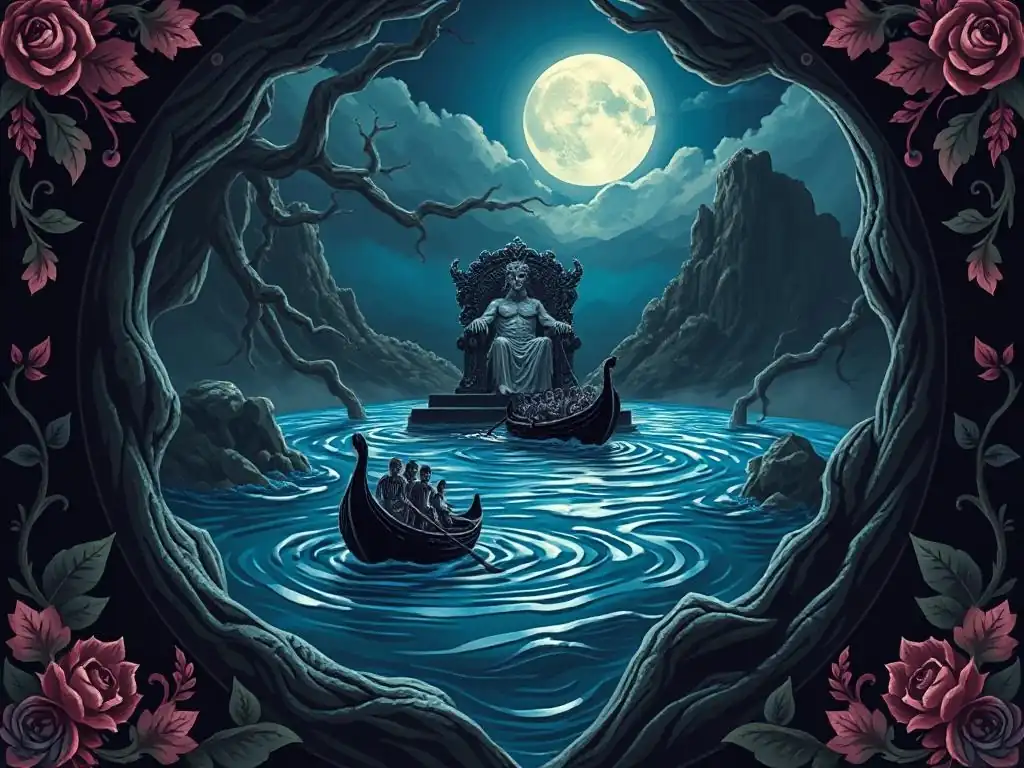
In ancient Greek mythology, the realm of the dead was known as Hades, named after its ruler, the god Hades. The entrance to this gloomy underworld was often depicted as being guarded by various features, including significant rivers that souls had to cross. The most famous of these was the River Styx, a boundary separating the world of the living from the realm of the dead.
To traverse the Styx, souls required the assistance of Charon, the ferryman. Charon was typically portrayed as a grim, elderly figure who transported the souls of the deceased across the river in his skiff.
Payment was required for Charon's service. The Greeks traditionally placed a coin, usually an obol or danake, in the mouth of the deceased before burial. This practice, known as Charon's Obol, ensured the soul had the fare needed for the passage.
Souls without the coin, or those who had not received proper burial rites, were condemned to wander the shores of the Styx for eternity, unable to cross. This highlights the importance of funerary customs in facilitating the ancient afterlife beliefs journeys in Greek culture. The journey across the Styx was often depicted as a somber, one-way trip into the depths of the underworld.
Cerberus: Guardian of the Gates of Hades
Upon successfully crossing the River Styx with Charon, the soul would arrive at the gates of the underworld. These gates were famously guarded by Cerberus, the monstrous hound of Hades. Cerberus was typically depicted as a fearsome dog with multiple heads, often three, though some accounts give him fifty or even a hundred. His appearance was terrifying, sometimes including a serpent's tail, a mane of snakes, and lion's claws. His primary function was to prevent the dead from leaving the underworld and to prevent the living from entering.
Heroes like Heracles (as part of his twelve labors), Orpheus, Aeneas, and Psyche managed to bypass or overcome Cerberus through various means – strength, music, or trickery – demonstrating the extraordinary nature of journeys into the underworld by the living. For the souls of the deceased, however, Cerberus was an impassable barrier, ensuring their permanent residence in Hades. The presence of such a formidable guardian underscores the finality of the Greek ancient afterlife beliefs journeys once the soul reached the underworld proper.
The Fields of Asphodel, Elysium, and Tartarus: Destinations for the Soul
The Greek underworld of Hades was not a single undifferentiated realm; it contained different regions where souls resided based on their lives and status. The most common destination for the average soul was the Fields of Asphodel. This was a dreary, grey, and joyless place where souls wandered aimlessly, retaining only faint memories of their former lives. It was not a place of punishment or reward, simply an eternal existence devoid of strong emotions or purpose.
For exceptional individuals, particularly heroes and those favored by the gods, there was Elysium (also known as the Elysian Fields). This was a paradise of eternal spring, light, and happiness, where souls enjoyed a blissful existence. Access to Elysium was often granted to those who had lived virtuous lives or performed great deeds.
In contrast, Tartarus was the deepest, darkest abyss of the underworld, reserved for the most wicked and those who had committed crimes against the gods. Figures like Sisyphus, Tantalus, and the Titans were eternally punished in Tartarus. These distinct regions illustrate that even within the general Greek concept of Hades, there were variations in the ancient afterlife beliefs journeys and final destinations, reflecting a nuanced view of post-mortem existence based on earthly conduct.
Norse Afterlife: Valhalla and Helheim
Valhalla: The Hall of the Slain Warriors
In Norse mythology, the fate of the soul after death depended significantly on the manner of one's passing. For warriors who died bravely in battle, the most coveted destination was Valhalla. Located in Asgard, the realm of the gods, Valhalla was the magnificent hall ruled by the god Odin. The Valkyries, female figures who served Odin, would select the most valorous fallen warriors from the battlefield and escort them to Valhalla. The name "Valhalla" itself means "hall of the slain."
Life in Valhalla was an idealized version of a warrior's existence. The Einherjar, as the residents were called, spent their days feasting on the meat of the magical beast Sæhrímnir (which regenerated every night) and drinking mead supplied by the goat Heiðrún. Their nights were spent fighting glorious battles, only to be resurrected each morning, fully healed, to feast again.
This eternal cycle of feasting and fighting was preparation for Ragnarök, the final battle at the end of the world, where the Einherjar would fight alongside Odin against the forces of chaos. Valhalla represents a specific trajectory within Norse ancient afterlife beliefs journeys, one reserved for a select, heroic few.
Helheim: The Realm of the Dead Ruled by Hel
While Valhalla awaited the battle-slain, the vast majority of souls in Norse belief went to Helheim, the realm of the dead ruled by the goddess Hel, daughter of Loki. Helheim was located in the cold, dark realm of Niflheim, deep beneath the roots of the world tree Yggdrasil. It was often depicted as a gloomy and undesirable place, though not necessarily a place of punishment (unlike the Greek Tartarus). It was simply the destination for those who died of illness, old age, or other non-heroic causes.
The journey to Helheim was arduous. It often involved traveling downwards and potentially crossing the river Gjöll, sometimes over the bridge Gjallarbrú guarded by the giantess Móðguðr. The entrance to Helheim was guarded by Garmr, a fierce hound. Life in Helheim was generally portrayed as bleak and uneventful, merely an eternal existence in a cold, dim land. Unlike the vibrant feasts and battles of Valhalla, Helheim offered no such rewards or activities. This stark contrast highlights the Norse emphasis on valor in battle as a determinant of one's afterlife fate, a key element in their ancient afterlife beliefs journeys.
The Journey to the Norse Underworld: Trials and Tribulations
Descriptions of the specific journey to the Norse underworld, whether Valhalla or Helheim, are less standardized than, for example, the Egyptian Duat, varying somewhat across sagas and eddas. However, certain elements are consistent, particularly for the journey to Helheim. It was a long and difficult path, often described as traveling north and downwards, sometimes taking many days. The path was known as Helveg, the "road to Hel."
One notable account is found in the Gylfaginning section of Snorri Sturluson's Prose Edda, which describes Hermóðr's ride to Helheim on Odin's eight-legged horse Sleipnir to retrieve Baldr. This journey took nine nights through deep, dark valleys where Hermóðr could see nothing. He had to cross the roaring river Gjöll and pass the gate of Helheim, which required jumping over. While this is a specific myth about a living being entering Helheim, it illustrates the perceived difficulty and length of the journey to the Norse realm of the dead, a significant undertaking within their ancient afterlife beliefs journeys.
Mesoamerican Afterlife Beliefs: Xibalba and Mictlan
Xibalba: The Mayan Underworld and its Lords
For the ancient Maya civilization, the underworld was known as Xibalba, meaning "Place of Fear." It was a dark, dangerous realm ruled by a council of powerful and malevolent deities, the Lords of Xibalba. The most prominent among them were One Death and Seven Death. Xibalba was not simply a destination for all the dead; it was primarily associated with disease, death, and suffering. Entry points were believed to be caves, cenotes (natural sinkholes), and other dark openings in the earth.
The most detailed account of Xibalba and a journey through it comes from the Popol Vuh, the sacred book of the K'iche' Maya. It describes the journey of the Hero Twins, Hunahpu and Xbalanque, who descend into Xibalba to avenge their father and uncle, the previous generation of Hero Twins, who were tricked and killed by the Lords.
The twins face numerous trials and trickery orchestrated by the Lords, including passing through houses of trials (like the House of Gloom, the House of Knives, the House of Cold, the House of Jaguars, the House of Fire, and the House of Bats). This narrative vividly illustrates the perilous nature of the Mayan ancient afterlife beliefs journeys, portraying the underworld as a place to be outsmarted and overcome rather than simply navigated.
Mictlan: The Aztec Land of the Dead
The Aztec civilization, another major power in Mesoamerica, had its own intricate belief system regarding the afterlife, centered around Mictlan, the lowest level of the underworld. Mictlan was the destination for most souls, regardless of their social status or moral conduct in life. Exceptions included warriors who died in battle or women who died in childbirth (who went to one of the heavens), and those who died by drowning or lightning (who went to Tlalocan, a watery paradise). Mictlan was ruled by the god Mictlantecuhtli and his consort Mictecacíhuatl, the lord and lady of the dead.
The journey to Mictlan was believed to be a long and arduous one, taking four years to complete. It involved traversing nine distinct levels, each presenting unique and increasingly difficult challenges. These levels were not places of punishment for past sins but obstacles inherent to the path itself. The Aztec ancient afterlife beliefs journeys to Mictlan were tests of endurance and perseverance, requiring the soul to overcome natural and supernatural barriers.
The Journey Through Mictlan: Overcoming the Trials
The Aztec journey through the nine levels of Mictlan was a demanding passage. According to Aztec beliefs, the soul first had to cross the vast river Apanohuayan, often with the help of a small dog ( xoloitzcuintli) cremated with the deceased. Subsequent levels presented challenges such as:
- Passing between mountains that crash together ( Tepētl Monamicyan).
- Crossing a path guarded by a giant snake ( Itzcuintlan).
- Traversing a place of sharp obsidian knives ( Itztepec).
- Enduring a region of freezing winds ( Cehueloyan).
- Crossing eight deserts and eight hills.
The journey culminated in reaching the ninth level, Chicunamictlan, where the soul would finally dissolve or find rest. To assist the deceased on this difficult path, the living performed elaborate funeral rites and provided offerings, including food, water, tools, and the crucial dog companion. These practices were essential for enabling the soul to successfully navigate the complex Aztec ancient afterlife beliefs journeys and reach its final destination in Mictlan.
Comparative Analysis of Ancient Afterlife Journeys
Similarities and Differences in Cultural Beliefs about the Soul's Fate
Examining the ancient afterlife beliefs journeys across different cultures reveals fascinating similarities and significant differences. A common thread is the concept of a separate realm for the dead, distinct from the world of the living, often located underground or across a body of water.
Many cultures also incorporated a form of judgment or evaluation of the soul, although the criteria varied wildly – from Egyptian moral weighing to Norse emphasis on the manner of death, or Greek separation into different realms based on life deeds. The idea of obstacles or trials on the path to the final destination is also prevalent, requiring the soul to possess specific knowledge, tools, or assistance.
However, the differences are equally striking. The purpose of the journey varies: in Egypt, it was about achieving eternal life in a perfected world; in Greece, often about reaching a somber, passive existence (unless heroic); in Norse belief, about joining specific groups based on death; and in Mesoamerica, about overcoming trials to reach a final resting place or facing trickery. The role of guides also differs, from Egyptian spells to Greek ferrymen and Aztec spirit companions.
Furthermore, the nature of the afterlife realm itself ranges from vibrant paradises (Egyptian Field of Reeds, Greek Elysium, Norse Valhalla) to bleak, shadowy places (Greek Asphodel, Norse Helheim, Aztec Mictlan) and terrifying, trial-filled underworlds (Egyptian Duat, Mayan Xibalba, Aztec Mictlan levels). These variations highlight how ancient afterlife beliefs journeys were deeply intertwined with each culture's unique values, social structures, and cosmological views.
The Role of Rituals and Offerings in Assisting the Deceased's Journey
Across nearly all ancient cultures with detailed afterlife beliefs, the living played a crucial role in assisting the deceased's journey through funerary rituals and offerings. These practices were not merely acts of mourning but were believed to be essential for the soul's successful passage. In Egypt, mummification preserved the body, the ka, and the ba, while tomb goods and inscriptions (like the Book of the Dead) provided the necessary magical protection and knowledge for the Duat. Offerings of food, drink, and goods were left to sustain the ka in the tomb and potentially assist the ba on its journey.
In Greece, placing a coin for Charon was paramount, along with proper burial rites; souls denied burial were condemned to wander. Offerings at the tomb continued for some time, although the Greek afterlife offered less sustenance than the Egyptian. The Aztecs cremated the dead with necessities for the four-year journey through Mictlan, including clothing, food, water, and the vital xoloitzcuintli dog. These examples underscore a universal belief: the fate of the soul in the ancient afterlife beliefs journeys was not solely determined by the deceased, but also depended significantly on the actions and diligence of the living.
Key Features of Ancient Afterlife Journeys
Synthesizing the various ancient afterlife beliefs journeys, several key features consistently emerge:
- Passage/Transition: Death is viewed as a transition to another state or realm.
- Distinct Realm: There is a clear separation between the world of the living and the realm(s) of the dead.
- Journey: The soul undertakes a physical or spiritual voyage to reach its destination.
- Obstacles/Trials: The journey is rarely straightforward and involves overcoming challenges, monsters, or environmental hazards.
- Guides/Helpers: The soul may require assistance from deities, spirits, texts, or objects provided by the living.
- Judgment/Evaluation: The outcome of the journey or the final destination is often influenced by the individual's life or manner of death.
- Multiple Destinations: The afterlife realm is often stratified, with different regions for different types of souls.
- Role of the Living: Funerary rituals, offerings, and proper burial are crucial for the soul's success.
These shared features suggest a common human psychological need to structure the unknown of death and provide a narrative framework for the soul's fate. While the specific details of these ancient afterlife beliefs journeys are culturally unique, the underlying concepts resonate across continents and time periods.
The Enduring Influence of Ancient Afterlife Beliefs
How Ancient Myths Shaped Modern Concepts of Death and the Afterlife
The ancient afterlife beliefs journeys, though rooted in distant pasts, have exerted a profound and lasting influence on subsequent religious, philosophical, and cultural concepts of death and the afterlife. The idea of a soul embarking on a journey, facing judgment, and reaching a final destination based on earthly deeds is a cornerstone of many later belief systems, including major world religions.
The Egyptian concept of judgment and a paradise realm bears striking similarities to later Abrahamic ideas of judgment day, heaven, and hell. The Greek underworld, with its distinct areas for heroes, average souls, and the damned, provided a template for stratified afterlives.
Even in secular thought and popular culture, echoes of these ancient narratives persist. The imagery of crossing a river to the underworld (like the Styx) appears in literature and art. The concept of trials after death resonates in various spiritual traditions. The very idea of a "soul" or "spirit" surviving the body is a direct descendant of the ancient beliefs that necessitated these complex journeys. These ancient afterlife beliefs journeys laid foundational ideas that continue to shape how humanity contemplates mortality and eternity.
The Psychological and Spiritual Significance of Believing in an Afterlife
Belief in an afterlife, particularly one involving a journey or transition, holds deep psychological and spiritual significance for individuals and societies. Psychologically, it offers a framework for coping with grief and loss, providing comfort in the idea that loved ones continue to exist in some form. It can also mitigate the fear of death itself, transforming it from an absolute end into a passage or transformation. The concept of judgment inherent in many ancient afterlife beliefs journeys also serves a social function, encouraging ethical behavior in life with the promise of post-mortem consequences or rewards.
Spiritually, these beliefs provide a sense of purpose and continuity. They suggest that life has meaning beyond its finite duration on Earth and that the individual consciousness persists. The details of the ancient beliefs about the afterlife journey often reflect a culture's highest values – valor in battle for the Norse, cosmic order for the Egyptians, perseverance for the Aztecs. Thus, the belief system not only addressed the mystery of death but also reinforced the core tenets by which the living were expected to abide.
Afterlife Beliefs in Contemporary Culture
While specific ancient afterlife beliefs journeys are no longer widely practiced in their original forms, their influence can still be seen in contemporary culture. References to Charon and the Styx appear in literature, film, and art. The imagery of Egyptian mummies and the Book of the Dead are instantly recognizable cultural touchstones. Mesoamerican underworld myths inspire modern storytelling. Beyond direct references, the underlying themes – the soul's persistence, judgment after death, the idea of a journey – remain central to many modern religious and spiritual beliefs.
Furthermore, interest in ancient afterlife beliefs journeys persists in academic study, comparative mythology, and popular exploration of historical cultures. Websites like Mythology and Legends play a role in keeping these fascinating narratives alive, allowing contemporary audiences to explore the diverse ways humanity has envisioned the ultimate voyage. This continued fascination speaks to the timeless nature of the questions these ancient beliefs sought to answer and the enduring power of the stories they created to describe the soul's fate.
Conclusion: The Timeless Appeal of Afterlife Voyages
Reflecting on the Universal Human Fascination with Death and the Unknown
The rich diversity and intricate detail found within ancient afterlife beliefs journeys underscore a universal human fascination with death and the unknown. Faced with the undeniable reality of mortality, people across time and cultures have sought to create narratives that provide understanding, comfort, and meaning.
The concept of the soul embarking on a journey is a powerful metaphor for transition and change, offering a sense of agency even in the face of the ultimate loss of control that death represents. Whether navigating fiery rivers, crossing cosmic oceans, or enduring trials in dark caverns, these journeys reflect humanity's courage to imagine what lies beyond.
This inherent curiosity about the post-mortem state has driven religious practices, artistic expression, and philosophical inquiry for millennia. The elaborate preparations, the myths of heroic descents, and the detailed descriptions of otherworldly realms all speak to a deep-seated need to pierce the veil of death and understand the fate of the spirit. The study of these ancient afterlife beliefs journeys is not just an academic exercise; it is an exploration of the fundamental human condition and our persistent quest to comprehend the final mystery.
The Continued Relevance of Ancient Afterlife Beliefs in Understanding Human Culture
The ancient afterlife beliefs journeys remain highly relevant today, not just as historical artifacts but as vital keys to understanding human culture, psychology, and the development of religious thought. They reveal the core values and anxieties of the societies that created them – their views on justice, heroism, community, and the relationship between the living and the dead. By comparing these different cultural approaches to death and the afterlife, we gain insight into the diverse ways humanity has grappled with universal questions.
Moreover, these ancient narratives continue to inspire and inform contemporary ideas about spirituality, consciousness, and the nature of reality. They remind us that while the specific maps of the afterlife may change, the impulse to chart the soul's journey is a fundamental part of the human experience. Exploring these ancient beliefs about the afterlife journey allows us to connect with the hopes, fears, and imaginative power of our ancestors, enriching our understanding of both the past and ourselves.
Frequently Asked Questions
What are some common themes found in ancient afterlife beliefs regarding the soul's journey?
Ancient afterlife beliefs often feature a dangerous journey through a realm of trials and tribulations. The soul may need to appease deities or overcome obstacles to reach its final destination.
How did different cultures depict the landscape of the afterlife in their beliefs about the soul's journey?
Cultures varied greatly, some envisioning underworlds of darkness and suffering, while others described paradise-like realms filled with abundance and joy. Geography and cultural values heavily influenced these depictions.
What role did gods and goddesses play in guiding or judging souls during their afterlife voyages in ancient belief systems?
Deities often acted as guides, protectors, or judges during the soul's journey. They could offer assistance, pose challenges, or determine the soul's ultimate fate based on its earthly actions.
How did ancient rituals and funerary practices prepare the deceased for their journey to the afterlife?
Rituals aimed to ensure a safe passage for the soul. This included providing provisions for the journey, performing specific ceremonies, and offering sacrifices to appease deities.
In what ways do ancient afterlife beliefs about the soul's journey continue to influence contemporary society and culture?
These beliefs continue to shape our understanding of death, mortality, and the meaning of life. They influence art, literature, and philosophical discussions about the human condition and the possibility of an afterlife.
Final Reflection: Echoes of the Afterlife in Our Modern World
The exploration of ancient afterlife beliefs isn't just a historical exercise; it's a vital lens through which we understand our enduring fascination with what lies beyond. Our innate curiosity about death and the possibility of an afterlife continues to resonate deeply within us, shaping our cultural narratives and personal philosophies even today. The echoes of these ancient journeys remain, whispering in our modern anxieties and aspirations.
The enduring power of these ancient beliefs lies in their ability to grapple with fundamental human questions about mortality and meaning. They offer solace, hope, and a framework for understanding the unknown, a need that transcends time and culture. The fear of death follows from the fear of life. A man who lives fully is prepared to die at any time.
– Mark Twain. This quote highlights the interconnectedness of our understanding of life and death, a connection deeply explored in the diverse afterlife beliefs examined in this article. The anxieties and hopes expressed thousands of years ago continue to mirror our own, reminding us of our shared human experience.
Consider the profound questions raised by these ancient voyages: What happens after death? What is the nature of the soul? What is the meaning of life in the face of inevitable mortality?
These are not questions confined to the past; they are questions that continue to challenge and inspire us. I invite you to reflect on your own beliefs about the afterlife, to consider the influence of these ancient narratives on your worldview, and to embark on your own personal journey of understanding. Let the echoes of these ancient voices guide you, not to definitive answers, but to a deeper appreciation of the enduring human quest for meaning and purpose beyond the confines of this life.
Unveil Your Ancient Wisdom: Explore the Afterlife's Mysteries
Thanks for embarking on this fascinating journey through ancient beliefs about the afterlife! We hope you gained a deeper appreciation for the rich tapestry of human perspectives on what lies beyond. Now, it's time to take your exploration further:
- Delve deeper: Research a specific culture's afterlife beliefs that resonated with you. Explore their rituals, symbols, and mythology in greater detail. See if you can find connections to modern spiritual practices.
- Share your insights: Discuss your favorite aspect of this article or your own personal reflections on the afterlife in the comments section below. Let's spark a conversation!
- Craft your own myth: Inspired by the ancient traditions, try creating a short story or poem imagining your own personal journey into the afterlife.
What unique aspect of ancient afterlife beliefs intrigues you the most, and why?